
A function is a rule that gives exactly one output for every input. If you put a number into the rule, you get one number back, and the same input always gives the same output. This guide explains functions in plain words, shows how to read function notation such as f(x), how to find the domain and range, and ends with practice questions you can check yourself.
Key takeaways
- A function assigns exactly one output to each input.
- f(x) is read "f of x" and means the output when the input is x.
- To evaluate f(4), replace every x with 4 and work out the answer.
- The domain is the set of allowed inputs. The range is the set of outputs you can get.
- On a graph, the vertical line test shows whether a relation is a function.
What is a function?
Quick answer: A function is a rule that takes an input and gives exactly one output. For f(x) = 2x + 3, the input 4 gives 2(4) + 3 = 11, and no other output is possible for 4. The key word is "exactly one": an input can never have two different outputs.
In the United States, students meet this idea in Grade 8. The Common Core standard 8.F.A.1 says that a function is a rule that assigns to each input exactly one output, and that the graph of a function is the set of ordered pairs of inputs and their outputs. High school returns to it in HSF-IF.A.1 and HSF-IF.A.2, which add the words domain, range and function notation. These are published on the Common Core State Standards site. Not every state uses Common Core, so check your state's own standards for the exact wording.
Think of a vending machine. You press one button (the input) and get one snack (the output). If one button gave two different snacks, it would not be a function.
How do you read function notation?
Function notation writes the rule as f(x). The letter f is the name of the function, and x is the input. If you have already met equations such as y = 2x + 3, see slope-intercept form explained. The function f(x) = 2x + 3 is the same rule with a name.
Example: f(x) = 2x + 3.
- f(4) means "put 4 in for x": 2(4) + 3 = 8 + 3 = 11.
- f(-1) = 2(-1) + 3 = -2 + 3 = 1.
- f(0) = 2(0) + 3 = 3.
 Evaluating f(4) for f(x) = 2x + 3.
The animation shows the same steps in order: f(4) = 2(4) + 3, then = 8 + 3, and finally = 11.
The Common Core standard HSF-IF.A.2 asks students to use function notation, evaluate functions for inputs in their domains, and explain what the statement means in a real situation. For example, if C(m) is the cost of a taxi ride of m miles, then C(5) is the cost of a 5-mile ride.
How do you tell if a relation is a function?
Check whether any input has more than one output.
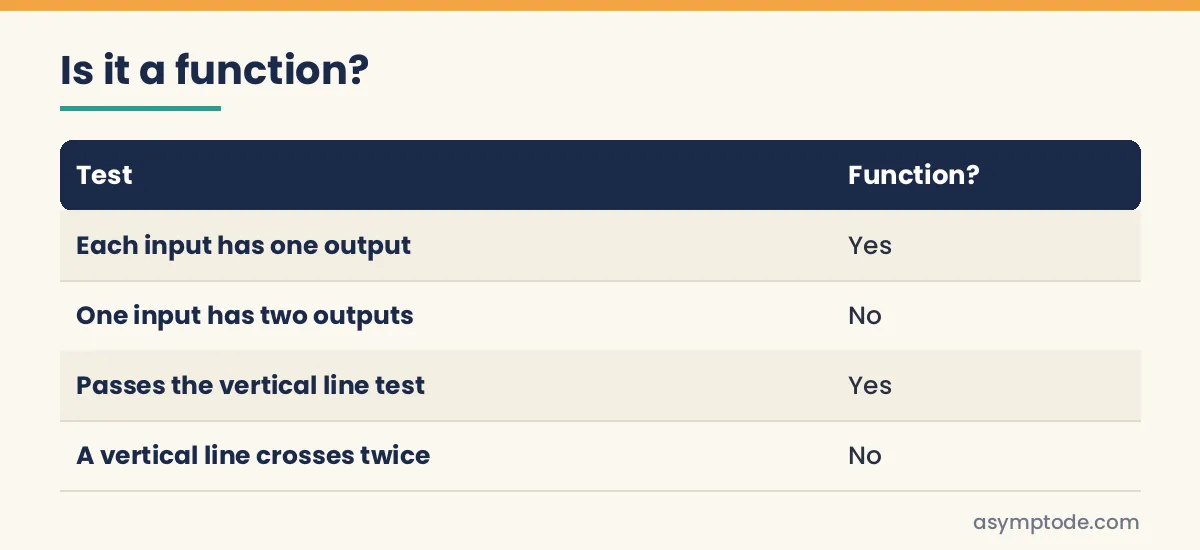 How to tell a function from a relation that is not a function.
The table repeats the rules: if each input has one output, it is a function; if one input has two outputs, it is not; if a graph passes the vertical line test, it is a function; and if a vertical line crosses a graph twice, it is not.
Examples with pairs (input, output):
- {(1, 3), (2, 5), (3, 7)} is a function. Each input has one output, and the rule is 2x + 1.
- {(1, 3), (1, 5), (2, 7)} is not a function. The input 1 has two outputs, 3 and 5.
Vertical line test: draw a vertical line anywhere on the graph. If it ever touches the graph twice, the graph is not a function. A straight line that is not vertical passes the test. A circle does not, so x² + y² = 25 is not a function.
What are the domain and range?
The domain is the set of inputs the function allows. The range is the set of outputs it produces. In the Common Core, HSF-IF.A.1 defines a function as assigning to each element of the domain exactly one element of the range.
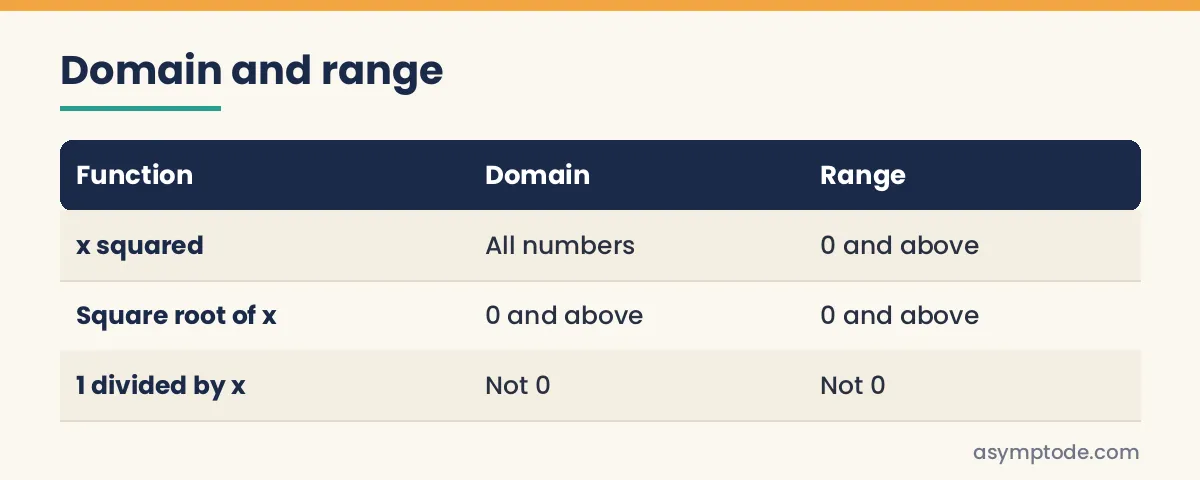 Domain and range for three common functions.
The table repeats the three examples: f(x) = x² accepts all numbers and gives outputs of 0 or more; f(x) = √x accepts inputs of 0 or more and gives outputs of 0 or more; and f(x) = 1/x cannot use 0 as an input, and its outputs are never 0.
Two things usually limit the domain: you cannot divide by zero, and you cannot take the square root of a negative number (in school maths). So for f(x) = 1/(x - 3), the domain is every number except 3.
Book a free demo class if your child finds domain and range confusing. A mentor can watch each line of working as it is written.
What are linear functions?
A linear function has the form f(x) = mx + b. Its graph is a straight line, where m is the slope (the rate of change) and b is the y-intercept. The College Board's SAT Algebra page lists "Linear functions" as one of its topics. For two lines at once, see systems of linear equations explained, and for ranges of answers see linear inequalities explained.
Example: a taxi charges $4 plus $2 per mile, so C(m) = 4 + 2m.
- Evaluate. A 5-mile ride costs C(5) = 4 + 2(5) = 14 dollars.
- Solve for the input. For a $20 ride, 4 + 2m = 20, so 2m = 16 and m = 8 miles.
- Read the parts. The slope 2 is the cost per mile, and the intercept 4 is the starting fee.
How do you evaluate a function at a given input?
- Write the rule. For example g(x) = x² - 4.
- Replace every x with the input, using brackets: g(3) = (3)² - 4.
- Work out the answer. g(3) = 9 - 4 = 5.
- Watch negative inputs. g(-2) = (-2)² - 4 = 4 - 4 = 0. The bracket matters, because -2² would mean -4.
Where do functions appear in school and tests?
- Grade 8 and Algebra 1 (US): the idea of a function, tied to Common Core 8.F.A.1, then function notation in HSF-IF.A.1 and HSF-IF.A.2.
- SAT: the College Board's Algebra page lists "Linear functions". See our digital SAT Math guide and the PSAT/NMSQT guide.
- ACT: see the ACT Math test guide for the format of the maths section.
- Later courses: functions are the language of precalculus and calculus. See the AP Precalculus guide, logarithms explained and differentiation explained.
If variables still feel new, start with understanding variables.
What are the most common mistakes with functions?
- Reading f(x) as f times x. It means "f of x", the output for input x.
- Forgetting brackets with negative inputs: g(-2) = (-2)² - 4, not -2² - 4.
- Calling a relation a function when one input has two outputs.
- Ignoring the domain, such as dividing by zero.
- Mixing up domain and range. Domain is inputs, range is outputs.
Practice questions with answers
- If f(x) = 3x - 2, find f(5).
- If g(x) = x² + 1, find g(-3).
- Is {(1, 2), (2, 4), (3, 6), (2, 5)} a function?
- What is the domain of f(x) = 1/(x - 3)?
- A plan costs h(t) = 50 + 12t dollars for t hours. Find h(4).
- For f(x) = 2x + 3, which input gives the output 11?
Answers
- f(5) = 3(5) - 2 = 13.
- g(-3) = (-3)² + 1 = 9 + 1 = 10.
- No. The input 2 has two outputs, 4 and 5.
- Every number except 3, because x - 3 cannot be 0.
- h(4) = 50 + 12(4) = 98 dollars.
- 2x + 3 = 11, so 2x = 8 and x = 4.
How to get better at functions
- Say every function in words: "take the input, double it, add 3".
- Make a small table of inputs and outputs, then check the rule fits every row.
- Sketch the graph and use the vertical line test.
- Always name the units in a word problem, such as miles or dollars.
How Asymptode Can Help You Prepare for Functions
Functions are the idea that connects algebra to everything after it, and small slips with notation or negative inputs add up. At Asymptode, your child has live, one-to-one online classes with a mentor who teaches maths at your child's grade, following their own school course and test dates. The mentor watches each line of working, so a missing bracket or a mixed-up domain and range is caught on the spot.
Between classes, your child gets AI-assisted practice built from what their own last attempt showed they had not yet understood, written to the mentor's brief and sent only after the mentor approves it. The AI supports the mentor; it never teaches or replaces the mentor. The mentor marks the work, and in the parent dashboard you can see what was understood and what to practise next.
Every class is recorded, so a tricky explanation can be rewatched. Book a free demo class or see our plans and fees.
Facts checked against official sources on 22 November 2026.
FAQ
What is a function in simple terms?
A function is a rule that gives exactly one output for every input. The same input always gives the same output.
What does f(x) mean?
f(x) is read "f of x". It is the output of the function f when the input is x. It does not mean f multiplied by x.
What is the difference between domain and range?
The domain is the set of allowed inputs. The range is the set of outputs the function produces.
How do you use the vertical line test?
Draw a vertical line on the graph. If a vertical line ever crosses the graph in more than one place, the graph is not a function.
Is every equation a function?
No. The equation x² + y² = 25 gives two values of y for most values of x, so it is not a function of x. The equation y = 2x + 3 is a function.
Are functions on the SAT?
The College Board's Algebra page lists "Linear functions" among the SAT Math topics. Check the College Board's official pages for the full list of skills.
Ready to start? Book a free demo class and advisor call, or see our plans and fees.
Sources
- Common Core State Standards: Grade 8 Functions
- Common Core State Standards: High School Functions, Interpreting Functions
- SAT Math: Algebra (College Board)