
A system of linear equations is two (or more) linear equations that share the same variables, and solving the system means finding the values that make every equation true at once. This guide explains the three standard methods, graphing, substitution and elimination, shows when to use each one, and ends with practice questions you can check yourself. Updated 22 November 2026: added a link to our guide on linear inequalities.
Key takeaways
- A system of linear equations asks for the point (x, y) that fits both equations.
- On a graph, the solution is the point where the two lines cross.
- Use graphing to see the picture, substitution when one variable is already alone, and elimination when the equations line up.
- A system can have one solution, no solution (parallel lines) or infinitely many (the same line).
- Always check the answer in both original equations.
What is a system of linear equations?
Quick answer: A system of linear equations is a set of equations, such as y = 2x + 1 and y = -x + 7, that must be true together. The solution is the pair (x, y) that works in every equation. For this pair the solution is (2, 5), because 5 = 2(2) + 1 and 5 = -2 + 7.
In the United States, students meet this idea in Grade 8. The Common Core standard 8.EE.C.8 says that the solutions of a system of two linear equations in two variables correspond to the points where their graphs cross, and asks students to solve such systems algebraically and to estimate them by graphing. High school algebra returns to it in HSA-REI.C.6. Both are published on the Common Core State Standards site. Not every state uses Common Core, so check your state's own standards for the exact wording.
How do you solve a system by graphing?
Graph each line, then read the point where they meet. If you need a refresher on drawing lines, see slope-intercept form explained.
- Write both equations as y = mx + b. Here y = 2x + 1 and y = -x + 7.
- Plot each line. Start at its y-intercept, then rise and run by the slope.
- Find the crossing point. The lines meet at (2, 5).
- Check it. Put x = 2 and y = 5 into both equations. Both are true.
Graphing is good for seeing what is happening and for estimates. It is slow when the crossing point is not a whole number, so the next two methods give exact answers.
How do you solve a system by substitution?
Use substitution when one equation already has a variable alone, such as y = 2x + 1.
Example: solve y = 2x + 1 and 3x + y = 11.
- Substitute. Replace y in the second equation with 2x + 1: 3x + (2x + 1) = 11.
- Solve for x. 5x + 1 = 11, so 5x = 10 and x = 2.
- Find y. y = 2(2) + 1 = 5.
- Check. 3(2) + 5 = 11. It works.
The solution is (2, 5). The same point appeared in the graph, because it is the same system seen two ways.
How do you solve a system by elimination?
Use elimination when the equations are in the form Ax + By = C and a variable can be cancelled by adding or subtracting.
Example: solve x + y = 7 and 3x - y = 5.
- Add the equations. The y terms cancel: (x + y) + (3x - y) = 7 + 5, so 4x = 12.
- Solve for x. x = 3.
- Find y. From x + y = 7, y = 7 - 3 = 4.
- Check. 3(3) - 4 = 5. It works.
 Elimination on x + y = 7 and 3x - y = 5.
The animation shows the same steps in order: the two equations, 4x = 12, then x = 3, and finally y = 7 - 3 = 4.
If the coefficients do not match, multiply one or both equations by a number first. For 2x + 3y = 12 and 2x - y = 4, subtract the second from the first: 4y = 8, so y = 2, and then x = 3.
Book a free demo class if your child finds the choice of method hard. A mentor can watch each line of working as it is written.
Which method should you use?
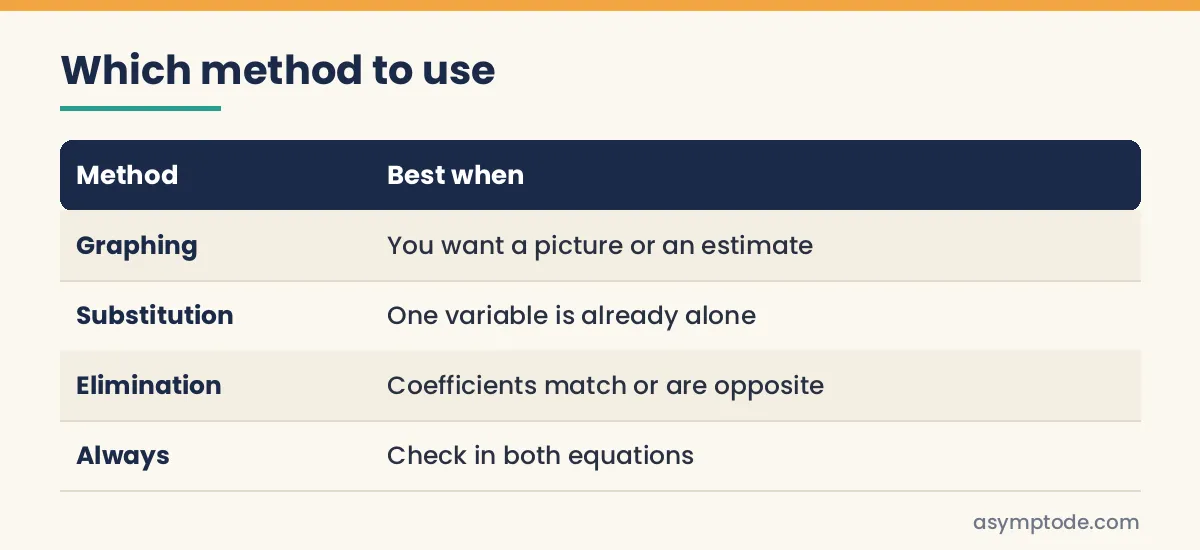 Choosing between graphing, substitution and elimination.
The table repeats the advice: graphing shows the picture and gives estimates, substitution is fastest when a variable is already alone, and elimination is fastest when the equations are in standard form with matching or opposite coefficients.
Can a system have no solution, or infinitely many?
Yes. Two lines can cross once, never, or lie on top of each other.
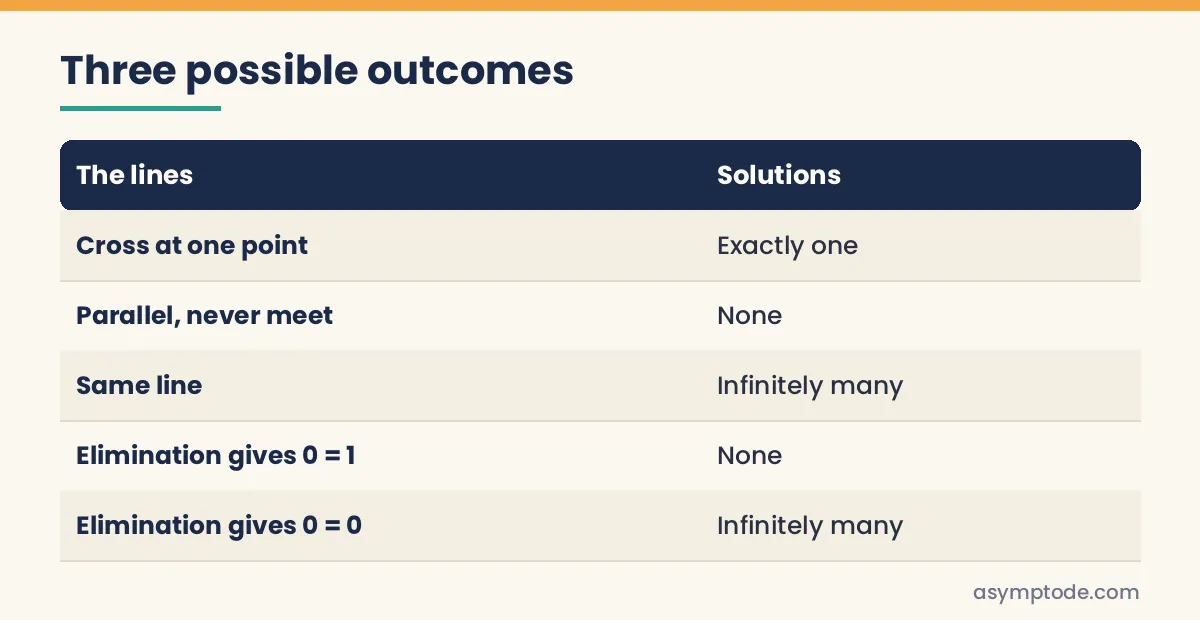 The three outcomes of a system of two linear equations.
- One solution: the lines have different slopes and cross at one point, like y = 2x + 1 and y = -x + 7.
- No solution: the lines are parallel. The Common Core standard gives the example 3x + 2y = 5 and 3x + 2y = 6, which cannot both be true because 3x + 2y cannot equal 5 and 6 at the same time.
- Infinitely many solutions: both equations describe the same line. For y = 2x + 1 and 2y = 4x + 2, the second is just the first multiplied by 2.
When elimination ends with a false statement such as 0 = 1, there is no solution. When it ends with a true statement such as 0 = 0, there are infinitely many.
How do you use a system to solve a word problem?
Name the two unknowns, write one equation for each fact, then solve.
Example: a school sells 10 tickets. Adult tickets cost $8 and child tickets cost $5. The total is $62. How many of each?
- Name the unknowns. a adult tickets and c child tickets.
- Write the equations. a + c = 10 and 8a + 5c = 62.
- Substitute. From the first, c = 10 - a. Then 8a + 5(10 - a) = 62, so 3a + 50 = 62 and a = 4.
- Find c. c = 10 - 4 = 6.
- Check. 8(4) + 5(6) = 32 + 30 = 62. It works.
So 4 adult tickets and 6 child tickets were sold.
Where do systems of equations appear in school and tests?
- Grade 8 and Algebra 1 (US): solving by graphing, substitution and elimination, tied to Common Core 8.EE.C.8 and HSA-REI.C.6.
- SAT: the College Board's Algebra page lists "Systems of 2 linear equations in 2 variables" as a topic on the SAT Math section. See our digital SAT Math guide and the PSAT/NMSQT guide.
- ACT: see the ACT Math test guide for the format of the maths section.
- Later courses: systems lead to matrices and to equations with a line and a curve. See solving quadratic equations and the AP Precalculus guide.
If variables still feel new, start with understanding variables. For answers that are a range of values instead of one point, see linear inequalities explained.
What are the most common mistakes with systems?
- Finding only x. A solution is a pair. Always find both x and y.
- Not multiplying the whole equation. If you multiply one side by 2, multiply every term on both sides.
- Sign errors when subtracting. Subtracting 3x - y means changing the sign of both terms.
- Substituting into the same equation. Substitute into the other equation, or you get 0 = 0.
- Skipping the check. Put the pair into both original equations. It takes ten seconds.
Practice questions with answers
- Solve y = x + 3 and y = 2x - 1.
- Solve x + y = 10 and x - y = 2.
- Solve 2x + y = 9 and y = x + 3.
- How many solutions do x + 2y = 8 and 3x + 6y = 24 have?
- How many solutions do 2x + y = 5 and 2x + y = 9 have?
- Pens cost $2 and notebooks cost $3. Five items cost $13 in total. How many of each?
Answers
- x + 3 = 2x - 1, so x = 4 and y = 7. The solution is (4, 7).
- Add the equations: 2x = 12, so x = 6 and y = 4.
- 2x + (x + 3) = 9, so 3x = 6, x = 2 and y = 5.
- Infinitely many. The second equation is the first multiplied by 3, so they are the same line.
- None. The lines are parallel, since 2x + y cannot equal both 5 and 9.
- p + n = 5 and 2p + 3n = 13. Then 2p + 3(5 - p) = 13, so -p + 15 = 13 and p = 2. There are 2 pens and 3 notebooks.
How to get better at systems of equations
- Solve the same system two ways, such as graphing and elimination, and see that the answers match.
- Practise spotting which method is quickest before you start.
- Check every answer in both equations.
- Turn real situations, such as tickets or phone plans, into two equations.
How Asymptode Can Help You Prepare for Systems of Linear Equations
Systems of equations bring together everything from linear equations: slope, intercepts, substitution and careful signs. At Asymptode, your child has live, one-to-one online classes with a mentor who teaches maths at your child's grade, following their own school course and test dates. The mentor watches each line of working, so a lost minus sign or a missed multiplication is caught on the spot.
Between classes, your child gets AI-assisted practice built from what their own last attempt showed they had not yet understood, written to the mentor's brief and sent only after the mentor approves it. The AI supports the mentor; it never teaches or replaces the mentor. The mentor marks the work, and in the parent dashboard you can see what was understood and what to practise next.
Every class is recorded, so a tricky explanation can be rewatched. Book a free demo class or see our plans and fees.
Facts checked against official sources on 20 November 2026.
FAQ
What is a system of linear equations in simple terms?
It is two or more linear equations that use the same variables. The solution is the set of values that makes all of them true at the same time.
What is the easiest way to solve a system of equations?
It depends on the system. Use substitution when one variable is already alone. Use elimination when the equations are in standard form and a variable can be cancelled. Use graphing when you want a picture or an estimate.
What does it mean when a system has no solution?
The lines are parallel, so they never meet. Their slopes are the same but their intercepts are different. Elimination ends with a false statement such as 0 = 1.
What does it mean when a system has infinitely many solutions?
Both equations describe the same line, so every point on it works. Elimination ends with a true statement such as 0 = 0.
How do you check the solution of a system?
Put the values of x and y into both original equations. If both come out true, the solution is correct.
Are systems of equations on the SAT?
The College Board's Algebra page lists "Systems of 2 linear equations in 2 variables" among the SAT Math topics. Check the College Board's official pages for the full list of skills.
Ready to start? Book a free demo class and advisor call, or see our plans and fees.
Sources
- Common Core State Standards: Grade 8 Expressions & Equations
- Common Core State Standards: High School Algebra, Reasoning with Equations & Inequalities
- SAT Math: Algebra (College Board)