

The PSAT/NMSQT is the practice SAT that most US students take in Grade 10 or 11. In Grade 11 it is also the entry test for the National Merit Scholarship Program. This guide explains the format, the scores, the Selection Index and a calm way to prepare.
Key takeaways
- The PSAT/NMSQT is a digital, adaptive test taken on the Bluebook app at school. It takes 2 hours 14 minutes of testing time.
- There are two sections: Reading and Writing (54 questions, 64 minutes) and Math (44 questions, 70 minutes).
- Scores run from 320 to 1520. Each section is scored from 160 to 760.
- Only the test taken in Grade 11 counts for National Merit. The NMSC uses a Selection Index from 48 to 228.
- The 2026 test is given by schools during October 2026. Students register through their school, not on their own.
What is the PSAT/NMSQT?
Quick answer: The PSAT/NMSQT (Preliminary SAT/National Merit Scholarship Qualifying Test) is a College Board test for Grade 10 and 11 students. It looks and feels like the SAT, but it is a little shorter and a little easier. It gives students practice, a score report with skill feedback and, in Grade 11, a chance to enter the National Merit Scholarship Program.
The PSAT/NMSQT is one of three PSAT-related tests in the SAT Suite:
- PSAT 8/9 for Grades 8 and 9.
- PSAT 10 for Grade 10, usually in spring.
- PSAT/NMSQT for Grades 10 and 11, usually in October.
PSAT 10 and the PSAT/NMSQT have the same content and score scale. But only the PSAT/NMSQT can be used to enter the National Merit Scholarship Program.
When is the PSAT/NMSQT in 2026?
College Board lists the fall 2026 PSAT/NMSQT window as October 1 to October 30, 2026. Each school picks its own day inside that window. Schools order the tests and register students, so ask your school counselor about the date.
If your child is homeschooled, or the school does not offer the test, contact a nearby high school early. Seats are limited and some schools close sign-ups in September.
What is the PSAT/NMSQT format?
The test is fully digital. Students take it on the Bluebook app on a laptop or tablet, at school.
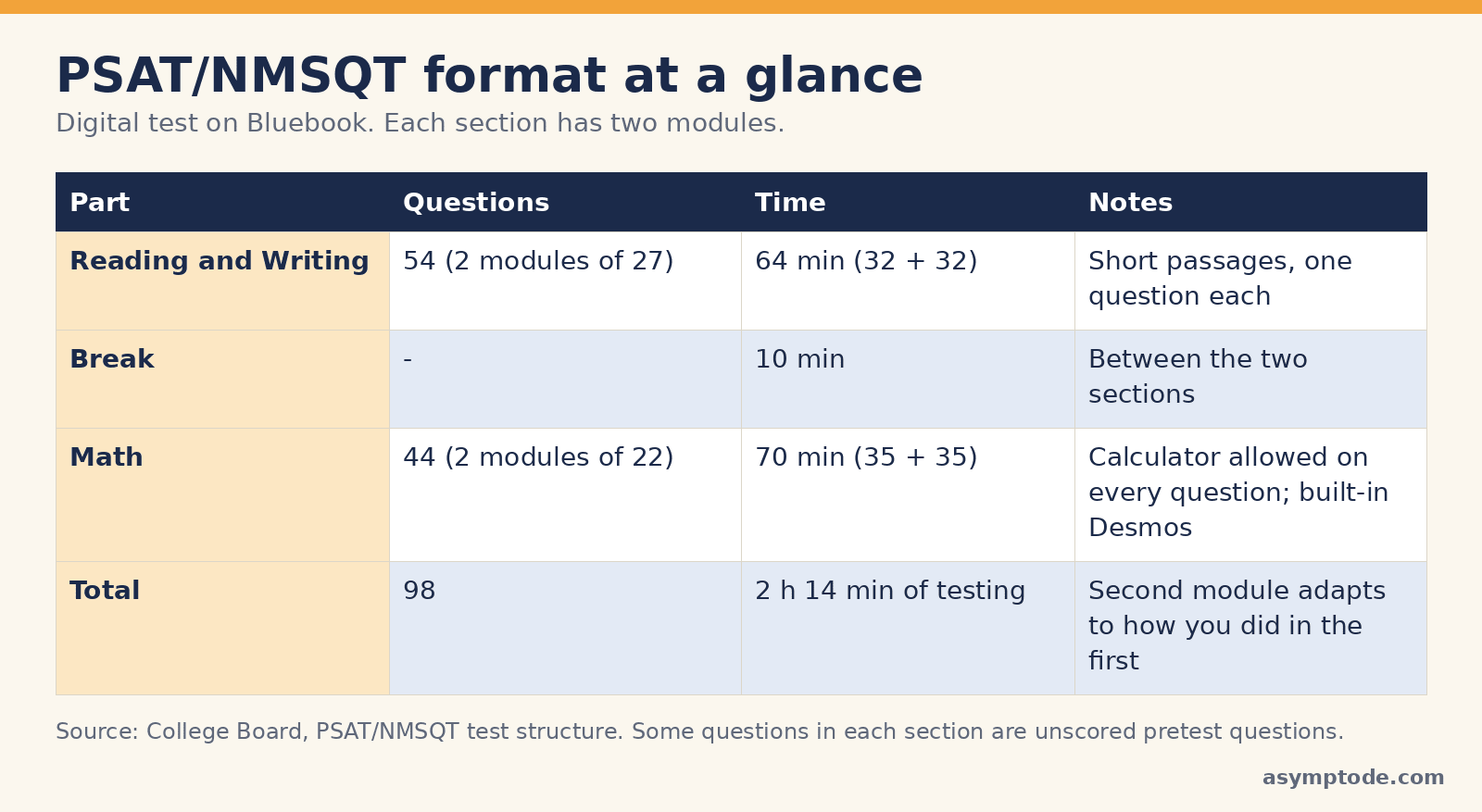
| Section | Questions | Time | Modules |
|---|---|---|---|
| Reading and Writing | 54 | 64 minutes | 2 modules of 27 questions, 32 minutes each |
| Break | - | 10 minutes | - |
| Math | 44 | 70 minutes | 2 modules of 22 questions, 35 minutes each |
| Total | 98 | 2 h 14 min | - |
What does "adaptive" mean?
Each section has two modules. The first module has a mix of easy, medium and hard questions. How a student does on it decides whether the second module is easier or harder. Students who do well in module 1 get a harder module 2, and that opens the door to the top scores.
This means careful work in module 1 really matters. Rushing and making small slips early can cap the score.
Can you use a calculator on the PSAT?
Yes. A calculator is allowed on the whole Math section. Bluebook also has a built-in Desmos graphing calculator. Students can bring their own approved calculator too. Practice with the Desmos tool before test day, because it can check many algebra answers in seconds.
What is on the PSAT Math section?
The Math section has four content areas. College Board gives an approximate share for each.
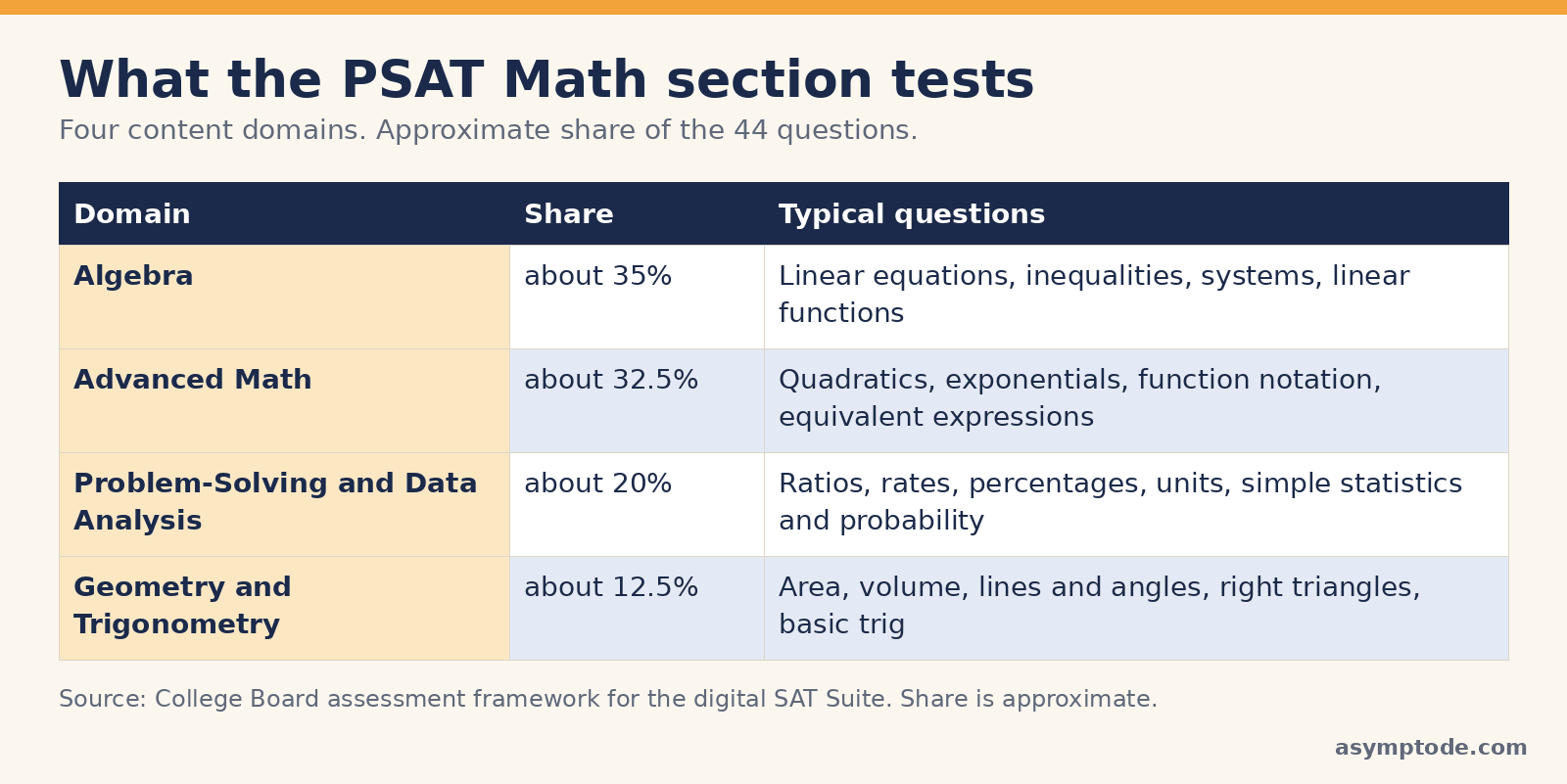
- Algebra (about 35%): linear equations, inequalities, systems of equations, linear functions.
- Advanced Math (about 32.5%): quadratics, exponential functions, function notation, equivalent expressions.
- Problem-Solving and Data Analysis (about 20%): ratios, rates, percentages, units, simple statistics and probability.
- Geometry and Trigonometry (about 12.5%): area, volume, angles, right triangles and basic trigonometry.
Most questions are multiple choice. Some are "student-produced response" questions, where students type their own answer. About 30% of the Math questions sit inside a real-world, science or social-studies context. For a deeper look at the math content, read our digital SAT Math guide. The PSAT uses the same kinds of questions.
Worked example 1: a linear equation
A phone plan costs $15 a month plus $0.10 per text. Last month the bill was $27. How many texts were sent?
- Write an equation: 15 + 0.10t = 27.
- Subtract 15 from both sides: 0.10t = 12.
- Divide by 0.10: t = 120.
- Answer: 120 texts. Check: 15 + 0.10 × 120 = 15 + 12 = 27. Correct.
Worked example 2: a percentage change
A jacket costs $80. The price goes up by 25%, then down by 20%. What is the final price?
- Increase by 25%: 80 × 1.25 = 100.
- Decrease by 20%: 100 × 0.80 = 80.
- Answer: $80. The price is back where it started. Many students guess $84 because they add +25 and −20. That trap is common on the PSAT.
Worked example 3: a quadratic
What are the solutions of x² − 5x + 6 = 0?
- Find two numbers that multiply to 6 and add to −5: −2 and −3.
- Factor: (x − 2)(x − 3) = 0.
- Answer: x = 2 or x = 3. In Desmos, graph y = x² − 5x + 6 and look where it crosses the x-axis to check.
How is the PSAT/NMSQT scored?
| Score | Range |
|---|---|
| Total score | 320 to 1520 |
| Reading and Writing section | 160 to 760 |
| Math section | 160 to 760 |
| NMSC Selection Index | 48 to 228 |
There is no penalty for wrong answers, so students should answer every question. Some questions in each section are unscored pretest questions, but students cannot tell which ones they are, so they should treat every question as real.
The score report also shows percentiles, the score range, and how the student did in each of the eight skill areas (four in Reading and Writing, four in Math). This skill breakdown is the most useful part for planning. It shows exactly where marks were lost.
A useful rule: the PSAT is scored on the same scale as the SAT, just with a lower top score (1520 instead of 1600). So a PSAT score is a fair early sign of the likely SAT score if your child keeps working.
How does the National Merit Selection Index work?
The National Merit Scholarship Corporation (NMSC) does not use the 320-1520 total. It uses the Selection Index:
Selection Index = (2 × Reading and Writing score + Math score) ÷ 10
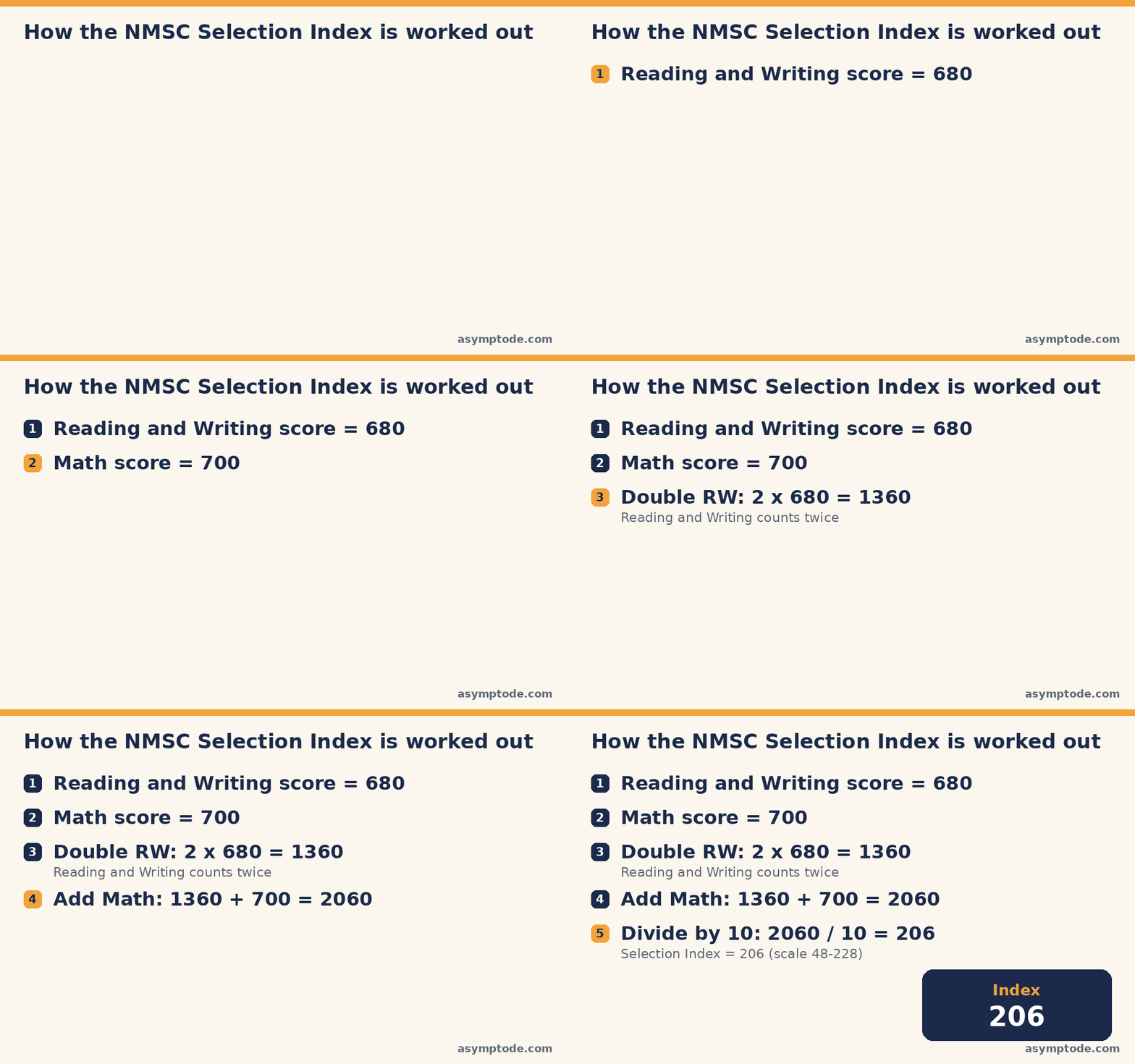
Reading and Writing counts twice. That surprises many families with strong math students.
Only students who take the PSAT/NMSQT in Grade 11 (and meet the other NMSC rules) enter that year's competition. Every year about 1.3 to 1.5 million juniors enter. Roughly 16,000 are named Semifinalists. Semifinalist cut-off scores are set state by state, so the score needed in one state can be quite different from another. About 34,000 more students receive Letters of Commendation. Semifinalists must then apply to become Finalists, and some Finalists win scholarships.
Cut-off scores change every year and are not published in advance. Be careful with any website that promises an exact "safe" score.
How should students prepare for the PSAT/NMSQT?
Good PSAT prep is the same as good SAT prep. It is not about tricks. It is about fixing the gaps in algebra, grammar and reading, then practising under real timing.
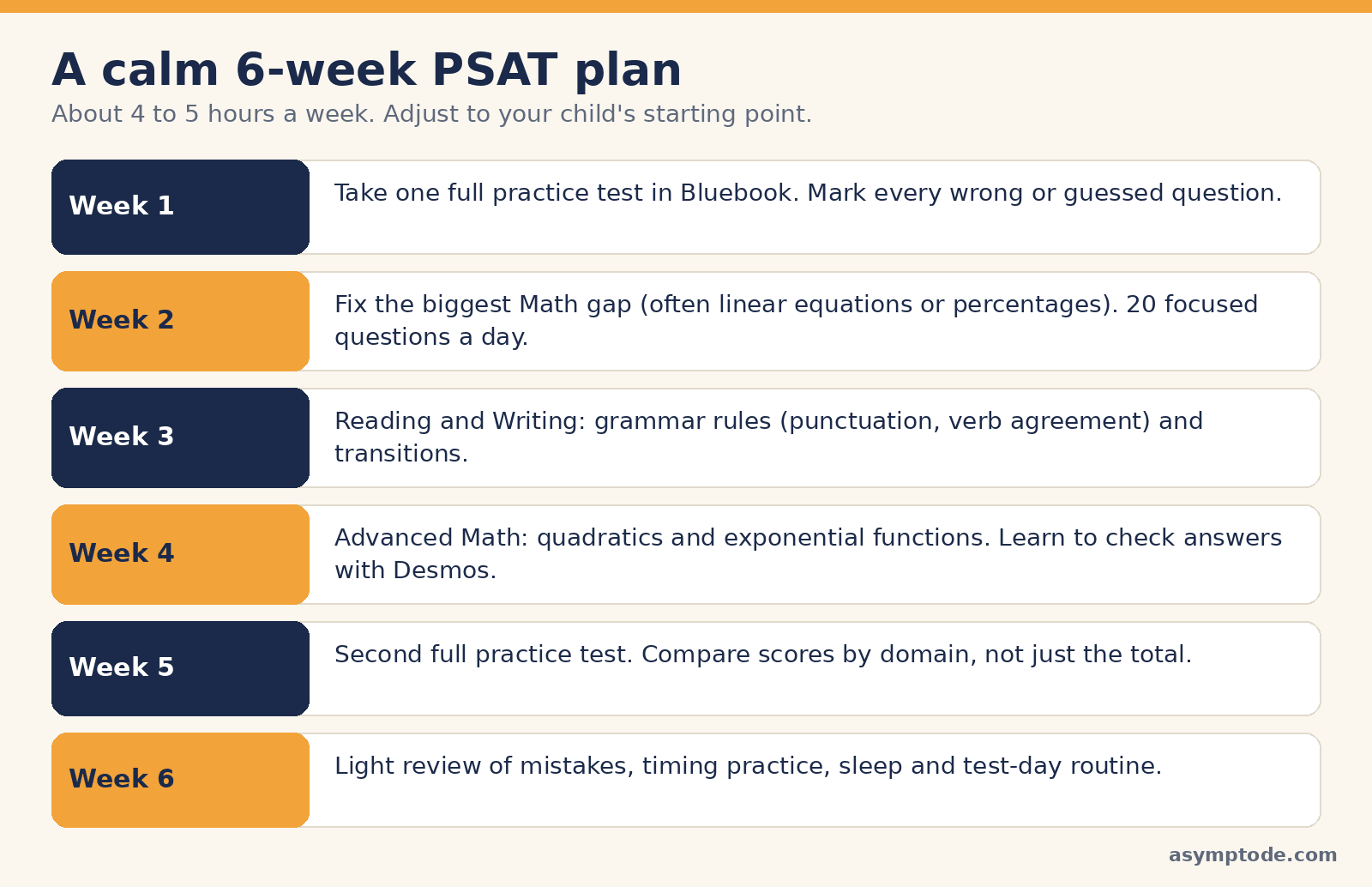
A simple 6-week plan
- Week 1: Take one full practice test in the Bluebook app. Mark every wrong or guessed question.
- Week 2: Fix the biggest Math gap. For many students it is linear equations or percentages. Do 20 focused questions a day.
- Week 3: Reading and Writing: punctuation, subject-verb agreement and transition words.
- Week 4: Advanced Math: quadratics and exponential functions. Learn to check answers with Desmos.
- Week 5: Take a second full practice test. Compare scores by skill area, not just the total.
- Week 6: Light review of mistakes, timing practice, good sleep and a test-day routine.
If the test is only a week or two away, skip to weeks 5 and 6: one practice test, review every mistake and learn the Bluebook tools.
Not sure how many hours to spend? Our guide on how many hours of tutoring a week helps you set a sensible weekly load.
What are the most common PSAT mistakes?
- Rushing module 1. Careless errors early can lead to the easier module 2 and a lower ceiling.
- Leaving questions blank. There is no penalty for guessing. Answer everything.
- Not using Desmos. Many algebra and quadratic questions can be checked with a quick graph.
- Ignoring units and "what is the question asking?" Many wrong answers are right numbers for the wrong quantity.
- Only doing math prep. Reading and Writing counts twice in the Selection Index.
- Practising without review. Ten questions reviewed well beat fifty questions marked and forgotten.
What should students do after the PSAT?
When scores come out, sit down with the report together:
- Look at the skill areas with the weakest bars. These are the first things to fix.
- Compare the score with your child's goal for the SAT. Our SAT guide for parents explains SAT dates, scores and planning.
- Decide between SAT and ACT. Our ACT Math guide shows how the ACT is different.
- Build a plan for the next 3 to 6 months, not just the next test.
How 1-on-1 tutoring helps with the PSAT/NMSQT
At Asymptode, PSAT and SAT prep is done in live 1-on-1 online classes, one student with one dedicated mentor. Here is how it works for the PSAT:
- A short assessment first. The mentor looks at a practice test or the score report and finds the real gaps, such as weak algebra or rushed reading.
- Method, not just answers. The mentor watches each step of the working and fixes the method. That is how careless errors in module 1 go down.
- Personalised homework. Worksheets on the exact skills your child needs, checked by the mentor before your child sees them.
- Parents stay in the loop. Short updates after lessons show what improved and what still needs practice.
- Recorded classes. Every class is recorded, so your child can rewatch a tricky method before the test.
One-on-one help works well for the PSAT because the test is adaptive. Small gaps decide which module 2 a student gets. A mentor can find and fix those gaps faster than a group class.
Want a clear plan for the PSAT and SAT? Book a free demo class with an Asymptode advisor, or see our fees.
FAQ
Does the PSAT/NMSQT score matter for college?
Colleges do not use PSAT scores for admission. The score matters for National Merit (in Grade 11) and as a guide for SAT prep.
Can a Grade 10 student qualify for National Merit?
No. Grade 10 students can take the PSAT/NMSQT for practice, but only the Grade 11 test counts for the National Merit Scholarship Program.
What is a good PSAT score?
It depends on the goal. Compare your child's score with the percentiles on the report and with the SAT scores of the colleges on their list. For National Merit, the cut-off depends on the state and changes every year.
Is the PSAT easier than the SAT?
A little. It has the same question types and scale, but it is shorter and tops out at 1520 instead of 1600. It also has fewer of the hardest questions.
Can my child take the PSAT/NMSQT outside school?
Students take it through a high school. If your child's school does not offer it, or your child is homeschooled, contact a nearby high school well before October.
How long should my child study for the PSAT?
Four to six weeks of steady work, about 4 to 5 hours a week, is enough for most students to see real gains. Students aiming for National Merit often start earlier.