
Logarithms explained in one line: a logarithm tells you which power you need. If 2 to the power 3 is 8, then log base 2 of 8 is 3. That is the whole idea. Below: how to read logs, the rules, solving equations, and where logs show up in real life and exams.
Key takeaways
- A logarithm is the inverse of an exponent: log_b(x) = y means b^y = x.
- "log" with no base means base 10. "ln" means base e (about 2.718).
- Six rules do most of the work: product, quotient, power, change of base, log_b(1) = 0 and log_b(b) = 1.
- To solve 2^x = 20, take logs of both sides and use the power rule: x is about 4.32.
- Always check the domain. You can only take the log of a positive number.
What are logarithms, explained simply?
Quick answer: A logarithm answers the question "what power do I raise the base to, to get this number?" So log_b(x) = y means exactly the same as b^y = x. For example, log base 10 of 1000 is 3, because 10^3 = 1000. Logs undo exponents, the same way subtraction undoes addition.
The College Board's AP Precalculus Course and Exam Description defines it the same way: log_b(c) = a if and only if b^a = c, where b > 0 and b is not 1.
How do you read log_b(x)?
Read log_b(x) as "log base b of x". The small number b is the base. The number x is called the argument. So log_2(8) is "log base 2 of 8". On a calculator or in plain text you will often see it written as log2(8).
The base b must be positive and not 1. The argument x must be positive: there is no real log of 0 or of a negative number.
What are the common log and the natural log?
Two bases are so useful that they get their own short names.
- Common log: "log x" with no base written means base 10. So log 100 = 2.
- Natural log: "ln x" means base e, where e is about 2.718. So ln(e) = 1.
Calculators have a LOG key (base 10) and an LN key (base e). For other bases, use change of base.
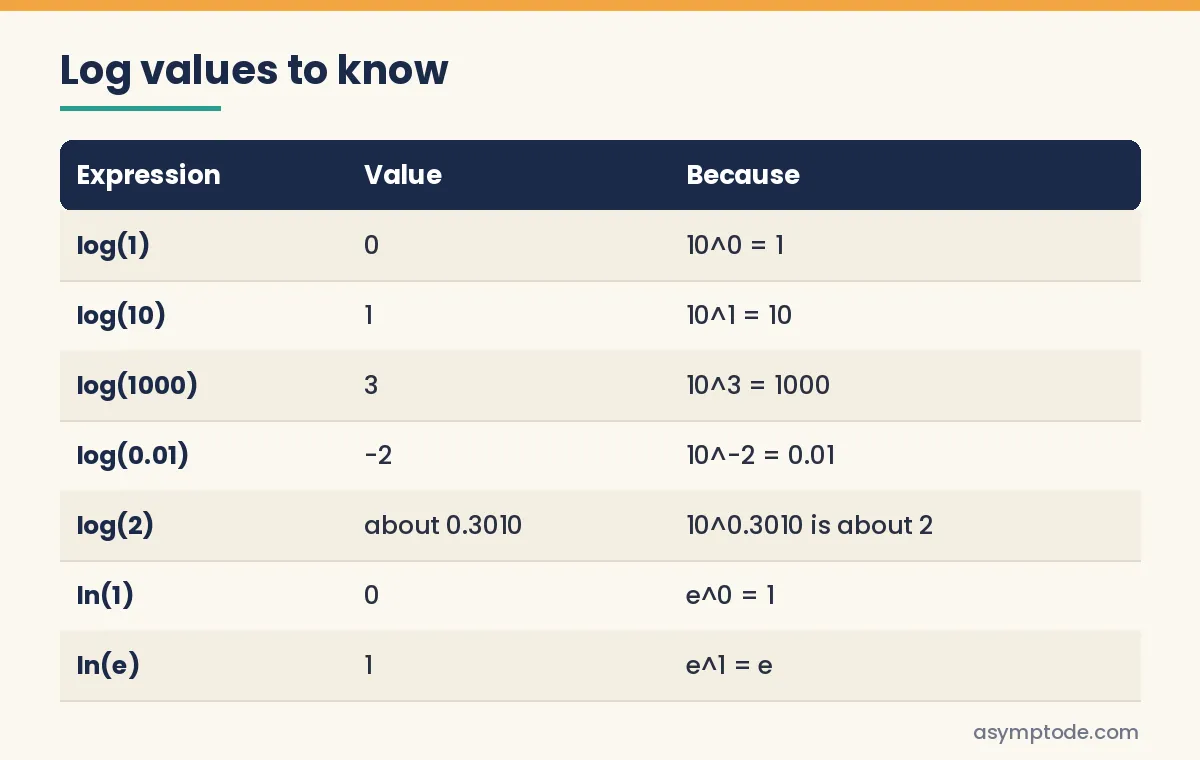 Values worth knowing by heart.
log(1) = 0 because 10^0 = 1, and log(10) = 1 because 10^1 = 10. log(1000) = 3 and log(0.01) = -2, because 10^-2 = 0.01. log(2) is about 0.3010, so 10^0.3010 is about 2. For natural logs, ln(1) = 0 and ln(e) = 1.
What are the log rules?
These rules come from the exponent rules.
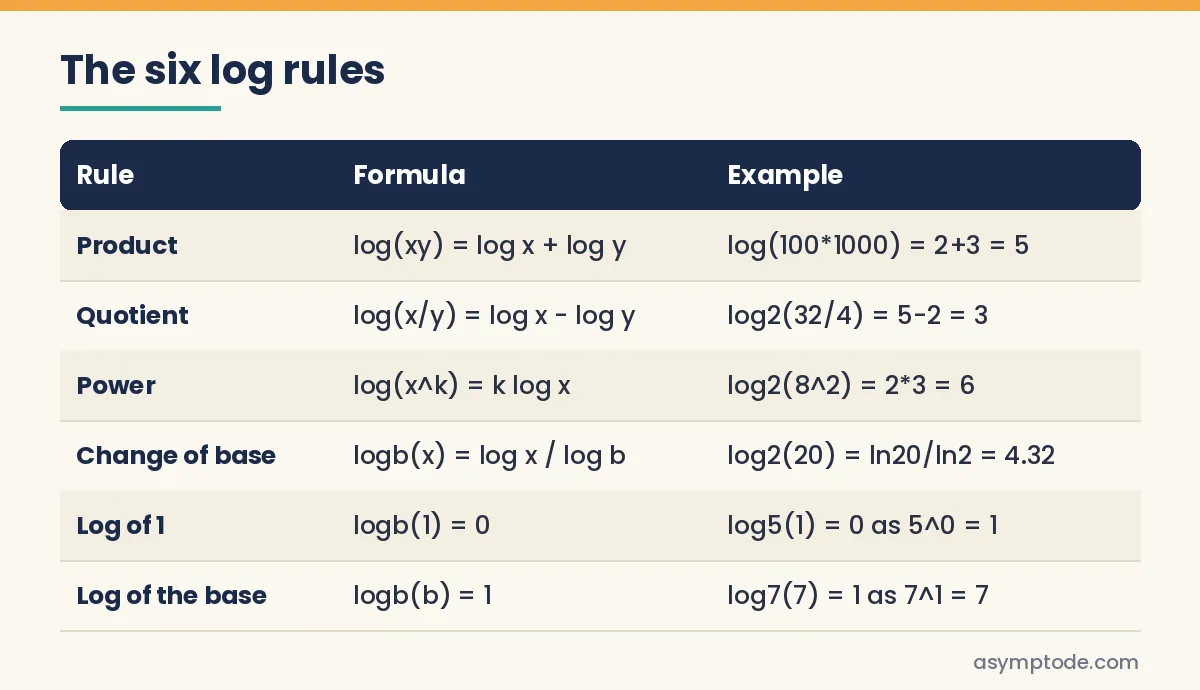 The six log rules, each with a quick numeric check.
- Product: log_b(xy) = log_b(x) + log_b(y). Check: log(100 x 1000) = log(100000) = 5, and 2 + 3 = 5.
- Quotient: log_b(x/y) = log_b(x) - log_b(y). Check: log_2(32/4) = log_2(8) = 3, and 5 - 2 = 3.
- Power: log_b(x^k) = k log_b(x). Check: log_2(8^2) = log_2(64) = 6, and 2 x 3 = 6.
- Change of base: log_b(x) = log(x) / log(b). Check: log_2(20) = ln 20 / ln 2, about 4.32.
- Log of 1 and log of the base: log_b(1) = 0 and log_b(b) = 1. Check: log_5(1) = 0 since 5^0 = 1, and log_7(7) = 1 since 7^1 = 7.
In words: adding logs multiplies the numbers, subtracting logs divides them, and a power inside a log jumps to the front. The change-of-base rule works with base 10 or base e. You get the same answer either way.
How does the change-of-base rule work?
Say you need log base 3 of 50. Your calculator has no base-3 key. So you divide one common log by another.
 Change of base turns any log into a calculator job.
Goal: find log_3(50). Use log_b(x) = log(x) / log(b). log(50) = 1.6990 and log(3) = 0.4771. 1.6990 / 0.4771 gives about 3.56. Check: 3^3.56 is about 50.
How do you solve exponential equations with logs?
When the unknown is in the exponent, take logs of both sides. The power rule then brings x down.
 Solving 2^x = 20 step by step.
- Start with 2^x = 20.
- Take logs of both sides: log(2^x) = log(20).
- Use the power rule: x log(2) = log(20).
- Divide: x = log(20) / log(2) = 1.3010 / 0.3010, which is about 4.32.
- Check: 2^4.32 is about 19.97. Close to 20, so the answer works.
How long does money take to double at 5% interest?
Suppose you save 1,000 at 5% interest, added once a year. When does it reach 2,000?
- Write the equation: 1000 x 1.05^t = 2000.
- Divide by 1000: 1.05^t = 2.
- Take natural logs: t ln(1.05) = ln(2).
- Solve: t = ln(2) / ln(1.05), which is about 14.2 years.
- Sense check: after 14 years you have about 1,979.93. After 15 years you have about 2,078.93. So the money doubles during year 15.
How do you solve log equations and check the domain?
To solve a log equation, rewrite it in exponent form. Then check every answer in the original equation.
Example 1: log(x + 3) = 2. Exponent form: x + 3 = 10^2 = 100. So x = 97. Check: log(100) = 2. It works.
Example 2: log_2(x) + log_2(x - 2) = 3.
- Product rule: log_2(x(x - 2)) = 3.
- Exponent form: x(x - 2) = 2^3 = 8.
- Expand: x^2 - 2x - 8 = 0.
- Factor: (x - 4)(x + 2) = 0, so x = 4 or x = -2.
- Check the domain: log_2(-2) does not exist, so reject x = -2.
- Check x = 4: log_2(4) + log_2(2) = 2 + 1 = 3. Correct.
Step 4 is a quadratic. If factoring feels shaky, see our guide to solving quadratic equations three ways.
What do the graphs of y = log x and y = 10^x look like?
The two graphs are mirror images of each other in the line y = x. That is what "inverse functions" means on a graph.
| Feature | y = 10^x | y = log x |
|---|---|---|
| Key points | (0, 1) and (1, 10) | (1, 0) and (10, 1) |
| Domain | all real x | x > 0 only |
| Range | y > 0 | all real y |
| Asymptote | horizontal, y = 0 | vertical, x = 0 |
| Shape | grows faster and faster | grows slower and slower |
Swap x and y in each point to jump between graphs. The log graph never touches the y-axis, so log(0) has no value.
Where are logarithms used in real life?
Logs help when numbers span a huge range. A log scale turns "times 10" into "plus 1".
- pH in chemistry. The IUPAC definition of pH is minus the base-10 log of hydrogen-ion activity. In school you usually use pH = -log[H+]. So [H+] = 10^-3 mol/L gives pH 3. The USGS notes that water at pH 5 is ten times more acidic than water at pH 6. Concentration in mol/L is covered in our mole concept guide.
- Decibels in sound. The level difference between two sounds is 10 log(P2/P1) dB, as this UNSW physics page explains. Ten times the power adds 10 dB. A hundred times the intensity adds 20 dB.
- Earthquake magnitude. The USGS says each whole-number step in magnitude is a tenfold increase in measured wave amplitude and about 32 times more energy. The Richter scale is now mainly used for small local quakes. The moment magnitude scale (Mw) is used for the rest.
What are the most common mistakes with logs?
Test any "rule" with real numbers. Fake rules fail fast.
| Mistake | Why it is wrong |
|---|---|
| log(a + b) = log a + log b | log(2 + 8) = log 10 = 1, but log 2 + log 8 = log 16, about 1.204 |
| log a / log b = log(a - b) | log 100 / log 10 = 2, but log 90 is about 1.954 |
| (log x)^2 = 2 log x | (log 1000)^2 = 9, but 2 log 1000 = 6 |
| Taking log of a negative | log(-5) has no real value |
| Keeping every solution | Always plug answers back in and drop any that break the domain |
Book a free demo class if log rules keep tripping you up, or see our plans and fees.
Where do logarithms appear in exam syllabuses?
Here is what the official documents say.
- AP Precalculus (US): Unit 2 is "Exponential and Logarithmic Functions" in the College Board CED (effective Fall 2026). Topics run from logarithmic expressions to semi-log plots. It carries 25-40% of the multiple-choice section. More in our AP Precalculus exam guide.
- AQA A-level Maths 7357 (UK): Section F "Exponentials and logarithms" covers log_a(x) as the inverse of a^x, ln x, the laws of logs, solving a^x = b, log graphs for y = ax^n and y = kb^x, and growth and decay models. See AQA's spec page and our A-level Maths guide.
- JEE Main 2027 (India): The NTA syllabus PDF lists logarithmic and exponential functions in Unit 7 (limits, continuity and differentiability) and log integrals in Unit 8. Read our JEE Main 2027 guide.
- IB, CBSE and others: Logs appear in these courses too, but wording differs. Check your board's current syllabus. Our IB Maths AA vs AI guide helps you pick the right IB course. For US college tests, see our Digital SAT Math guide.
How Asymptode helps you with logarithms
Logs click when each rule makes sense, not when it is memorised. At Asymptode, a qualified mentor teaches your child one-to-one, live and online. The mentor follows your child's own course, such as AP Precalculus, AQA A-level, IB, CBSE or JEE, and plans around the real test dates on their school or exam calendar.
Between classes, your child gets practice built for them. Say their last attempt split log(a + b) into log a + log b, or forgot to check the domain. The next worksheet works on that exact gap, at their level. It is never a generic sheet. This is Asymptode's AI-assisted practice, written to the mentor's brief and sent only after the mentor approves it.
The mentor marks the worksheet. You see what your child now understands, for example change of base, and what to practise next. So the practice keeps correcting itself toward solid log skills for their course.
Talk to an advisor for a free demo class, or see our fees.
Facts checked against official sources on 7 November 2026.
FAQ
What is a logarithm in simple words?
A logarithm is the power you need. log_b(x) = y means b^y = x. For example, log base 2 of 8 is 3 because 2^3 = 8.
What is the difference between log and ln?
"log" with no base means base 10. "ln" means the natural log, base e, which is about 2.718.
Why can't you take the log of a negative number?
A positive base raised to any real power always gives a positive result. So log x is only defined for x > 0.
How do I find a log with a base my calculator doesn't have?
Use the change-of-base rule: log_b(x) = log(x) / log(b). For log base 3 of 50, work out log 50 / log 3, which is about 3.56.
Is log(a + b) equal to log a + log b?
No. The product rule says log(ab) = log a + log b. Test it: log(2 + 8) = 1, but log 2 + log 8 is about 1.204.
Are logarithms on the AP Precalculus exam?
Yes. Unit 2, "Exponential and Logarithmic Functions", carries 25-40% of the multiple-choice section in the College Board course description effective Fall 2026. Check AP Central for updates.
Ready to start? Book a free demo class and advisor call, or see our plans and fees.
Sources
- AP Precalculus Course and Exam Description (College Board, effective Fall 2026)
- AQA A-level Mathematics 7357: F Exponentials and logarithms
- NTA Syllabus for JEE (Main) 2027
- JEE Main official website (NTA)
- IUPAC Gold Book: pH
- USGS Water Science School: pH and Water
- USGS: Earthquake Magnitude, Energy Release, and Shaking Intensity
- UNSW Physics: What is a decibel?