

The ACT Math test changed in 2025. It is now shorter, with fewer answer choices and more time for each question. This guide explains the new format, how scoring works, and a simple plan to prepare.
Key takeaways
- The enhanced ACT Math test has 45 questions in 50 minutes.
- Each math question now has 4 answer choices, not 5.
- Your Composite score uses English, Math and Reading only. Science is optional.
- You may use an approved calculator on the whole Math test.
- Steady weekly practice on algebra, functions and word problems helps most.
What does the ACT Math test look like now?
Quick answer: The ACT Math test has 45 multiple-choice questions. You get 50 minutes. Each question has 4 answer choices. A calculator is allowed for the whole section.
ACT calls the new version the "enhanced ACT". It started on online national tests in April 2025 and on paper national tests in September 2025. State and district school-day tests moved to it in spring 2026.
Here is the full test at a glance:
| Section | Questions | Minutes |
|---|---|---|
| English | 50 | 35 |
| Math | 45 | 50 |
| Reading | 36 | 40 |
| Science (optional) | 40 | 40 |
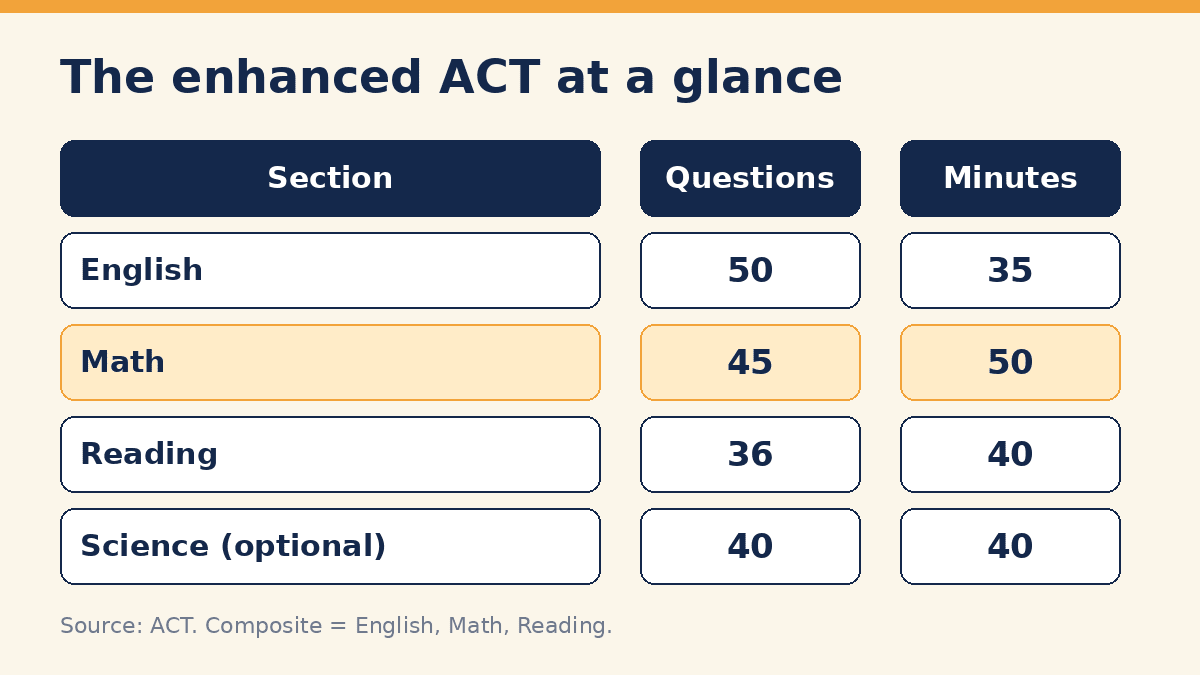
Without Science, the test takes 125 minutes of testing time. With Science, it takes 165 minutes. Breaks are extra.
How is the new ACT Math different from the old one?
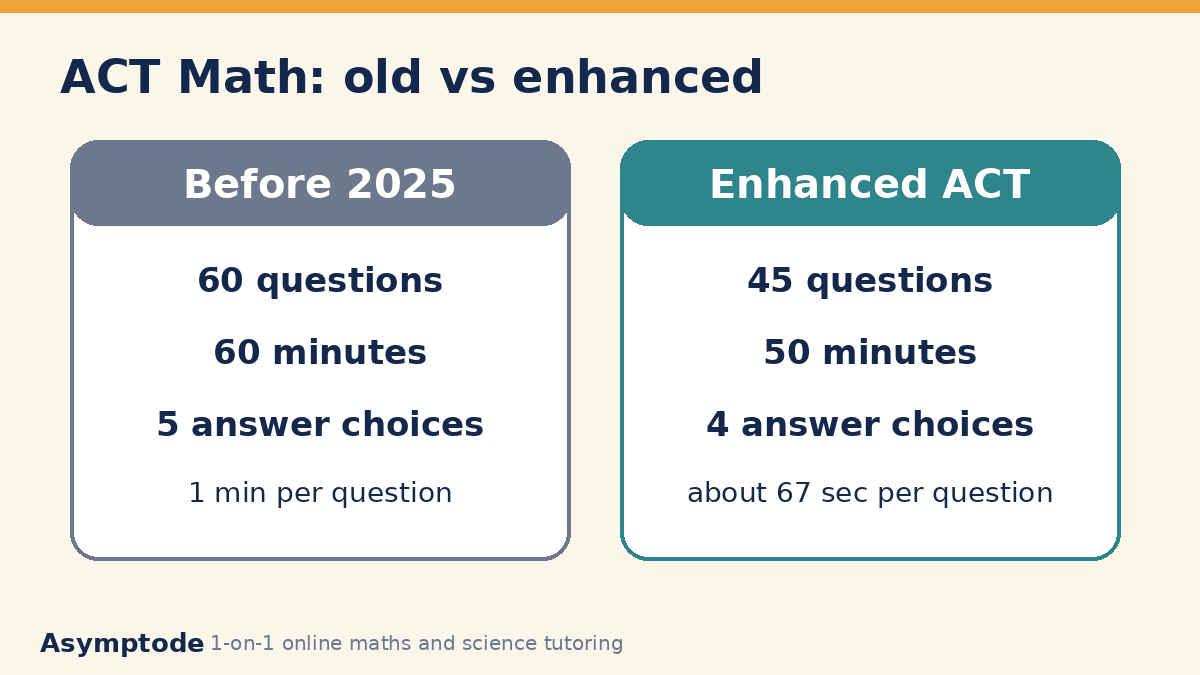
The old ACT Math test had 60 questions in 60 minutes, with 5 answer choices each. That is one minute per question. The enhanced test gives about 67 seconds per question.
What this means for your child:
- A bit more time to think. Rushing is still a risk, but less so.
- Smarter guessing. With 4 choices, a random guess has a 1 in 4 chance, not 1 in 5. There is no penalty for wrong answers, so never leave a question blank.
- Each question counts more. With fewer questions, a few careless errors move the score more.
How is the ACT scored?
Each section is scored from 1 to 36. The Composite score is the average of English, Math and Reading. It is also on the 1 to 36 scale.
If a student takes Science, ACT reports a Science score and a STEM score, which combines Math and Science. Science does not change the Composite.
Some colleges still look at Science or STEM scores, especially for engineering or science programs. Check each college's website before you skip Science.
Can you use a calculator on ACT Math?
Yes. You may use a calculator for the whole Math test. ACT says every problem can be solved without one, but a calculator saves time.
- Allowed: four-function, scientific and most graphing calculators.
- Not allowed: calculators with a computer algebra system (CAS), such as the TI-89 and TI-Nspire CAS.
- Online testers get a built-in Desmos graphing calculator.
Always check the ACT calculator policy before test day. Use the same calculator in practice that you will use in the exam.
What topics are on ACT Math?
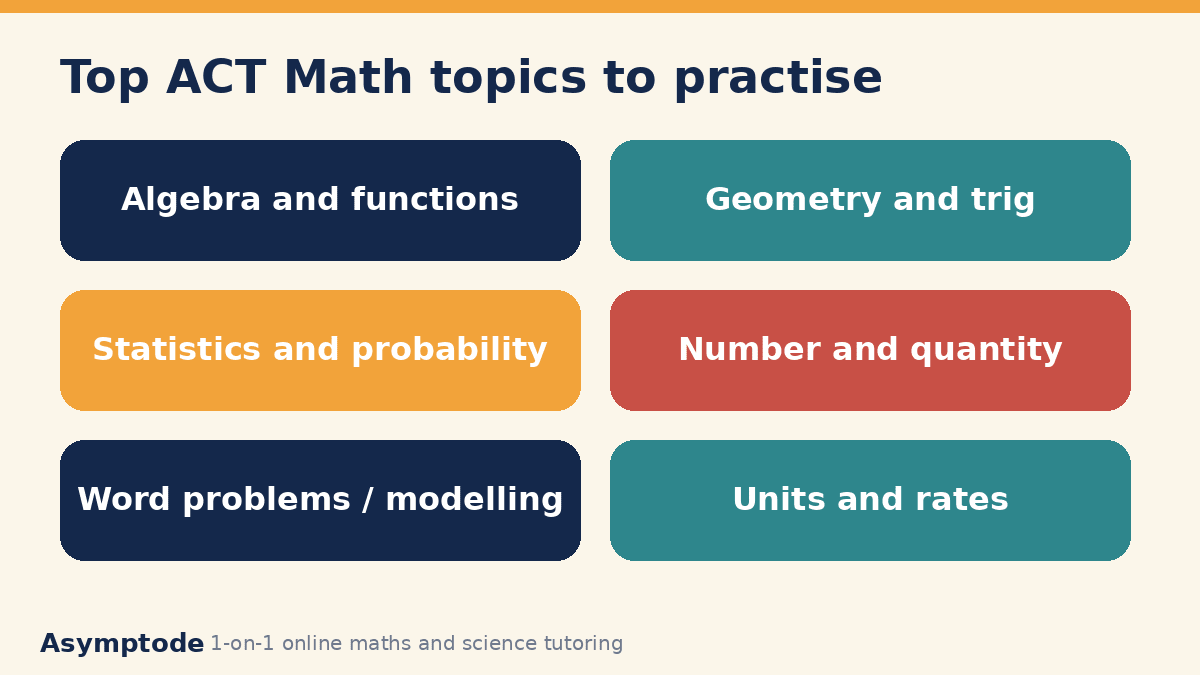
ACT Math covers math most students learn up to the start of grade 12. The biggest areas are:
- Algebra and functions: linear equations, systems, quadratics, exponents, function notation.
- Geometry and trigonometry: area, volume, angles, circles, right-triangle trig.
- Statistics and probability: mean, median, data tables, simple probability.
- Number and quantity: fractions, percents, ratios, roots.
- Modelling and word problems: turning a real story into math.
What does a typical ACT Math question look like?
Many questions are short word problems. Here is one worked example.
Question: A $40 shirt is 25% off. What is the sale price?
- Find 25% of 40: 0.25 × 40 = 10.
- Subtract the discount: 40 − 10 = 30.
- Shortcut: if 25% is taken off, you pay 75%. So 0.75 × 40 = 30.
- Answer: $30.

The shortcut in step 3 matters on a timed test. Learning a few smart methods like this saves minutes over 45 questions.
When are the ACT test dates for 2026-27?
ACT lists these US national test dates for 2026-27:
- September 19, 2026
- October 17, 2026
- December 12, 2026
- February 27, 2027
- April 10, 2027
- June 12, 2027
- July 10, 2027
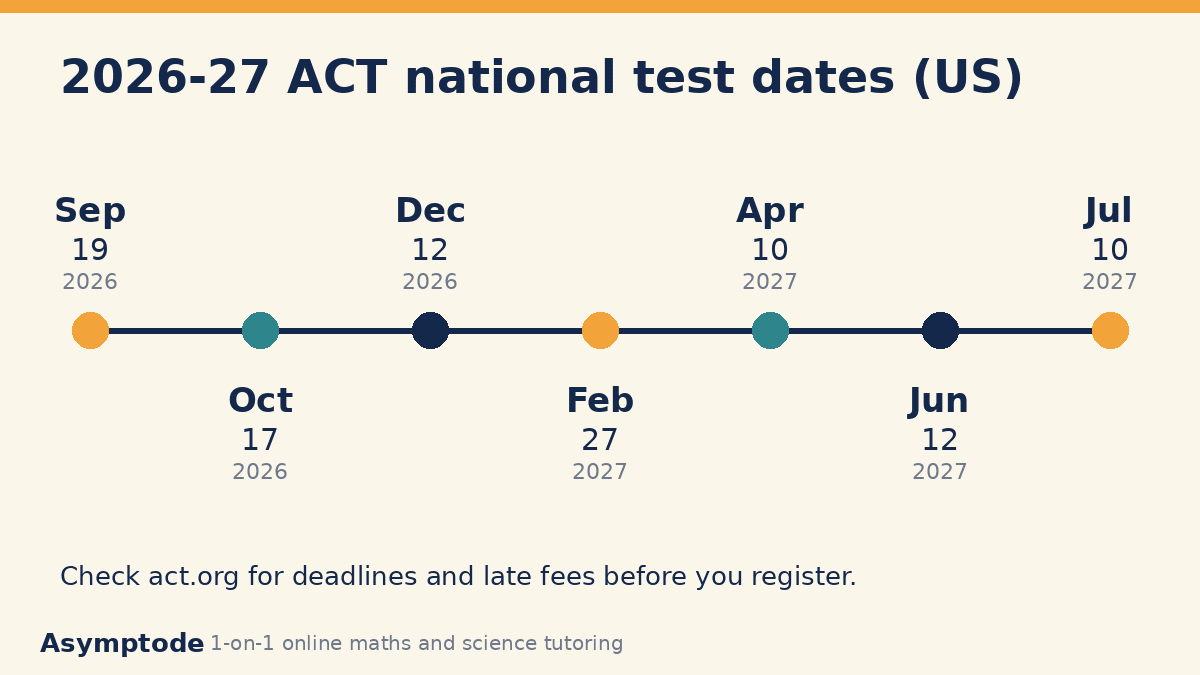
Registration closes several weeks before each date, and late fees apply. Always confirm deadlines on act.org.
How should my child prepare for ACT Math?
A calm, steady plan beats last-minute cramming. Try this 8-week outline:
- Week 1: Take a full practice test. Use an official ACT practice test. Note every wrong answer.
- Weeks 2-3: Fix algebra first. It is the biggest area. Practise equations, systems and functions.
- Weeks 4-5: Geometry and trig. Learn key area and volume formulas and SOH-CAH-TOA.
- Week 6: Statistics, probability and percents. These are quick points if the basics are strong.
- Week 7: Timed sets. Do 15 questions in about 17 minutes to build pace.
- Week 8: Second full practice test. Compare with week 1. Review every mistake.
Tips for test day:
- Answer every question. There is no penalty for guessing.
- Do the questions you know first. Mark hard ones and come back.
- Check that your answer makes sense in the story.
Want a plan built around your child's real gaps? Talk to an Asymptode advisor about 1-on-1 ACT Math support.
How does 1-on-1 tutoring help with ACT Math?
Every student loses points in different places. One student needs faster algebra. Another needs help reading long word problems. A good tutor finds those gaps and works on them first.
At Asymptode, students learn in live 1-on-1 online sessions. Tutors set personalized homework with feedback, so practice targets real weak spots. Parents can see progress, so you know how the plan is going. You can see our plans on the fees page.
If your child is also thinking about the SAT, read our Digital SAT Math guide to compare the two tests. Our ACT practice test article also covers how to learn from practice tests.
FAQ
How many questions are on the ACT Math test?
The enhanced ACT Math test has 45 multiple-choice questions. You have 50 minutes to answer them.
Is the ACT Science test still required?
No. On national test dates, Science is optional. The Composite score uses English, Math and Reading only. Some colleges may still want Science, so check first.
Can I use a calculator on the whole ACT Math test?
Yes. An approved calculator is allowed for the whole Math test. CAS calculators like the TI-89 are not allowed. Online testers also get a Desmos calculator.
Is there a penalty for wrong answers on the ACT?
No. Your score is based on correct answers. Always pick an answer for every question.
How long should my child study for ACT Math?
Many students do well with about 6 to 10 weeks of steady practice. Students with bigger gaps may need longer. A practice test at the start shows how much work is needed.
What is a good ACT Math score?
It depends on the colleges your child is applying to. Look up the middle 50% ACT range for each college on its website, then set a target.
Ready to start? Book a free chat with an advisor or see our fees.