
A linear inequality is like a linear equation, but instead of an equals sign it uses a symbol such as >, <, "at least" or "at most", and its answer is a whole range of numbers, not just one. This guide explains how to solve linear inequalities, when to flip the sign, how to graph the answer on a number line and on a coordinate grid, and ends with practice questions you can check yourself.
Key takeaways
- A linear inequality has a whole set of solutions, not one number.
- Solve it like an equation: do the same thing to both sides.
- If you multiply or divide both sides by a negative number, flip the inequality sign.
- On a number line, an open circle means "not included" and a closed circle means "included".
- For two variables, graph the boundary line, then shade the side that makes the inequality true.
What is a linear inequality?
Quick answer: A linear inequality compares two expressions using >, <, "at least" (≥) or "at most" (≤). For 3x + 2 > 11, every x greater than 3 makes it true, so the solution is x > 3. The answer is a range of values, which you can show on a number line.
In the United States, students meet this idea in Grade 7. The Common Core standard 7.EE.B.4.B asks students to solve word problems that lead to inequalities of the form px + q > r or px + q < r, to graph the solution set, and to interpret it in the problem. High school algebra returns to it in HSA-REI.B.3, which says to solve linear equations and inequalities in one variable. Both are published on the Common Core State Standards site. Not every state uses Common Core, so check your state's own standards for the exact wording.
How do you solve a linear inequality step by step?
Treat it like an equation. Do the same thing to both sides until x is alone. If you are still getting comfortable with equations, see understanding variables.
Example: solve 3x + 2 > 11.
- Subtract 2 from both sides. 3x > 9.
- Divide both sides by 3. x > 3.
- Check with a test number. Try x = 4: 3(4) + 2 = 14, and 14 > 11 is true. Try x = 3: 3(3) + 2 = 11, and 11 > 11 is false, so 3 is not included.
 Solving 3x + 2 > 11 step by step.
The animation shows the same steps in order: 3x + 2 > 11, then 3x > 9, and finally x > 3.
When do you flip the inequality sign?
Flip the sign when you multiply or divide both sides by a negative number. Adding or subtracting never flips it.
Example: solve -2x < 8.
- Divide both sides by -2. The sign flips: x > -4.
- Check. Try x = 0: -2(0) = 0, and 0 < 8 is true. Try x = -5: -2(-5) = 10, and 10 < 8 is false. So x > -4 is right.
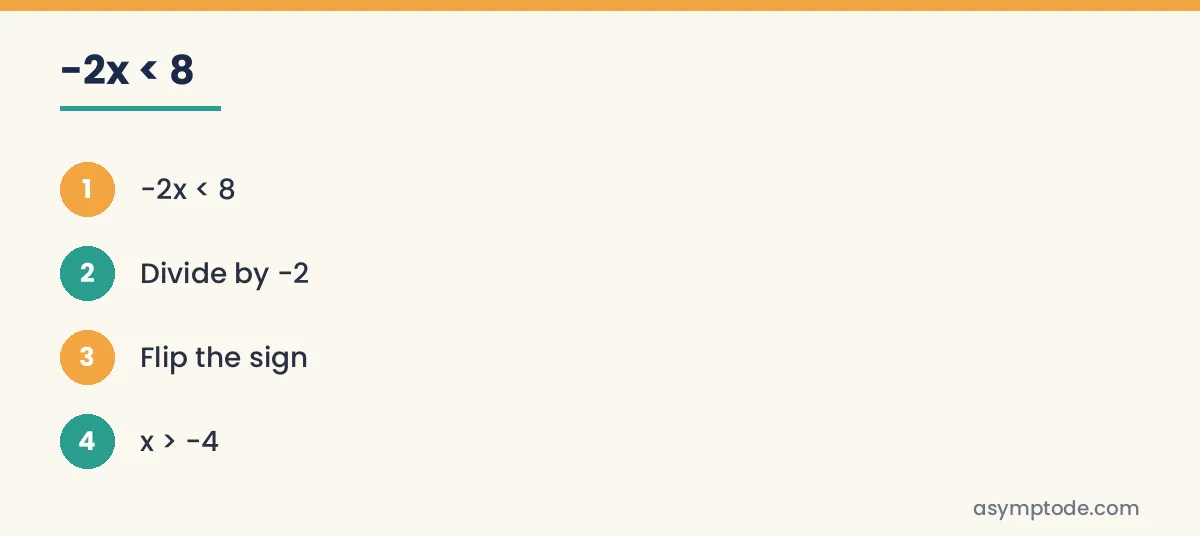 Dividing by a negative number flips the sign.
The card repeats the steps: start with -2x < 8, divide by -2, flip the sign, and get x > -4.
Why does it flip? Think of 2 < 5. Multiply both sides by -1 and you get -2 and -5. Now -2 is bigger than -5, so the sign must turn around: -2 > -5.
Book a free demo class if your child keeps forgetting this rule. A mentor can watch each line of working as it is written.
How do you graph an inequality on a number line?
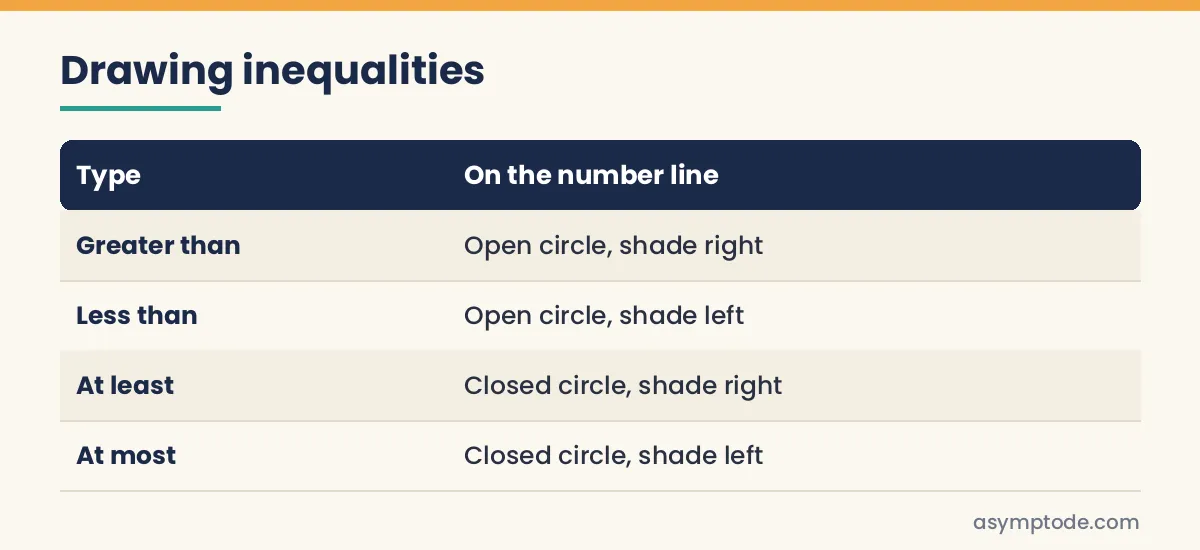 How to draw each type of inequality.
The table repeats the rules: greater than gets an open circle and shading to the right, less than gets an open circle and shading to the left, at least gets a closed circle and shading to the right, and at most gets a closed circle and shading to the left.
For x > 3, put an open circle at 3 and shade to the right. For x ≥ 3, use a closed circle at 3 and shade to the right.
How do you solve a compound inequality?
A compound inequality has two parts at once, such as -1 < 2x + 3 ≤ 9. Do the same step to all three parts.
- Subtract 3 from all three parts. -4 < 2x ≤ 6.
- Divide all three parts by 2. -2 < x ≤ 3.
The solution is every x that is greater than -2 and at most 3. On a number line this is an open circle at -2, a closed circle at 3, and shading between them.
How do you use an inequality in a word problem?
Look for phrases such as "at least", "at most", "no more than" and "more than". Then write the inequality and solve it.
Example (from the Common Core standard): you are paid $50 per week plus $3 per sale. This week you want your pay to be at least $100. How many sales do you need?
- Write the inequality. 50 + 3s ≥ 100.
- Subtract 50. 3s ≥ 50.
- Divide by 3. s ≥ 50/3, which is about 16.7.
- Read the answer in context. Sales are whole numbers, so you need at least 17 sales.
How do you graph a linear inequality in two variables?
Graph the boundary line first, then shade one side. If you need a refresher on drawing lines, see slope-intercept form explained.
Example: graph y > 2x + 1.
- Draw the line y = 2x + 1. Use a dashed line, because the inequality uses > and the line itself is not included. Use a solid line for ≥ or ≤.
- Pick a test point. Try (0, 3): 3 > 2(0) + 1 is 3 > 1, which is true.
- Shade the side with the true point. (0, 3) is above the line, so shade above it.
Systems of inequalities work the same way, and the solution is where the shaded regions overlap. See systems of linear equations explained for the idea of solving two conditions together.
Where do linear inequalities appear in school and tests?
- Grade 7 to Algebra 1 (US): solving, graphing and word problems, tied to Common Core 7.EE.B.4.B and HSA-REI.B.3.
- SAT: the College Board's Algebra page lists "Linear inequalities in 1 or 2 variables" as a topic on the SAT Math section. See our digital SAT Math guide and the PSAT/NMSQT guide.
- ACT: see the ACT Math test guide for the format of the maths section.
- Later courses: inequalities lead to absolute value, quadratics and limits. See solving quadratic equations and the AP Precalculus guide.
What are the most common mistakes with inequalities?
- Forgetting to flip the sign when dividing by a negative number.
- Using the wrong circle. Open for > and <, closed for ≥ and ≤.
- Flipping the sign when subtracting. Only multiplying or dividing by a negative number flips it.
- Treating the answer as one number. The answer is a range.
- Skipping the test point. Put one value back into the original inequality. It takes ten seconds.
Practice questions with answers
- Solve x + 5 > 12.
- Solve 4x - 3 ≤ 13.
- Solve -3x > 12.
- Solve 7 - 2x ≥ 1.
- Is the point (1, 4) a solution of y > 2x + 1?
- A taxi costs $4 plus $2 per mile. You can spend at most $20. How many miles can you ride?
Answers
- Subtract 5: x > 7.
- Add 3: 4x ≤ 16, then divide by 4: x ≤ 4.
- Divide by -3 and flip the sign: x < -4.
- Subtract 7: -2x ≥ -6. Divide by -2 and flip the sign: x ≤ 3.
- 2(1) + 1 = 3, and 4 > 3 is true. Yes, (1, 4) is a solution.
- 4 + 2m ≤ 20, so 2m ≤ 16 and m ≤ 8. You can ride at most 8 miles.
How to get better at linear inequalities
- Always check with a test number, one inside the answer and one outside.
- Say the rule out loud: "negative multiply or divide, flip the sign".
- Draw the number line every time, even a quick one.
- Turn real limits, such as budgets and time, into inequalities.
How Asymptode Can Help You Prepare for Linear Inequalities
Inequalities look like equations, but a single forgotten sign flip changes the whole answer. At Asymptode, your child has live, one-to-one online classes with a mentor who teaches maths at your child's grade, following their own school course and test dates. The mentor watches each line of working, so a missed sign flip or a wrong circle is caught on the spot.
Between classes, your child gets AI-assisted practice built from what their own last attempt showed they had not yet understood, written to the mentor's brief and sent only after the mentor approves it. The AI supports the mentor; it never teaches or replaces the mentor. The mentor marks the work, and in the parent dashboard you can see what was understood and what to practise next.
Every class is recorded, so a tricky explanation can be rewatched. Book a free demo class or see our plans and fees.
Facts checked against official sources on 21 November 2026.
FAQ
What is a linear inequality in simple terms?
It is a statement that one linear expression is greater than, less than, at least or at most another. Its solution is a range of numbers, not a single number.
When do you flip the inequality sign?
Flip it when you multiply or divide both sides by a negative number. Adding or subtracting a number, even a negative one, does not flip it.
What is the difference between an open and a closed circle?
An open circle means the number is not part of the answer, which is used for > and <. A closed circle means it is part of the answer, used for ≥ and ≤.
How do you solve a compound inequality?
Do the same steps to all three parts at once. For -1 < 2x + 3 ≤ 9, subtract 3 and divide by 2 to get -2 < x ≤ 3.
How do you graph a linear inequality with x and y?
Draw the boundary line, dashed for > or < and solid for ≥ or ≤. Then test a point, such as (0, 0) when it is not on the line, and shade the side that makes the inequality true.
Are linear inequalities on the SAT?
The College Board's Algebra page lists "Linear inequalities in 1 or 2 variables" among the SAT Math topics. Check the College Board's official pages for the full list of skills.
Ready to start? Book a free demo class and advisor call, or see our plans and fees.
Sources
- Common Core State Standards: Grade 7 Expressions & Equations
- Common Core State Standards: High School Algebra, Reasoning with Equations & Inequalities
- SAT Math: Algebra (College Board)