
Trigonometry ratios explained simply: in a right-angled triangle, sin, cos and tan are fixed ratios between two sides for a given angle. This guide shows how to label the sides, use SOH CAH TOA, find a missing side, find an angle, learn the exact values and solve elevation problems. It is for GCSE, IGCSE, CBSE Class 10 and SAT students, and their parents.
Key takeaways
- Trig ratios only work this way in a right-angled triangle.
- Label the sides from the angle you are using: opposite, adjacent and hypotenuse.
- SOH CAH TOA: sin = O/H, cos = A/H, tan = O/A.
- Use sin, cos or tan to find a side. Use the inverse (sin^-1, cos^-1, tan^-1) to find an angle.
- Set your calculator to degrees before you start.
What are trigonometry ratios? Trigonometry ratios explained
Quick answer: Sine, cosine and tangent compare two sides of a right-angled triangle for one angle, x. Sin x = opposite ÷ hypotenuse, cos x = adjacent ÷ hypotenuse and tan x = opposite ÷ adjacent. The ratio depends only on the angle, not the triangle's size, so you can use it to find unknown sides and angles.
In any right-angled triangle with a 30° angle, the side opposite 30° is half the hypotenuse, so sin 30° = 1/2. Trigonometry builds on Pythagoras' theorem: Pythagoras links three sides, while trig links sides and angles.
How do you label the hypotenuse, opposite and adjacent sides?
Always label the sides before you choose a ratio.
- Hypotenuse (H): the longest side. It is always opposite the right angle.
- Opposite (O): the side across from the angle x you are using. It does not touch x.
- Adjacent (A): the side next to x that is not the hypotenuse.
If you switch to the other acute angle, opposite and adjacent swap. The hypotenuse never changes.
What does SOH CAH TOA mean?
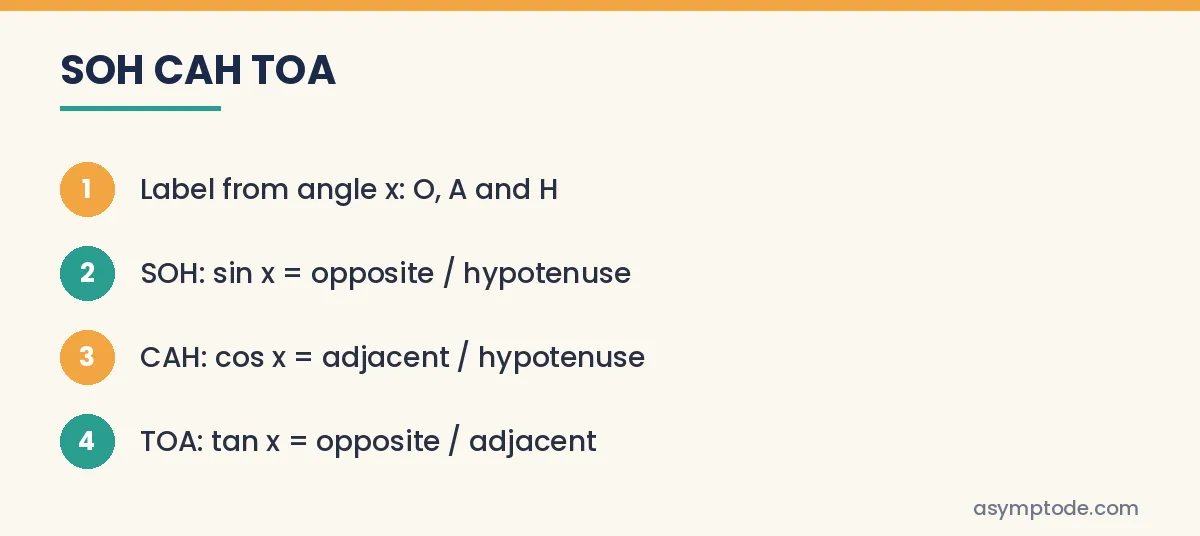 SOH CAH TOA: the three ratios in one memory aid.
SOH: sin x = opposite / hypotenuse. CAH: cos x = adjacent / hypotenuse. TOA: tan x = opposite / adjacent. To choose one, find the two sides in the question (the one you know and the one you want).
| You know or want | Use |
|---|---|
| Opposite and hypotenuse | sin (SOH) |
| Adjacent and hypotenuse | cos (CAH) |
| Opposite and adjacent | tan (TOA) |
How do you find a missing side using trigonometry?
 Worked example: a 5 m ladder at 70° to the ground.
The ladder is the hypotenuse (5 m). We want the height up the wall, which is opposite the 70° angle. O and H means SOH: sin 70° = h / 5, so h = 5 × sin 70° = 4.698... = 4.7 m (1 d.p.). The foot of the ladder is the adjacent side: 5 × cos 70° = 1.7 m (1 d.p.). Check with Pythagoras: 4.698² + 1.710² = 25 = 5².
Steps: label O, A and H; pick the ratio; write the equation; rearrange (multiply if the unknown is on top, divide if it is on the bottom); round only at the end.
When the unknown is on the bottom: the opposite side is 6 cm and the angle is 40°. Find the hypotenuse. sin 40° = 6 / H, so H = 6 ÷ sin 40° = 9.3 cm (1 d.p.).
How do you find an angle using inverse trig functions?
 Worked example: finding a ramp angle with inverse tan.
A ramp rises 1.2 m over a horizontal distance of 4 m. Find the angle x with the ground. The rise is opposite x and the 4 m is adjacent, so use TOA: tan x = 1.2 / 4 = 0.3. Use inverse tan: x = tan^-1(0.3) = 16.699... = 16.7° (1 d.p.). Check: 4 × tan 16.7° is about 1.2.
On most calculators, press SHIFT (or 2nd) then sin, cos or tan. Inverse trig turns a ratio back into an angle. Cambridge IGCSE asks for angles in degrees, correct to one decimal place (Cambridge IGCSE Mathematics 0580 syllabus).
What are the exact trig values for 0°, 30°, 45°, 60° and 90°?
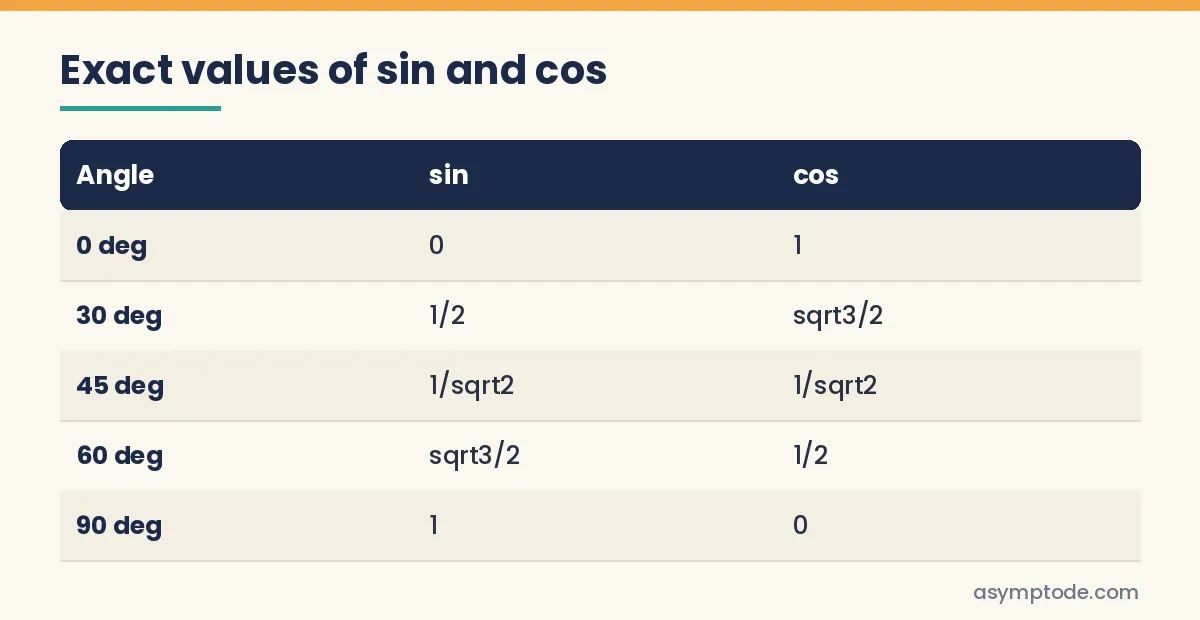 Exact values of sin and cos for the five key angles.
Sin at 0°, 30°, 45°, 60°, 90° is 0, 1/2, 1/√2, √3/2, 1. Cos at the same angles is 1, √3/2, 1/√2, 1/2, 0: the sin values in reverse. Tan = sin ÷ cos, so tan at 0°, 30°, 45°, 60° is 0, 1/√3, 1, √3. Tan 90° is undefined, because cos 90° = 0 and you cannot divide by zero.
| Angle | sin | cos | tan |
|---|---|---|---|
| 0° | 0 | 1 | 0 |
| 30° | 1/2 | √3/2 | 1/√3 (= √3/3) |
| 45° | 1/√2 (= √2/2) | 1/√2 (= √2/2) | 1 |
| 60° | √3/2 | 1/2 | √3 |
| 90° | 1 | 0 | undefined |
These come from two triangles. Half a square with sides 1 gives 45°, 45° and a hypotenuse of √2. Half an equilateral triangle with sides 2 gives 30°, 60°, sides 1 and √3, and a hypotenuse of 2. AQA GCSE students must know these exact values (AQA GCSE Mathematics 8300 specification, G21). So must Cambridge IGCSE Extended students (E6.3).
How do you solve angle of elevation and depression problems?
The angle of elevation is measured up from the horizontal to an object above you. The angle of depression is measured down from the horizontal to an object below you. Both start from the horizontal.
Elevation example: you stand 30 m from a tree. The angle of elevation to the top is 35°. How tall is the tree? The 30 m is adjacent and the height is opposite, so use tan. Height = 30 × tan 35° = 21.0 m (1 d.p.).
Depression example: from the top of a 50 m cliff, the angle of depression to a boat is 20°. How far is the boat from the foot of the cliff? The angle of depression equals the angle of elevation from the boat (alternate angles). So tan 20° = 50 / d, and d = 50 ÷ tan 20° = 137.4 m (1 d.p.).
Always sketch first and mark the horizontal. The same ideas return in projectile motion, where velocity splits into v cos x and v sin x.
Want a mentor to check your method live? Book a free demo class or see our plans and fees.
Should your calculator be in degrees or radians?
When angles are given in degrees, as in GCSE, IGCSE and CBSE Class 10 questions, use degrees mode. Look for a small "D" or "DEG" on the screen. In radians mode, sin 30 gives -0.988 instead of 0.5. If an answer looks odd, check the mode first. Radians become common later, for example in A-level Maths.
What are the most common trigonometry mistakes?
- Labelling opposite and adjacent from the wrong angle.
- Using sin or cos when the question does not involve the hypotenuse. Use tan.
- Calculator in radians mode.
- Rounding too early.
- Pressing tan instead of tan^-1 when finding an angle.
- Measuring an angle of elevation or depression from the vertical.
Where do trigonometry ratios appear in your syllabus?
| Course | What the official document says |
|---|---|
| AQA GCSE Maths 8300 | G20: know sin, cos, tan as ratios and use them to find angles and lengths. G21: exact values. G22 (Higher): sine and cosine rules. AQA 8300 specification |
| Cambridge IGCSE 0580 (exams 2025-2027) | C6.2/E6.2: sin, cos, tan in right-angled triangles, bearings. E6.2: elevation and depression. E6.3: exact values (Extended). 0580 syllabus |
| NCERT Class 10 | Chapter 8, "Introduction to Trigonometry": ratios, values at 0° to 90°, identities. NCERT textbook chapter |
| SAT Math | Domain "Geometry and Trigonometry" includes "right triangles and trigonometry". College Board |
For paper formats, see our guides to GCSE maths papers, IGCSE Maths 0580, Digital SAT Math and the CBSE board exams 2027. For marks and weightings, check the official page.
Practice questions with answers
Give answers to 1 decimal place.
- The hypotenuse is 10 cm and the angle is 25°. Find the opposite side.
- The adjacent side is 8 cm and the angle is 50°. Find the opposite side.
- The opposite side is 7 cm and the hypotenuse is 12 cm. Find the angle.
- The adjacent side is 9 cm and the hypotenuse is 15 cm. Find the angle.
- Without a calculator, find sin 30° + cos 60°.
- A kite string is 40 m long at an angle of elevation of 55°. How high is the kite?
Answers: 1) 10 × sin 25° = 4.2 cm. 2) 8 × tan 50° = 9.5 cm. 3) sin^-1(7/12) = 35.7°. 4) cos^-1(9/15) = 53.1°. 5) 1/2 + 1/2 = 1. 6) 40 × sin 55° = 32.8 m.
How Asymptode helps you with trigonometry ratios
At Asymptode, a qualified mentor teaches your child one-to-one, live online. The mentor follows your child's own syllabus: AQA 8300, Cambridge IGCSE 0580, NCERT Class 10 Chapter 8 or SAT Geometry and Trigonometry. Lessons are planned around the real exam dates and cover labelling, SOH CAH TOA, inverse trig, exact values and elevation problems.
Between classes, your child gets practice built just for them. It is a worksheet made from what their last attempt showed they had not understood. If they mixed up opposite and adjacent, or left the calculator in radians, the next sheet targets exactly that, at their level, never generic. This is Asymptode's AI-assisted practice. It is written to the mentor's brief and sent only after the mentor approves it.
The mentor marks the work. Parents see what was understood and what to practise next, so preparation keeps correcting itself towards confident trigonometry in the exam. Book a free demo class or see our plans and fees.
Facts checked against official sources on 8 November 2026.
FAQ
What is SOH CAH TOA?
It is a memory aid: sin = opposite / hypotenuse, cos = adjacent / hypotenuse and tan = opposite / adjacent. It only works in right-angled triangles.
How do I know whether to use sin, cos or tan?
Label the sides from your angle, then find the side you know and the side you want. O and H mean sin, A and H mean cos, and O and A mean tan.
How do I find an angle with trigonometry?
Work out the ratio from the two known sides, then use the inverse function. For example, if tan x = 0.3, then x = tan^-1(0.3) = 16.7°. On most calculators this is SHIFT or 2nd, then tan.
Do I need to memorise exact trig values?
Yes, for many courses. AQA GCSE and Cambridge IGCSE Extended list exact values of sin and cos for 0°, 30°, 45°, 60° and 90°, and tan for 0°, 30°, 45° and 60°. Learn the sin values and reverse them for cos.
Why does my calculator give the wrong answer for sin 30?
It is probably in radians mode, where sin 30 gives -0.988 instead of 0.5. Switch to degrees mode.
Can I use SOH CAH TOA in any triangle?
No. SOH CAH TOA needs a right angle. For other triangles, use the sine rule or the cosine rule, which are Higher-tier content in AQA GCSE Maths.
Ready to start? Book a free demo class and advisor call, or see our plans and fees.