
Differentiation explained in one line: it is the maths of finding how fast something changes. This guide shows you how to differentiate step by step, from gradients to the power rule, tangents and stationary points, with fully worked examples.
Key takeaways
- A derivative tells you the gradient of a curve at one point. It is also a rate of change.
- The power rule does most of the work: x^n becomes n x^(n-1).
- Learn four more results: sin x, cos x, e^x and ln x.
- Set dy/dx = 0 to find stationary points. Use the second derivative to tell a maximum from a minimum.
- Differentiation is in A-level, Level 2 Further Maths, AP Calculus, IB AA, JEE Main and CBSE Class 12.
What is differentiation explained simply?
Quick answer: Differentiation finds the gradient of a curve at any point. A straight line has one gradient everywhere, but a curve's gradient changes as you move along it. The derivative, written dy/dx or f'(x), is a new function. It gives that gradient, or rate of change, at every value of x.
Think of a car. Speed is the rate at which distance changes, so speed is the derivative of distance with respect to time. That is why calculus links closely to motion graphs.
What do dy/dx and f'(x) mean?
Both mean "the derivative". Use dy/dx when the curve is written y = ..., and f'(x) when it is written f(x) = .... The second derivative, d2y/dx2 or f''(x), is the rate of change of the gradient. dy/dx is one symbol, not a fraction to cancel.
What is the gradient of a curve?
The gradient of a curve at a point is the gradient of the tangent at that point. A tangent is a straight line that just touches the curve there.
 The tangent to y = x^2 gets steeper as x grows.
For y = x^2, dy/dx = 2x. At x = 1 the gradient is 2, so the tangent is y = 2x - 1. At x = 2 the gradient is 4, so the tangent is y = 4x - 4.
What is differentiation from first principles?
First principles is the idea behind every rule. Take two points on the curve very close together, find the gradient of the chord between them, then let the gap shrink to zero.
For f(x) = x^2, use the points x and x + h:
- Gradient of chord = ((x + h)^2 - x^2) / h
- = (2xh + h^2) / h = 2x + h
- As h gets close to 0, this gets close to 2x.
Test it at x = 1: with h = 0.1 the chord gradient is 2.1, and with h = 0.01 it is 2.01. The values close in on 2.
The Edexcel A-level Maths specification (Topic 7) expects this for powers such as n = 2 and n = 3, and for sin x and cos x.
How to differentiate: the basic rules
In practice you use rules. Here are the ones to learn first.
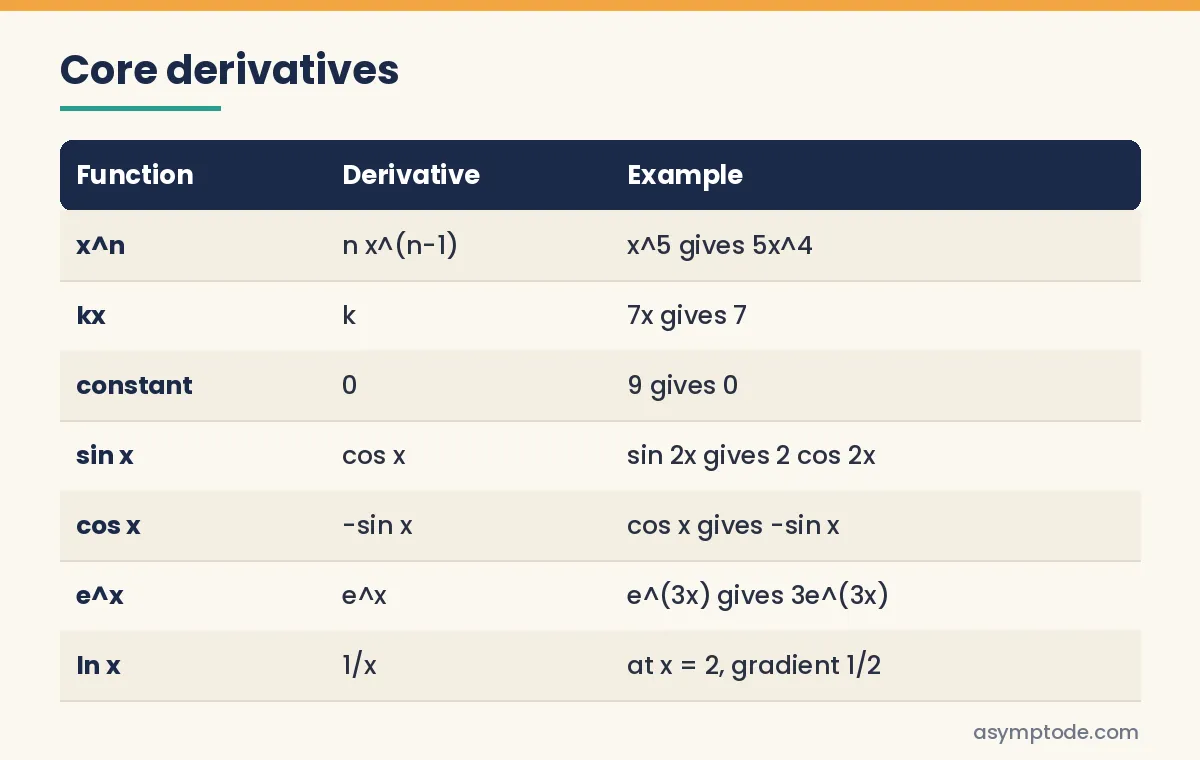 The core derivatives to learn by heart.
| Function | Derivative | Example |
|---|---|---|
| x^n | n x^(n-1) | x^5 gives 5x^4 |
| kx | k | 7x gives 7 |
| constant | 0 | 9 gives 0 |
| sin x | cos x | sin 2x gives 2 cos 2x |
| cos x | -sin x | cos x gives -sin x |
| e^x | e^x | e^(3x) gives 3e^(3x) |
| ln x | 1/x | at x = 2, gradient 1/2 |
Two more rules sit underneath the table:
- Sum rule: differentiate each term on its own, then add.
- Constant multiple rule: a number in front stays in front. So 3x^4 gives 3 x 4x^3 = 12x^3.
For sin x and cos x, x must be in radians.
In AQA A-level, the power rule, e^kx, sin kx, cos kx, tan kx and ln x are all in content point G2. In IB Maths AA, the power rule for whole-number powers is SL 5.3, and sin x, cos x, e^x and ln x are SL 5.6. For differentiation, AQA Level 2 Further Maths covers kx^n where n is an integer. To revise e and ln, read logarithms explained.
Worked example 1: the power rule
Differentiate y = 3x^4 - 5x^2 + 7x - 2, then find the gradient at x = 1.
 Each term is differentiated on its own.
- 3x^4 gives 3 x 4x^3 = 12x^3.
- -5x^2 gives -5 x 2x = -10x.
- 7x gives 7.
- -2 is a constant, so it gives 0.
- So dy/dx = 12x^3 - 10x + 7.
- At x = 1: 12 - 10 + 7 = 9.
Worked example 2: roots and fractions
Differentiate y = 4√x + 6/x, then find the gradient at x = 4.
- Rewrite as powers: y = 4x^(1/2) + 6x^(-1).
- 4x^(1/2) gives 4 x (1/2) x^(-1/2) = 2x^(-1/2).
- 6x^(-1) gives 6 x (-1) x^(-2) = -6x^(-2).
- So dy/dx = 2/√x - 6/x^2.
- At x = 4: 2/2 - 6/16 = 1 - 0.375 = 0.625.
How do you find the equation of a tangent and a normal?
A normal is at right angles to the tangent at the same point. Their gradients multiply to -1.
Worked example 3: tangent and normal
Find the tangent and normal to y = x^3 - 3x + 1 at x = 2.
- Find the point: y = 8 - 6 + 1 = 3. So the point is (2, 3).
- Differentiate: dy/dx = 3x^2 - 3.
- Gradient at x = 2: 3(4) - 3 = 9.
- Tangent: y - 3 = 9(x - 2), so y = 9x - 15.
- Normal gradient = -1/9.
- Normal: y - 3 = -1/9 (x - 2). Multiply by 9: 9y - 27 = -x + 2, so x + 9y - 29 = 0.
Check: 2 + 9(3) - 29 = 0, so (2, 3) is on the normal.
How do you find stationary points?
A stationary point is where the gradient is zero. It can be a maximum, a minimum or a point of inflection.
The method:
- Differentiate to get dy/dx.
- Set dy/dx = 0 and solve for x.
- Put each x back into y to get the coordinates.
- Find the second derivative, d2y/dx2.
- If d2y/dx2 < 0, it is a maximum. If d2y/dx2 > 0, it is a minimum.
- If d2y/dx2 = 0, check the gradient on each side instead.
Worked example 4: maximum and minimum
Find and classify the stationary points of y = x^3 - 6x^2 + 9x + 1.
- dy/dx = 3x^2 - 12x + 9 = 3(x - 1)(x - 3).
- dy/dx = 0 when x = 1 or x = 3.
- At x = 1: y = 1 - 6 + 9 + 1 = 5. Point (1, 5).
- At x = 3: y = 27 - 54 + 27 + 1 = 1. Point (3, 1).
- d2y/dx2 = 6x - 12.
- At x = 1: 6 - 12 = -6, which is negative, so (1, 5) is a maximum.
- At x = 3: 18 - 12 = 6, which is positive, so (3, 1) is a minimum.
What are the chain, product and quotient rules?
| Rule | Use it for | Pattern |
|---|---|---|
| Chain rule | A function inside a function | dy/dx = dy/du x du/dx |
| Product rule | Two functions multiplied | (uv)' = u'v + uv' |
| Quotient rule | One function divided by another | (u/v)' = (u'v - uv') / v^2 |
Worked example 5: chain, product and quotient
- Chain: y = (2x + 1)^5. Bring down the 5, lower the power by 1, and multiply by 2 (the inside's derivative): dy/dx = 10(2x + 1)^4. At x = 0 the gradient is 10.
- Product: y = x^2 sin x, so dy/dx = 2x sin x + x^2 cos x.
- Quotient: y = ln x / x, so dy/dx = (1 - ln x) / x^2.
How is differentiation used as a rate of change?
If s is displacement and t is time, then ds/dt is velocity. For example, if s = 5t^2, then v = 10t, so at t = 3 the velocity is 30 m/s. Differentiate again and the acceleration is 10 m/s^2. The same idea appears in projectile motion.
Where is differentiation examined?
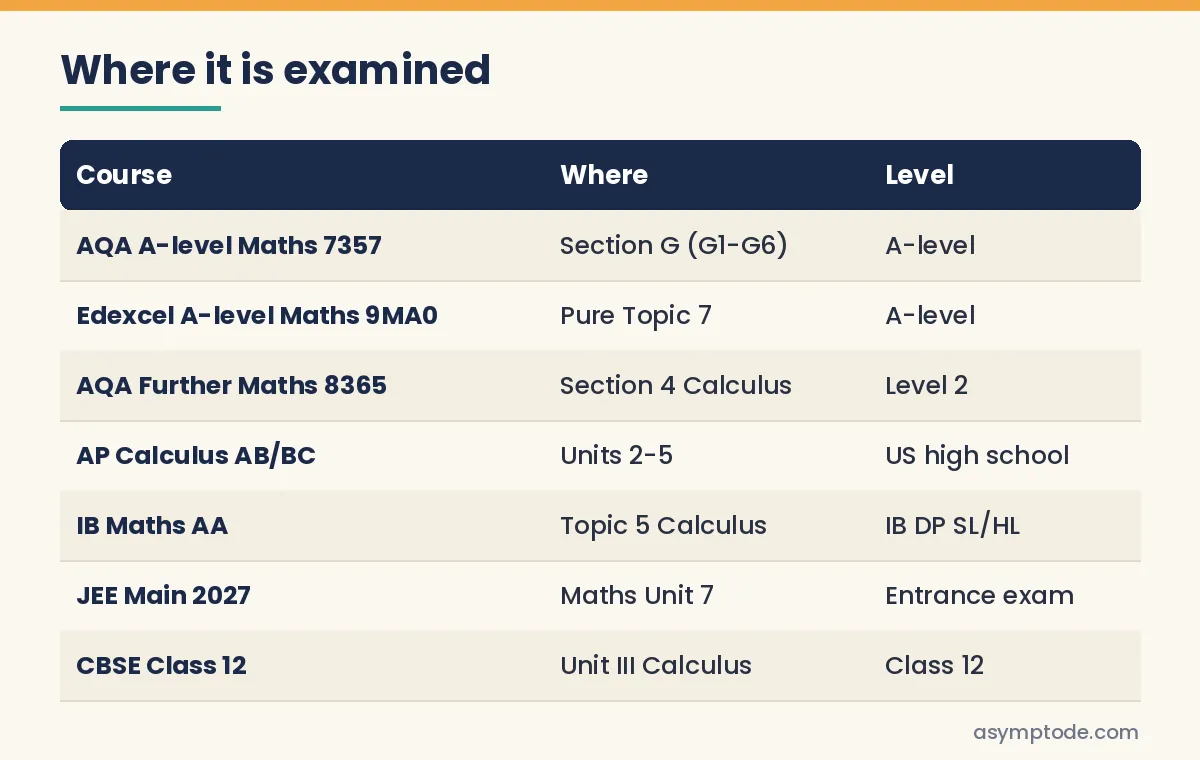 Where differentiation sits in seven common maths courses.
| Course | Where | Level |
|---|---|---|
| AQA A-level Maths 7357 | Section G (G1-G6) | A-level |
| Edexcel A-level Maths 9MA0 | Pure Topic 7 | A-level |
| AQA Further Maths 8365 | Section 4 Calculus | Level 2 |
| AP Calculus AB/BC | Units 2-5 | US high school |
| IB Maths AA | Topic 5 Calculus | IB DP SL/HL |
| JEE Main 2027 | Maths Unit 7 | Entrance exam |
| CBSE Class 12 | Unit III Calculus | Class 12 |
- AQA A-level Maths 7357: section G includes first principles, the standard derivatives, tangents, normals, stationary points and the chain, product and quotient rules. See our A-level Maths guide.
- AQA Level 2 Further Maths 8365: kx^n for integer n, tangents, normals, d2y/dx2, and maxima and minima.
- AP Calculus AB and BC: Units 2 to 5 cover differentiation. College Board says course content has not changed for 2026-27, but question numbers and timing change from the May 2027 exams. See our AP Calculus AB vs BC guide.
- IB Maths: analysis and approaches: Topic 5 Calculus. First principles (for polynomials) is in AHL 5.12, so it is for HL only. See IB Maths AA vs AI.
- JEE Main 2027: the NTA syllabus puts it in Unit 7, "Limit, Continuity and Differentiability", including derivatives up to order two and maxima and minima. See our JEE Main 2027 guide. For exam dates, check the official page.
- CBSE Class 12: Unit III Calculus includes "Continuity and Differentiability" and "Applications of Derivatives". Confirm the current version on the CBSE academic curriculum page.
What are the most common differentiation mistakes?
- Forgetting the constant goes to zero. In y = x^2 + 5, the 5 disappears.
- Lowering the power the wrong way with negatives. x^(-1) becomes -x^(-2), not -x^0.
- Differentiating a root or fraction before rewriting it. Turn 6/x into 6x^(-1) first.
- Forgetting the inside in the chain rule. (2x + 1)^5 gives 10(2x + 1)^4, not 5(2x + 1)^4.
- Wrong normal gradient. It is -1 divided by the tangent gradient, not just the negative.
Stuck on these? Book a free demo class with a maths mentor, or see our plans and fees.
Practice questions with answers
- Differentiate y = 2x^3 + 4x.
- Differentiate y = 5/x^2, then find the gradient at x = 1.
- Find and classify the stationary point of y = x^2 - 6x + 11.
- Find the tangent to y = x^2 at x = 3.
- Differentiate y = sin 3x.
Answers
- dy/dx = 6x^2 + 4.
- y = 5x^(-2), so dy/dx = -10x^(-3) = -10/x^3. At x = 1 the gradient is -10.
- dy/dx = 2x - 6 = 0, so x = 3 and y = 9 - 18 + 11 = 2. d2y/dx2 = 2, which is positive, so (3, 2) is a minimum.
- Point (3, 9). Gradient 2 x 3 = 6. Tangent: y - 9 = 6(x - 3), so y = 6x - 9.
- dy/dx = 3 cos 3x.
How to get better at differentiation
- Learn the core table by heart.
- Rewrite before you differentiate: powers of x first.
- Do short daily sets. Ten quick questions beat one long weekly session.
- Sort your errors: rule, algebra or arithmetic?
- Move to past papers from your own exam board.
How Asymptode helps you with differentiation
At Asymptode, a qualified mentor teaches your child one-to-one, live online. The mentor follows your child's own course, whether that is AQA section G, Edexcel Topic 7, AP Calculus Units 2 to 5, IB AA Topic 5, JEE Main Unit 7 or CBSE Unit III, and works to that course's real exam dates.
Between classes, your child gets practice built for them. If their last attempt showed they mixed up the normal gradient, or forgot to rewrite 6/x as a power, the next worksheet targets exactly that, at their level. It is never generic. This is Asymptode's AI-assisted practice. It is written to the mentor's brief, and it is sent only after the mentor approves it.
The mentor then marks the work. As a parent, you see what was understood and what to practise next. So preparation keeps correcting itself, from the power rule to stationary points and the chain rule.
Book a free demo class or see our fees.
Facts checked against official sources on 12 November 2026.
FAQ
What is differentiation in simple words?
It is a way to find how fast one thing changes compared with another. On a graph, it gives the gradient of a curve at any point.
How do you differentiate x^n?
Bring the power down in front and take 1 off the power. For example, x^5 becomes 5x^4, and x^(-1) becomes -x^(-2).
What is the derivative of a constant?
It is 0. A constant does not change, so y = 9 is a flat line with gradient 0.
How do I know if a stationary point is a maximum or a minimum?
Find the second derivative there. Negative means a maximum and positive means a minimum. If it is zero, check the gradient on each side.
Is differentiation in GCSE Maths?
Check your own board's GCSE specification. Differentiation is part of the AQA Level 2 Certificate in Further Maths (8365), including tangents, normals and maxima and minima.
Do I need first principles for my exam?
AQA and Edexcel A-level include it for small positive integer powers of x and for sin x and cos x. In IB Maths AA it is in AHL 5.12, so it is for HL students.
Ready to start? Book a free demo class and advisor call, or see our plans and fees.
Sources
- AQA A-level Mathematics 7357 specification (section G: Differentiation)
- Pearson Edexcel A-level Mathematics specification, Issue 4 (Topic 7)
- AQA Level 2 Certificate in Further Maths 8365
- AP Calculus AB course page, AP Central
- AP Calculus AB and BC Course and Exam Description
- IB Diploma Programme mathematics curriculum
- JEE (Main) official site, NTA
- CBSE academic curriculum 2026-27