

Key takeaways
- The digital SAT Math section has two modules and four content areas.
- Algebra and Advanced Math make up about two thirds of the questions.
- Some questions are word problems. Others are plain equations.
- Short, regular practice beats one long weekend of study.
- Always check the latest rules on the College Board website before test day.
What is on the digital SAT Math section?
Quick answer: The digital SAT Math section covers four areas: Algebra, Advanced Math, Problem-Solving and Data Analysis, and Geometry and Trigonometry. It is split into two modules. Algebra and Advanced Math have the most questions.
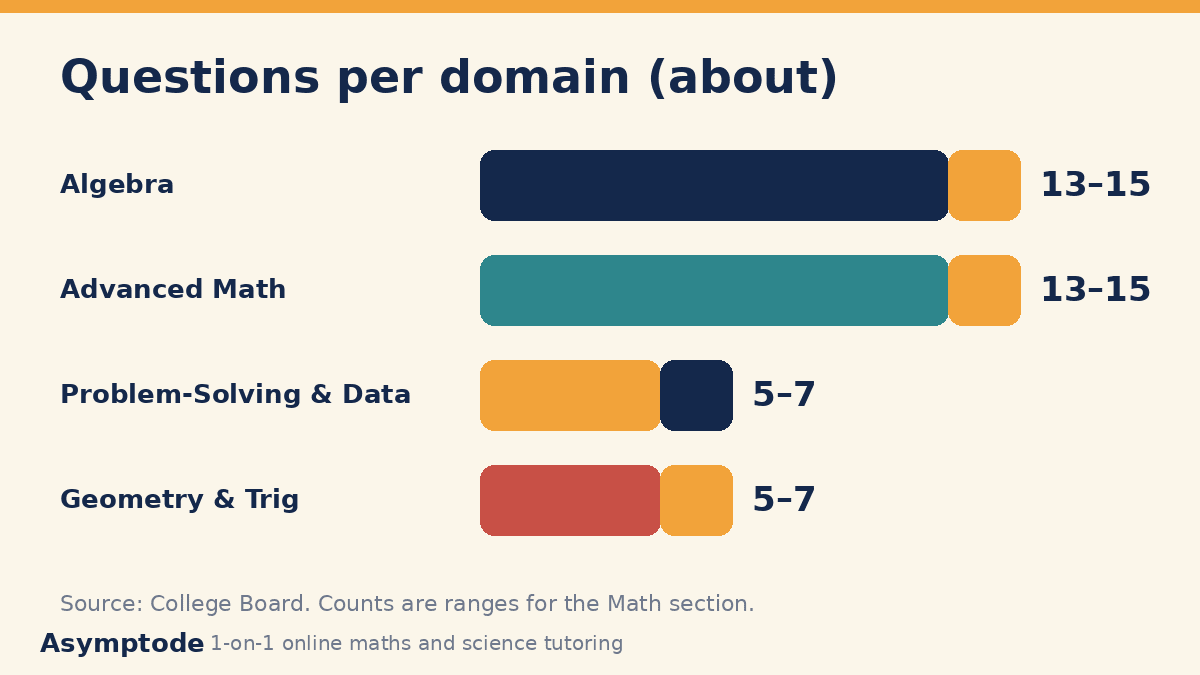
The College Board publishes the number of questions it expects in each area. These are ranges, not fixed numbers. The chart shows them.
The College Board also says that about 30% of the questions are set in a real-life context. That means a short story, a graph or a table. The rest are plain maths with no story.
What does each area test?
Here is a simple guide. Use it to see where your child is strong and where they need help.
- Algebra: linear equations, linear inequalities, and systems of equations. Think of problems like 3x + 5 = 20.
- Advanced Math: quadratics, exponents and other non-linear ideas. This is the area where many students lose marks.
- Problem-Solving and Data Analysis: ratios, percentages, rates, and reading tables and graphs.
- Geometry and Trigonometry: area, volume, angles, circles and right triangles.
If your child is still shaky on fractions or negative numbers, fix that first. Our guide on adding and subtracting fractions is a good start.
How do the two modules work?
The Math section is split into two modules. Each module mixes the four content areas. You do not do all the algebra first and then all the geometry. Questions from different areas appear in the same module.
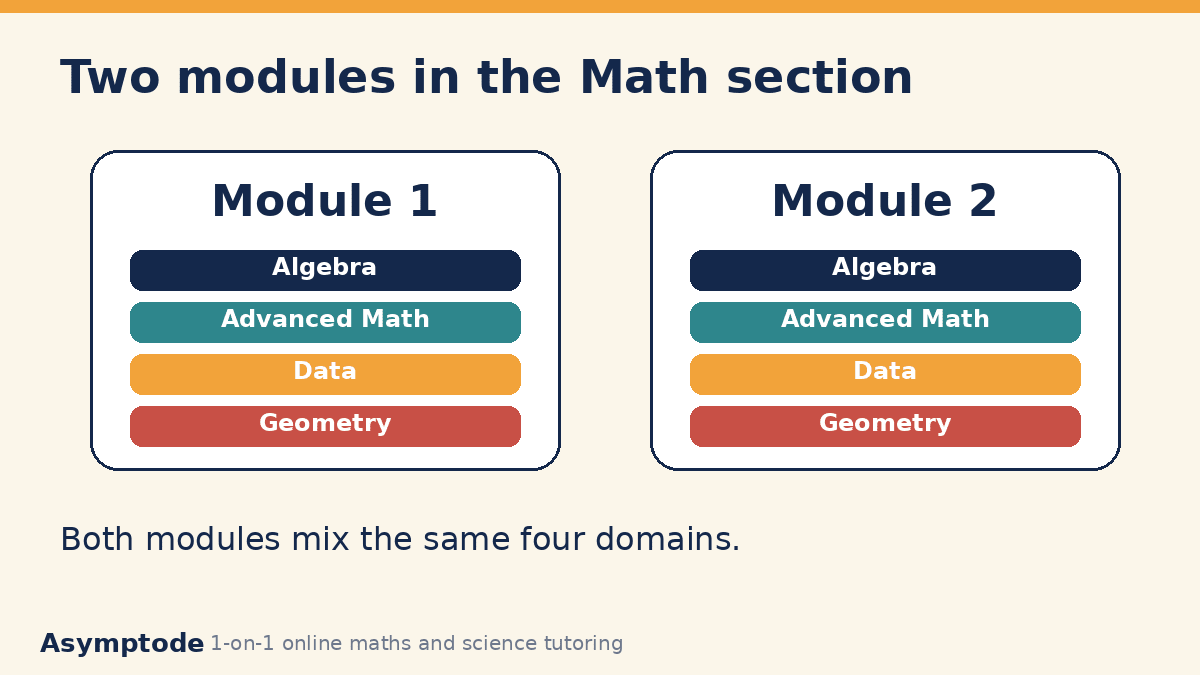
What this means for your child: they must be ready to switch topics quickly. Practise with mixed sets, not only one topic at a time.
How do you solve a typical Algebra question?
Most Algebra questions ask your child to find the value of a variable. The method is always the same. Do the same thing to both sides.
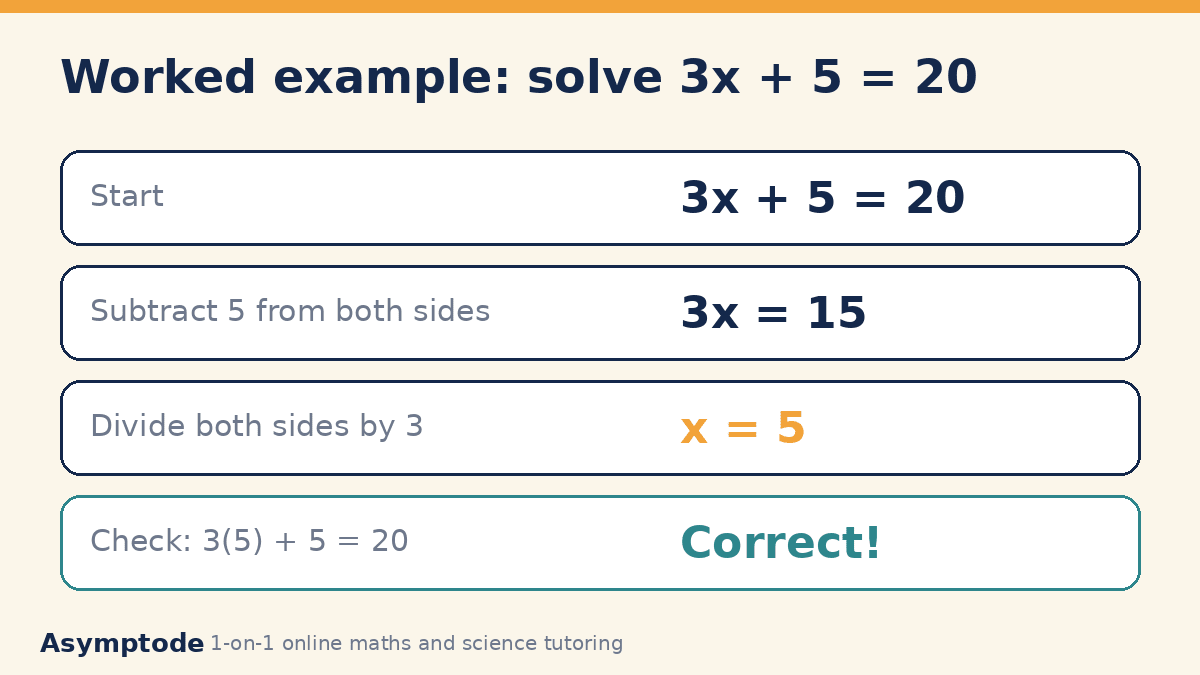
- Start with 3x + 5 = 20.
- Subtract 5 from both sides. You get 3x = 15.
- Divide both sides by 3. You get x = 5.
- Check: 3(5) + 5 = 20. It works.
Watch another example. This one has a fraction. The animation shows each step appear one at a time.
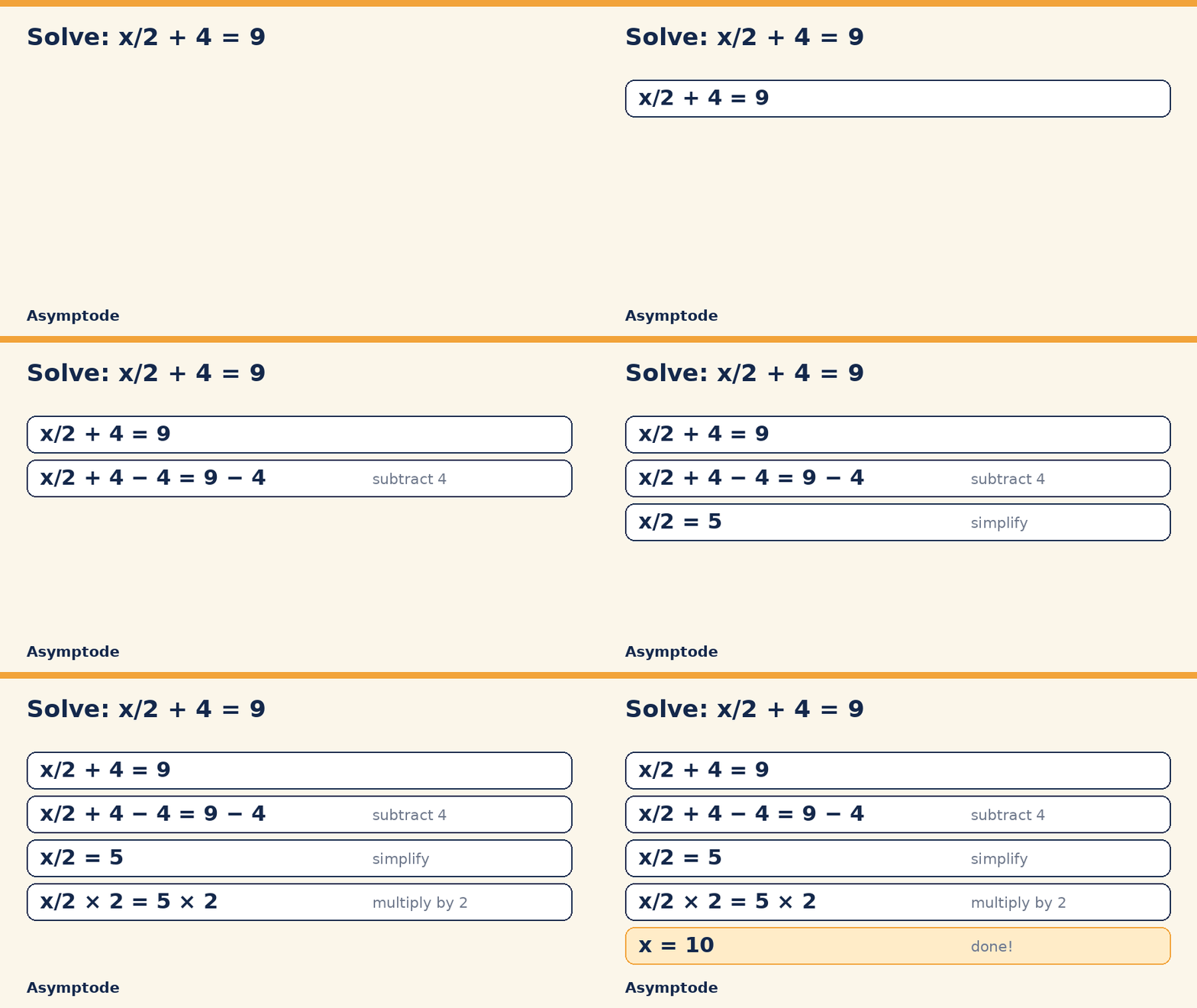
The key habit is checking the answer. Put the answer back in the equation. It takes ten seconds and catches many mistakes.
How can your child prepare for SAT Math?
Start with one honest question: where are the gaps? A short diagnostic test will show them. Then build a plan. Here is a simple four-week example. Change it to fit your child's date and level.
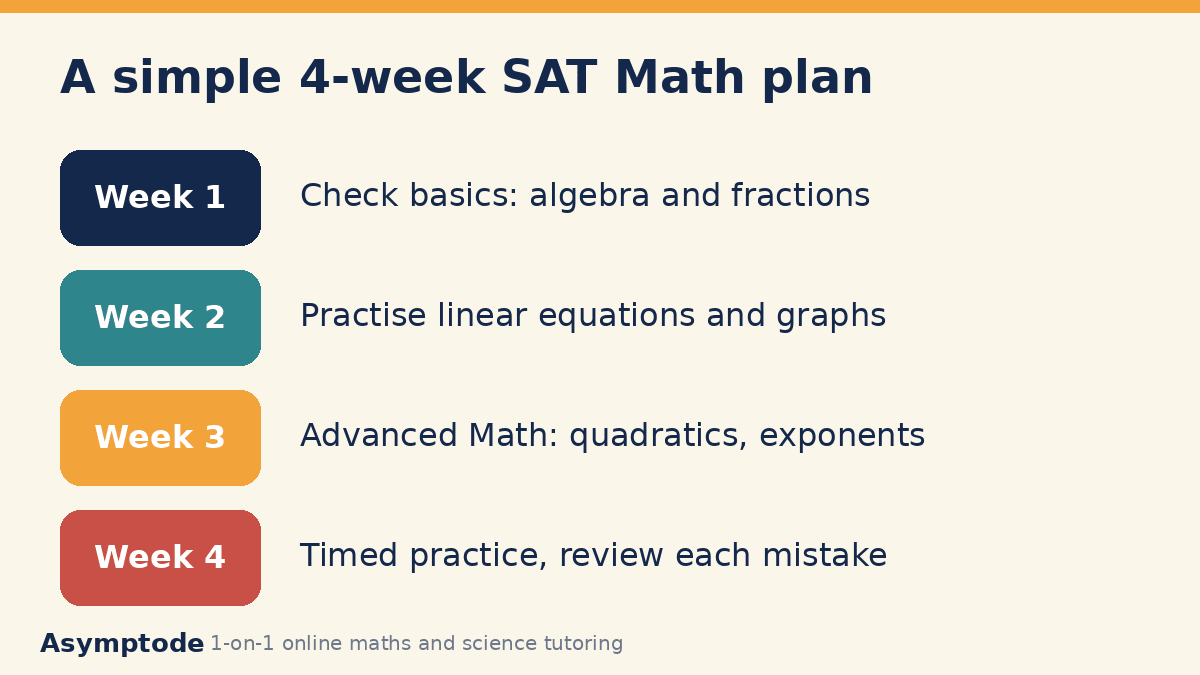
- Week 1: Check basics such as fractions, percentages and algebra rules.
- Week 2: Practise linear equations, inequalities and graphs.
- Week 3: Work on Advanced Math, such as quadratics and exponents. See our guide to solving quadratic equations.
- Week 4: Do timed practice. Review every mistake and write down why it happened.
Not sure how much practice is enough? Read how many SAT practice questions your child needs. For the full picture, see our SAT guide for parents.
When does 1-on-1 help?
Some students learn well from books and videos. Others get stuck and stay stuck. A tutor can see exactly where the thinking goes wrong.
At Asymptode, sessions are live, online and 1-on-1. Your child gets personalised homework with feedback. You can see their progress. We do not promise a score. We help your child understand each step.
Want to talk it through? Talk to an advisor or see our fees.
Common mistakes to avoid
- Skipping the check step.
- Rushing word problems and missing a key word like "at least".
- Practising only the topics they already like.
- Studying for hours once a week instead of 20 minutes most days.
- Not reviewing wrong answers.
How should students handle word problems?
Word problems scare many students. The maths is often easy. The reading is the hard part. Teach your child this four-step routine.
- Read it twice. The first time, get the story. The second time, circle the numbers and the question.
- Write what you know. Make a short list. For example: "price = $40, discount = 25%".
- Pick a plan. Ask: is this an equation, a percentage, a rate or a graph?
- Answer the real question. Many wrong answers are right numbers for the wrong question. Check the units too.
Here is a quick example. A shirt costs $40. It is 25% off. What is the sale price? A 25% discount means the student pays 75%. So 0.75 × 40 = 30. The sale price is $30. A student who stops at 25% of 40, which is 10, has answered a different question.
How long should your child study each week?
There is no magic number. Short and regular is best. Many students do well with 20 to 30 minutes on most days. That is better than three hours on a Sunday.
Here is a simple weekly rhythm you can try:
- Two days: learn or review one topic, with a few worked examples.
- Two days: mixed practice from all four areas.
- One day: review last week's mistakes.
- One day off. Rest helps memory.
Keep a small "mistake notebook". For each error, write the question, the right method and one line on why the mistake happened. Read it before every practice session. Over time, the same mistakes stop coming back.
What are signs your child needs extra help?
Practice alone is not always enough. Look for these signs:
- Scores stay flat after several weeks of practice.
- Your child can follow a solution but cannot start a new problem alone.
- They guess often and cannot explain their answer.
- They avoid maths homework or feel anxious before practice.
- The same type of error keeps coming back.
If you see two or three of these, it is a good time to get support. Early help is easier than last-minute help. A calm chat with your child's teacher is a good first step. A 1-on-1 tutor can then work on the exact gaps.
How can parents support without adding stress?
Your role is not to teach every topic. Your role is to make the routine easy.
- Set a fixed study time, even if it is short.
- Ask your child to explain one problem to you. You do not need to know the answer.
- Praise effort and good methods, not only scores.
- Keep practice tests rare and planned, so each one gives useful information.
Stress hurts thinking. A child who feels safe asking "I do not get this" learns faster than one who hides confusion.
FAQ
How many content areas are on the digital SAT Math section?
There are four: Algebra, Advanced Math, Problem-Solving and Data Analysis, and Geometry and Trigonometry.
Which area has the most questions?
Algebra and Advanced Math. The College Board lists 13 to 15 questions for each of them.
Are all SAT Math questions word problems?
No. The College Board says about 30% are set in a real-life context. The others are straight maths.
When should my child start preparing?
Many families start a few months before the test. Start earlier if there are gaps in basic algebra. Check the College Board site for current test dates.
Can a tutor help with SAT Math?
Yes. A tutor can find gaps, explain ideas in simple steps and give feedback on practice work. No tutor can guarantee a score.
Where do I find official SAT information?
On the College Board SAT Suite website. Always check it for the latest rules.