
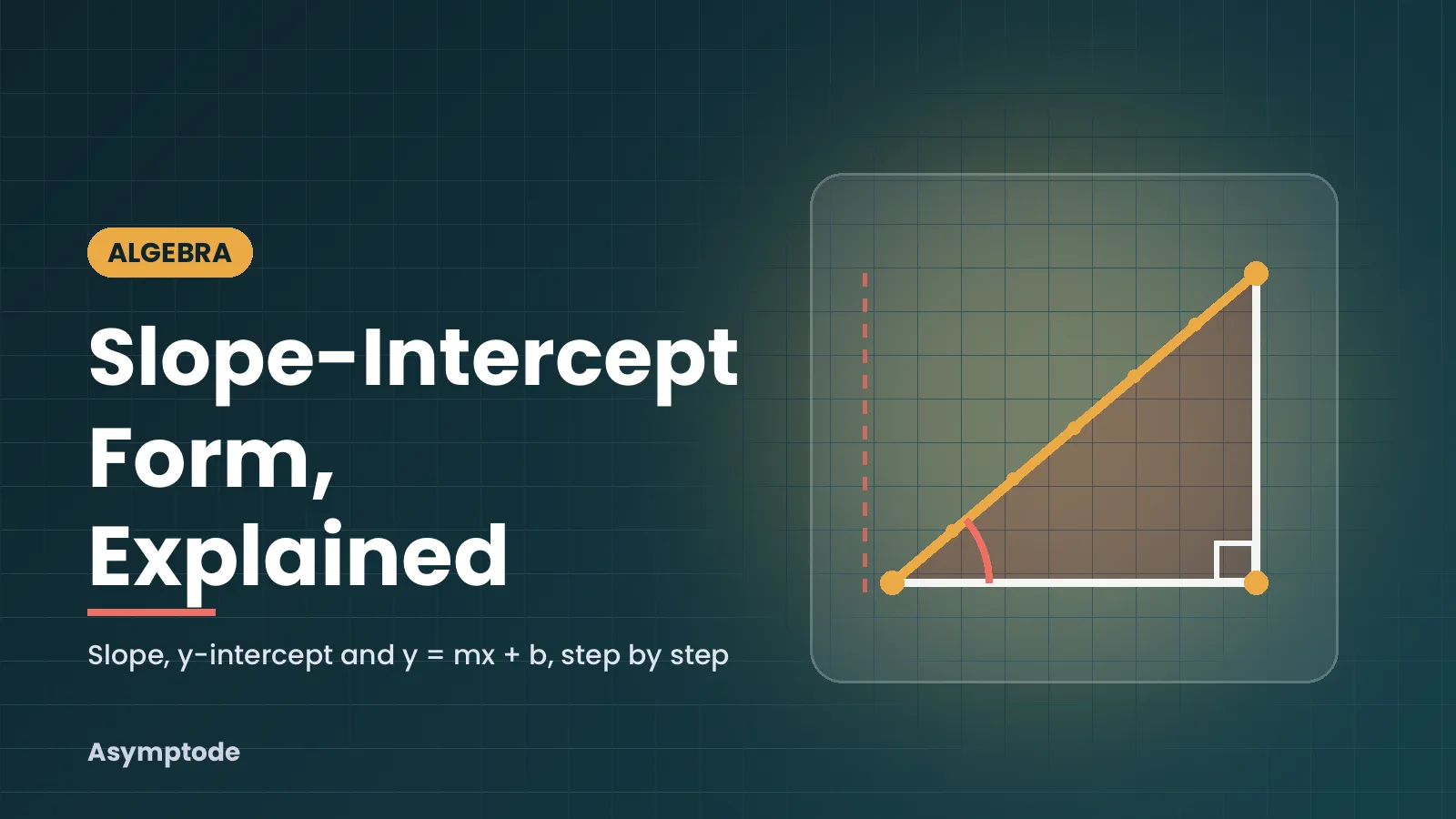
Slope-intercept form is the most common way to write the equation of a straight line: y = mx + b. The letter m is the slope, which tells you how steep the line is, and b is the y-intercept, which tells you where the line crosses the y-axis. This guide explains both ideas in plain words, shows how to graph and build a line step by step, and gives practice questions you can check yourself.
Key takeaways
- Slope-intercept form is y = mx + b, where m is the slope and b is the y-intercept.
- Slope is "rise over run": the change in y divided by the change in x between two points.
- To write a line from two points, find m first, then use one point to find b.
- Parallel lines have the same slope. Perpendicular lines have slopes that are negative reciprocals.
- The most common mistakes are mixing up rise and run, and losing a minus sign.
What is slope-intercept form?
Quick answer: Slope-intercept form writes a line as y = mx + b. The number m is the slope, how much y changes when x goes up by 1. The number b is the y-intercept, the value of y when x is 0. For y = 2x + 1, the slope is 2 and the line crosses the y-axis at 1.
In the United States, students meet this idea in Grade 8. The Common Core standard 8.EE.B.6 asks students to explain why the slope m is the same between any two points on a line, and to derive y = mx + b for a line that crosses the vertical axis at b, as published on the Common Core State Standards site. Not every state uses Common Core, so check your state's own standards for the exact wording.
What does slope mean?
Slope measures steepness. Pick two points on a line. The rise is how far you go up or down. The run is how far you go across. The slope is the rise divided by the run.
m = (y2 - y1) / (x2 - x1)
- A positive slope goes up as you move right.
- A negative slope goes down as you move right.
- A slope of 0 is a flat, horizontal line.
- A vertical line has no slope (it is "undefined"), and it cannot be written as y = mx + b.
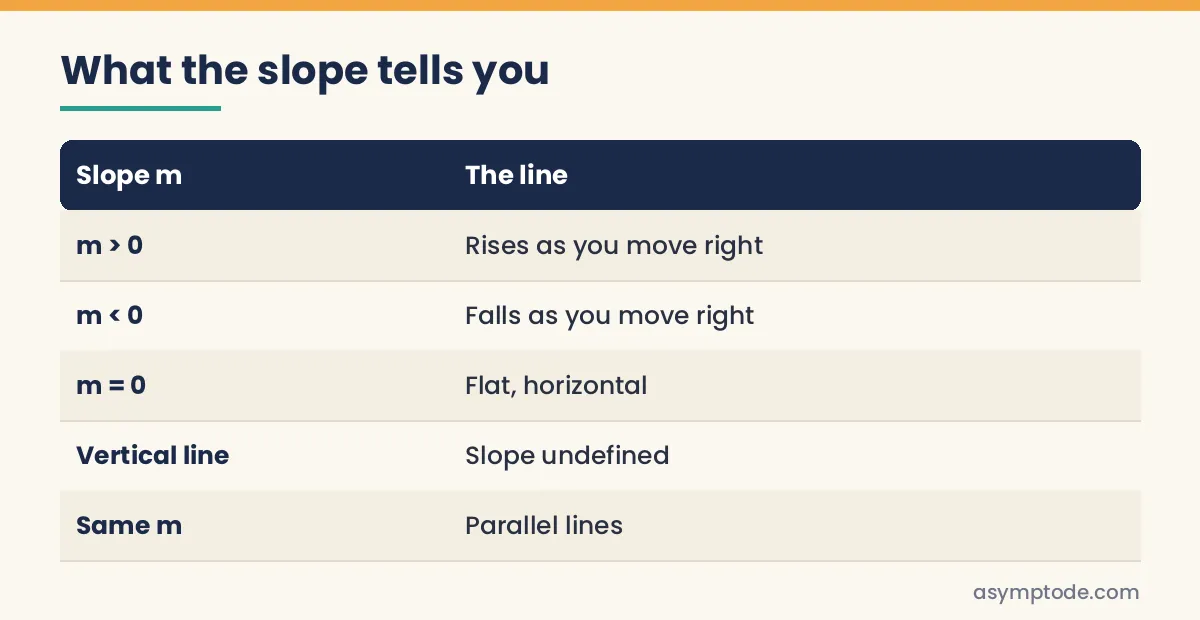 What the sign of the slope tells you about a line.
The table repeats the rule: m above 0 rises, m below 0 falls, m equal to 0 is flat, a vertical line has an undefined slope, and lines with the same m are parallel.
If a car travels 60 miles each hour, the graph of distance against time has slope 60. The slope is the rate of change.
How do you graph y = mx + b step by step?
- Find b. Mark the point (0, b) on the y-axis.
- Read m as a fraction. For m = 2, think 2/1: rise 2, run 1. For m = -3/2, rise -3, run 2.
- Move from (0, b). Go up or down by the rise, then right by the run, and mark the new point.
- Draw the line through the points and extend it in both directions.
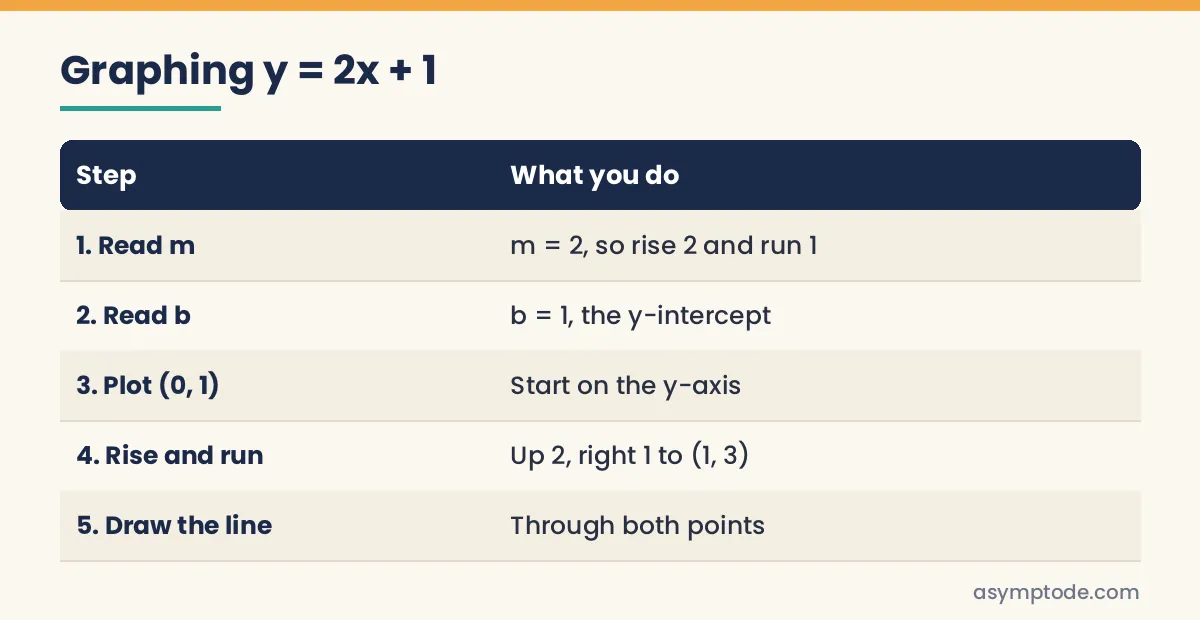 Reading the slope and y-intercept of y = 2x + 1, one step at a time.
For y = 2x + 1: the y-intercept is 1, so start at (0, 1). The slope is 2, which is 2/1, so go up 2 and right 1 to reach (1, 3). Draw the line through both points. The table above lists the same five steps: read m, read b, plot (0, 1), rise 2 and run 1, then draw the line.
How do you write the equation of a line from two points?
Say a line passes through (1, 3) and (4, 9).
- Find the slope. m = (9 - 3) / (4 - 1) = 6 / 3 = 2.
- Put m into y = mx + b. Now you have y = 2x + b.
- Use one point to find b. Use (1, 3): 3 = 2(1) + b, so b = 1.
- Write the equation. y = 2x + 1.
- Check with the other point. For x = 4, y = 2(4) + 1 = 9. It matches.
 Finding the equation of the line through (1, 3) and (4, 9).
The animation shows the same four steps in order: m = (9 - 3) / (4 - 1) = 2, then y = 2x + b, then 3 = 2(1) + b so b = 1, and finally y = 2x + 1.
Book a free demo class if your child finds this step hard. A mentor can watch each line of working as it is written.
How do you change an equation into slope-intercept form?
Solve for y. Move everything except y to the other side, then divide.
Example: change 3x + 2y = 12 into y = mx + b.
- Subtract 3x from both sides: 2y = -3x + 12.
- Divide every term by 2: y = -3/2 x + 6.
The slope is -3/2 and the y-intercept is 6. The most common slip is dividing only one term by 2. Divide every term.
What is point-slope form, and when should you use it?
Point-slope form is y - y1 = m(x - x1). Use it when you know the slope and one point that is not on the y-axis.
Example: slope 3 through (2, 5).
- y - 5 = 3(x - 2)
- y - 5 = 3x - 6
- y = 3x - 1
Both forms describe the same line. Slope-intercept form is best for graphing. Point-slope form is quick for building an equation.
How are parallel and perpendicular lines related to slope?
- Parallel lines have the same slope. The lines y = 2x + 5 and y = 2x - 4 never meet.
- Perpendicular lines meet at a right angle. Their slopes are negative reciprocals: flip the fraction and change the sign. A line with slope 2 has perpendicular slope -1/2. A line with slope -3/4 has perpendicular slope 4/3.
Where does slope-intercept form appear in school and tests?
- Grade 8 and Algebra 1 (US): graphing lines and writing equations, tied to Common Core 8.EE.B.5 and 8.EE.B.6.
- SAT: the College Board lists Algebra as one of the four content areas on the SAT Math section, and linear equations and graphs sit inside it. See our digital SAT Math guide and the PSAT 8/9 guide.
- Later courses: the idea of slope as a rate of change leads to the derivative in calculus. See differentiation explained and the AP Precalculus guide.
- Ontario (Canada): linear relations are taught in Grade 9. See the Ontario Grade 9 math guide.
If variables still feel new, start with understanding variables. Once lines are comfortable, try solving quadratic equations and the Pythagorean theorem, which uses the same coordinate grid.
What are the most common mistakes with slope?
- Swapping rise and run. Slope is rise over run, not run over rise.
- Subtracting in different orders. Use (y2 - y1) / (x2 - x1) with both subtractions in the same order.
- Losing a minus sign when moving terms across the equals sign.
- Reading b from the wrong spot. The y-intercept is where x = 0, not where y = 0.
- Forgetting to check. Put a known point back into the equation. It takes ten seconds.
Practice questions with answers
- What are the slope and y-intercept of y = -4x + 7?
- Write the equation of the line through (0, 2) and (3, 8).
- Write 2x + y = 6 in slope-intercept form.
- Write the line with slope -3 through (1, 4).
- Is the point (2, 9) on the line y = 4x + 1?
- What slope is perpendicular to a line with slope 2?
Answers
- Slope -4, y-intercept 7.
- m = (8 - 2) / (3 - 0) = 2, and b = 2 (the line crosses at x = 0), so y = 2x + 2.
- Subtract 2x: y = -2x + 6.
- y - 4 = -3(x - 1), so y - 4 = -3x + 3, so y = -3x + 7.
- 4(2) + 1 = 9. Yes, the point is on the line.
- -1/2.
How to get better at linear equations
- Sketch every line, even roughly. A picture shows if your slope should be positive or negative.
- Practise changing between forms until it feels automatic.
- Check answers by putting a point back into the equation.
- Link each equation to a real rate, such as miles per hour or dollars per month.
How Asymptode Can Help You Prepare for Slope-Intercept Form
Linear equations are the first big algebra idea, and a shaky start shows up again in quadratics, systems of equations and calculus. At Asymptode, your child has live, one-to-one online classes with a mentor who teaches maths at your child's grade, following their own school course and test dates. The mentor watches each line of working, so a swapped rise and run or a lost minus sign is caught on the spot.
Between classes, your child gets AI-assisted practice built from what their own last attempt showed they had not yet understood, written to the mentor's brief and sent only after the mentor approves it. The AI supports the mentor; it never teaches or replaces the mentor. The mentor marks the work, and in the parent dashboard you can see what was understood and what to practise next.
Every class is recorded, so a tricky explanation can be rewatched. Book a free demo class or see our plans and fees.
Facts checked against official sources on 19 November 2026.
FAQ
What is slope-intercept form in simple terms?
It is the equation y = mx + b. The number m tells you how steep the line is, and b tells you where the line crosses the y-axis.
How do you find the slope of a line?
Pick two points and divide the change in y by the change in x: m = (y2 - y1) / (x2 - x1). Subtract in the same order on the top and the bottom.
How do you find the y-intercept?
Put x = 0 into the equation. For y = 2x + 1, y = 1 when x = 0. If you only have a point and the slope, put the point into y = mx + b and solve for b.
What is the difference between slope-intercept form and point-slope form?
Slope-intercept form is y = mx + b and shows the y-intercept straight away. Point-slope form is y - y1 = m(x - x1) and is quick when you know the slope and any one point. They describe the same line.
Why can a vertical line not be written as y = mx + b?
A vertical line has the same x-value for every point, so the run is 0. Dividing by 0 is not possible, so its slope is undefined. It is written as x = a number.
Is slope-intercept form on the SAT?
The College Board lists Algebra as a content area on the SAT Math section, and linear equations and their graphs are part of algebra. Check the College Board's official pages for the full list of skills.
Ready to start? Book a free demo class and advisor call, or see our plans and fees.