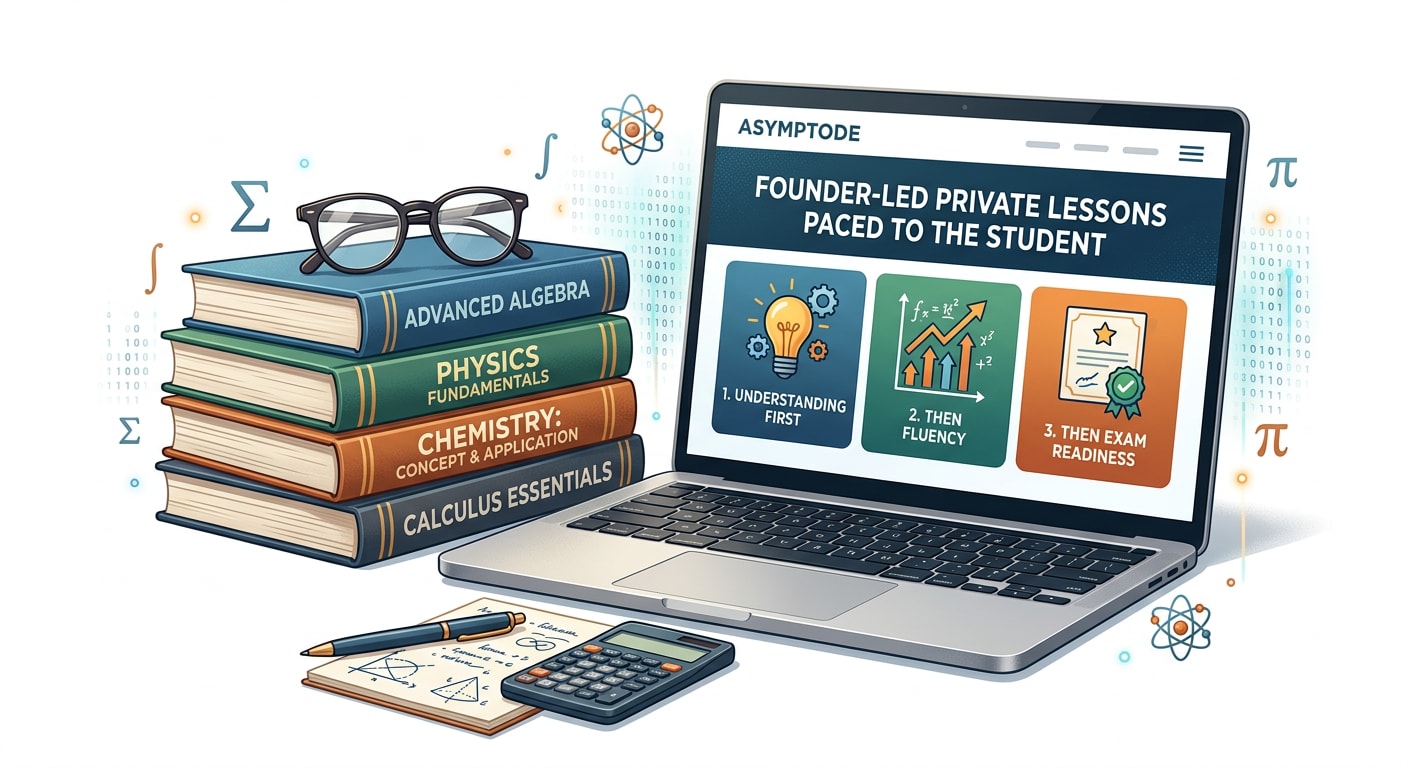
Math & Science courses

Mentorship organised by learning stage

Private math and science mentorship that adapts to each student's stage, learning rhythm, and academic goals—from confidence-building foundations to high-school depth and exam readiness.

Each stage outlines topics, who it suits, what tends to feel hard, and what strengthens with consistent one-on-one work.

New families usually begin with a calm conversation on the book demo page. For teaching philosophy, see About; for scheduling and payments, see the FAQ.

Learning stages

Stage 1

Foundations & confidence

Patient pacing for younger learners—rebuilding number sense, reducing avoidance, and making routine work feel manageable.

Grades 7–8

Pre-algebra & early algebra

Ratios, expressions, and linear relationships—paced so reasoning stays clear before high-school speed picks up.

Book demo

Topics we emphasize

  • Rational numbers, ratios, and proportional reasoning
  • Expressions, equations, and early linear models
  • Introductory geometry, measurement, and basic statistics
  • Word problems and multi-step reasoning

Learning goals

  • Clearer step-by-step habits on homework
  • Stronger number sense before formal algebra
  • Less avoidance when a problem looks unfamiliar

Best fit for

  • Families wanting school-aligned support with room to slow down
  • Students whose grades swing when topics change quickly
  • Parents who want early gaps addressed before high school

Common struggles

  • Rushing through procedures without understanding why they work
  • Word problems that feel disconnected from class examples
  • Fraction and ratio intuition that never quite solidified

What improves over time

  • Explaining reasoning in complete sentences, not only answers
  • Checking work with a simple structure instead of guessing
  • A calmer weekly rhythm around homework and quizzes

Pace and fit

Foundational—confidence first, then fluency

Students entering algebra-heavy years, switching schools, or needing steadier explanations than a crowded classroom allows.

Stage 2

Middle-school transitions

The shift into formal algebra and proof. Slower explanations where it matters, then steadier practice as fluency returns.

Algebra I

Algebra I

Linear and quadratic foundations, functions, and modeling—aligned to your course sequence so skills transfer to tests, not just worksheets.

Book demo

Topics we emphasize

  • Linear equations, inequalities, and systems
  • Quadratics: factoring, graphs, and meaning of roots
  • Functions: notation, domain and range, transformations
  • Exponents, polynomials, and introductory rational expressions

Learning goals

  • Fewer sign errors and manipulation slips
  • Ability to read a problem and choose a sensible first step
  • Stronger performance on chapter tests and cumulative exams

Best fit for

  • Students who passed earlier grades but feel shaky when symbols stack up
  • Families preparing for geometry or Algebra II next year
  • Learners who need method-first explanations, not memorised shortcuts

Common struggles

  • Mixing up rules across chapters when everything looks similar
  • Graphing and algebraic forms feeling like separate subjects
  • Timed tests exposing gaps that homework hid

What improves over time

  • A personal checklist for starting linear vs quadratic problems
  • Cleaner written work that is easier to review before submitting
  • More stable marks when units combine on midterms

Pace and fit

Core high-school algebra—steady practice with clear feedback

Students building the language of algebra before geometry or Algebra II, including honors tracks where pace is demanding.

High school geometry

Geometry

Proofs, constructions, coordinate geometry, and trigonometry basics—so spatial reasoning and logical structure both grow.

Book demo

Topics we emphasize

  • Deductive reasoning, definitions, and proof writing
  • Triangles, circles, similarity, and right-triangle trigonometry
  • Coordinate geometry and transformations
  • Area, volume, and modeling problems

Learning goals

  • Less fear of “show your reasoning” questions
  • Better diagrams and labels that unlock harder problems
  • Stronger preparation for trigonometry and precalculus

Best fit for

  • Learners who think in sketches but need help turning ideas into words
  • Students aiming for STEM tracks where geometry feeds later courses
  • Anyone whose exam papers lose marks on justification, not arithmetic

Common struggles

  • Knowing a fact but not how to use it in a proof sequence
  • Skipping steps that teachers expect to be explicit
  • Coordinate and synthetic approaches feeling unrelated

What improves over time

  • A small library of standard proof patterns to recognise
  • Neater figures and variable choices that reduce confusion
  • More confidence on cumulative geometry finals

Pace and fit

Visual and logical together—often a mindset shift from algebra-only work

Students whose course emphasizes proofs, constructions, or integrated pathways.

Stage 3

High-school mathematics

Functions, trigonometry, and pre-calculus depth—aligned to the school course, with room to repair earlier gaps without panic.

Algebra II · precalculus

Algebra II & precalculus

Advanced functions, logarithms, sequences, and trigonometry—structured so juniors and seniors stay ready for calculus or rigorous college math.

Book demo

Topics we emphasize

  • Polynomial and rational functions, end behavior, and graphs
  • Exponentials, logarithms, and modeling
  • Trigonometric identities, equations, and the unit circle
  • Sequences, series, and polar or parametric introductions where applicable

Learning goals

  • Faster, calmer navigation of long multi-topic assessments
  • Algebraic fluency that supports calculus notation
  • Better use of a graphing tool when the syllabus allows it

Best fit for

  • Families who want precalculus to feel like preparation, not panic
  • Students repeating a unit or rebuilding after a difficult semester
  • Anyone balancing school math with early exam preparation

Common struggles

  • Trig identities feeling arbitrary instead of structured
  • Log rules and exponential models mixing together under pressure
  • Long review packets with no sense of priority

What improves over time

  • Topic-level confidence maps so revision is intentional
  • Fewer “I forgot this chapter existed” surprises before finals
  • Smoother transition into calculus language and pace

Pace and fit

Upper high school—multi-step problems and tighter time expectations

Students targeting AP Calculus, strong SAT or ACT math scores, or provincial diploma exams that pull from these strands.

Stage 4

Advanced pathways & exam preparation

Calculus, AP courses, and college-entrance exams—built around consistency, not cramming, with honest pacing for each student.

Calculus · AP Calculus AB/BC

Calculus & AP Calculus AB/BC

Limits, derivatives, integrals, and applications—taught with attention to definitions and exam form so understanding survives pressure.

Book demo

Topics we emphasize

  • Limits, continuity, and differentiation rules with meaning
  • Applications: motion, related rates, optimization, and curve analysis
  • Integration techniques and the Fundamental Theorem
  • AP-style free response and multiple choice habits (where relevant)

Learning goals

  • Cleaner setup on applied problems before differentiating or integrating
  • Stronger free-response habits: units, justification, and structure
  • Exam practice that builds judgment, not only speed

Best fit for

  • Students who can commit to consistent problem sets between sessions
  • Families who want AP Calculus mentorship without batch review centers
  • Learners who prefer definitions-first explanations

Common struggles

  • Recognising which tool applies in mixed review sections
  • Free-response rubrics that reward communication, not only answers
  • Time pressure on non-calculator sections

What improves over time

  • A personal error log that turns repeats into prevention
  • More stable mock scores as weeks stay predictable
  • Calm confidence walking into the exam window

Pace and fit

College-level pace on a high-school calendar—selective about fit and workload

Students in AP Calculus AB or BC, IB-related calculus strands, or introductory college calculus who want depth without chaos.

SAT · ACT

SAT Math & ACT Math

Content review, accuracy drills, and timing strategy—built around your target band and the school math you're already doing.

Book demo

Topics we emphasize

  • Heart of algebra, problem solving, and passport to advanced math (SAT)
  • ACT Math pacing across pre-algebra through early precalculus
  • Data analysis, graphs, and careful reading of question stems
  • Calculator discipline and when mental math saves time

Learning goals

  • Fewer careless losses on medium questions
  • A pacing plan that matches your target and stamina
  • Clearer priorities between content gaps and test-skill gaps

Best fit for

  • Juniors and seniors with a test date and a realistic weekly commitment
  • Students who already have classroom math support but need exam craft
  • Families who prefer a private mentor over a noisy prep hall

Common struggles

  • Running out of time on the second half of the paper
  • Misreading constraints or skipping “except” clauses
  • Inconsistent practice between official mocks

What improves over time

  • Predictable warm-up and review routines before official sittings
  • Higher accuracy on questions you “should” get every time
  • Less anxiety from knowing exactly what a session will target

Pace and fit

Exam-specific—sessions stay focused, not endless problem dumps

Students sitting college-entrance exams who want one-on-one diagnosis of mistake patterns.

AP Statistics

AP Statistics

Design, probability, inference, and communication-heavy free response—aligned to College Board expectations with careful reading practice.

Book demo

Topics we emphasize

  • Exploring data: distributions, comparisons, and association
  • Study design, random variables, and probability models
  • Sampling distributions and confidence intervals
  • Significance tests and clear written conclusions

Learning goals

  • Templates for conclusions that match rubric language
  • Stronger calculator fluency where the course expects it
  • Better intuition for when a method is valid vs forced

Best fit for

  • Learners who are comfortable reading and writing in math class
  • Families seeking AP Statistics support alongside school homework
  • Students pairing stats with calculus or science-heavy schedules

Common struggles

  • Knowing the formula but not the conditions for inference
  • Losing marks on communication even when computations are fine
  • Keeping vocabulary straight across many similar procedures

What improves over time

  • Shorter, clearer FRQ drafts under time limits
  • A checklist for conditions and conclusions before moving on
  • More stable unit-test performance as the course accelerates

Pace and fit

Interpretation-heavy—rewarded for language and structure, not only numbers

Students who can handle wordy questions and want honest pacing on FRQ work.

AMC-style · enrichment

Contest foundations (selective)

Pattern-rich problems and reflective review—for students with strong school foundations who can sustain extra independent work.

Book demo

Topics we emphasize

  • Strategies for counting, divisibility, and clever algebra
  • Timed sets with careful post-mortem, not only scoring
  • Bridging contest insight back to school exams so neither suffers

Learning goals

  • Sharper intuition under time limits
  • Better organisation of scratch work during mocks
  • Healthier balance between contest stretch and classroom priorities

Best fit for

  • Students who ask for harder problems but need structure around review
  • Families preparing for selective pathways without abandoning school marks

Common struggles

  • Chasing tricks instead of building repeatable methods
  • Burnout when contest prep ignores sleep and school load

What improves over time

  • A sustainable weekly loop: mock, log errors, reteach, retry
  • Honest awareness of which topics deserve the next hour

Pace and fit

High focus—offered only when school math is already stable

Serious students with parent support for homework volume and honest scheduling.

Fees depend on stage, intensity, and goals—see the fees page for typical ranges, or return to the homepage.