

AP Precalculus is one of the newest AP courses. It is a good bridge to calculus, and the exam rewards clear algebra skills more than tricks. This guide explains the May 2027 exam format, what is tested, how to prepare, and where students usually lose points.
Key takeaways
- The May 2027 AP Precalculus Exam is on Monday, May 11, 2027.
- It has 42 multiple-choice questions and 4 free-response questions.
- Only Units 1, 2 and 3 are tested. Unit 4 is taught but not on the exam.
- About two-thirds of the multiple-choice score is no-calculator, so hand skills matter.
- Steady weekly practice, with timed no-calculator sets, works better than last-minute cramming.
What is on the AP Precalculus exam?
Quick answer: The AP Precalculus Exam tests functions: polynomial and rational functions, exponential and logarithmic functions, and trigonometric and polar functions. It has 42 multiple-choice questions and 4 free-response questions. Some parts allow a graphing calculator and some do not.
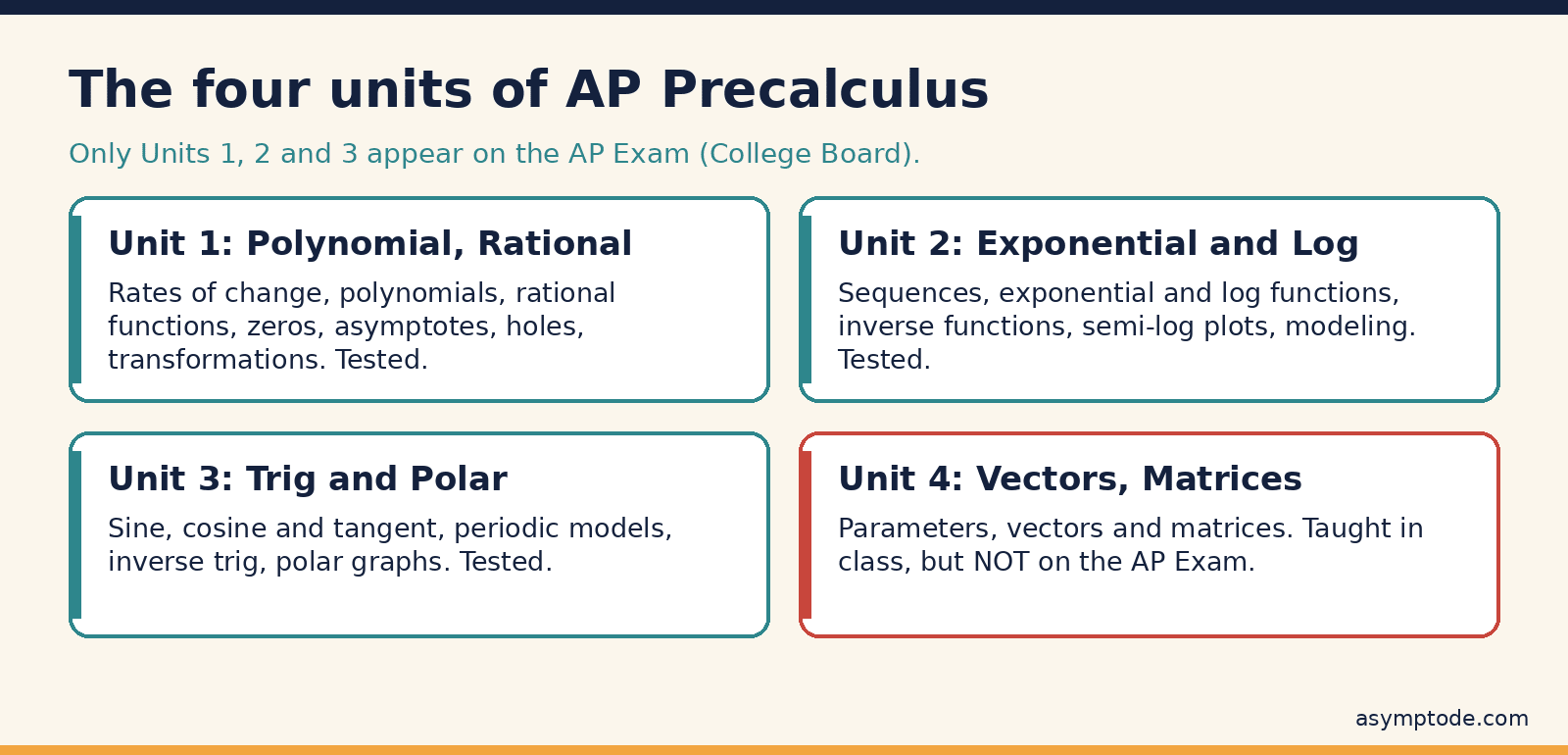
The course has four units. College Board says only the first three units are on the AP Exam. Schools still teach Unit 4, and it helps in later maths classes.
| Unit | Main ideas | On the AP Exam? |
|---|---|---|
| 1. Polynomial and Rational Functions | Rates of change, zeros, end behavior, asymptotes, holes, transformations | Yes |
| 2. Exponential and Logarithmic Functions | Sequences, exponential models, logs, inverse functions, semi-log plots | Yes |
| 3. Trigonometric and Polar Functions | Sine, cosine, tangent, periodic models, inverse trig, polar graphs | Yes |
| 4. Functions Involving Parameters, Vectors, and Matrices | Parametric functions, vectors, matrices | No |
A big idea runs through the whole course: modeling. Students look at data or a real situation and choose the right type of function for it. Is it linear, quadratic, exponential or periodic? Then they build the model and use it.
What is the AP Precalculus exam format for 2027?
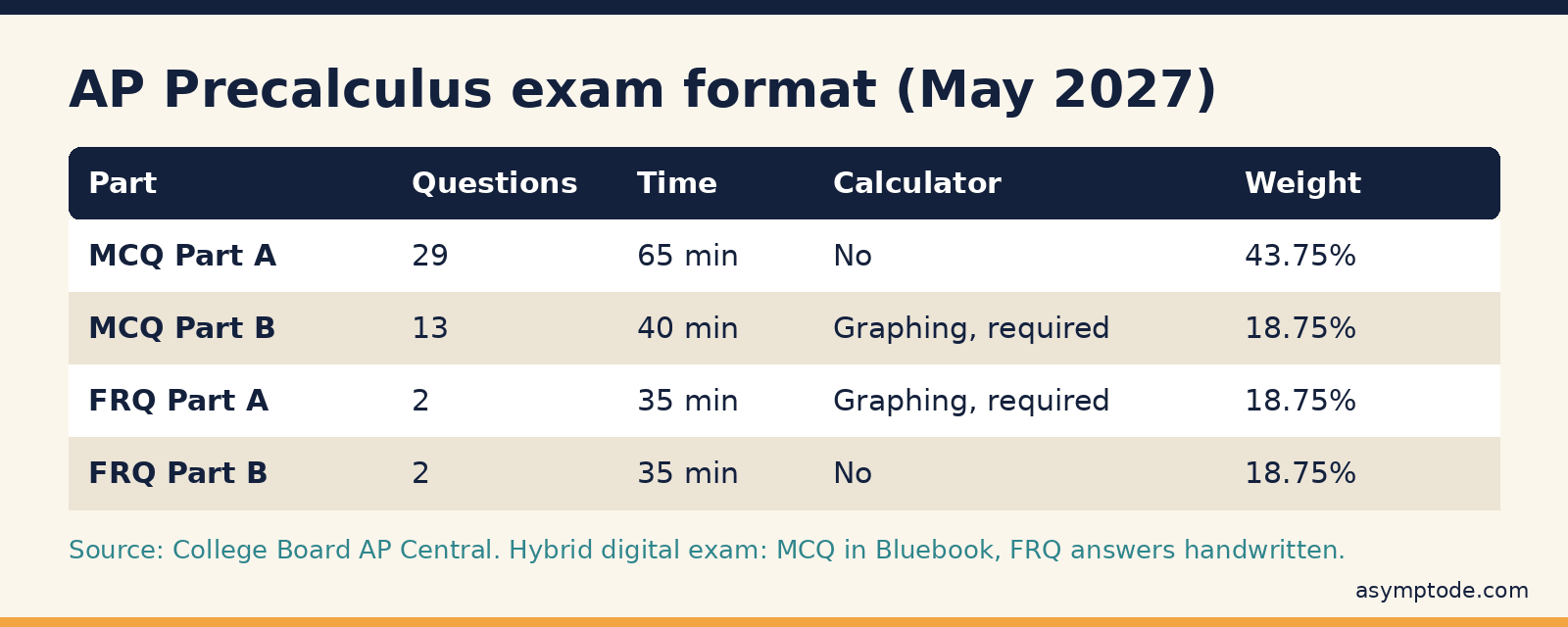
Quick answer: Section I has 42 multiple-choice questions in 1 hour 45 minutes (62.5% of the score). Section II has 4 free-response questions in 1 hour 10 minutes (37.5%). Each section has a no-calculator part and a graphing-calculator part.
| Part | Questions | Time | Calculator | Share of score |
|---|---|---|---|---|
| Section I, Part A | 29 multiple choice | 65 min | Not allowed | 43.75% |
| Section I, Part B | 13 multiple choice | 40 min | Graphing calculator required | 18.75% |
| Section II, Part A | 2 free response | 35 min | Graphing calculator required | 18.75% |
| Section II, Part B | 2 free response | 35 min | Not allowed | 18.75% |
The exam is a hybrid digital exam. Students answer multiple-choice questions in the Bluebook app. They read the free-response questions in Bluebook, but write their answers by hand in a paper booklet.
College Board updated the number of multiple-choice questions and the timing for the May 2027 exam. If your child is using an older review book, check the format against AP Central before they do timed practice.
What are the four free-response questions?
The free-response questions follow a set pattern:
- Function Concepts (calculator)
- Modeling a Non-Periodic Context (calculator)
- Modeling a Periodic Context (no calculator)
- Symbolic Manipulations (no calculator)
Because the pattern is known, students can practise each type on purpose. College Board posts past free-response questions with scoring guidelines on AP Central. These are the best practice material there is.
How is AP Precalculus scored?
Scores go from 1 to 5. Many colleges give credit or placement for a 3 or higher, but each college sets its own rules. Use College Board's AP Credit Policy Search to check the colleges on your child's list.
Which skills matter most on the exam?
There are no surprises in this course. The same core skills appear again and again. Here are four worked examples, one for each big skill.
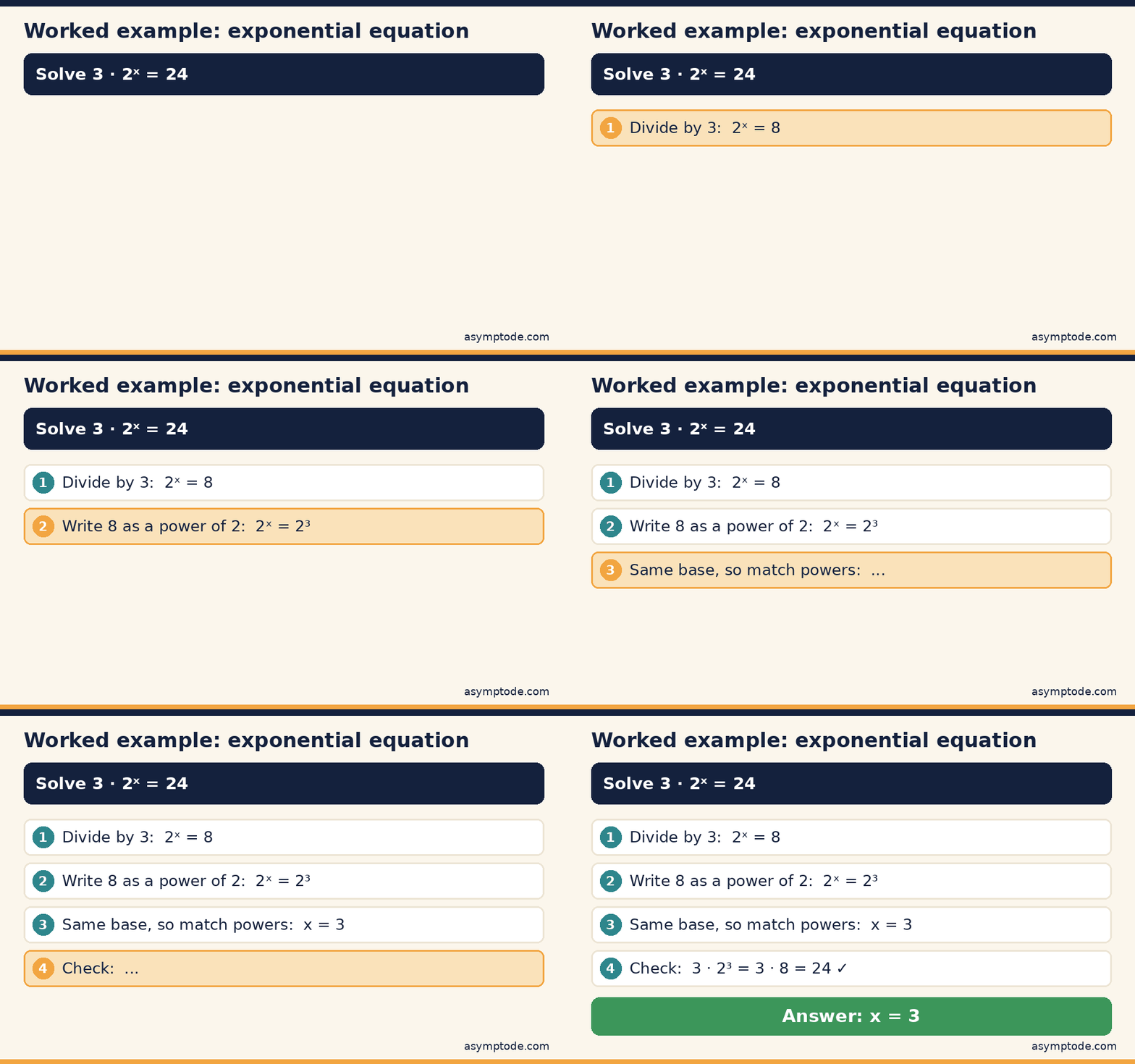
Worked example 1: solve an exponential equation (no calculator)
Solve 3 · 2ˣ = 24.
- Divide both sides by 3: 2ˣ = 8.
- Write 8 as a power of 2: 2ˣ = 2³.
- The bases match, so the powers match: x = 3.
- Check: 3 · 2³ = 3 · 8 = 24. Correct.
Worked example 2: solve a log equation
Solve log₂(x) + log₂(x − 2) = 3.
- Use the product rule: log₂(x(x − 2)) = 3.
- Rewrite in exponential form: x(x − 2) = 2³ = 8.
- Expand: x² − 2x − 8 = 0.
- Factor: (x − 4)(x + 2) = 0, so x = 4 or x = −2.
- Check the domain. You cannot take the log of a negative number, so x = −2 does not work. x = 4.
Step 5 is where many students lose a point. Always check that each answer fits the domain.
Worked example 3: find a hole in a rational function
Where is the hole in f(x) = (x − 2)(x + 3) / (x − 2)?
- The factor (x − 2) is on the top and the bottom.
- Cancel it: f(x) = x + 3, but only for x ≠ 2.
- Put x = 2 into the simplified function: 2 + 3 = 5.
- The graph has a hole at (2, 5), not a vertical asymptote.
Worked example 4: read a sinusoidal function
For f(θ) = 4 sin(3θ) + 1, find the amplitude, period, midline and range.
- Amplitude = 4 (the number in front of sin).
- Period = 2π ÷ 3 = 2π/3.
- Midline: y = 1 (the number added at the end).
- Range: 1 − 4 to 1 + 4, so −3 ≤ f(θ) ≤ 5.
Free-response Question 3 often asks students to build a model like this from a story, such as a Ferris wheel or tide heights. Practise going both ways: from equation to graph, and from graph or story to equation.
How should my child prepare for AP Precalculus?
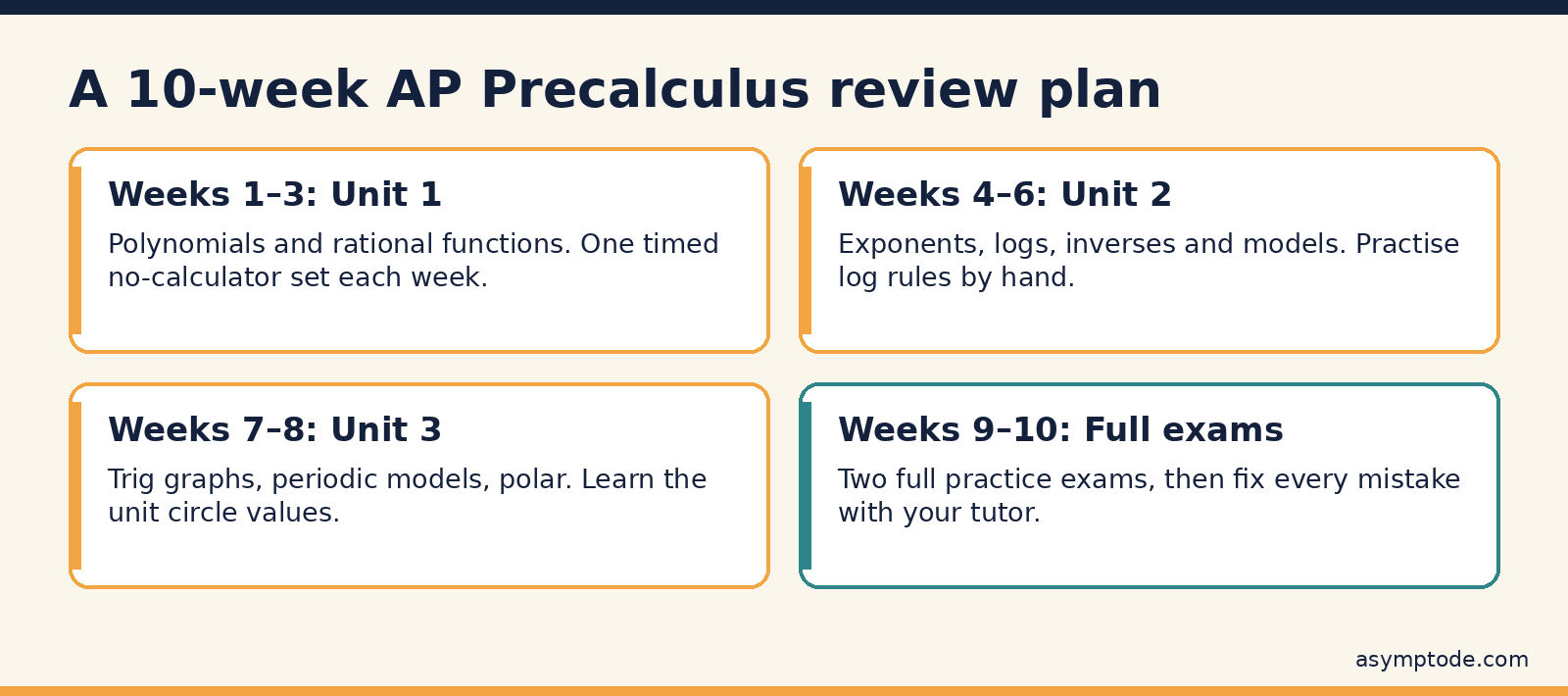
Quick answer: Start review about 10 weeks before the exam. Spend about three weeks on each tested unit, then two weeks on full timed practice exams. Do one no-calculator set every week, and check every wrong answer.
Here is a simple plan that works alongside normal schoolwork:
| Weeks | Focus | Weekly practice |
|---|---|---|
| 1–3 | Unit 1: polynomial and rational functions | 1 timed no-calculator set, 1 free-response question |
| 4–6 | Unit 2: exponential and log functions | Log rules by hand, 1 modeling question |
| 7–8 | Unit 3: trig and polar functions | Unit circle values, 1 periodic modeling question |
| 9–10 | Full practice exams | 2 full timed exams, then fix every mistake |
A few habits make a big difference:
- Learn the unit circle by heart. Part A has no calculator, so values like sin(π/6) = 1/2 must be quick.
- Write every step on free-response. Scorers give points for correct work, not just the final answer.
- Use the calculator for the right jobs. In calculator parts, use it to graph, find intersections and run regressions, not for simple arithmetic.
- Keep an error log. Write down each mistake, why it happened and the correct method. Review it each week.
If your child is also thinking about calculus next year, read our AP Calculus AB vs BC guide. For the full picture of AP courses, see our complete AP guide for parents.
What are the most common AP Precalculus mistakes?
- Forgetting domain checks. Log equations and rational functions often give an extra answer that does not work.
- Mixing up holes and asymptotes. A factor that cancels gives a hole. A factor left on the bottom gives a vertical asymptote.
- Wrong period for trig functions. For sin(bθ), the period is 2π ÷ b, not 2π × b.
- Weak log rules. log(a + b) is not log(a) + log(b). Only log(ab) = log(a) + log(b).
- Leaning on the calculator. Students who rely on a calculator in class often slow down badly in the no-calculator parts.
- Not explaining in context. Modeling questions ask what a number means in the story. "The rate is 3" loses points. "The water level rises 3 cm per hour" earns them.
How 1-on-1 tutoring helps with AP Precalculus
AP Precalculus is a skills course. Small gaps from Algebra 1 and Algebra 2, like factoring or exponent rules, show up again and again. In a class of 30, these gaps are easy to miss.
At Asymptode, each student has one dedicated mentor in live 1-on-1 online lessons. Here is how that works for AP Precalculus:
- The mentor watches the working, not just the answer. If a student keeps losing marks on log equations, the mentor finds the real cause, often a weak exponent rule, and fixes that first.
- Lessons follow your child's school course and exam date. The mentor plans backwards from May 11, 2027.
- Personalised homework. Practice sets match the units your child is studying, and the mentor reviews them before the next lesson.
- Free-response practice with feedback. Students write full answers, and the mentor shows where points are earned or lost.
- Parents stay informed. You get regular updates on what improved and what still needs practice.
- Every class is recorded, so your child can rewatch a tricky explanation before a test.
Want to see if it is a good fit? Book a free demo class or check our fees.
FAQ
Is AP Precalculus hard?
It is challenging but fair. Students with solid Algebra 2 skills usually do well. The hardest parts for most students are logs, trig modeling and the no-calculator sections.
Is Unit 4 on the AP Precalculus exam?
No. College Board says Unit 4 (functions involving parameters, vectors and matrices) is not assessed on the AP Exam. Schools still teach it.
When is the 2027 AP Precalculus exam?
The exam is on Monday, May 11, 2027. Check AP Central or ask your school's AP coordinator for the start time.
Can I use a calculator on the AP Precalculus exam?
Only in some parts. A graphing calculator is required in Section I Part B and Section II Part A. Calculators are not allowed in Section I Part A or Section II Part B.
Should my child take AP Precalculus or go straight to calculus?
It depends on how strong their algebra and trig are. If those skills are shaky, AP Precalculus builds a solid base for AP Calculus. A short assessment with a teacher or tutor can help you decide.
How long should my child study for AP Precalculus?
Most students do best with steady practice through the school year, plus about 10 weeks of focused review before the exam.
Ready to plan your child's year? Talk to an Asymptode advisor for a free demo class, or see our fees.