
The AP Environmental Science exam is a three-hour digital exam on how ecosystems, resources, pollution and climate fit together. The 2027 exam is on Thursday, May 13. This guide covers who takes it, the format, the nine units, how to register and a calm plan to prepare.
Key takeaways
- The AP Environmental Science exam is on Thursday, May 13, 2027 (Session 2), in the Bluebook app.
- It has 80 multiple-choice questions (90 minutes, 60%) and 3 free-response questions (70 minutes, 40%).
- Calculators are allowed.
- College Board recommends two years of lab science and one year of algebra first.
- Your school's AP coordinator orders the exam. The final ordering deadline, November 13, 2026, has passed.
What is the AP Environmental Science exam?
Quick answer: AP Environmental Science (often called APES) is a college-level course and exam from the College Board. College Board says it matches a one-semester introductory college course in environmental science. Students learn to use the tools of science, such as data, models and calculations, to study problems like pollution, energy and climate change.
It is taken in high school, usually in Grade 10, 11 or 12. Whether a college gives credit for a score is each college's decision, so check the College Board's AP Credit Policy Search for the colleges on your list.
Who can take it, and what should you know first?
AP exams are taken through a school or an authorised testing centre. Your school's AP coordinator tells you when and where. College Board's recommended preparation is two years of high school laboratory science, including life science and physical science, and at least one year of algebra.
That is good news for families planning early. A child who is steady in Grade 8 and 9 science and algebra can reach APES calmly in Grade 10 or 11. For algebra help, see our guides on slope-intercept form and systems of linear equations.
What is the exam format?
The exam is fully digital. Students answer in the Bluebook app, and reference information is inside the app.
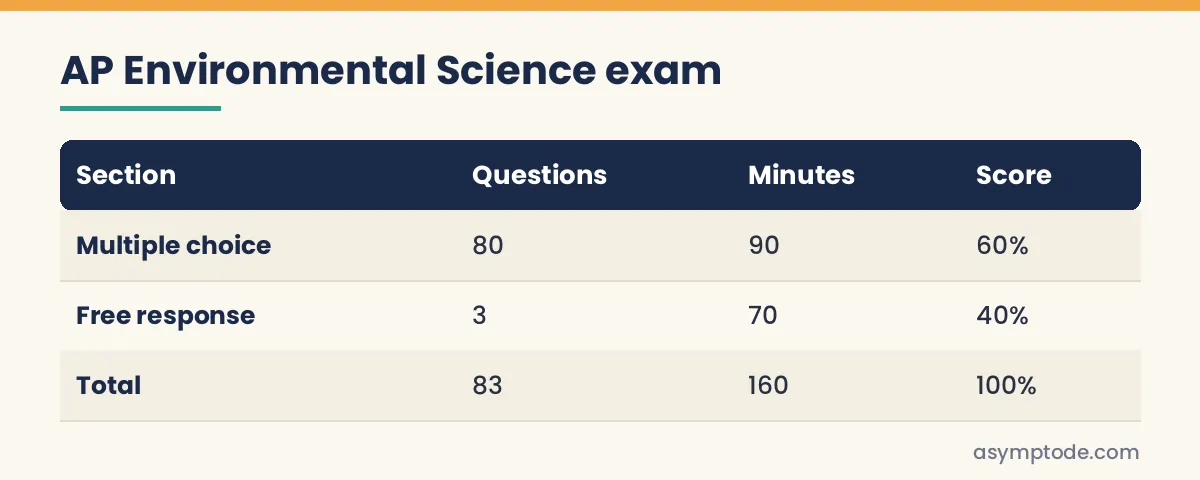 The two sections of the exam (source: AP Central).
The three free-response questions are always the same types:
- Question 1: design an investigation from a real scenario.
- Question 2: analyse and interpret data from a table, chart or graph.
- Question 3: analyse an environmental problem with calculations.
What are the nine units?
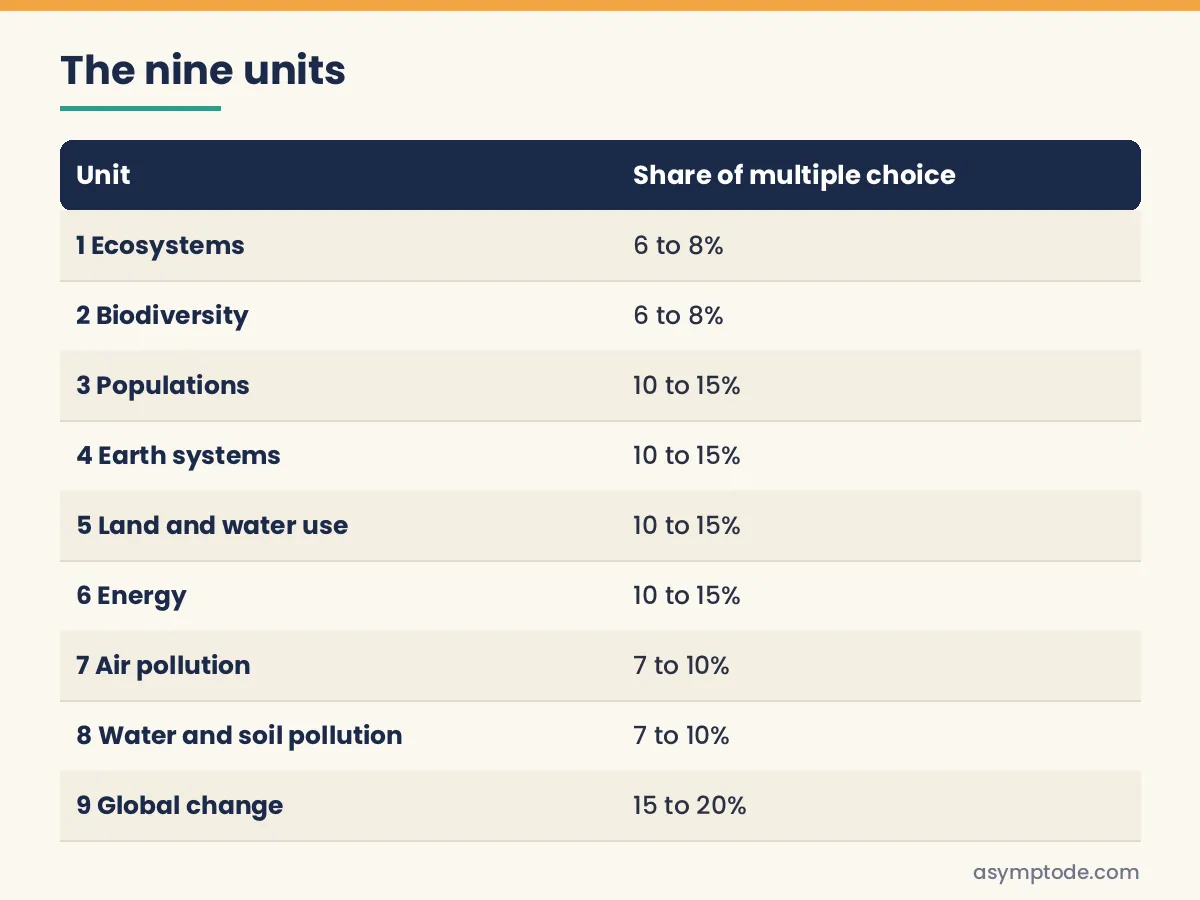 The nine units and their weight in the multiple-choice section.
Unit 9, Global Change, is the largest share (15 to 20%). Units 3 to 6 are 10 to 15% each, so no unit can be skipped. Your teacher may order the units differently.
What do the calculations look like?
Question 3 needs short, clean calculations. Here is a population example. A town of 1,000 people has 50 births and 20 deaths in a year.
 Growth rate, then doubling time with the rule of 70.
Growth rate = (50 − 20) ÷ 1,000 × 100 = 3%. The rule of 70 says doubling time is 70 ÷ growth rate, so 70 ÷ 3 ≈ 23 years.
Unit conversions come up often too. A power plant makes 2.5 gigawatts for one day.
 Convert the unit first, then multiply by the hours.
Convert first: 2.5 GW = 2,500 MW. Then 2,500 MW × 24 h = 60,000 MWh. Write the unit at every step.
When and how do you register?
Quick answer: The exam is on Thursday, May 13, 2027, Session 2. You do not register yourself: your school's AP coordinator orders it.
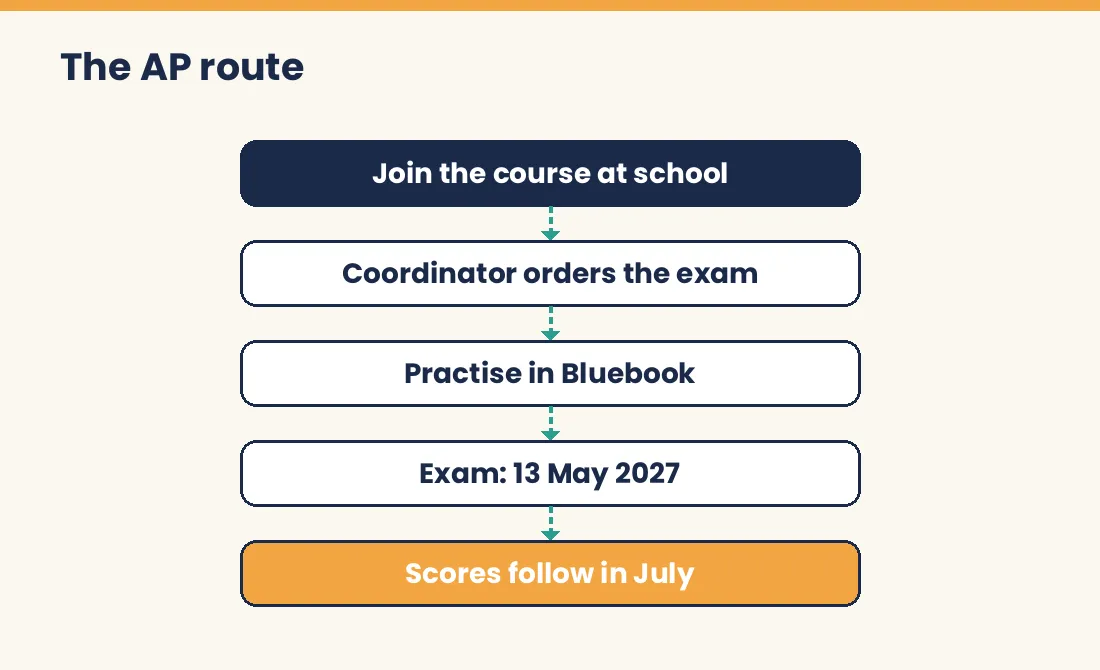 From the course to the score.
- Ordering: the final deadline was November 13, 2026. Exams ordered from November 14, 2026 to March 12, 2027 cost $40 extra each, with some exceptions. Ask your coordinator now.
- Fee: $99 per exam in US, US territory, Canada and DoWEA schools, and $129 elsewhere. Eligible students can get a $37 reduction.
- Clash: if two of your exams are in the same session, you take one in late testing (May 17 to 21, 2027) with no extra fee.
See our AP exam dates 2027 guide for the whole schedule and deadlines.
How can you prepare?
Start with the units that carry the most weight, and practise data questions every week.
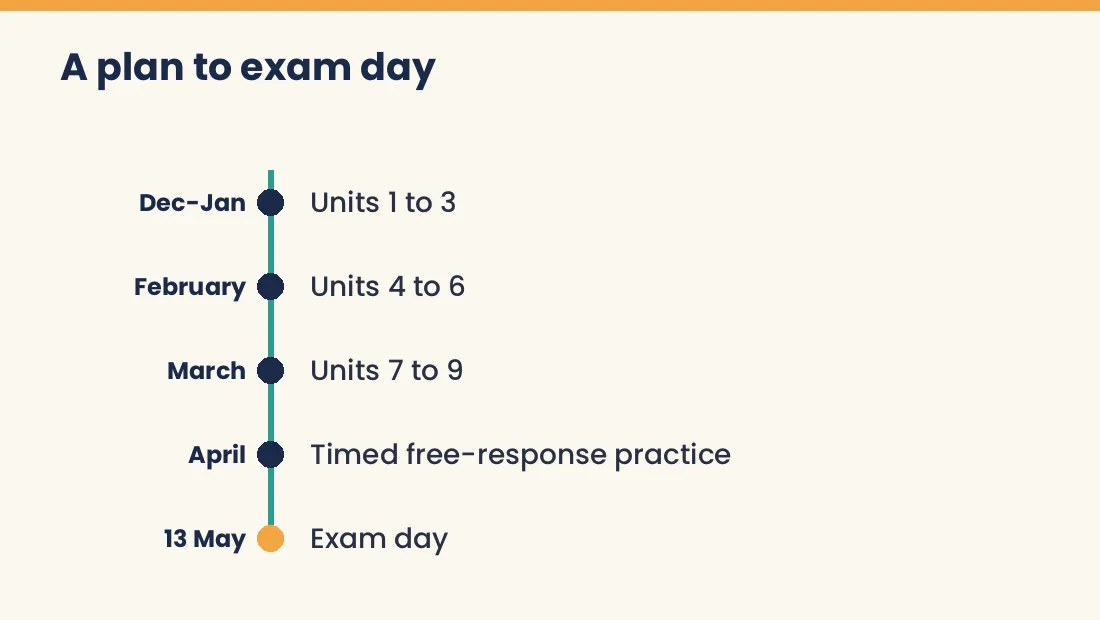 A revision plan from now to exam day.
- Read graphs slowly. Say what the axes and units are before you answer.
- Practise the rule of 70 and unit conversions until they feel easy.
- Write full sentences in free response and propose a solution, as the questions ask.
- Use the Bluebook test preview to learn the app before exam day.
How Asymptode Can Help You Prepare for AP Environmental Science
- One mentor, one child, live online. The mentor teaches the science and the quantitative skills, such as rates, unit conversions and reading graphs, around your child's real exam date of May 13, 2027.
- Practice at your child's level. Between classes, AI-assisted practice is built from what your child's last attempt showed they had not yet understood, for example forgetting to convert GW to MW first, and goes out only after the mentor approves it. The AI supports the mentor and never replaces them. Work that fits builds confidence instead of wearing it down.
- Every class is recorded and searchable by topic, and the parent view shows what was understood and what to practise next.
- Lessons are reviewed, so the quality of the teaching is checked, not assumed.
- Start early, gently. Steady science and algebra in Grades 8 and 9 make AP feel lighter later.
We never promise a score. Book a free demo class or see our plans and fees.
Facts checked against official sources on 25 November 2026: AP Central and AP Students (College Board). Ordering and fee details as checked on 12 November 2026.
Related guides
FAQ
When is the AP Environmental Science exam in 2027?
Thursday, May 13, 2027, in Session 2. Your AP coordinator tells you the start time.
Can you use a calculator on AP Environmental Science?
Yes. Calculators are permitted. Check the College Board AP calculator policy for approved models.
How many questions are on the exam?
80 multiple-choice questions in 90 minutes and 3 free-response questions in 70 minutes.
What should I study before AP Environmental Science?
College Board recommends two years of high school lab science, with life science and physical science, and at least one year of algebra.
Do colleges give credit for AP Environmental Science?
It depends on the college. College Board says the course matches a one-semester introductory environmental science course. Use the AP Credit Policy Search to check each college.
How do I sign up for the exam?
Ask your school's AP coordinator. The final ordering deadline was November 13, 2026, and later orders cost $40 extra per exam.