

AP Chemistry has a reputation as one of the toughest AP exams. The good news: the exam is very predictable once you know how it is built. This guide explains the May 2027 format, the 9 units, the free-response questions, and a clear plan to prepare.
Key takeaways
- The AP Chemistry exam is on Thursday, May 6, 2027 (Session 2), according to the College Board.
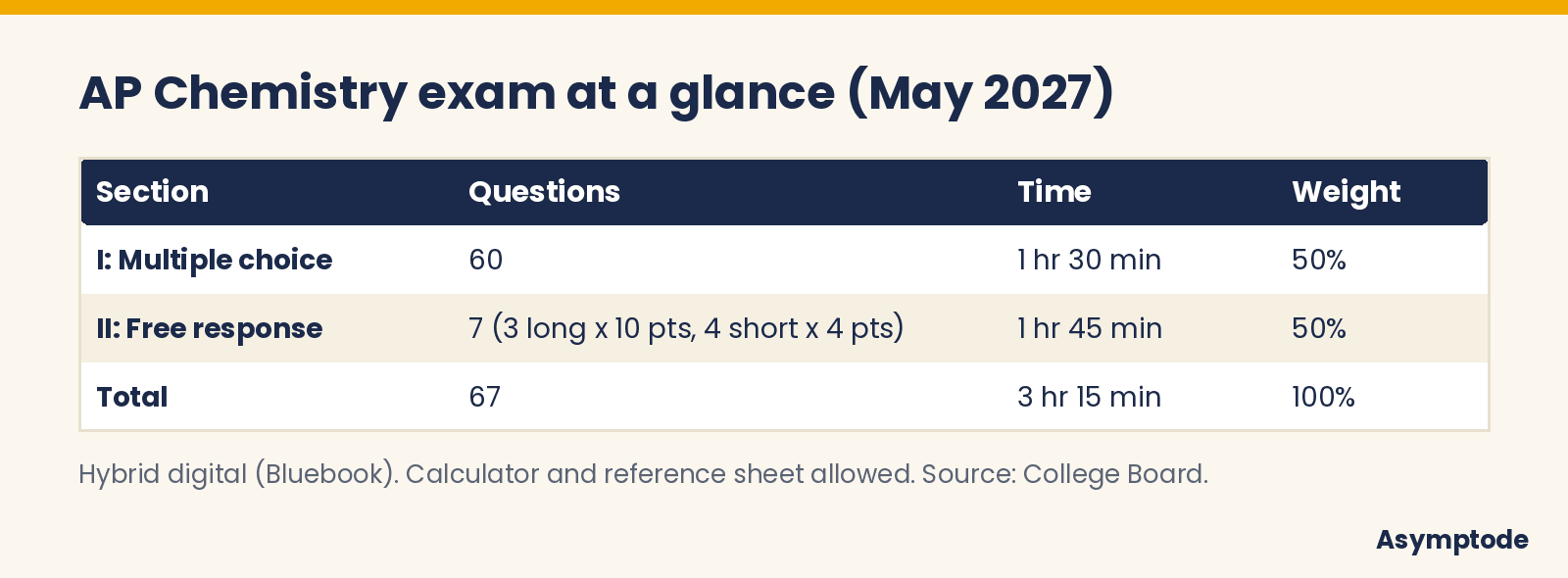
- It has 60 multiple-choice questions in 1 hour 30 minutes and 7 free-response questions in 1 hour 45 minutes. Each section is worth 50%.
- The free-response section has 3 long questions (10 points each) and 4 short questions (4 points each).
- The exam is hybrid digital: multiple choice in the Bluebook app, free-response answers handwritten in a paper booklet.
- Unit 3 (Properties of Substances and Mixtures) carries the most weight: 18–22% of the multiple-choice section.
What is the AP Chemistry exam?
Quick answer: AP Chemistry is a college-level general chemistry course run by the College Board. Students learn atomic structure, bonding, reactions, kinetics, equilibrium, acids and bases, thermodynamics and electrochemistry. The 3-hour 15-minute exam in May is scored from 1 to 5, and many colleges give credit for a qualifying score.
Each college sets its own credit rules. Check the college website or the College Board's AP credit policy search before you count on credit.
AP Chemistry is not a memory test. Most questions ask students to use a model, read data, or do a calculation and then explain what the numbers mean. That is why strong students can still find it hard. If your child is planning several AP courses, our complete AP guide for parents explains how the whole AP program works.
When is the AP Chemistry exam in 2027?
The College Board lists the 2027 AP Chemistry exam for Thursday, May 6, 2027, in Session 2. Schools order exams in the fall, so speak to the AP coordinator early. Scores are usually released in July.
What is the AP Chemistry exam format?
| Section | Questions | Time | Weight |
|---|---|---|---|
| I: Multiple choice | 60 | 1 hr 30 min | 50% |
| II: Free response | 7 (3 long + 4 short) | 1 hr 45 min | 50% |
| Total | 67 | 3 hr 15 min | 100% |
A few rules matter on exam day:
- Calculator: allowed. Check the AP calculator policy for approved models.
- Reference sheet: students get the AP Chemistry reference information (periodic table, equations and constants) in Bluebook and on paper.
- Hybrid digital: students read all questions in Bluebook. They type multiple-choice answers and handwrite free-response answers in a booklet that is mailed for scoring.
- Question sets: many multiple-choice questions share one graph, table or diagram. Read the stimulus carefully once, then answer the set.
What are the long and short free-response questions?
- Long questions (3 x 10 points): multi-part problems. Expect a lab set-up, data to analyse, a calculation and a "justify your answer" part in one question.
- Short questions (4 x 4 points): one focused idea, such as drawing a particle diagram, predicting a shift in equilibrium or doing one calculation.
Points come from clear steps, correct units and correct reasoning. A right number with no working often earns little.
What are the 9 units of AP Chemistry?
The College Board gives a weighting range for each unit in the multiple-choice section.
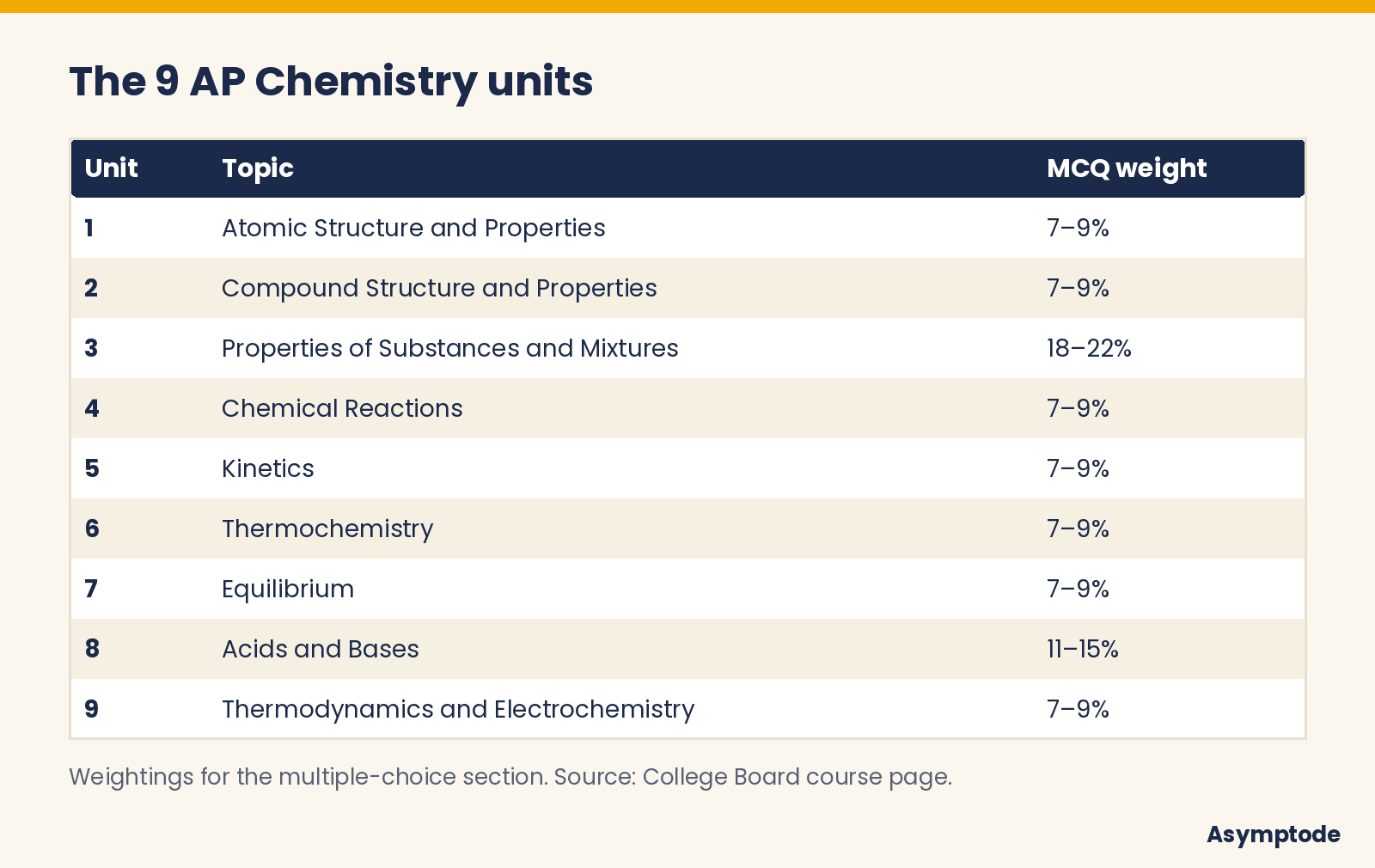
| Unit | Topic | MCQ weighting |
|---|---|---|
| 1 | Atomic Structure and Properties | 7–9% |
| 2 | Compound Structure and Properties | 7–9% |
| 3 | Properties of Substances and Mixtures | 18–22% |
| 4 | Chemical Reactions | 7–9% |
| 5 | Kinetics | 7–9% |
| 6 | Thermochemistry | 7–9% |
| 7 | Equilibrium | 7–9% |
| 8 | Acids and Bases | 11–15% |
| 9 | Thermodynamics and Electrochemistry | 7–9% |
Two units stand out. Unit 3 covers intermolecular forces, gases, solutions and spectroscopy, and it is the biggest single unit. Unit 8 (acids and bases) is the second biggest and builds on equilibrium from Unit 7, so students need Unit 7 to be secure first.
The College Board also weights six science practices. The largest is Mathematical Routines (35–42% of multiple choice and 43–53% of free response). In plain terms: about half the free-response points come from calculations done well.
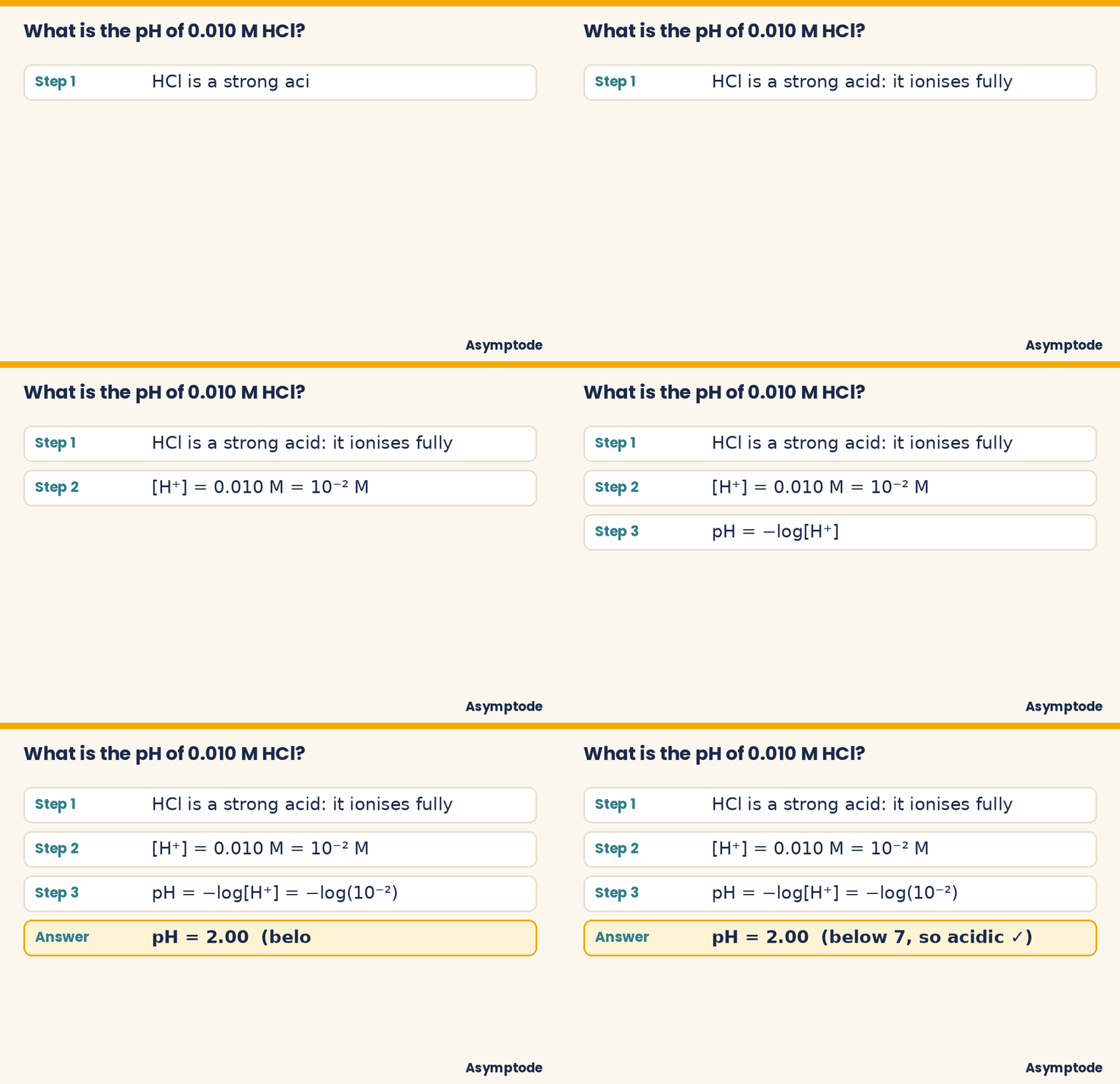
Worked example 1: what is the pH of 0.010 M HCl?
This is a classic short calculation from Unit 8.
- HCl is a strong acid, so it ionises fully. [H⁺] = 0.010 M.
- pH = −log[H⁺] = −log(0.010).
- 0.010 = 10⁻², so pH = 2.00.
- Check the sense: an acid should have pH below 7. It does.
Common trap: for a weak acid, such as ethanoic (acetic) acid, the acid does not ionise fully. Students must use Ka and an equilibrium (ICE) table instead. Mixing up strong and weak acids is one of the most common lost points in Unit 8.
Worked example 2: how much water forms from 4.0 g of hydrogen?
The balanced equation is 2H₂ + O₂ → 2H₂O. Assume plenty of oxygen.
- Moles of H₂ = mass ÷ molar mass = 4.0 g ÷ 2.0 g/mol = 2.0 mol.
- The mole ratio H₂ : H₂O is 2 : 2, so 2.0 mol of water forms.
- Mass of water = 2.0 mol × 18.0 g/mol = 36 g.
Every stoichiometry problem follows this path: grams → moles → mole ratio → moles → grams. If balancing equations still feels shaky, start with our guide on how to balance chemical equations.
Worked example 3: which way does equilibrium shift?
Take N₂(g) + 3H₂(g) ⇌ 2NH₃(g), which is exothermic. What happens if the temperature rises?
- For an exothermic reaction, think of heat as a product.
- Adding heat pushes the reaction to use it up, so equilibrium shifts left.
- Less NH₃ forms, and K decreases, because temperature is the only change that alters K.
A full-mark answer names the direction and gives the reason. "It shifts left" alone usually earns only part of the credit.
What are the most common AP Chemistry mistakes?
- Missing units and significant figures. Write the unit at every step.
- Weak justifications. Free-response answers need a claim plus evidence plus reasoning, not just a number.
- Confusing intermolecular forces with bonds. Boiling a liquid breaks intermolecular forces, not covalent bonds.
- Treating weak acids as strong. Check the Ka before you calculate.
- Sign errors in thermodynamics. ΔG = ΔH − TΔS. Track the signs of ΔH and ΔS carefully.
- Skipping the particle diagram. Some questions ask students to draw particles. Practise drawing them neatly.
How should you study for AP Chemistry? A 10-week plan
Start this plan about 10 weeks before May 6. Most of the course should already be taught by then.
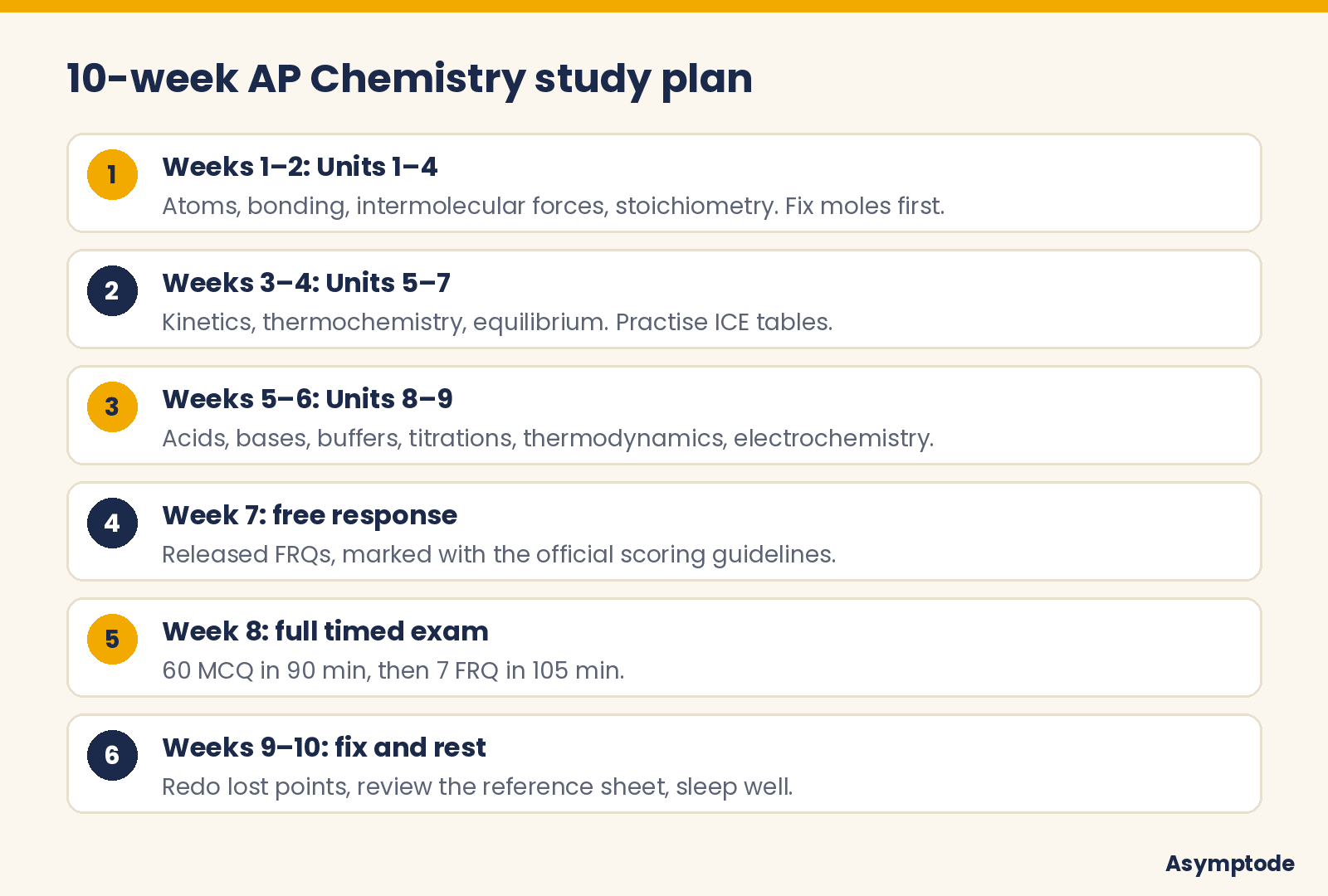
- Weeks 1–2: Units 1–4. Atomic structure, bonding, intermolecular forces, stoichiometry. Fix any gaps in moles first.
- Weeks 3–4: Units 5–7. Kinetics, thermochemistry and equilibrium. Practise ICE tables until they feel routine.
- Weeks 5–6: Units 8–9. Acids, bases, buffers, titrations, thermodynamics and electrochemistry.
- Week 7: free-response focus. Do released College Board free-response questions. Mark them with the official scoring guidelines.
- Week 8: one full timed exam. Sit 60 multiple-choice questions in 90 minutes, then the free-response section in 105 minutes.
- Week 9: fix the weak list. Redo every question you lost points on. Write a one-line rule for each mistake.
- Week 10: light review. One more timed section, the reference sheet, and good sleep.
Use the free practice in AP Classroom, which your child's teacher can assign, and released free-response questions on AP Central.
Not sure where your child stands? Book a free demo class and an Asymptode mentor will check their chemistry skills and suggest a plan.
How does 1-on-1 tutoring help with AP Chemistry?
AP Chemistry rewards clear thinking step by step. That is exactly what one-to-one lessons are built for.
At Asymptode, each student works live online with one dedicated mentor. There are no batches. The mentor watches the student's working on every problem, so they can spot the real cause of a mistake, such as a weak grasp of moles hiding inside an equilibrium question. They fix the method, not just the answer.
Here is how that looks for AP Chemistry:
- A plan to the exam date. The mentor starts with a short assessment, then plans lessons around your child's school pace and May 6.
- Free-response practice with feedback. The mentor sets questions like the real ones, marks them, and shows how each point is won or lost.
- Personal homework. Worksheets are set on the topics just taught and checked by the mentor before your child sees them.
- Recordings for revision. Every class is recorded, so your child can rewatch a tricky equilibrium or electrochemistry lesson before the exam.
- Parents stay informed. You get short updates on what improved and what needs more practice.
No tutor can promise a score. What 1-on-1 lessons give is focused time on your child's weak spots, at their pace. See our fees or talk to an advisor to plan the year.
Related AP guides
- Complete AP guide for parents
- AP Biology exam guide
- AP Physics 1 exam guide
- AP Precalculus exam guide
- AP Statistics changes for 2026–27
- How many hours of tutoring per week?
FAQ
Is AP Chemistry hard?
It is one of the more demanding AP sciences because it mixes calculation, models and written explanation. Students who are secure in algebra and practise free-response questions with feedback usually find it much more manageable.
Can you use a calculator on the AP Chemistry exam?
Yes. A calculator is permitted. Check the College Board's AP calculator policy for approved models before exam day.
Is a periodic table given on the AP Chemistry exam?
Yes. Students get the AP Chemistry reference information, which includes a periodic table and a list of equations and constants, in Bluebook and on paper.
How many questions are on the AP Chemistry exam?
There are 67 questions: 60 multiple-choice questions and 7 free-response questions (3 long and 4 short).
When is the 2027 AP Chemistry exam?
The College Board lists it for Thursday, May 6, 2027, in Session 2. Confirm the start time with your school's AP coordinator.
Should my child take AP Chemistry or AP Physics 1 first?
It depends on the school's course order and the student's maths. AP Chemistry relies on algebra, logs and ratios. Talk to the school counsellor, and ask a tutor to check maths readiness if you are unsure.