
The AP Biology exam tests far more than facts. Students must read data, explain experiments and use a little maths. This guide explains the 2027 exam format, the 8 units and their weights, the maths skills you need (with worked examples), common mistakes and a 10-week study plan.
Key takeaways
- The 2027 AP Biology exam is on Monday, May 3, 2027 (afternoon session), per College Board.
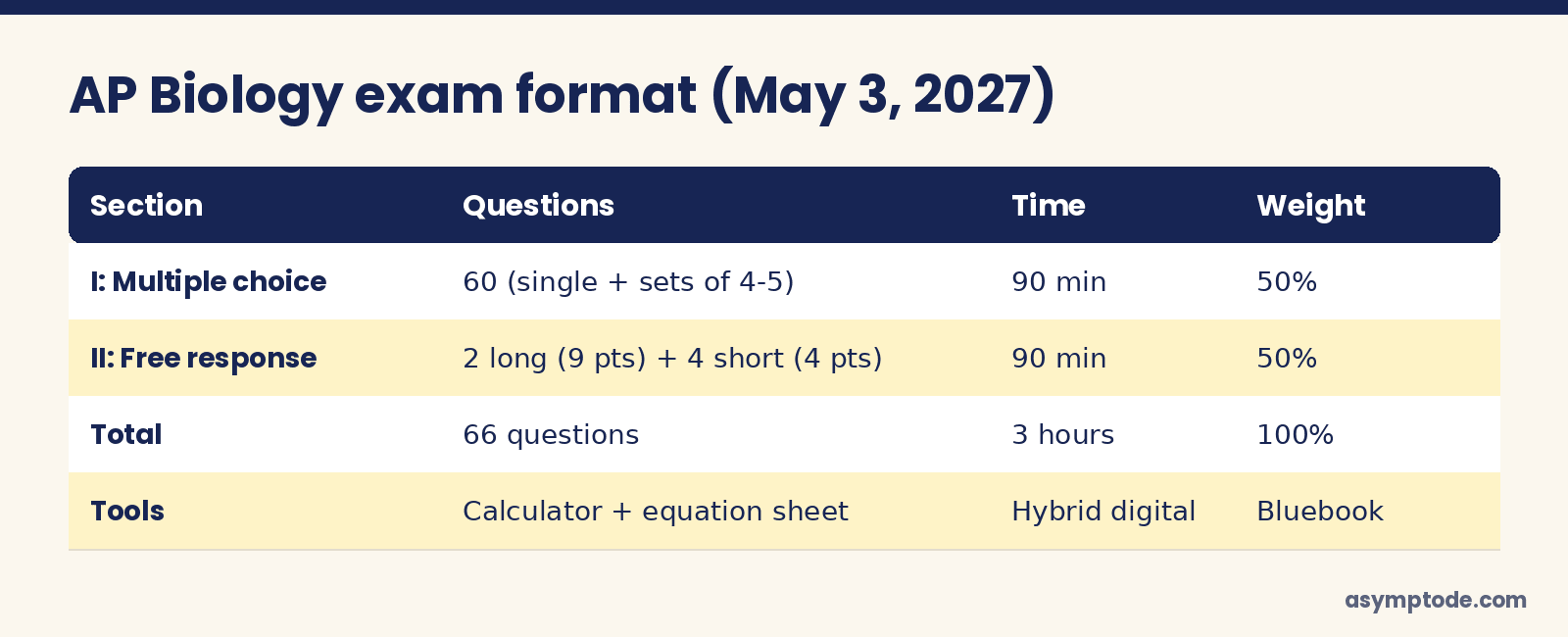
- It lasts 3 hours: 60 multiple-choice questions in 90 minutes (50%) and 6 free-response questions in 90 minutes (50%).
- The free-response section has 2 long questions (9 points each) and 4 short questions (4 points each).
- The exam is hybrid digital: multiple choice in the Bluebook app, free-response answers handwritten in a paper booklet.
- A calculator is allowed and a formula and equation sheet is provided.
- Unit 7, Natural Selection (13–20%) is the biggest unit on the exam.
What is the AP Biology exam format in 2027?
Quick answer: The AP Biology exam is 3 hours long. Section I has 60 multiple-choice questions in 90 minutes and is worth 50% of the score. Section II has 6 free-response questions in 90 minutes, also worth 50%. Students may use a calculator and get an equation sheet. Scores run from 1 to 5.
| Section | Questions | Time | Weight |
|---|---|---|---|
| I: Multiple choice | 60 (single and in sets of 4–5 on one stimulus) | 90 minutes | 50% |
| II: Free response | 2 long (9 points each) + 4 short (4 points each) | 90 minutes | 50% |
Many multiple-choice questions come in sets that share one graph, table or diagram. So reading data quickly is a core skill, not a bonus.
The free-response section has a fixed pattern. College Board describes it like this:
- 2 long questions: interpret and evaluate experimental results. One of them includes graphing.
- 4 short questions: one each on scientific investigation, conceptual analysis, analysis of a model or visual representation, and analysis of data.
If your child is planning several AP subjects, our AP guide for parents explains how scores, credit and choosing courses work.
When is the AP Biology exam in 2027?
College Board lists AP Biology for Monday, May 3, 2027, in Session 2 (afternoon, local time). Scores are usually released in July. Schools handle registration, and most set an autumn deadline to order exams, so ask the AP coordinator early.
What are the 8 units of AP Biology?
Quick answer: AP Biology has 8 units. The heaviest are Natural Selection (13–20%), Cellular Energetics (12–16%) and Gene Expression and Regulation (12–16%). The lightest are Chemistry of Life and Heredity (8–11% each). Every unit can appear in both sections.
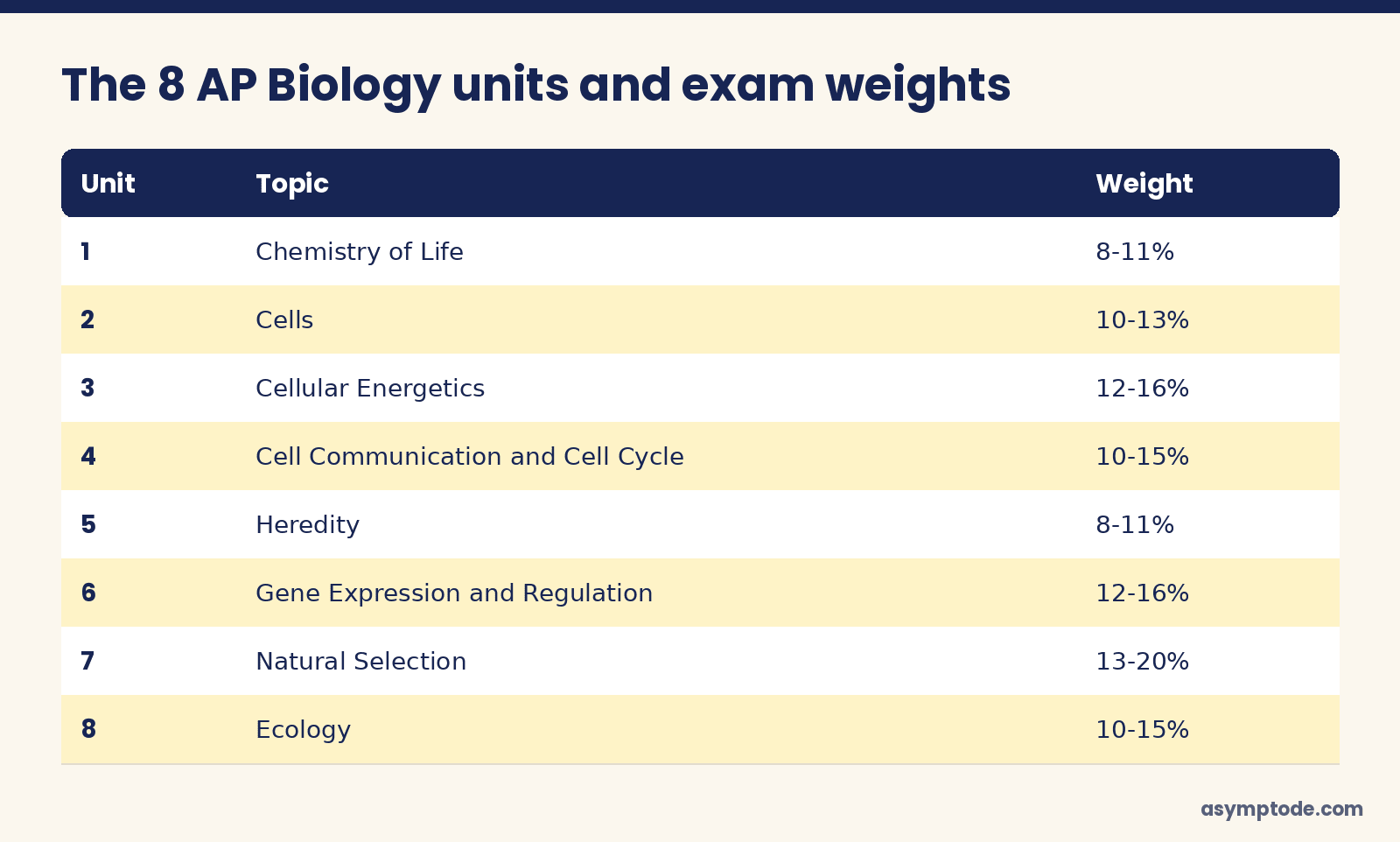
| Unit | Topic | Exam weight |
|---|---|---|
| 1 | Chemistry of Life | 8–11% |
| 2 | Cells | 10–13% |
| 3 | Cellular Energetics | 12–16% |
| 4 | Cell Communication and Cell Cycle | 10–15% |
| 5 | Heredity | 8–11% |
| 6 | Gene Expression and Regulation | 12–16% |
| 7 | Natural Selection | 13–20% |
| 8 | Ecology | 10–15% |
Weights come from College Board's AP Biology Course at a Glance. Use them to plan revision time, but do not skip a "small" unit. A free-response question can be built on any unit.
What maths do you need for AP Biology?
AP Biology maths is not hard, but students lose easy points when they rush it. The main skills are:
- Percent change and rates from graphs.
- Surface area to volume ratio (Unit 2).
- Water potential (Unit 2).
- Hardy-Weinberg equations (Unit 7).
- Chi-square tests (Unit 5 genetics and lab data).
- Mean, standard deviation and error bars for comparing data.
The equation sheet gives the formulas. The skill is choosing the right one and showing clear working.
Worked example 1: Hardy-Weinberg
Question: In a population, 16% of individuals show a recessive trait. Assuming Hardy-Weinberg equilibrium, what percent are heterozygous?
- Recessive phenotype = q², so q² = 0.16.
- q = √0.16 = 0.4.
- p = 1 − q = 0.6.
- Heterozygotes = 2pq = 2 × 0.6 × 0.4 = 0.48.
- Answer: 48% are heterozygous.
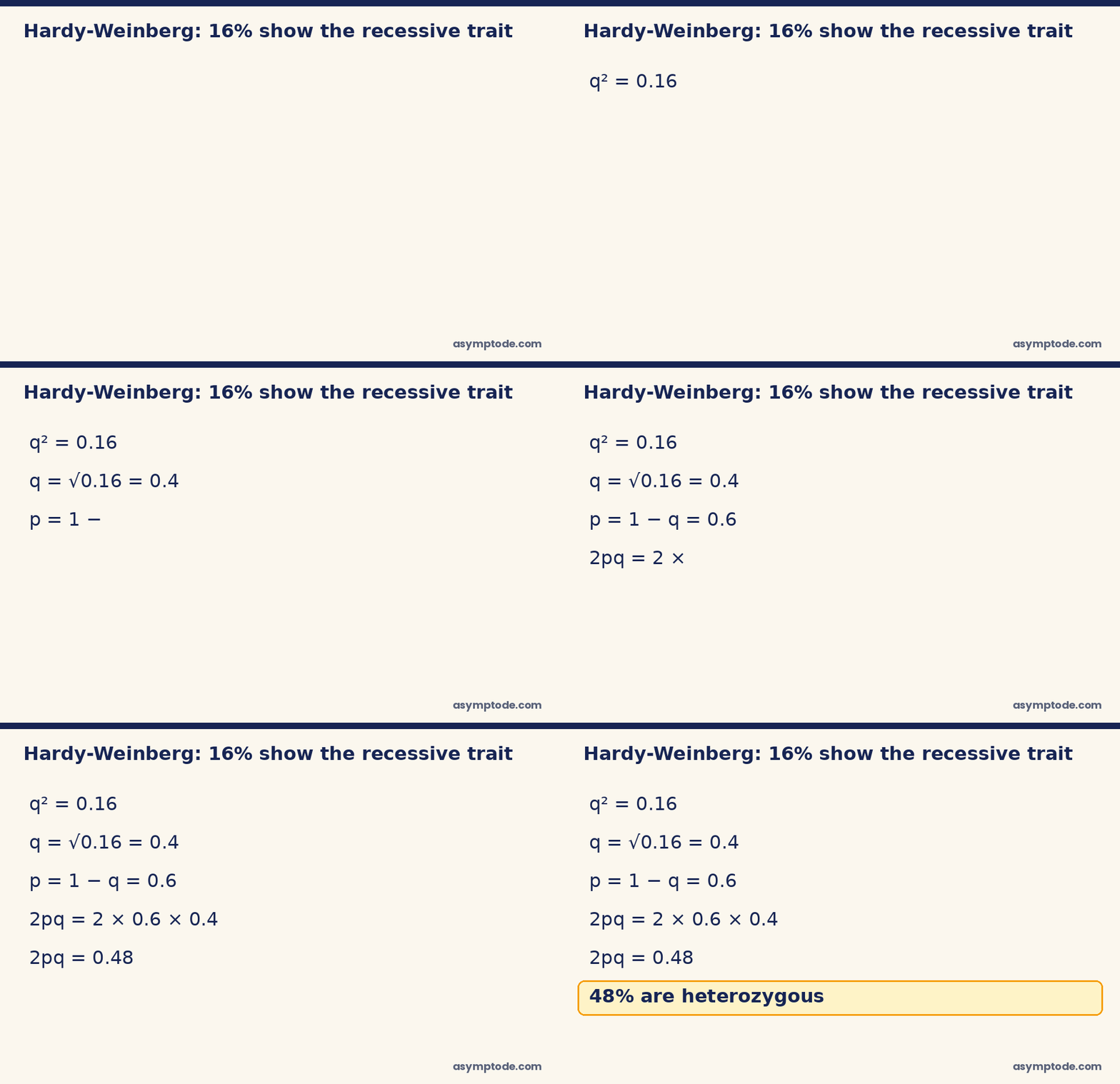
The common mistake is to take q = 0.16. Always ask: "Is this number q or q²?" The recessive phenotype is q².
Worked example 2: Chi-square test
Question: A cross is expected to give a 3:1 ratio. Out of 400 offspring, 290 are purple and 110 are white. Does the data fit the 3:1 ratio at p = 0.05?
- Expected: purple = 3/4 × 400 = 300. White = 1/4 × 400 = 100.
- χ² = Σ (o − e)² / e.
- Purple: (290 − 300)² / 300 = 100 / 300 = 0.33.
- White: (110 − 100)² / 100 = 100 / 100 = 1.00.
- χ² = 0.33 + 1.00 = 1.33.
- Degrees of freedom = 2 categories − 1 = 1. The critical value at p = 0.05 is 3.84.
- 1.33 < 3.84, so we fail to reject the null hypothesis. The data fits a 3:1 ratio.
Students often say they "accept" or "prove" the null hypothesis. On the exam, write "fail to reject" and explain what that means in plain words.
Worked example 3: Surface area to volume ratio
Question: A cube-shaped cell has sides of 2 µm. What is its surface area to volume ratio?
- Surface area = 6 × 2² = 24 µm².
- Volume = 2³ = 8 µm³.
- Ratio = 24 : 8 = 3 : 1.
Then link it to biology: a larger cube (say 4 µm sides) has a ratio of 96 : 64 = 1.5 : 1. Smaller cells have more surface for each unit of volume, so they exchange materials faster. The explanation earns the point, not just the number.
How do you answer AP Biology free-response questions?
Free response is half the score, so it needs its own practice. A simple routine helps:
- Read the verb. "Identify" needs a short answer. "Describe" needs detail. "Explain" needs a reason (use "because"). "Justify" needs evidence from the data.
- Answer every part in order. Label parts (a), (b), (c) clearly.
- Use data. Quote numbers from the graph or table when you make a claim.
- Name variables. For experiments, state the independent variable, dependent variable, controls and a clear null hypothesis.
- Graph carefully. Title, labelled axes with units, an even scale, correct graph type, and error bars if the data has them.
Practise with real released questions from AP Central and mark them with the official scoring guidelines. This shows exactly what earns each point.
What are the most common AP Biology mistakes?
- Memorising without explaining. Many points need a cause-and-effect link, not a definition.
- Vague answers. "It affects the enzyme" earns nothing. "The higher temperature changes the shape of the active site, so less substrate binds" can earn the point.
- Mixing up q and q² in Hardy-Weinberg.
- Weak graphs. Missing units, uneven scales or the wrong graph type.
- Running out of time on the long questions. Practise timed sections.
- Skipping the data in front of you. Many answers are in the stimulus.
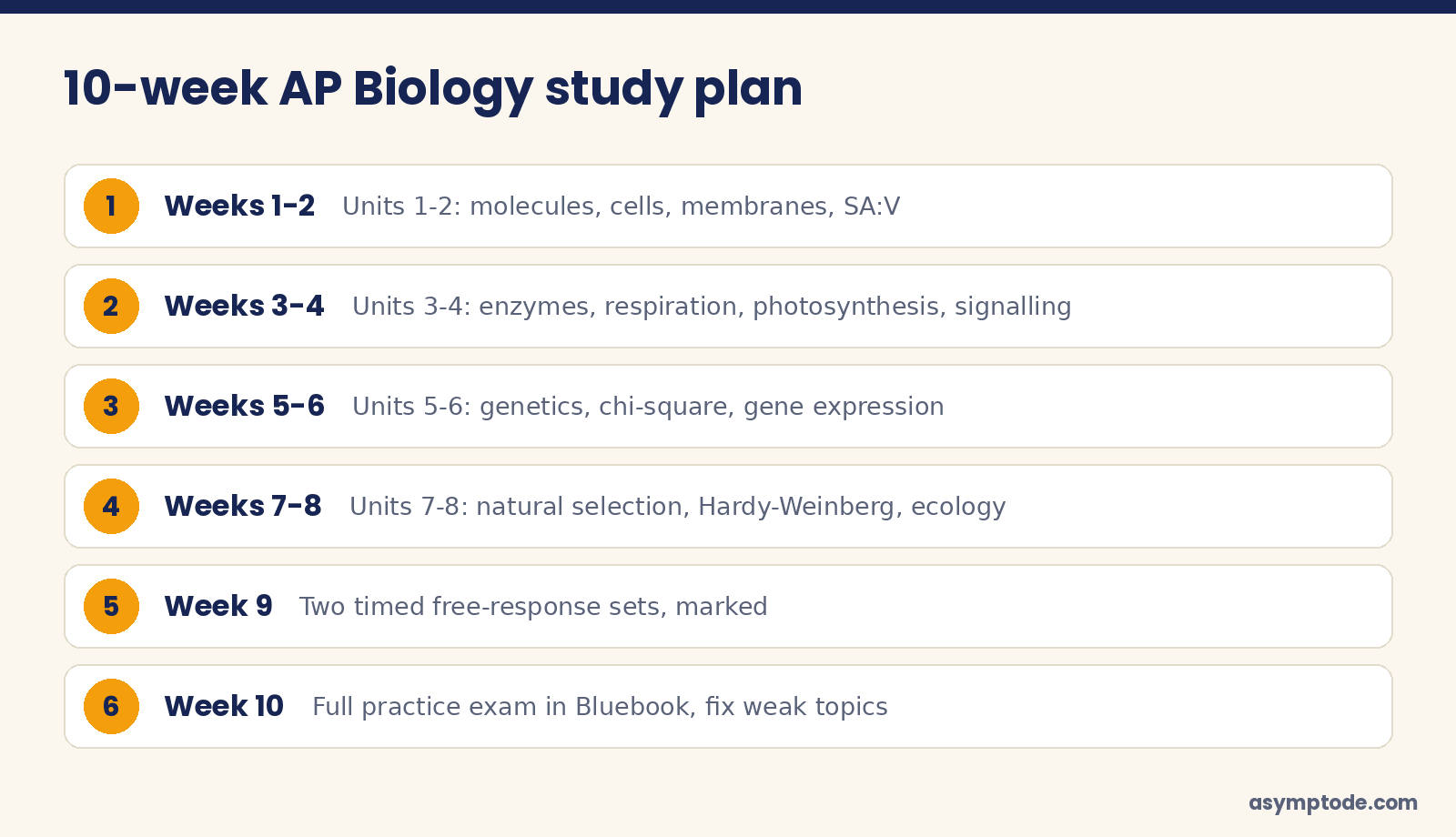
A 10-week AP Biology study plan
| Weeks | Focus |
|---|---|
| 1–2 | Units 1–2: biomolecules, cell parts, membranes, water potential, SA:V |
| 3–4 | Units 3–4: enzymes, respiration, photosynthesis, signalling, cell cycle |
| 5–6 | Units 5–6: genetics, chi-square, DNA, gene expression, biotechnology |
| 7–8 | Units 7–8: natural selection, Hardy-Weinberg, phylogeny, ecology |
| 9 | Two full timed free-response sets, marked with scoring guidelines |
| 10 | One full practice exam in Bluebook, then fix the weakest topics |
Each week, do two short sessions of mixed multiple-choice sets and one free-response question. Keep an error log: write the mistake, the reason and the correct idea. Review it every week.
For a quick refresh on core topics, see our explainers on photosynthesis, food chains and food webs and the circulatory system.
How 1-on-1 tutoring helps with AP Biology
AP Biology rewards clear reasoning, and that is easiest to build when someone watches how a student thinks. In 1-on-1 lessons at Asymptode, one dedicated mentor works with one student:
- The mentor follows your child's own school syllabus and pace, and plans backwards from the May exam date.
- In each lesson the mentor checks the full working on calculations like chi-square and Hardy-Weinberg, and fixes the method, not just the answer.
- For free response, the student writes answers and the mentor shows exactly which words would earn or lose points.
- Homework is set on the topics taught and marked with feedback.
- Every class is recorded, so students can rewatch a tricky topic before the exam.
- Parents get regular updates on what improved and what needs more practice.
Want to see how it works? Book a free demo class or see our fees.
Related AP science guides
FAQ
How long is the AP Biology exam?
It is 3 hours. Section I is 60 multiple-choice questions in 90 minutes. Section II is 6 free-response questions in 90 minutes.
Can you use a calculator on the AP Biology exam?
Yes. Calculators are allowed on the whole exam, following College Board's AP calculator policy. An equation and formula sheet is also provided.
When is the 2027 AP Biology exam?
College Board lists Monday, May 3, 2027, in the afternoon session. Check AP Central for any changes.
Which AP Biology unit is the most important?
Unit 7, Natural Selection, has the highest weight at 13–20%. Units 3 and 6 are next at 12–16% each. All 8 units can be tested.
Is AP Biology hard?
It has a lot of content and many questions ask students to explain data, not just recall facts. With steady weekly practice on free response and data questions, most students improve a lot.
Is the AP Biology exam digital?
It is hybrid digital. Students answer multiple choice in the Bluebook app and handwrite free-response answers in a paper booklet.