
If your child is applying to a private or independent school in the USA, the school will ask for the ISEE, the SSAT, or either one. The two tests look alike, but the maths sections, the levels and the test rules are different. This guide compares them side by side and helps you choose.
Key takeaways
- The ISEE and SSAT are both admission tests for independent schools. Many schools accept either one.
- Both are now run by E3n, formed in 2026 when ERB (the ISEE) and EMA (the SSAT) merged. The two tests still have separate formats and registration.
- The ISEE has two maths sections: Quantitative Reasoning and Mathematics Achievement. The SSAT has one Quantitative section in two parts.
- No calculator is allowed on either test.
- The ISEE can be taken once per testing season, so up to three times a year.
- The best choice is the test your child's schools accept, then the one that suits how your child thinks.
What is the difference between the ISEE and the SSAT?
Quick answer: The ISEE and SSAT both test verbal skills, reading and maths for private school admission. The ISEE has two maths sections and synonym and sentence-completion verbal questions. The SSAT has one maths section in two parts and uses analogies. Neither allows a calculator. Check which test each school accepts first, then pick the one that suits your child.
The ISEE (Independent School Entrance Exam) was created by ERB. The SSAT (Secondary School Admission Test) was run by the Enrollment Management Association. In March 2026 the two organisations merged into one nonprofit called E3n. For now, both tests continue in their current forms, and schools still say which test or tests they accept.
How do the ISEE and SSAT compare?
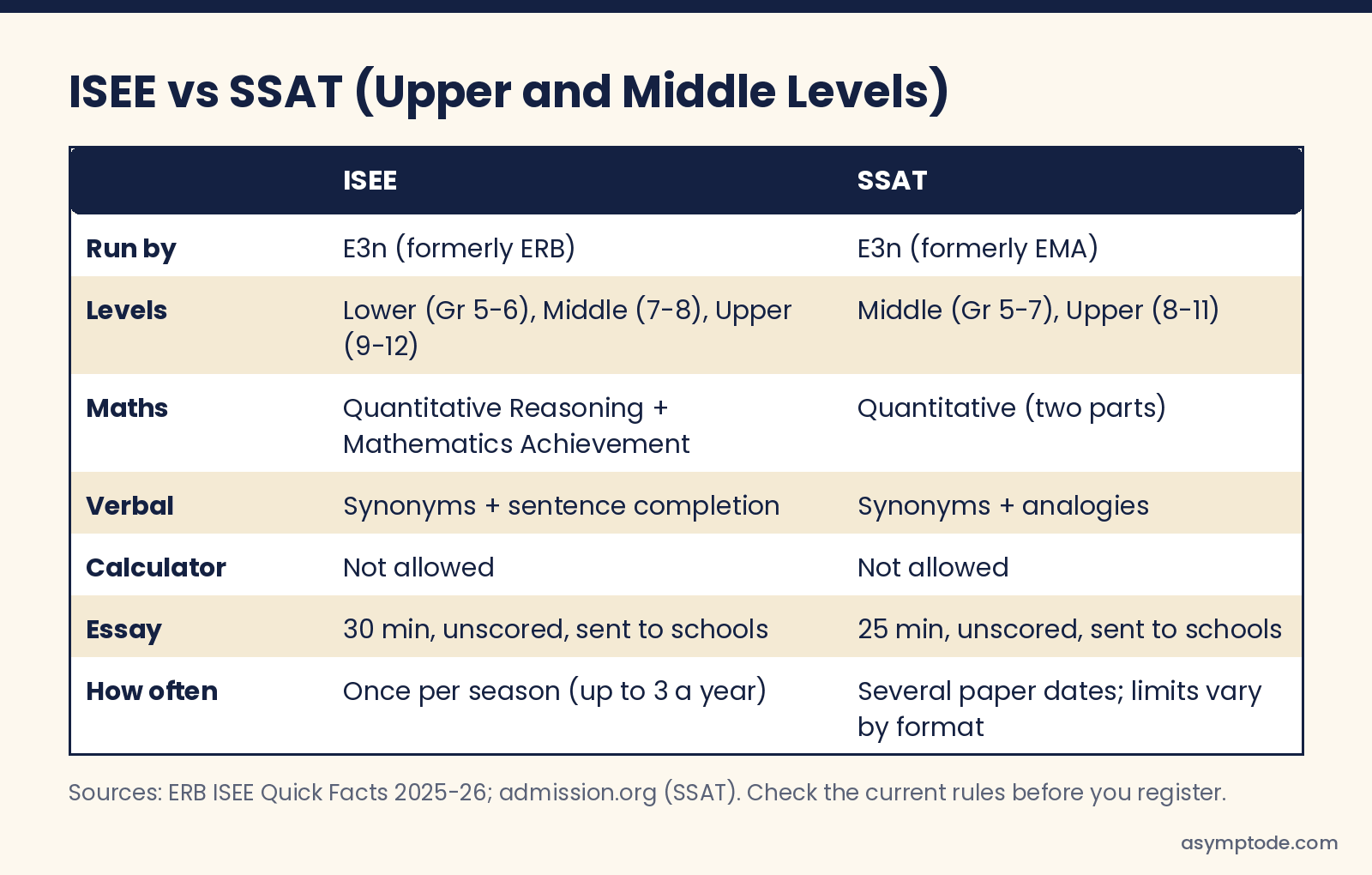
| ISEE | SSAT | |
|---|---|---|
| Levels for older students | Lower (Grades 5-6), Middle (Grades 7-8), Upper (Grades 9-12) | Middle (Grades 5-7), Upper (Grades 8-11) |
| Maths | Quantitative Reasoning + Mathematics Achievement | Quantitative, in two parts |
| Verbal | Synonyms and sentence completion | Synonyms and analogies |
| Reading | Reading Comprehension | Reading Comprehension |
| Calculator | Not allowed | Not allowed |
| Essay | 30 minutes, not scored, sent to schools | 25 minutes, not scored, sent to schools |
| Experimental section | None listed | Short unscored section at the end |
| How often | Once per testing season (up to 3 times a year) | Depends on the format: paper, at home or test centre |
The "level" is based on the grade your child is in now, not the grade they are applying for. A student in Grade 8 applying for Grade 9 takes the ISEE Upper Level or the SSAT Upper Level.
What maths is on the ISEE?
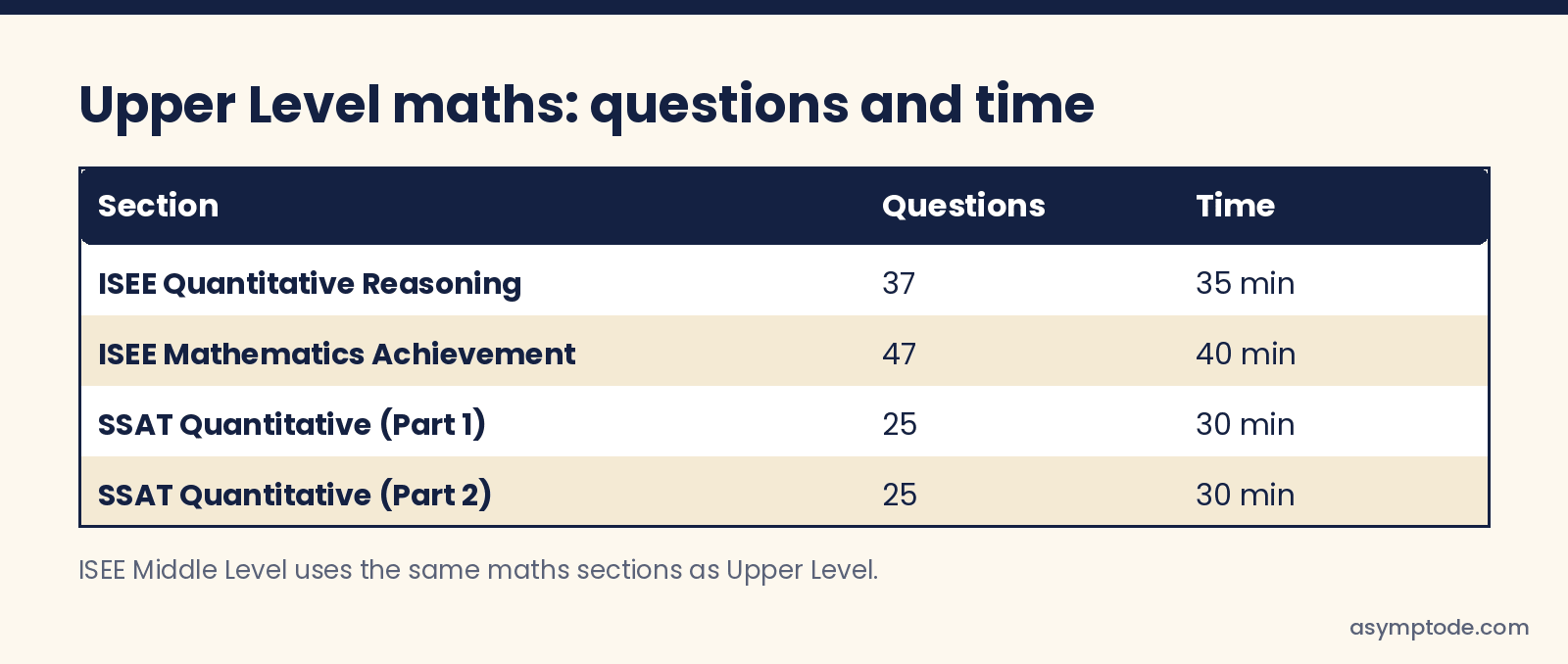
The ISEE Middle and Upper Levels have the same structure. ERB's 2025-26 Quick Facts lists:
| Section | Questions | Time |
|---|---|---|
| Verbal Reasoning | 40 | 20 minutes |
| Quantitative Reasoning | 37 | 35 minutes |
| Reading Comprehension | 36 | 35 minutes |
| Mathematics Achievement | 47 | 40 minutes |
| Essay | 1 prompt | 30 minutes |
The total is about 2 hours 40 minutes, plus two short breaks. The Lower Level (Grades 5-6) is shorter, with 38 Quantitative Reasoning questions and 30 Mathematics Achievement questions.
Quantitative Reasoning tests thinking with numbers. It includes word problems and, at Middle and Upper Level, quantitative comparison questions. In those, the student compares two amounts and decides whether A is greater, B is greater, they are equal, or it cannot be decided.
Mathematics Achievement looks more like a school maths test. It checks skills in number, algebra, geometry, measurement, data and probability.
The ISEE does not take marks away for wrong answers. Your child should answer every question.
What maths is on the SSAT?
The SSAT Upper Level has a Quantitative section of 50 questions in two parts of 25. Each part takes 30 minutes. Topics include arithmetic, basic algebra, geometry and other number concepts. The full Upper Level test takes about 3 hours 10 minutes, including the writing sample, an unscored experimental section and two breaks.
Upper Level SSAT scores are reported on a scale of 500 to 800 per section, with percentiles that compare your child with other students in the same grade. The SSAT has long used a small penalty for wrong answers at the Middle and Upper Levels. Check the current SSAT score guide before test day, because the rule decides whether your child should guess or leave a question blank.
ISEE-style worked example: quantitative comparison
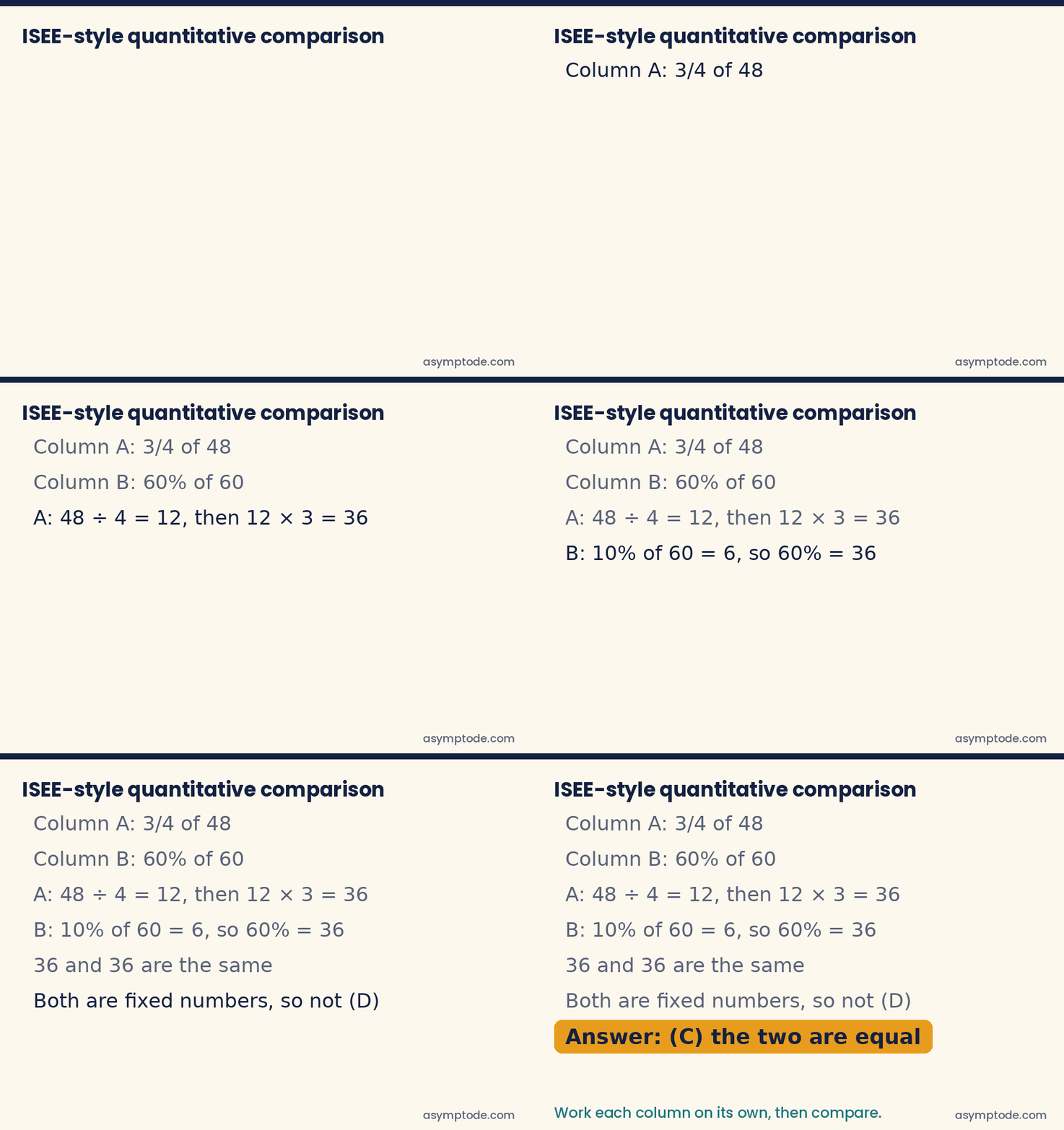
Column A: 3/4 of 48. Column B: 60% of 60.
- Work out Column A on its own. 48 ÷ 4 = 12. Then 12 × 3 = 36.
- Work out Column B on its own. 10% of 60 is 6. So 60% is 6 × 6 = 36.
- Compare: 36 and 36 are equal.
- Both amounts are fixed numbers, so "cannot be determined" is not possible.
Answer: (C), the two quantities are equal.
A key tip: answer (D) "cannot be determined" is only right when there is an unknown, such as x, that could make either side bigger. If both columns are plain numbers, (D) is never the answer.
Two more maths examples (both tests)
Example 2: Solve a simple equation
If 2x + 7 = 19, what is x?
- Subtract 7 from both sides: 2x = 12.
- Divide both sides by 2: x = 6.
- Check: 2 × 6 + 7 = 19. Correct.
Example 3: The missing test score
Maya's mean score on four tests is 85. What must she score on the fifth test to raise her mean to 87?
- Total for four tests: 4 × 85 = 340.
- Total needed for five tests: 5 × 87 = 435.
- Fifth score: 435 − 340 = 95.
This "use the total" idea appears on both tests. Students who try to guess and check lose a lot of time.
How do I choose between the ISEE and the SSAT?
- List your schools. Look at each admission page. If a school accepts only one test, that decides it.
- If both are accepted, try both. Have your child do a timed practice section of each. Notice which one feels calmer.
- Think about maths style. The ISEE asks for more maths overall (two sections). Students who like school-style maths often do well on Mathematics Achievement. The SSAT puts more weight on verbal analogies.
- Think about retakes. The ISEE allows one test per season, so up to three a year. Plan the first sitting early in the fall to leave room for a second try.
- Check dates and deadlines. Many schools have application deadlines in winter. Work back from that date.
What are the most common maths mistakes on these tests?
- Reaching for a calculator habit. Neither test allows one. Practise mental and written arithmetic from day one.
- Picking (D) too often on ISEE quantitative comparison questions.
- Not reading the question to the end. "Which is NOT" or "how many more" changes the answer.
- Spending too long on one question. Each question is worth the same. Move on and come back.
- Weak fractions and percent. These appear all over both tests. They are worth extra practice.
How should my child prepare?
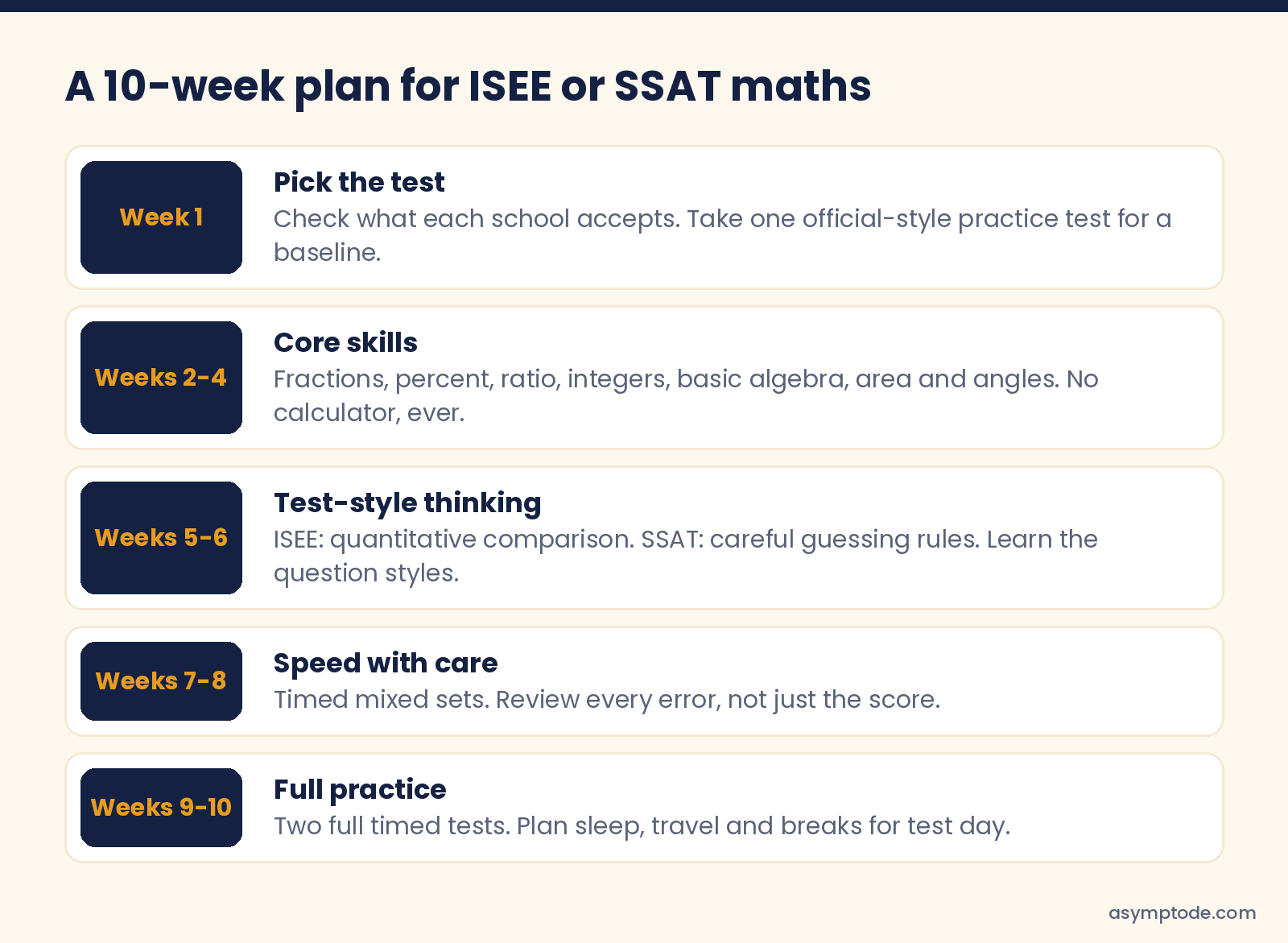
| Weeks | Focus | What to do |
|---|---|---|
| 1 | Pick the test | Check school requirements. Take one official-style practice test for a baseline. |
| 2-4 | Core skills | Fractions, percent, ratio, integers, basic algebra, area and angles. No calculator. |
| 5-6 | Test-style thinking | ISEE quantitative comparison or SSAT guessing strategy. Learn each question style. |
| 7-8 | Speed with care | Timed mixed sets. Review every error, not just the score. |
| 9-10 | Full practice | Two full timed tests. Plan sleep, travel and breaks for test day. |
Use the official practice guides from the test makers first. They show the real wording. Then add focused practice on the topics your child gets wrong.
If your child is also preparing for later tests, our PSAT/NMSQT guide and Digital SAT Math guide show where these skills lead.
Want help picking the right test? Book a free demo class with an Asymptode advisor.
How does 1-on-1 tutoring help with the ISEE and SSAT?
These tests mix school maths with puzzle-style thinking, under time pressure and without a calculator. Most students have one or two weak spots, often fractions, percent or word problems, that cost many marks. A 1-on-1 mentor can find those spots fast and fix them.
At Asymptode, every lesson is live and 1-on-1, with one dedicated mentor:
- A short assessment first, then a plan that works back from your child's test date and school deadlines.
- The mentor watches every step of the working, so slow or shaky methods get fixed, not just wrong answers.
- Homework is set on the topics taught and checked by the mentor before the next class.
- Parents get short updates on what improved and what needs more practice.
- Classes are recorded, so your child can rewatch a method before practice tests.
We cannot promise a score or an offer from a school. We can give your child calm, steady practice and clear feedback.
Related guides
- How to choose an online maths tutor
- How many hours of maths tutoring per week?
- Why smart students struggle with maths
Ready to plan? Talk to an Asymptode advisor or see our fees.
FAQ
Is the ISEE or SSAT easier?
Neither is simply easier. The ISEE has more maths (two sections), while the SSAT has verbal analogies. The better test is the one your child's schools accept and the one that suits your child's strengths.
Can you use a calculator on the ISEE or SSAT?
No. Calculators are not allowed on either test, except for students with an approved accommodation.
How many times can you take the ISEE?
Once per testing season. There are three seasons (fall, winter and spring/summer), so a student can test up to three times a year.
What level of the ISEE or SSAT should my child take?
The level depends on the grade your child is in now. For example, a Grade 8 student applying for Grade 9 takes the Upper Level of either test.
Do schools see the essay?
Yes. The essay on both tests is not scored, but a copy is sent to the schools you choose. It is worth practising a clear, simple essay.
Did the ERB and EMA merger change the tests?
Not yet. The two groups merged into E3n in 2026, but the ISEE and SSAT continue in their current formats with separate registration. Check the official sites before you book.