

The PSAT 8/9 is the first test in the College Board's SAT Suite. It shows how an 8th or 9th grader is doing in reading, writing and math, years before the SAT. This guide explains the format, the scores, the math topics and how to prepare without stress.
Key takeaways
- The PSAT 8/9 is for students in grades 8 and 9. It is digital and taken at school.
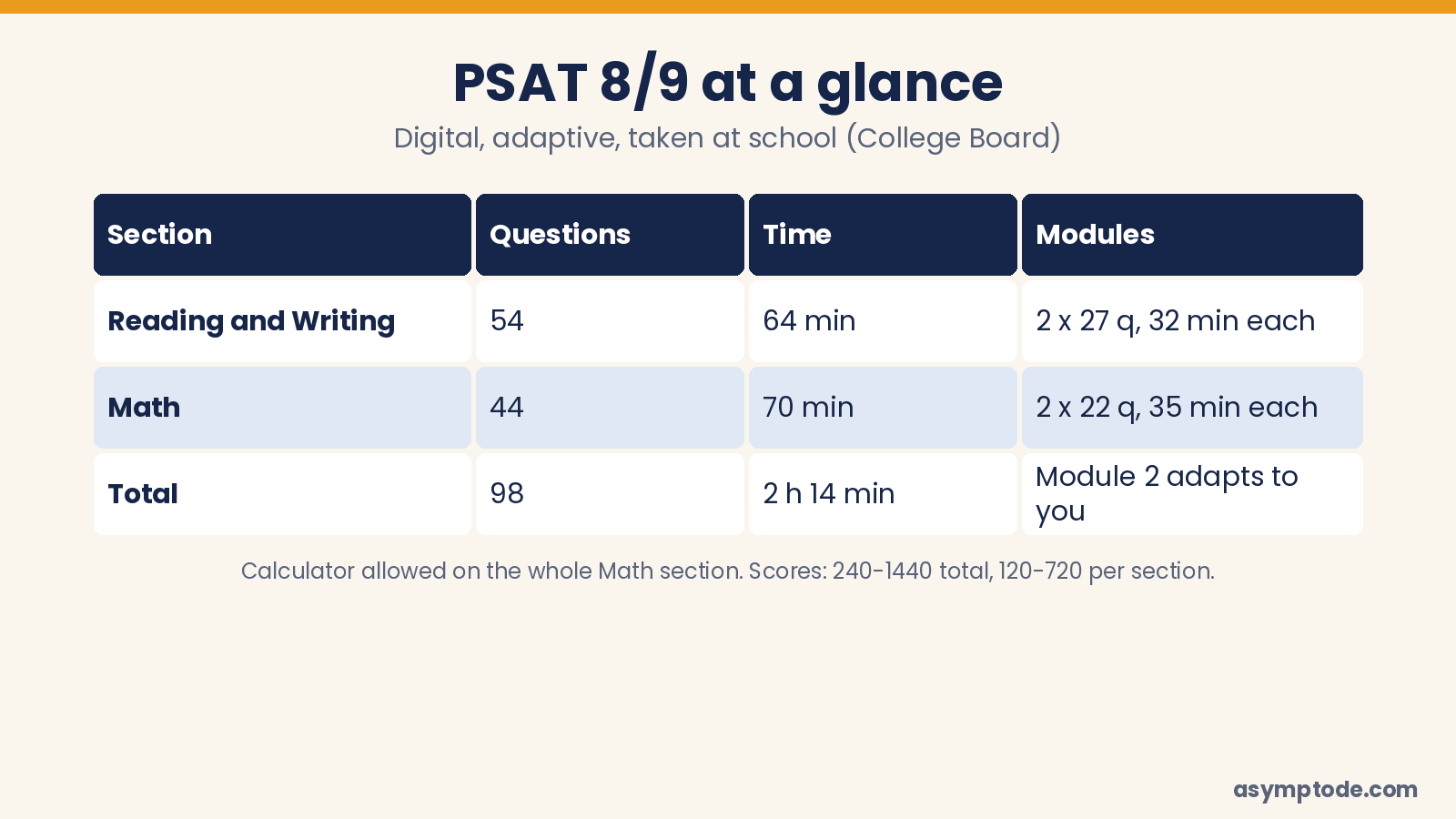
- It has 98 questions in 2 hours 14 minutes: Reading and Writing (54 questions, 64 minutes) and Math (44 questions, 70 minutes).
- Scores run from 240 to 1440. Each section is 120 to 720.
- The math benchmark is 430 in grade 8 and 450 in grade 9.
- It does not count for college or for National Merit. It is a check-up, not a final exam.
What is the PSAT 8/9?
Quick answer: The PSAT 8/9 is a digital test from the College Board for students in grades 8 and 9. It measures reading, writing and math skills on the same score scale as the SAT. Schools give it in the fall or spring. Scores show strengths, gaps and whether a student is on track for college-ready skills.
The College Board makes three PSAT-style tests: the PSAT 8/9, the PSAT 10 and the PSAT/NMSQT. All three share one score scale with the SAT. So a student who scores 450 in math on the PSAT 8/9 can see how that compares with later tests. If your child is already in grade 10 or 11, read our PSAT/NMSQT guide instead.
When is the PSAT 8/9 in 2026-27?
The College Board lists two testing windows for 2026-27:
| Window | Dates |
|---|---|
| Fall 2026 | October 1 to October 30, 2026 |
| Spring 2027 | March 1 to April 30, 2027 |
Each school picks its own day inside the window. Students do not register on their own. The school or district signs students up, so ask the school counselor if your child will take it.
What is the format of the PSAT 8/9?
The test is taken in the Bluebook app on a laptop or tablet. It has two sections. Each section has two modules of equal length.
| Section | Questions | Time | Modules |
|---|---|---|---|
| Reading and Writing | 54 | 64 minutes | 2 modules of 27 questions, 32 minutes each |
| Math | 44 | 70 minutes | 2 modules of 22 questions, 35 minutes each |
| Total | 98 | 2 hours 14 minutes |
How does the adaptive part work?
The first module in each section has easy, medium and hard questions. How a student does on it decides the second module. A strong first module leads to a harder second module. A weaker first module leads to an easier one. This is called multistage adaptive testing.
What this means for your child: the first module matters a lot. Careless slips early can cap the score. So steady, careful work in module 1 is a real strategy.
Is a calculator allowed?
Yes. The College Board allows an acceptable calculator on the whole Math section. Bluebook also has a built-in graphing calculator. Practise with it before test day so it feels normal.
How is the PSAT 8/9 scored?
| Score | Range |
|---|---|
| Total score | 240 to 1440 |
| Reading and Writing | 120 to 720 |
| Math | 120 to 720 |
There is no penalty for a wrong answer. The College Board says that for most students, guessing is better than leaving a question blank, especially after ruling out one or two choices. So your child should answer every question.
What is a good PSAT 8/9 score?
The College Board sets benchmarks. A student at or above the benchmark is on track to be college ready in that subject.
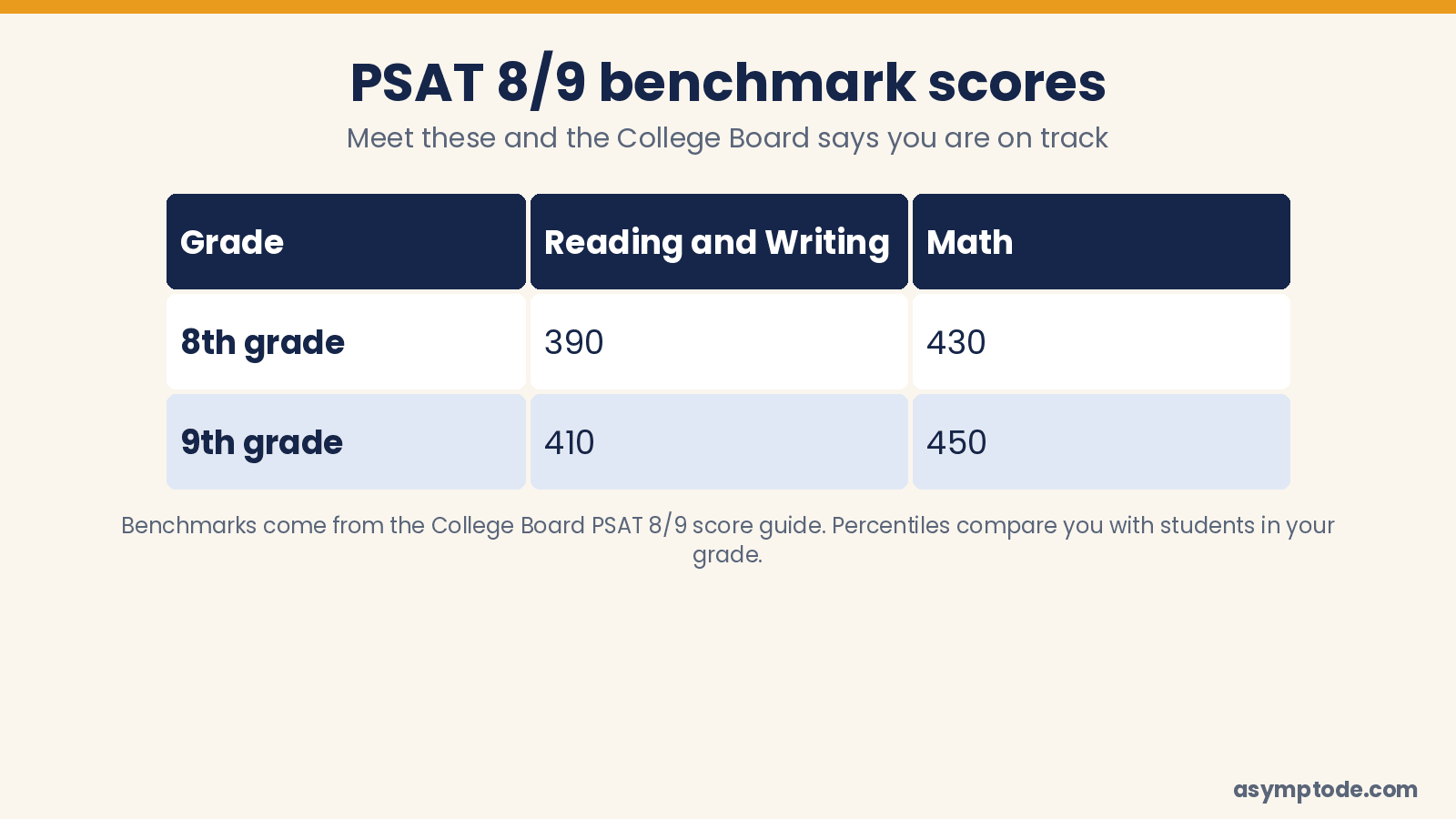
| Grade | Reading and Writing benchmark | Math benchmark |
|---|---|---|
| 8th grade | 390 | 430 |
| 9th grade | 410 | 450 |
The score report also shows percentiles. These compare your child with other students in the same grade. A 7th grader who takes the test is compared with 8th graders.
A "good" score is one that meets the benchmark and shows clear growth next time. Do not compare your child with friends. Compare this year's report with next year's.
What math is on the PSAT 8/9?
The Math section covers four content areas. They are the same four areas as the SAT, at an easier level.
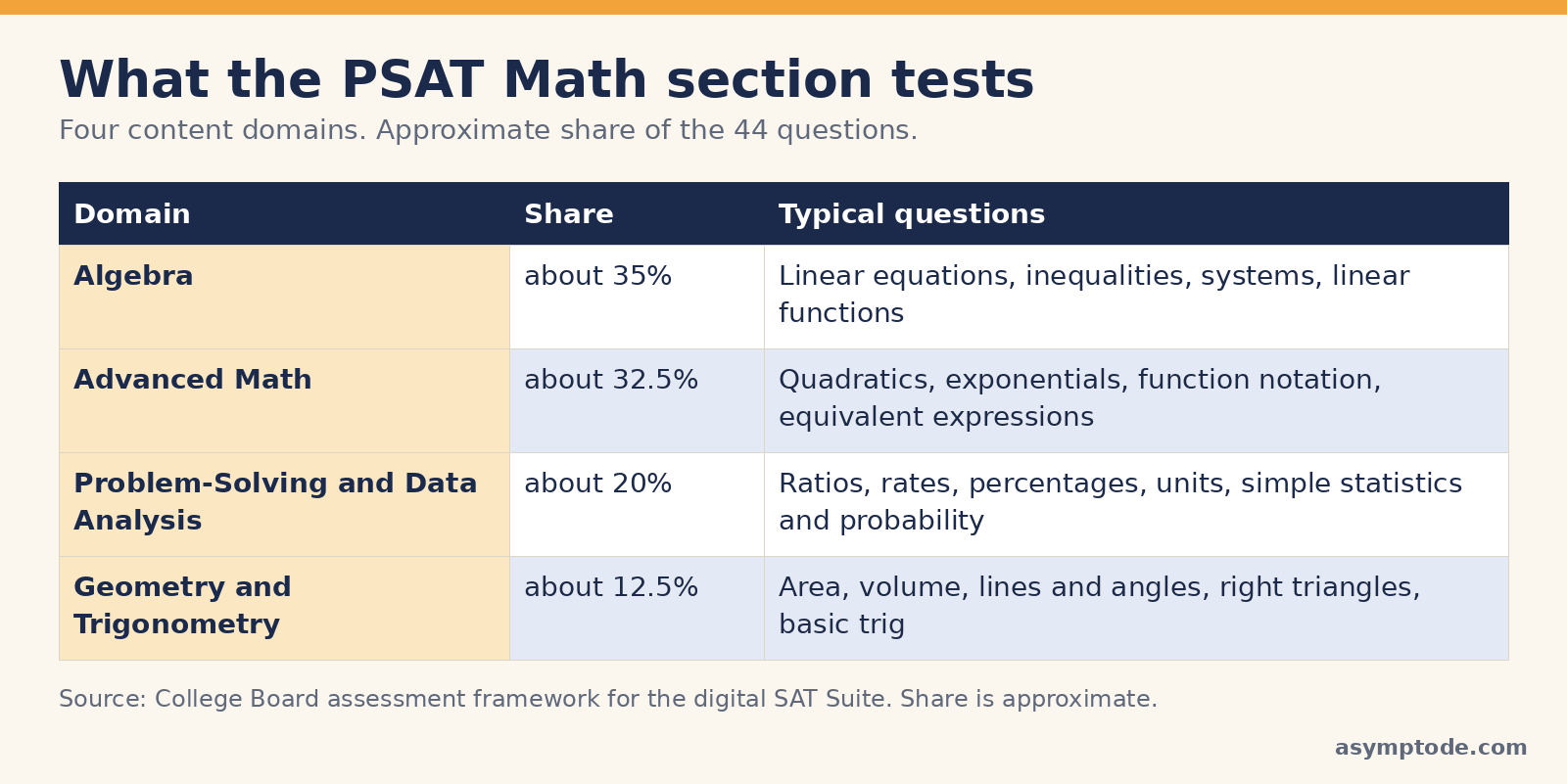
| Content area | What it includes |
|---|---|
| Algebra | Linear equations in one and two variables, linear functions, systems of two linear equations, linear inequalities |
| Advanced Math | Equivalent expressions, nonlinear equations, quadratic, exponential and other nonlinear functions |
| Problem-Solving and Data Analysis | Ratios, rates, units, percentages, one-variable data, scatterplots, probability |
| Geometry and Trigonometry | Area and volume, lines, angles and triangles, right triangles, circles |
About 30% of math questions are set in a real-world, science or social studies context. Most are multiple choice. Some ask students to type in their own answer.
Worked examples: PSAT 8/9 style math
These are our own practice questions, written in the PSAT 8/9 style.
Example 1: a one-step linear equation
Question: If 3x + 7 = 25, what is the value of x?
- Subtract 7 from both sides: 3x = 18.
- Divide both sides by 3: x = 6.
- Check: 3(6) + 7 = 18 + 7 = 25. Correct.
Answer: x = 6
Example 2: a system of two equations
Question: If 2x + y = 11 and x − y = 1, what is the value of x and y?
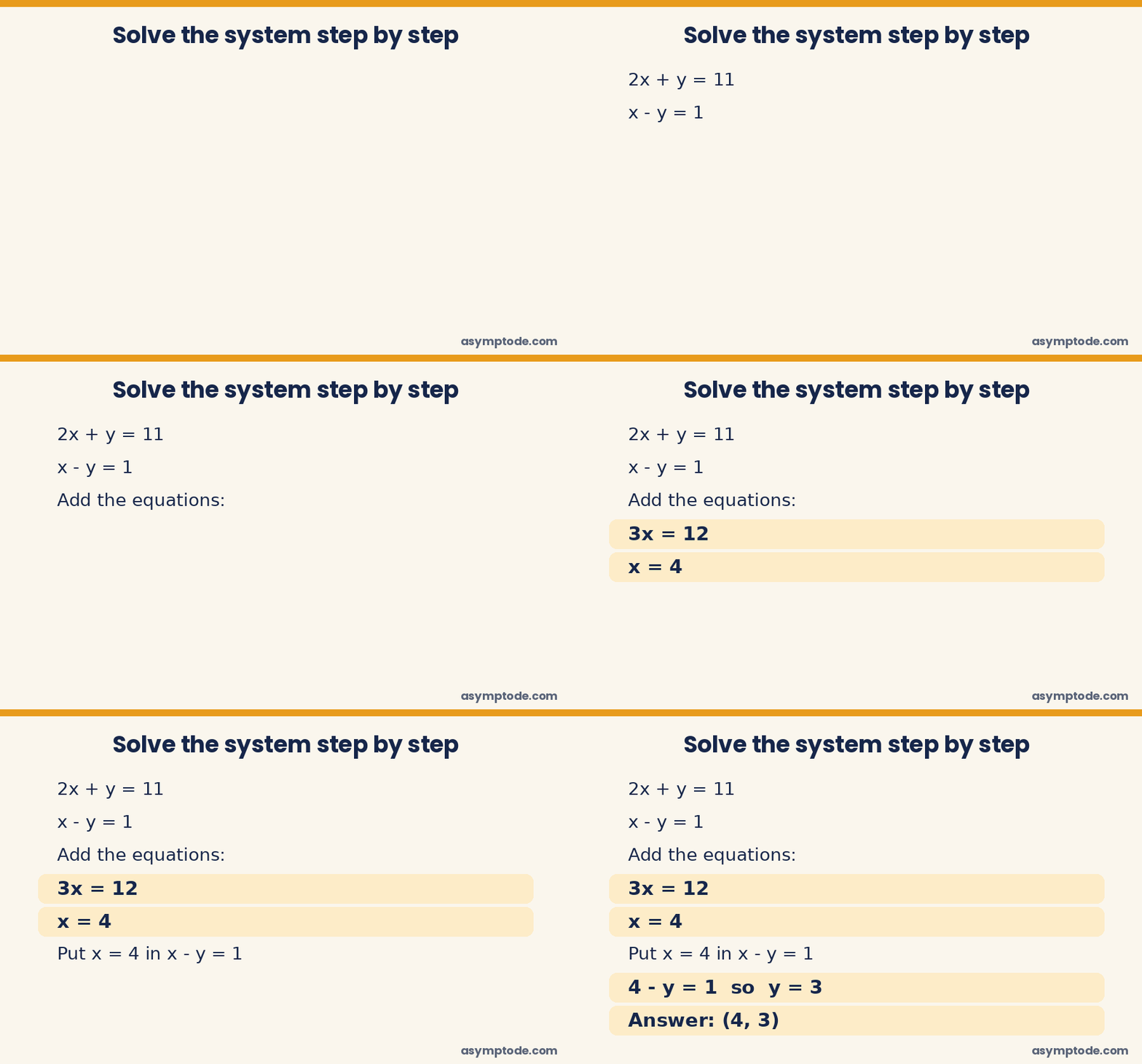
- Add the two equations. The y terms cancel: 3x = 12.
- Divide by 3: x = 4.
- Put x = 4 into x − y = 1: 4 − y = 1, so y = 3.
- Check in the first equation: 2(4) + 3 = 11. Correct.
Answer: x = 4, y = 3
Example 3: a percent question
Question: A jacket costs $80. It is on sale for 25% off. What is the sale price?
- Find 25% of 80: 0.25 × 80 = 20.
- Subtract: 80 − 20 = 60.
- Faster way: 75% of 80 = 0.75 × 80 = 60.
Answer: $60
What are the most common PSAT 8/9 mistakes?
- Rushing module 1. The first module decides the second. Slow, careful work here pays off.
- Leaving questions blank. There is no penalty for guessing. Answer every question.
- Not reading what the question asks. Many students find x when the question asks for 2x or x + 3. Underline the final ask.
- Weak fraction and percent skills. These show up across all four areas. Fix them early.
- Never trying the Bluebook app. The tools and the timer feel different on screen. Take at least one full practice test in Bluebook.
- Skipping the review. The score report shows the skills that lost points. That list is the best study plan you can get.
Want a mentor to read your child's score report with you and turn it into a clear plan? Book a free demo class with Asymptode.
How should my child prepare for the PSAT 8/9?
The PSAT 8/9 should feel low-pressure. A short, steady plan is enough for most students. Here is a simple six-week plan with about three short sessions a week.
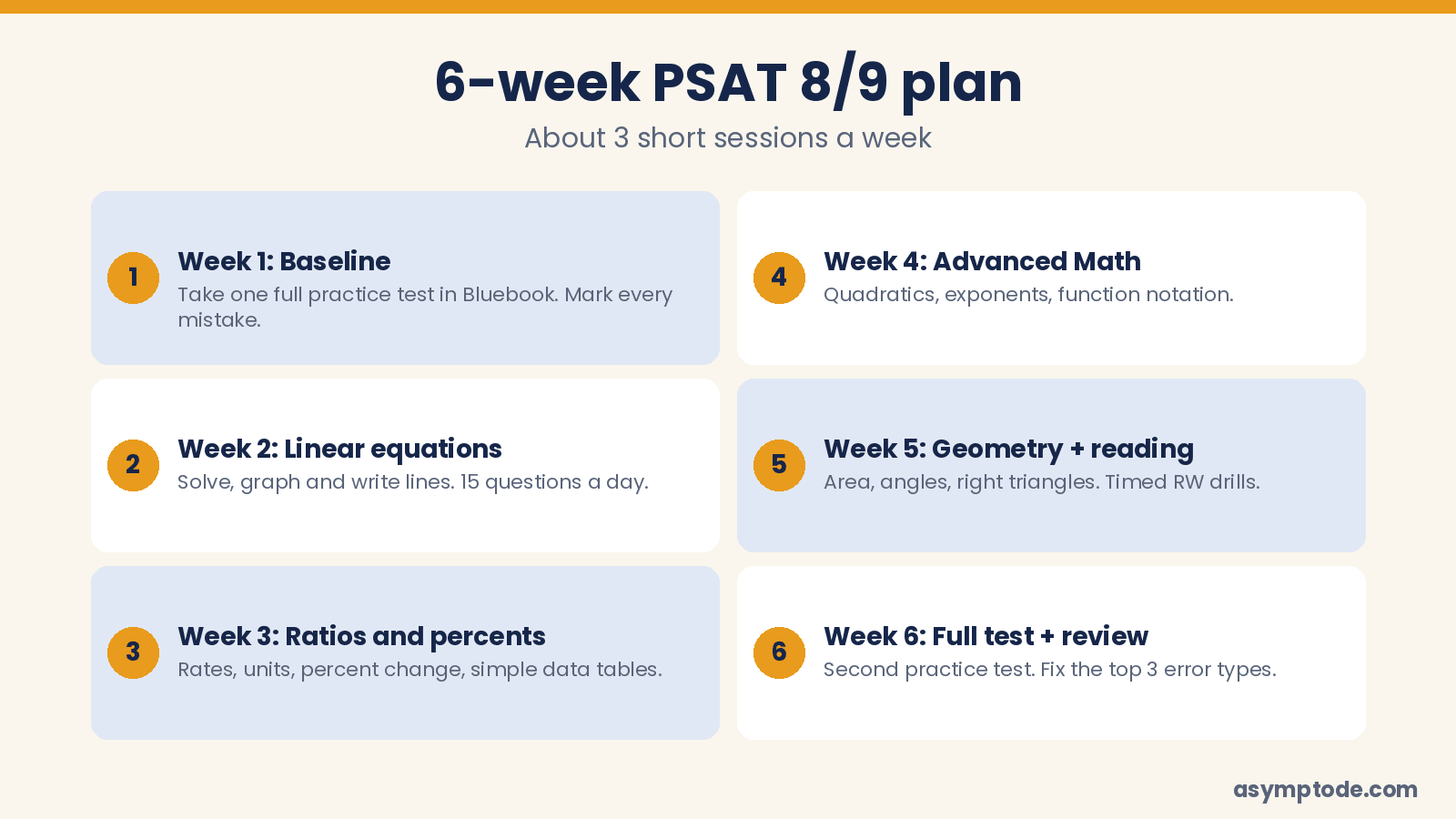
| Week | Focus | What to do |
|---|---|---|
| 1 | Baseline | Take one full practice test in Bluebook. List every mistake by topic. |
| 2 | Linear equations | Solve, graph and write equations of lines. About 15 questions a session. |
| 3 | Ratios and percents | Rates, units, percent change, reading tables and charts. |
| 4 | Advanced Math | Simple quadratics, exponents and function notation. |
| 5 | Geometry and reading | Area, angles, right triangles. Timed Reading and Writing sets. |
| 6 | Full test and review | Second practice test. Fix the top three error types. |
Tips that help at home:
- Keep it short. 30 to 40 minutes of focused work beats a two-hour session.
- Use official practice. The College Board's free practice tests in Bluebook match the real test best.
- Talk about the "why." Ask your child to explain one solution to you. If they can teach it, they know it.
- Protect sleep. A rested student makes fewer careless mistakes.
Does the PSAT 8/9 matter?
The PSAT 8/9 does not go to colleges. It is not used for National Merit. That only comes from the PSAT/NMSQT in grade 11.
But it still matters as a map. It shows, early, which skills need work before high school math gets harder. A student who fixes linear equations and percents in grade 8 or 9 has a much easier path to the SAT and to courses like Algebra 2. Our Digital SAT Math guide shows where these skills lead.
Some families also use the PSAT 8/9 to plan for private high school entry tests. If that is your goal, see our ISEE vs SSAT guide.
How 1-on-1 tutoring helps with the PSAT 8/9
At Asymptode, every class is live, online and 1-on-1. One mentor works with one student. Here is how that helps with the PSAT 8/9:
- We start from the score report. The mentor looks at the skills that lost points and builds a plan around them, not around a generic course.
- We watch the working, not just the answer. Many PSAT mistakes are method slips, such as a sign error or misreading the question. A mentor sees each step and fixes the habit.
- Homework fits the gap. Your child gets practice on the exact topics they need, at their level, with feedback from the same mentor.
- Parents see progress. You get short updates on what improved and what still needs practice.
- Every class is recorded. Your child can rewatch a tricky method before the test.
The aim is calm confidence and strong math foundations, not cramming. See our fees or talk to an advisor to book a free demo class.
FAQ
What grade takes the PSAT 8/9?
The PSAT 8/9 is for students in grades 8 and 9. Some schools let younger students take it. A 7th grader is compared with 8th graders in the percentile.
How long is the PSAT 8/9?
The test is 2 hours 14 minutes of testing time. Reading and Writing takes 64 minutes and Math takes 70 minutes. There are 98 questions in total.
What is a good PSAT 8/9 score?
A good score meets the College Board benchmark: 390 Reading and Writing and 430 Math in grade 8, or 410 and 450 in grade 9. Growth from one year to the next also matters.
Can you use a calculator on the PSAT 8/9?
Yes. A calculator is allowed on the whole Math section. The Bluebook app also has a built-in graphing calculator.
Does the PSAT 8/9 count for National Merit?
No. Only the PSAT/NMSQT, taken in grade 11, is used for the National Merit Scholarship Program.
How do I register my child for the PSAT 8/9?
You do not register on your own. Schools and districts register students. Ask your child's school counselor if and when the school offers it.