
If you want to know how to get into the University of Melbourne, start with three things: the right school subjects, a strong final score, and an application sent on time. Australian Year 12 students apply through VTAC. Most international students apply to the University directly or through an authorised agent.
Key takeaways
- Melbourne uses the "Melbourne Model": a 3-year bachelor's degree first, then an optional graduate degree such as Medicine, Law or Engineering.
- Domestic and Australian Year 12 students apply through VTAC. Late applications close 30 October 2026 and very late applications close 4 December 2026.
- The 2026 guaranteed ATARs were 92.00 for Commerce, 91.00 for Science and 93.00 for Biomedicine. The 2027 figures are not yet published.
- International students apply directly or through an agent, pay an AUD 150 fee and can list up to 3 course preferences.
- Maths prerequisites matter. Commerce, Science and Biomedicine all need Mathematical Methods or Specialist Mathematics (or an equivalent).
How to get into the University of Melbourne: what is the short version?
Quick answer: Choose one of the University's bachelor's degrees, check its prerequisites, and reach the entry score for your qualification. Australian Year 12 students apply through VTAC and list up to 8 preferences. International students apply directly or through an authorised agent. Meet the English test rules, apply early, and look at scholarships and Access Melbourne before the deadlines.
What is the Melbourne Model?
Under the Melbourne curriculum, you study a three-year bachelor's degree first. Then you can start work or go on to a graduate degree.
Inside your degree you choose majors, electives and breadth subjects. A major is one third of your subjects. Breadth subjects come from other fields, for example marketing, genetics or philosophy.
 The Melbourne Model in four steps.
The path starts with Year 12 (or IB, A Levels or another qualification). Next comes a 3-year bachelor's degree, such as the Bachelor of Science. Some students then take a graduate degree such as the MD (Medicine), JD (Law) or MEng (Engineering). The final step is a career.
Which bachelor's degrees can you apply for?
There are seven bachelor's degrees: Arts, Biomedicine, Commerce, Design, Fine Arts, Music and Science. There are also specialist degrees in Agriculture and Oral Health. You can take concurrent diplomas in computing, languages, mathematics and music alongside your degree.
What graduate degrees come after the bachelor's?
Graduate degrees include Law, Engineering, Medicine, Architecture and Teaching:
| Graduate route | How it works | Key entry points |
|---|---|---|
| Medicine (MD) | 3-year bachelor's, then the 4-year Doctor of Medicine | GAMSAT, a minimum WAM, and a Multi Mini Interview (MMI). No subject prerequisites. |
| Law (JD) | Non-law bachelor's (3 years), then the 3-year Juris Doctor | About 6 years in total. No mid-year entry to the JD. |
| Engineering (MEng) | 3-year bachelor's, then the 2-year Master of Engineering ("3+2") | Relevant maths and science prerequisites, and a minimum WAM of 65% |
The MD page does not state the minimum WAM figure, so check the Doctor pathway page. Any BSc major can lead to the MD. For a wider view of these careers, read our guides on how to become a doctor and how to become an engineer.
Graduate Degree Packages give you an undergraduate offer and a graduate offer together, in areas such as Engineering, Health, Law and Teaching. You must start your bachelor's straight after school.
How do Australian Year 12 students apply through VTAC?
All domestic applicants apply through VTAC. This includes Year 12 students studying interstate or overseas. You can list up to 8 courses or Graduate Degree Packages.
International students doing an Australian Year 12, or the IB in Australia or New Zealand, also use VTAC.
What are the VTAC dates for 2027 entry?
All dates below come from VTAC Dates and Fees.
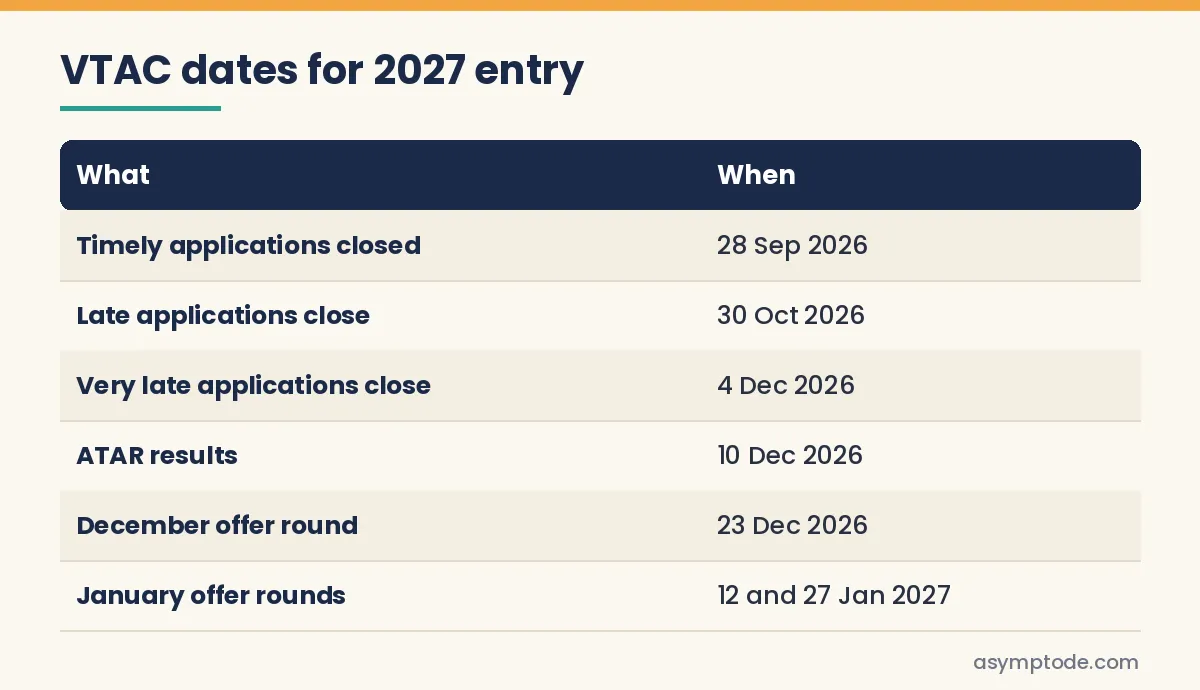 VTAC key dates for courses starting in 2027.
Timely applications closed on 28 September 2026. Late applications close on 30 October 2026, and very late applications close on 4 December 2026. ATARs are released on 10 December 2026, and December round offers come out on 23 December 2026. January round offers follow on 12 and 27 January 2027.
| Event | Date | Fee |
|---|---|---|
| Timely applications | 3 Aug to 28 Sep 2026 (closed) | $83 (current Year 12) or $104 (others) |
| Late applications close | 30 Oct 2026, 5pm | $166 |
| Very late applications close | 4 Dec 2026, 5pm | $208 |
| VCE results and ATARs online | 10 Dec 2026, 7am | – |
| Change of preference closes (current VCE) | 12 Dec 2026, 12 noon | – |
| December offer round | 23 Dec 2026, 10am | – |
| January rounds 1 and 2 | 12 Jan and 27 Jan 2027 | – |
Late applications close today, 30 October 2026, at 5pm. After that, the very late window runs until 4 December. IB notional ATARs go online on 18 December 2026.
Semester 1, 2027 starts on Monday 1 March 2027. Orientation runs from 22 to 26 February 2027.
What ATAR do you need for the University of Melbourne?
The 2027 guaranteed ATARs are not yet published (checked 30 October 2026). The table shows the official 2026 ATAR guarantees. A guaranteed ATAR means you get an offer if you reach it and meet every prerequisite.
| Course | 2026 guaranteed ATAR (domestic) | 2026 Access Melbourne guarantee | 2026 international guarantee |
|---|---|---|---|
| Agriculture | 72.00 | 68.00 | 70.00 |
| Arts | 88.00 | 74.00 | 83.00 |
| Biomedicine | 93.00 | 86.00 | 92.00 |
| Commerce | 92.00 | 80.00 | 91.00 |
| Design | 88.00 | 74.00 | 83.00 |
| Science | 91.00 | 74.00 | 85.00 |
Oral Health has no guaranteed ATAR. Treat these figures as a guide for 2027, not a promise.
What are the VCE prerequisites?
Prerequisites are Units 3 and 4 subjects. Missing one can stop an offer, even with a high ATAR.
| Course | Prerequisites |
|---|---|
| Science (Option 1) | English 25+ (or EAL 30+), Methods or Specialist 25+, and one of Biology, Chemistry or Physics 25+ |
| Science (Option 2) | English 25+ (or EAL 30+), plus both Methods and Specialist 25+ (no science needed) |
| Commerce | English or EAL, plus Mathematical Methods or Specialist Mathematics |
| Biomedicine | English or EAL, plus Chemistry, and Methods or Specialist |
| Arts and Design | English or EAL only (some Design majors may need a bridging maths subject) |
| Oral Health | English or EAL, plus Biology or Chemistry |
Science scores come from the official Bachelor of Science prerequisites. For Commerce and Biomedicine, check the minimum study scores on each course page.
Non-English prerequisites must generally have been met within the last 10 years.
Do you need Specialist Maths for Science? No, if you have Methods 25+ and one science at 25+. If you take no science, Methods 25+ and Specialist 25+ together meet the rule. Our VCE Maths Methods exam guide and VCE Specialist Maths exam guide explain both subjects.
Missed Methods? The University's Calculus and Probability Online is equivalent to VCE Methods 3/4 ($990 for both parts in 2025).
What is Access Melbourne?
Access Melbourne is the University's equity entry scheme for VTAC applicants. It can give adjusted or guaranteed ATARs. It also gives automatic scholarship consideration, including the Narrm Scholarship Program.
Eligible groups include low-income, regional or remote, first-in-family, and Aboriginal or Torres Strait Islander students, students with a disability, and people aged 23+.
You apply through the VTAC SEAS application. For 2027 entry it ran from 3 August to 9 October 2026. Read the Access Melbourne page for full rules.
How do international students get into the University of Melbourne?
If you are not doing an Australian Year 12, you apply directly or through an authorised education agent. All mid-year applicants apply directly.
- Check the entry score and prerequisites for your qualification.
- Apply with up to 3 preferences and pay the AUD 150 non-refundable fee.
- Wait about 2–4 weeks for assessment.
- Accept your offer and pay the deposit (at least AUD 17,000).
- Arrange OSHC (health cover) and apply for your student visa.
Semester 1 (February/March) is the main intake. The official dates page had not been updated for 2027 when we checked on 30 October 2026. Check the important dates page and apply as early as you can.
Guaranteed or minimum? A guaranteed score means you get an offer if you meet it and all course requirements. A minimum score means you can be considered, but an offer is not assured.
What are the entry scores by country?
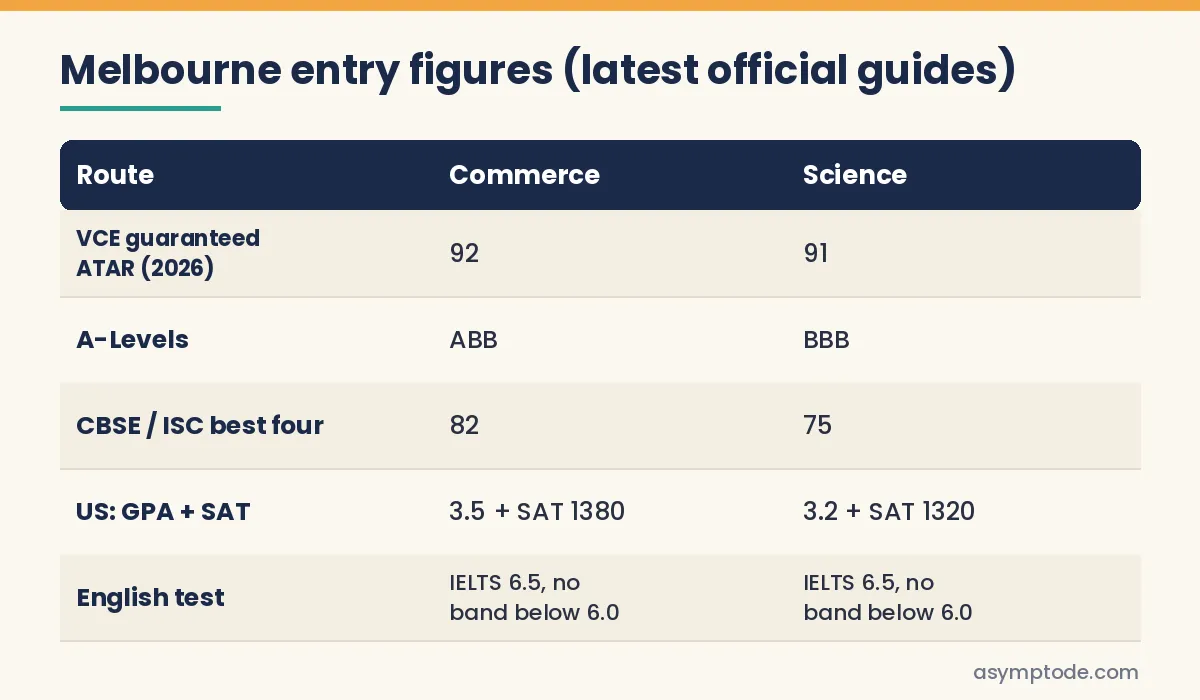 Commerce and Science entry figures by route.
VCE guaranteed ATAR (2026): Commerce 92, Science 91. GCE A Levels: Commerce ABB, Science BBB. CBSE or ISC best-four average: Commerce 82, Science 75. US GPA plus SAT: Commerce 3.5 and 1380, Science 3.2 and 1320. English: IELTS 6.5 with no band below 6.0.
GCE A Levels (2026 intake). Points are A* = 6, A = 5, B = 4, C = 3, D = 2, E = 1, added over 3 subjects. See the official A Levels entry scores.
| Course | Guaranteed | Minimum | Notes |
|---|---|---|---|
| Arts | BBB (12) | BBC (11) | |
| Biomedicine | AAB (14) | ABB (13) | |
| Commerce | ABB (13) | – | Needs Maths |
| Science | BBB (12) | – | Needs Maths plus Biology, Chemistry or Physics |
Worked example: AAB = 5 + 5 + 4 = 14, which meets the Biomedicine guarantee. A*BC = 6 + 4 + 3 = 13, which meets the Commerce guarantee, as long as Maths is one of the subjects. Our A-Level Maths guide helps with the Maths grade.
India (CBSE AISSC or CISCE ISC). The University uses the average of your best four final-year subjects. The page gives no year. See the India entry scores.
| Course | Score | Prerequisites |
|---|---|---|
| Biomedicine | 91 | English, Chemistry, Maths |
| Commerce | 82 | English, Maths |
| Science | 75 | English, Maths, plus Biology, Chemistry or Physics |
| Arts, Design | 75 | English |
Worked example: 92 + 88 + 85 + 79 = 344. Divide by 4 and you get 86. That clears Commerce (82) but not Biomedicine (91). Indian applicants with prior tertiary study must apply through an authorised agent. For board exam planning, see our CBSE board exams 2027 guide.
United States. The University looks at your unweighted Year 11–12 GPA plus an SAT, ACT, STAT or AP aggregate. Commerce lists GPA 3.5 with SAT 1380 or ACT 29. Science lists GPA 3.2 with SAT 1320 or ACT 28. Biomedicine lists GPA 3.7 with SAT 1400 or ACT 30. A slightly lower SAT or ACT may be accepted with a higher GPA.
Not sure which test to sit? Read our SAT vs ACT comparison.
IB Diploma. The University's IB page lists Agriculture 25, Arts 31, Biomedicine 37, Commerce 35, Design 31 and Science 31. But the page says these are "guaranteed for 2024 intake only", so check the current page before you rely on them. Commerce needs maths at grade 4+ (HL or SL). Science needs maths 4+ and Biology, Chemistry or Physics 4+. Our IB Diploma Programme guide explains how IB scores work.
China. The University "does not currently accept Gaokao results for direct entry". Students from Chinese government high schools usually go through Trinity College Foundation Studies.
What is Trinity College Foundation Studies?
Trinity College Foundation Studies (TCFS) is a pathway into the University. It has three entry levels: Standard, Comprehensive and Fast Track. For 2027, Standard entry needs IELTS 6.0 with no band below 5.5. Check intake dates and fees on the TCFS entry page.
What English test scores do you need?
These are the standard undergraduate English requirements for all degrees except Oral Health:
| Test | Score needed |
|---|---|
| IELTS Academic | 6.5 overall, no band below 6.0 |
| TOEFL iBT | 79 (Writing 21, Speaking 18, Reading 13, Listening 13) |
| PTE Academic | 58, no skill below 50 |
| Cambridge C1 Advanced | 176, no skill below 169 |
Oral Health needs more: IELTS 7.0 with no band below 7.0, TOEFL iBT 94, or PTE 65 with no skill below 65.
Tests must be taken in one sitting, within 24 months of your course start. At-home tests are not accepted, and Duolingo is not listed. Secondary study in English can also meet the rule, for example a VCE English study score of 25+.
What scholarships can you get?
- Melbourne International Excellence Scholarship (Undergraduate): a 20% tuition fee remission for the whole course. At least 140 are awarded. It is for international (Overseas Fee) students starting in 2027 or later. Consideration is automatic. See the scholarship page.
- Melbourne Chancellor's Scholarship: for an ATAR of 99.90+ (90+ for Indigenous students). Domestic winners get full CSP sponsorship plus a living allowance. You are considered automatically through VTAC. For 2026 entry, 90 were offered.
- Narrm Scholarships: considered through Access Melbourne. For 2026 entry, 1,410 were offered.
How much does it cost?
Domestic students take a Commonwealth Supported Place (CSP) and pay a student contribution set by the Australian Government. The 2027 bands are not yet published. In 2026, a full-time year cost $4,738 for Maths and Statistics, $9,537 for Science and Engineering, and $17,399 for Commerce and Law. The SSAF is charged on top.
International students pay per subject, by discipline band. We have not verified 2027 international fees. Check the official fees and payments page for your course. Remember the deposit of at least AUD 17,000 to accept an offer, and that OSHC is compulsory.
What do you need for a student visa?
The basics of the Student visa (subclass 500), from Study Australia:
- You generally need a Confirmation of Enrolment (CoE) before you apply.
- You must arrange OSHC.
- You can work up to 48 hours per fortnight during study periods, and unlimited hours in scheduled breaks.
- You must meet the Genuine Student requirement. Each answer is limited to 150 words.
The visa charge rose on 1 July 2025. Check the current amount on the Home Affairs website.
When should you start planning?
Start in Year 9 or 10, when you choose the subjects that become prerequisites.
- Year 9–10: Pick a target degree and check its prerequisites.
- Year 10: Choose subjects that keep Methods (and a science) open.
- Year 12: Apply through VTAC before the timely close.
- After results: Use change of preference and watch the offer rounds.
What mistakes cost students an offer?
- Dropping Methods too early. Commerce, Science and Biomedicine all need it (or Specialist).
- Missing a deadline. Late fees climb fast.
- Ignoring Access Melbourne. Many eligible students never apply through SEAS.
- Trusting old figures. Some pages still show 2024 numbers.
- Relying on a minimum score. A minimum score only gets you considered.
Want a plan for your maths prerequisites? Book a free demo class with an Asymptode mentor.
How does a Methods-style maths question look?
Here is a typical VCE Methods-style question.
 Finding a maximum using the derivative.
Start with f(x) = -x² + 6x - 5 and find the derivative: f'(x) = -2x + 6. Set f'(x) = 0, so -2x + 6 = 0 and x = 3. Substitute back: f(3) = -9 + 18 - 5 = 4. The maximum point is (3, 4).
How 1-on-1 tutoring helps you get into the University of Melbourne
- One dedicated mentor, live online and 1-on-1. Your mentor follows your own syllabus (VCE, IB, A Levels, CBSE or US) and plans around your exam dates and application deadlines.
- Method-first maths and science. Your mentor watches each step of your working in Methods, Specialist, Chemistry or Physics, so you build the skills your prerequisites need.
- Personalised homework with feedback. You get practice set for your weak spots, plus short updates for parents. Every class is recorded so you can rewatch it.
- Help with planning. For non-maths parts such as English tests or VTAC preferences, your mentor helps with planning and study method. Start with a free demo class.
Facts checked against official sources on 30 October 2026.
FAQ
What ATAR do you need for the University of Melbourne?
It depends on the course. The 2026 guaranteed ATARs were 92.00 for Commerce, 91.00 for Science, 93.00 for Biomedicine and 88.00 for Arts. The 2027 figures are not yet published, so check the official ATAR guarantees page.
Is it too late to apply through VTAC for 2027?
Late applications close on 30 October 2026 at 5pm, with a $166 fee. Very late applications close on 4 December 2026, with a $208 fee. After that, later round applications open on 4 December 2026.
Can international students apply without an agent?
Yes. You can apply directly to the University or through an authorised agent. The fee is AUD 150 and you can list up to 3 preferences. Indian applicants with prior tertiary study must use an authorised agent.
Does the University of Melbourne accept the Gaokao?
No. The University does not currently accept Gaokao results for direct entry. Students from Chinese government high schools usually enter through Trinity College Foundation Studies. Students with A Levels, IB or a US diploma may be able to apply directly.
Can I study Medicine straight after Year 12?
Not as a direct undergraduate degree. You first complete a 3-year bachelor's degree, such as the BSc, and then apply for the 4-year Doctor of Medicine. You need the GAMSAT, a minimum WAM and a Multi Mini Interview.
Is Duolingo accepted for English?
Duolingo is not listed as an accepted test. Approved tests include IELTS Academic, TOEFL iBT, PTE Academic and Cambridge C1 Advanced. Online and at-home tests are not accepted.
Ready to start? Book a free demo class and advisor call, or see our plans and fees.
Sources
- The Melbourne curriculum
- ATAR guarantees (2026 guaranteed ATARs)
- VTAC Dates and Fees 2026-2027
- International applications
- GCE A Levels entry scores
- India CBSE/ISC entry scores
- Undergraduate English language requirements
- Bachelor of Science prerequisites
- Melbourne International Excellence Scholarship (Undergraduate)
- Access Melbourne
- Study Australia: Student visa (subclass 500)
- Doctor of Medicine pathway
- International important dates
- International fees and payments
- Trinity College Foundation Studies entry requirements