

VCE Specialist Mathematics is the most advanced maths study in Victoria's VCE. It covers proof, complex numbers, vectors, calculus, differential equations and statistics. This guide explains the two exams, the 2026 dates, how the study score is made up, the six content areas with worked examples, and a final-weeks plan.
Key takeaways
- Specialist Maths has two end-of-year exams: Exam 1 (15 min reading + 1 hour, 40 marks, no technology) and Exam 2 (15 min reading + 2 hours, 80 marks, CAS calculator and one bound reference).
- Exam 1 is worth 20% of the study score and Exam 2 40%. School-assessed coursework in Units 3 and 4 makes up the other 40%.
- Exam 2 has Section A: 20 multiple-choice questions and Section B: 60 marks of extended questions.
- A formula sheet is provided in both exams.
- In 2026, Exam 1 is on Monday 9 November and Exam 2 on Wednesday 11 November (check the VCAA timetable).
What is the VCE Specialist Maths exam format?
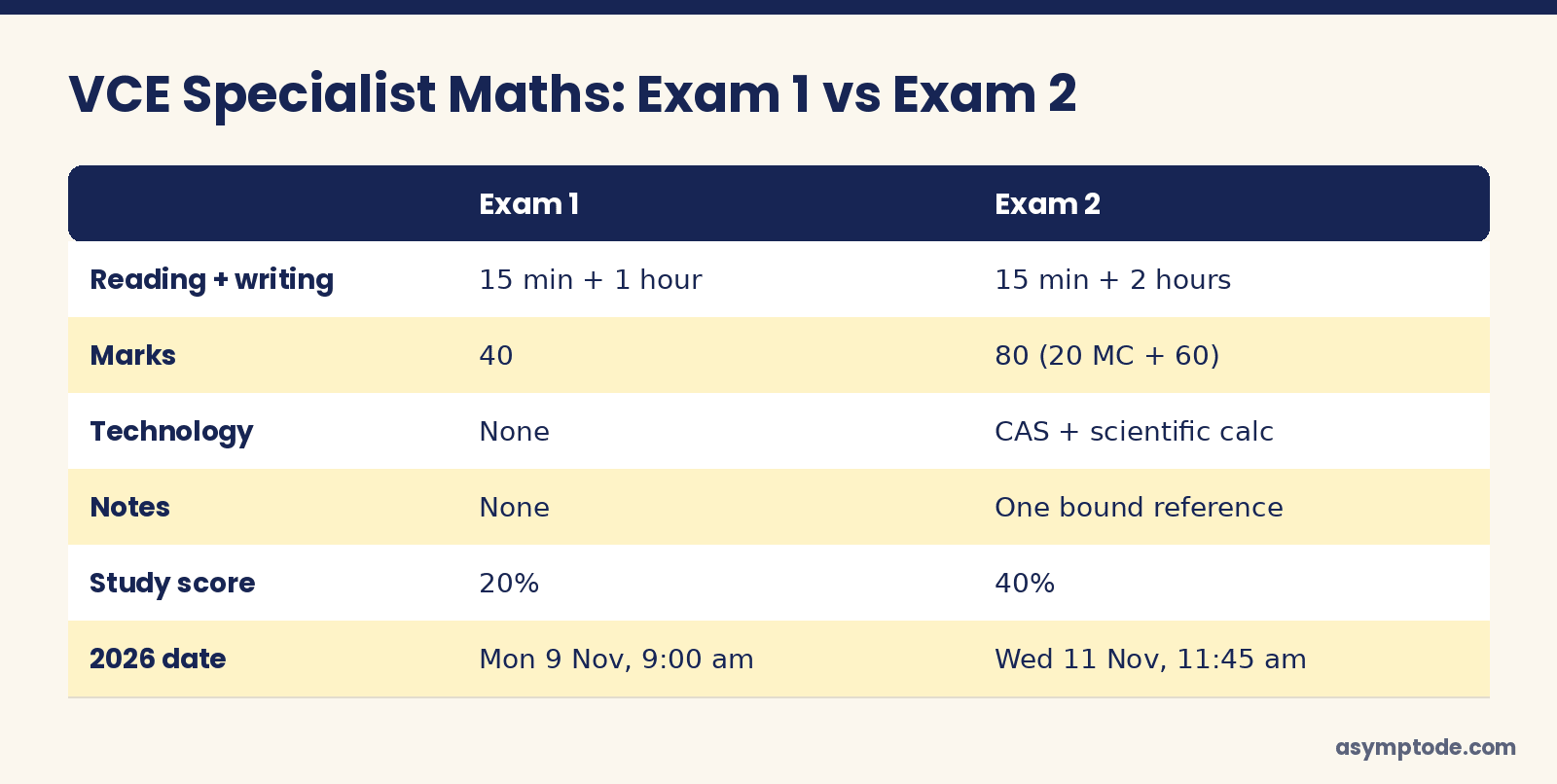
Quick answer: VCE Specialist Mathematics has two exams. Exam 1 has 15 minutes reading and 1 hour writing, 40 marks, short and extended answers, and no calculator or notes. Exam 2 has 15 minutes reading and 2 hours writing, 80 marks: 20 multiple-choice questions plus 60 marks of extended questions, with CAS and one bound reference allowed.
| Exam 1 | Exam 2 | |
|---|---|---|
| Reading time | 15 minutes | 15 minutes |
| Writing time | 1 hour | 2 hours |
| Marks | 40 | 80 |
| Questions | Short and extended answer | Section A: 20 MC (20 marks), Section B: 60 marks |
| Technology | Not allowed | CAS + scientific calculator |
| Notes | Not allowed | One bound reference |
| Study score weight | 20% | 40% |
The format comes from the VCAA examination specifications for the 2023 study design. Both exams use the same formula sheet.
Exam 1 checks that students can do the algebra and calculus by hand, cleanly. Exam 2 checks problem solving and modelling, where CAS speeds up the routine steps.
When are the 2026 VCE Specialist Maths exams?
For 2026, Specialist Mathematics Exam 1 is on Monday 9 November, 9:00 am to 10:15 am, and Exam 2 is on Wednesday 11 November, 11:45 am to 2:00 pm (times include reading time). Always confirm on the official VCAA examination timetable. Methods exams are a few days earlier, on 5 and 6 November. Our VCE Maths Methods exam guide covers those.
How is the Specialist Maths study score worked out?
The study score combines school-assessed coursework (SACs) from Units 3 and 4 with the two exams:
| Part | Weight |
|---|---|
| Unit 3 school-assessed coursework | 20% |
| Unit 4 school-assessed coursework | 20% |
| Exam 1 | 20% |
| Exam 2 | 40% |
So the two exams are 60% of the score. Exam 2 alone is worth as much as both units of SACs together.
What topics are in VCE Specialist Maths Units 3 and 4?
Quick answer: Units 3 and 4 cover six areas: discrete mathematics (logic and proof), functions, relations and graphs, algebra, number and structure (complex numbers), calculus (including differential equations and kinematics), space and measurement (vectors and vector calculus), and data analysis, probability and statistics.
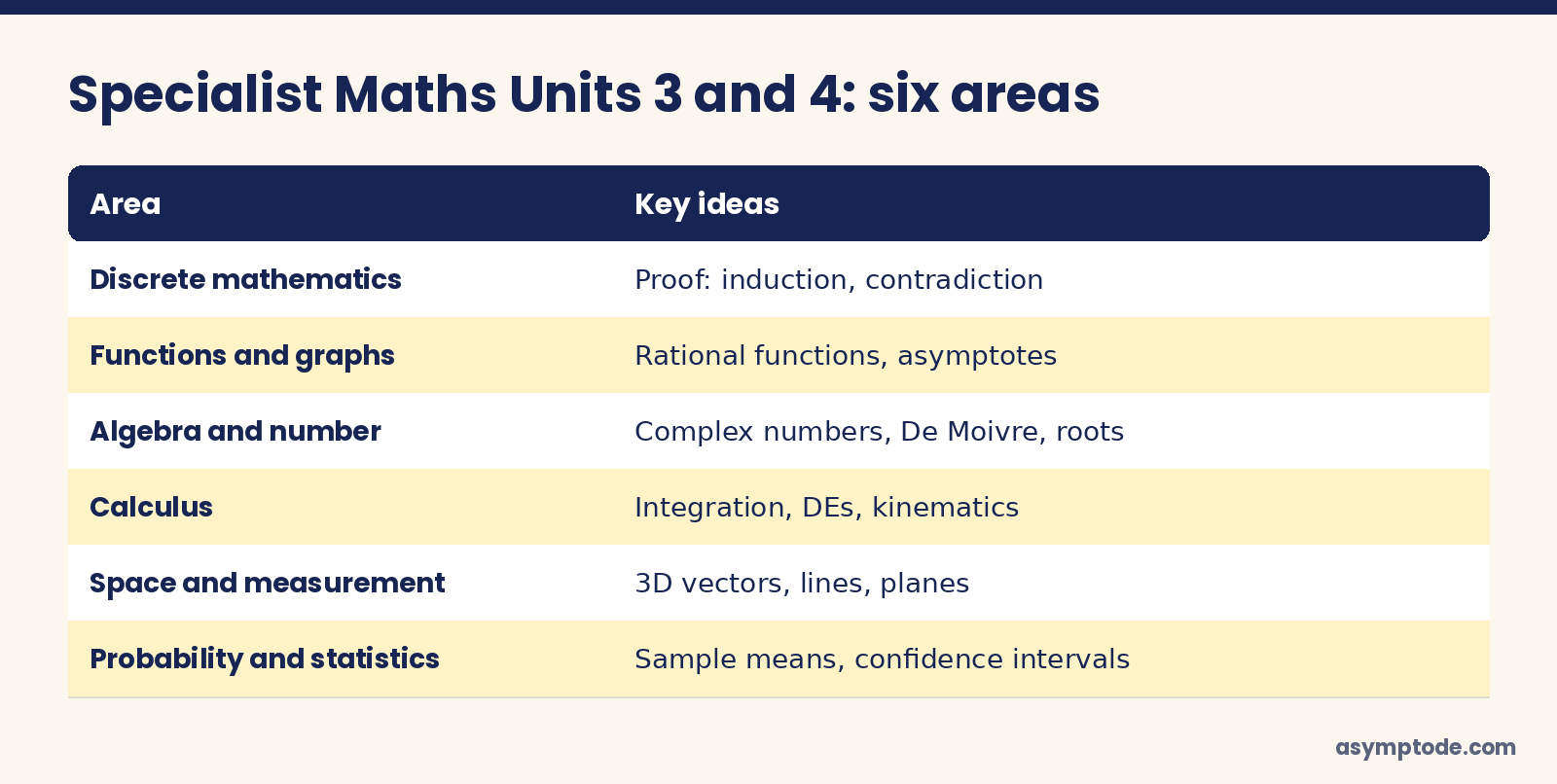
| Area | What students learn |
|---|---|
| Discrete mathematics | Proof by induction, contradiction and counterexample |
| Functions, relations and graphs | Rational functions, asymptotes, sketching |
| Algebra, number and structure | Complex numbers, polar form, De Moivre, roots |
| Calculus | Integration techniques, volumes, arc length, differential equations, kinematics |
| Space and measurement | Vectors in 3D, lines and planes, vector calculus |
| Data analysis, probability and statistics | Linear combinations of random variables, sample means, confidence intervals, hypothesis tests |
Worked examples for VCE Specialist Maths
Worked example 1: De Moivre's theorem (Exam 1 style)
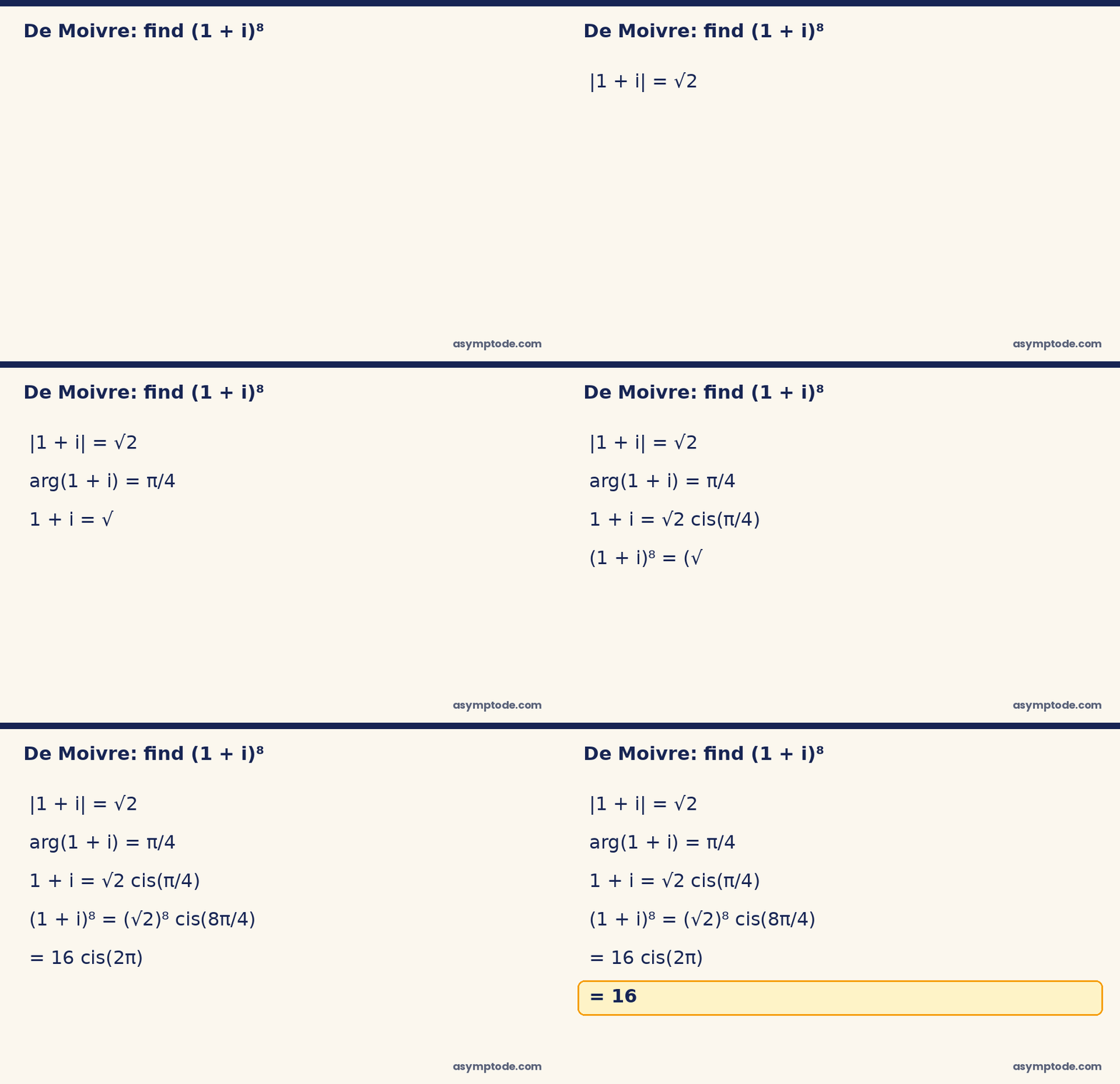
Question: Find (1 + i)⁸.
- Modulus: |1 + i| = √(1² + 1²) = √2.
- Argument: arg(1 + i) = π/4.
- So 1 + i = √2 cis(π/4).
- By De Moivre: (1 + i)⁸ = (√2)⁸ cis(8 × π/4) = 16 cis(2π).
- cis(2π) = 1, so (1 + i)⁸ = 16.
Worked example 2: Angle between vectors
Question: Find the angle between a = i + 2j + 2k and b = 2i + j − 2k.
- Dot product: a · b = (1)(2) + (2)(1) + (2)(−2) = 2 + 2 − 4 = 0.
- If the dot product is 0 (and neither vector is zero), the vectors are perpendicular.
- The angle is 90° (π/2).
Spotting a zero dot product saves a lot of time on Exam 1.
Worked example 3: A simple differential equation
Question: Solve dy/dx = 2y, given y = 3 when x = 0.
- Separate: (1/y) dy = 2 dx.
- Integrate: ln|y| = 2x + c.
- So y = Ae^(2x).
- Use y(0) = 3: 3 = Ae⁰, so A = 3.
- y = 3e^(2x).
Worked example 4: Confidence interval for a mean (Exam 2 style)
Question: A sample of 100 has mean 50. The population standard deviation is 10. Find an approximate 95% confidence interval for the population mean.
- Standard error = σ ÷ √n = 10 ÷ √100 = 1.
- 95% interval = x̄ ± 1.96 × SE = 50 ± 1.96.
- Interval ≈ (48.04, 51.96).
On Exam 2, CAS gives the interval quickly, but students still need to state what it means in context.
What are the most common Specialist Maths mistakes?
- Weak proof writing. Induction proofs need a clear base case, assumption and conclusion statement.
- Wrong argument for complex numbers in the second or third quadrant. Draw a quick Argand diagram.
- Leaving out "+ c" or not using the initial condition in differential equations.
- Relying on CAS for everything. Exam 1 has no technology, so hand skills must be fast.
- A messy bound reference. A short, well-organised reference beats a thick folder.
- Not reading the whole question in Exam 2 Section B. Later parts often build on earlier answers.
A final-weeks study plan for VCE Specialist Maths
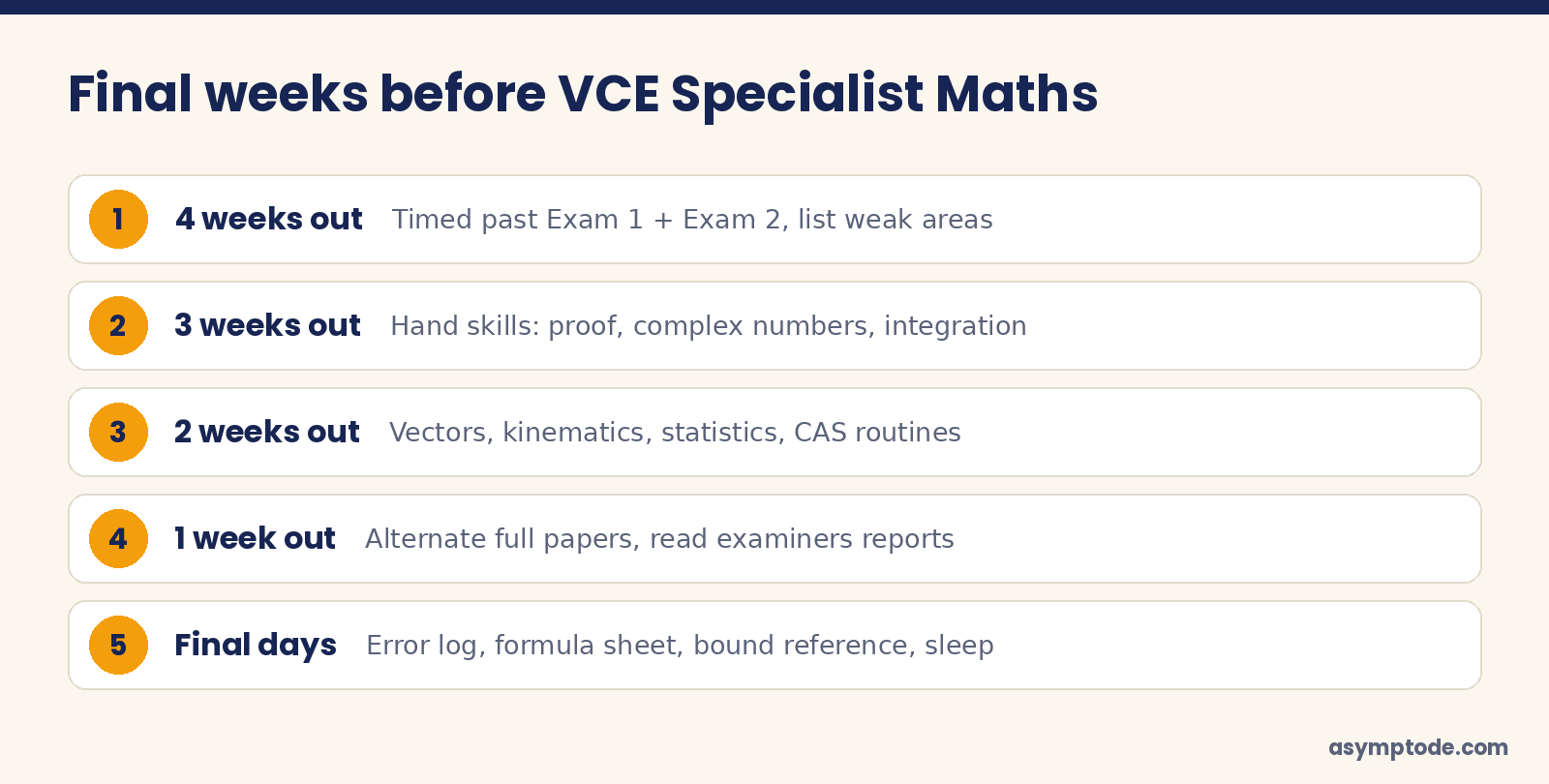
| Time before Exam 1 | Focus |
|---|---|
| 4 weeks | One past Exam 1 and one past Exam 2 under timed conditions; list weak areas |
| 3 weeks | Hand skills: proof, complex numbers, integration techniques (daily Exam 1 questions) |
| 2 weeks | Vectors, kinematics and statistics; CAS routines for Exam 2 |
| 1 week | Alternate full Exam 1 and Exam 2 papers; read examiners' reports |
| Final days | Error log, formula sheet familiarity, bound reference check, sleep |
Use real past papers and examiners' reports from the VCAA website. The reports explain exactly where students lose marks. For students outside Victoria, our HSC Maths Advanced guide covers the NSW path.
How 1-on-1 tutoring helps with VCE Specialist Maths
Specialist Maths moves fast, and gaps in Methods or algebra show up quickly. In 1-on-1 lessons at Asymptode, one dedicated mentor works with one student:
- The mentor follows the school's order of topics and SAC dates, and plans backwards to the November exams.
- In lessons the mentor watches each line of working, especially in proofs and Exam 1 questions, and fixes the method, not just the answer.
- The mentor helps the student build a clean, short bound reference for Exam 2.
- Homework is set at the right level and marked with feedback.
- Every class is recorded so students can rewatch a topic during exam revision.
- Parents get regular updates on progress.
Lessons run online, so time zones and busy Year 12 timetables are easier to fit. Book a free demo class or see our fees.
FAQ
Can you use a calculator in VCE Specialist Maths Exam 1?
No. Exam 1 allows no calculators, software or notes. A formula sheet is provided.
What can you bring into Specialist Maths Exam 2?
One approved CAS calculator, one scientific calculator and one bound reference, which may be annotated. A formula sheet is provided.
How many multiple-choice questions are in Exam 2?
Section A of Exam 2 has 20 multiple-choice questions worth 1 mark each. Section B has 60 marks of extended questions.
When are the 2026 VCE Specialist Maths exams?
Exam 1 is on Monday 9 November 2026 and Exam 2 on Wednesday 11 November 2026. Confirm on the VCAA timetable.
Do you need Methods to take Specialist Maths?
Most schools require students to take Mathematical Methods Units 3 and 4 with Specialist Units 3 and 4, because Specialist builds on Methods content. Check with your school.
How much are the exams worth in Specialist Maths?
The two exams are 60% of the study score: Exam 1 is 20% and Exam 2 is 40%.