
Here is how to become a doctor: do well in biology, chemistry, physics and maths at school, pass your country's medical admissions test, finish a medical degree, then complete supervised training and a licensing exam. The route takes roughly 6 to 15 years, sometimes longer, depending on your country and your chosen specialty.
This guide for students and parents covers the USA, UK, India, Canada and Australia, with official sources.
Key takeaways
- Every route needs strong school science: biology and chemistry first, then physics and maths.
- Each country has its own test: MCAT (USA, most of Canada), UCAT (UK), NEET (UG) (India), UCAT ANZ or GAMSAT (Australia).
- In the UK, India and Australia you can start medicine straight after school. In the USA and Canada you usually need a university degree first.
- After medical school, every doctor does supervised training (internship, Foundation Programme or residency) before working alone.
- Start early, but steadily: good grades, real experience with people, and calm test practice matter more than cramming.
How long does it take to become a doctor?
Quick answer: It usually takes roughly 6 to 15 years after school, sometimes longer. In the UK, India and Australia, many students start a medical degree straight after school. In the USA and Canada, most students first earn a bachelor's degree, then do 4 years of medical school. Every route ends with supervised training and a licensing step.
The exact length depends on your country and your specialty.
What does a doctor actually do?
A doctor diagnoses and treats illness and injury. Doctors take a patient's history, examine them, order tests, explain results and plan treatment. They also prevent disease and work in teams with nurses, pharmacists and other health workers.
There are many types of doctor. A few common ones:
- Family doctors / GPs look after people of all ages in the community.
- Physicians (internal medicine) treat adult illnesses such as diabetes or heart disease.
- Surgeons operate to treat injuries and diseases.
- Paediatricians care for children.
- Psychiatrists treat mental health conditions.
You do not pick your specialty at school. Most doctors choose after medical school.
Which school subjects do you need to become a doctor?
Choose the sciences and keep maths strong. Here is why each one matters:
| Subject | Why it matters for medicine |
|---|---|
| Biology | Cells, body systems, genetics. NEET (UG) gives it half the marks. |
| Chemistry | Asked for by most medical schools. It is the base for drugs and biochemistry. |
| Physics | Tested in NEET (UG) and the MCAT. Used in scans, blood flow and lungs. |
| Maths | Doses, rates, graphs and statistics. Tested in UCAT Quantitative Reasoning. |
| English | Clear writing and speaking. NEET (UG) eligibility needs English too. |
Every medical school sets its own subject rules, so always check the exact entry requirements of the schools you like.
If you are in the US system, AP Biology and AP Chemistry are good ways to stretch yourself. In the UK, a strong base in GCSE Combined Science leads well into A level chemistry and biology.
How do you become a doctor in each country?
Below is the path in five countries. Rules change, so treat this as a map and check the official links.
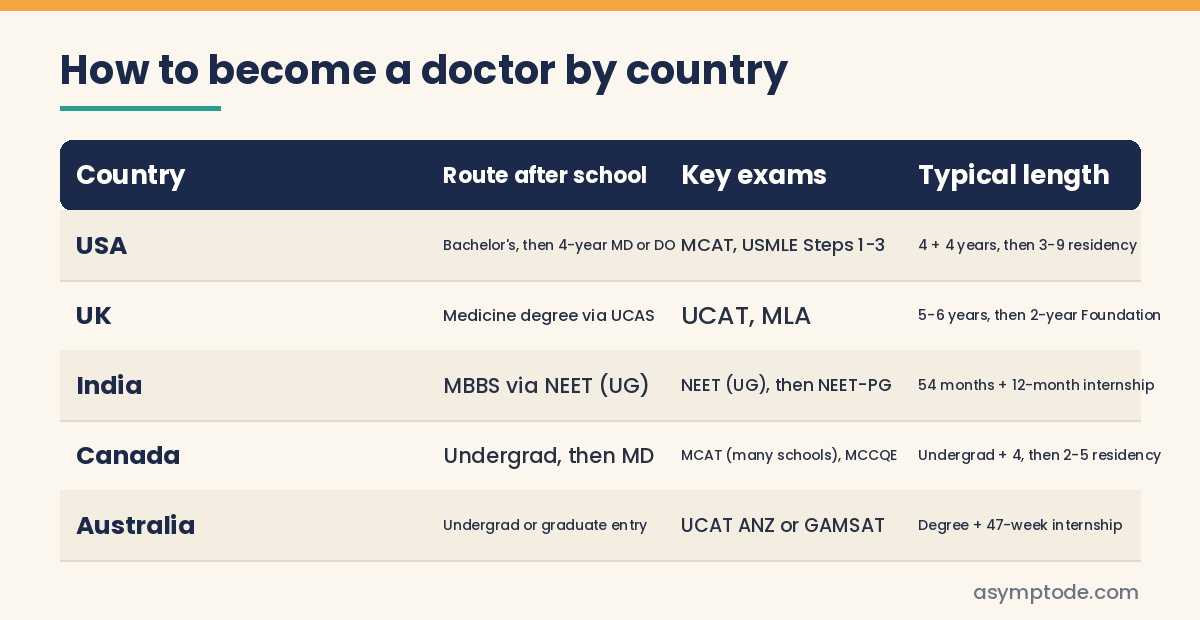
| Country | Route after school | Key exams | Typical length |
|---|---|---|---|
| USA | Bachelor's, then 4-year MD or DO | MCAT, USMLE Steps 1-3 (MD) or COMLEX (DO) | 4 + 4 years, then 3-9 years residency |
| UK | Medicine degree via UCAS | UCAT, MLA | Usually 5-6 years, then 2-year Foundation Programme |
| India | MBBS via NEET (UG) | NEET (UG), then NEET-PG | 54-month course + 12-month internship |
| Canada | Undergrad, then MD | MCAT (at many schools), MCCQE | Undergrad + about 4 years, then 2-5 years residency |
| Australia | Undergraduate or graduate entry | UCAT ANZ or GAMSAT | Degree + 47-week intern year |
How to become a doctor in the USA
- Finish high school with strong science and maths.
- Earn a bachelor's degree. You can major in any subject, but take the premed science courses medical schools ask for.
- Take the MCAT. The AAMC lists four sections: Chemical and Physical Foundations of Biological Systems; Critical Analysis and Reasoning Skills; Biological and Biochemical Foundations of Living Systems; and Psychological, Social, and Biological Foundations of Behavior. Seated time is about 7 hours 30 minutes.
- Go to medical school for four years, for an MD or a DO degree.
- Do residency. The BLS says doctors need 3 to 9 years of internship and residency, depending on specialty. Fellowships add 1 to 3 years.
- Pass the licensing exams. MD students take USMLE Step 1, Step 2 CK and Step 3. DO students take the COMLEX-USA series. Then you apply to a state medical board for a licence.
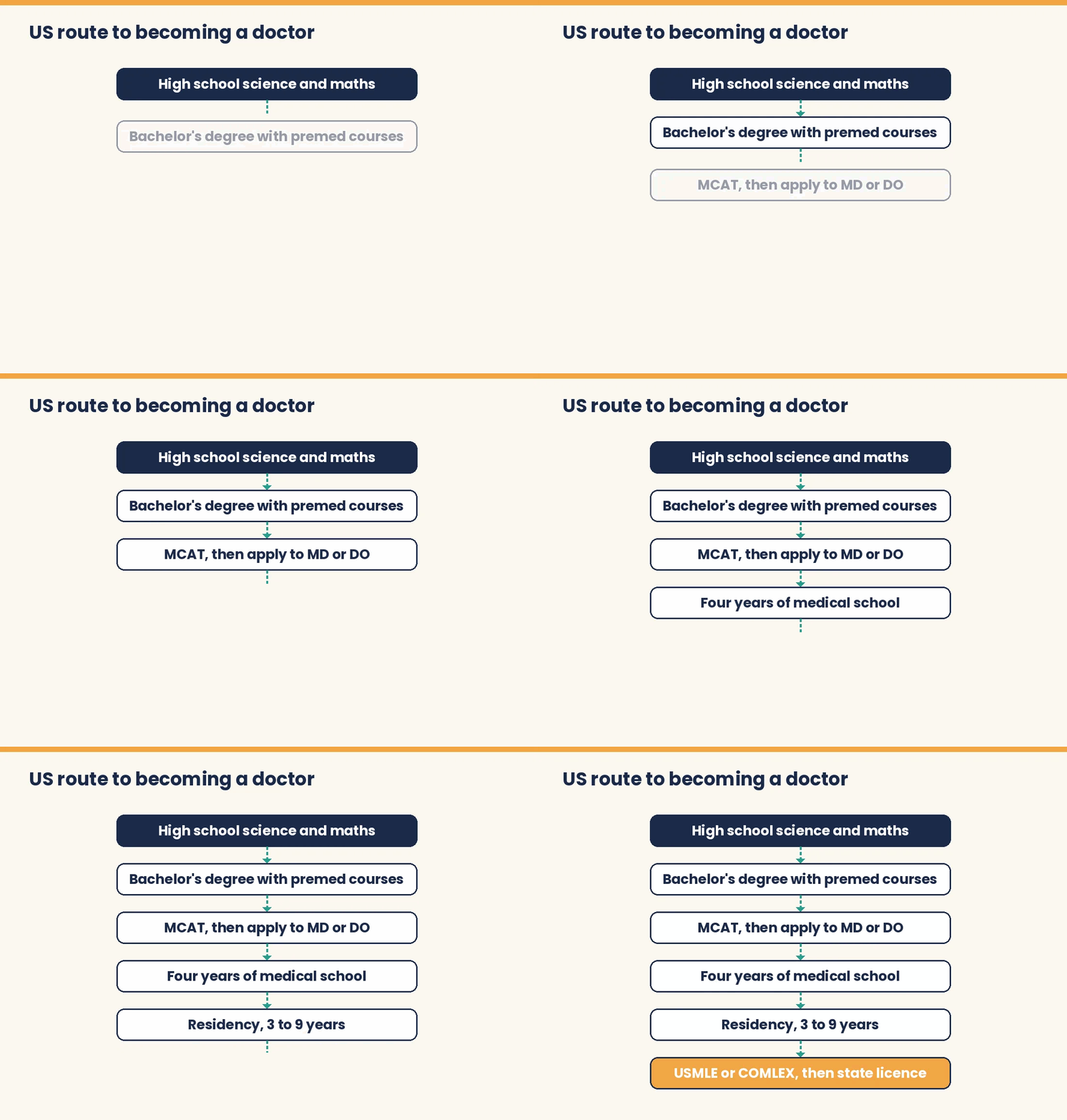
In short: high school science and maths, then a bachelor's degree with premed courses, then the MCAT and an MD or DO application, then four years of medical school, then 3 to 9 years of residency, with USMLE or COMLEX and a state licence.
How to become a doctor in the UK
- Choose strong science A levels (or Scottish Highers, IB or equivalent). Most schools ask for chemistry, and many ask for biology. Check each course.
- Sit the UCAT before you apply. The booking deadline comes before the UCAS deadline. It has four subtests: Verbal Reasoning, Decision Making, Quantitative Reasoning and Situational Judgement. The test is just under 2 hours and has no negative marking (UCAT). Abstract Reasoning was removed from 2025.
- Apply through UCAS by 15 October. For 2027 entry, the deadline for most medicine courses was 15 October 2026 at 18:00 UK time (UCAS). Expect the same date pattern next year; check UCAS once it confirms.
- Study medicine for usually five or six years. Graduate-entry courses are shorter.
- Pass the MLA. The GMC says all medical students graduating from UK universities from 2024-25 onwards must pass the Medical Licensing Assessment.
- Do the Foundation Programme. It is a two-year, work-based programme. You need full GMC registration before the second year (UK Foundation Programme).
- Train in GP or a specialty.
UCAT 2026 booking closed on 16 September 2026. Official UCAT 2027 dates are not yet announced, so watch ucat.ac.uk.
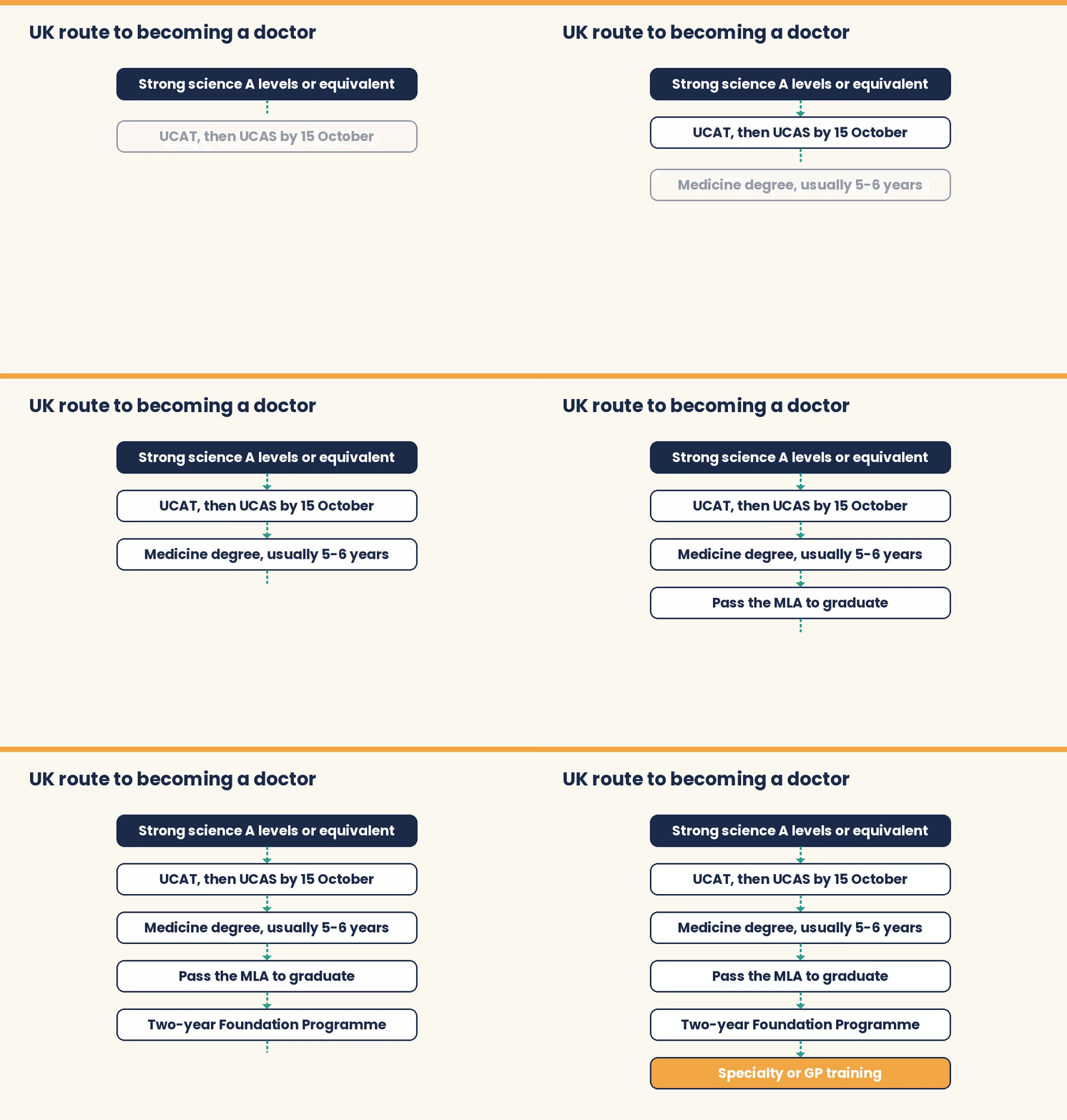
Step by step: strong science A levels, then the UCAT and a UCAS application by 15 October, then a medicine degree of usually 5-6 years, then the MLA, then the two-year Foundation Programme, then GP or specialty training.
How to become a doctor in India
- Take Physics, Chemistry and Biology (or Biotechnology) with English in Class 11 and 12. This is part of NEET (UG) eligibility.
- Sit NEET (UG), run by the NTA. In the NEET (UG) 2026 bulletin, the exam was pen-and-paper, 3 hours, 180 questions for 720 marks: Physics 45, Chemistry 45 and Biology 90. Each correct answer is +4, each wrong answer is -1. You must be at least 17 by 31 December of the exam year, and there is no upper age limit.
- Study MBBS. The NMC describes the MBBS course as 54 months (4.5 years).
- Complete the internship. The Compulsory Rotating Medical Internship lasts at least 12 months, after the final MBBS exam. So the full path is about 5.5 years.
- For MD or MS, take NEET-PG. NBEMS says NEET-PG is the single entrance exam for MD/MS/PG Diploma seats.
What about NExT? The NMC Act, 2019 (Section 15) provides for a National Exit Test. It would be a common final-year MBBS exam for the licence and the basis for postgraduate admission. It starts only from a date the Central Government notifies. We found no official NExT exam date on NMC or NBEMS pages as of 26 October 2026. Ignore rumours and check the NMC website.
NEET (UG) 2026 was first held on 3 May 2026. A re-examination was held on 21 June 2026, and results came out on 16 July 2026 (NTA press release). NEET (UG) is usually held in May; official 2027 dates are not yet announced.
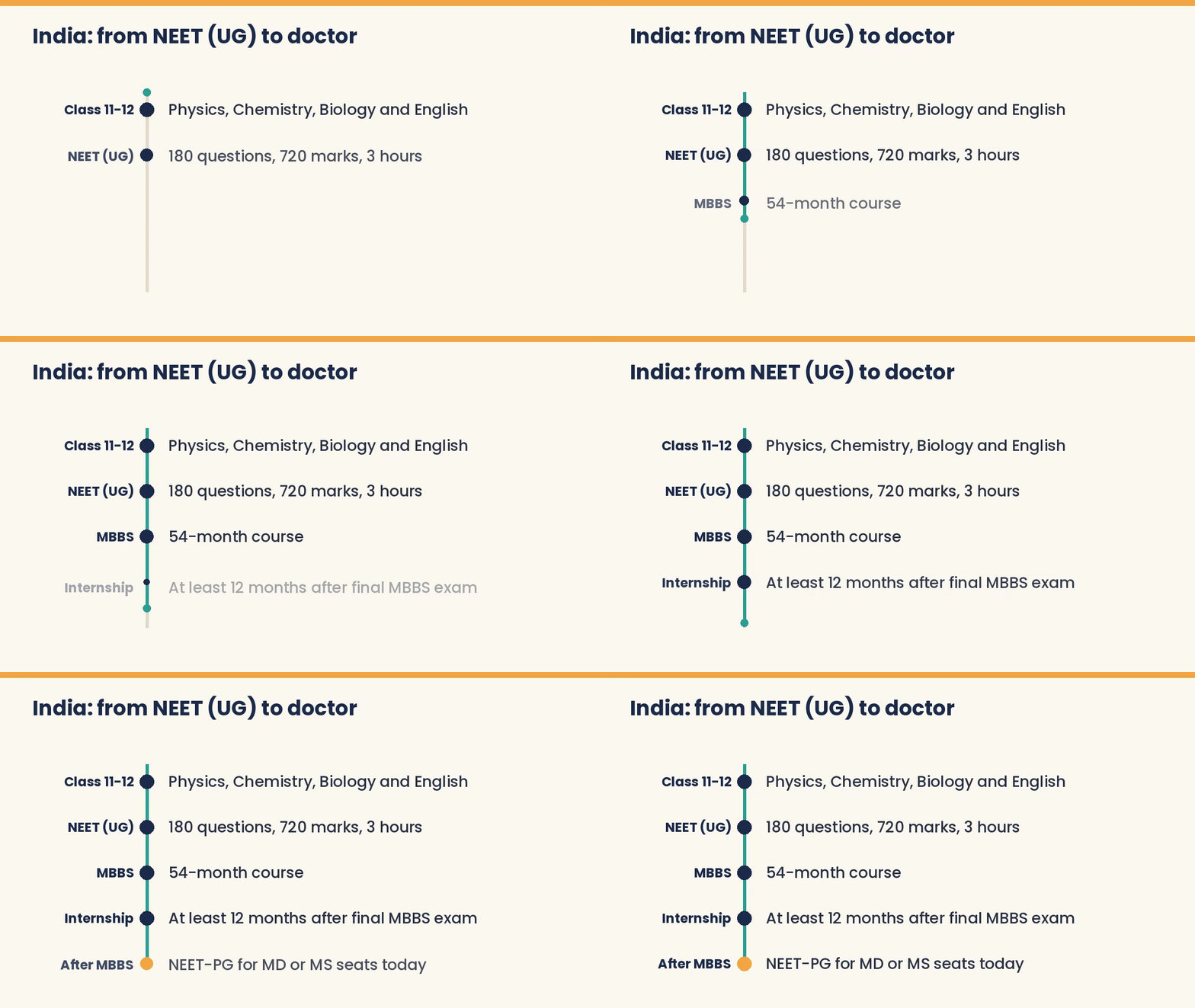
The Indian route in order: Class 11-12 with Physics, Chemistry, Biology and English; NEET (UG) with 180 questions, 720 marks and 3 hours; the 54-month MBBS; at least 12 months of internship; then NEET-PG for MD or MS seats.
How to become a doctor in Canada
- Earn undergraduate credits or a degree. The Canadian Medical Association says there is no "pre-med" major, but schools expect biology, chemistry and maths.
- Take the MCAT if your schools need it. Requirements differ by school.
- Study for an MD. Usually two preclinical years and two clinical years.
- Match to residency through CaRMS, the national residency matching service. Residency lasts 2 to 5 years, depending on the field (CMA).
- Pass the MCCQE. The Medical Council of Canada says it is a one-day exam of 230 multiple-choice questions, taken at the end of medical school. A pass is one step toward the LMCC and a provincial licence.
How to become a doctor in Australia
There are two main doors:
- Undergraduate entry (from school). Many universities use the UCAT ANZ. The 2026 test ran from 1 July to 5 August 2026 for 2027 entry. Some pathways do not need it.
- Graduate entry (after a degree). Many universities use GAMSAT, made by ACER. It has three parts: Written Communication, Humanities and Social Sciences, and Biological and Physical Sciences. GAMSAT is also used by some schools in the UK and Ireland.
After graduation, you complete an intern year. The Medical Board of Australia says interns must finish 47 weeks full-time equivalent, in at least four terms, to get general registration. Specialist training comes after that.
Need help planning subjects or test prep for any of these routes? Book a free demo class or see fees.
What work experience do you need for medicine?
Medical schools want proof that you understand the job and care about people. Official advice is clear on one point: quality beats quantity.
- USA: The AAMC says shadowing is not strictly required. In an AAMC survey, 87% of admissions officers said they accept another activity instead. Ideas include hospice volunteering, caring for an ill family member, and later roles such as scribe or EMT.
- UK: The Medical Schools Council guidance says all forms of voluntary work can help. It says repeated short shadowing is unlikely to help much, and longer work with the public is more valuable. Talking to doctors is a good way to learn about the job. NHS work experience is not expected for overseas students.
Good options for school students:
- Volunteer regularly in a care home, hospice, charity shop or community project.
- Help younger students, people with disabilities or older neighbours.
- Talk to doctors about their real working day.
- Keep a short reflection log: what you did, what you learned, what surprised you.
What is the job outlook for doctors?
We only quote official figures here. The US Bureau of Labor Statistics Occupational Outlook Handbook says:
- Median annual wage for physicians and surgeons: $275,930 (May 2025).
- Employment: 862,800 jobs in 2025.
- Projected growth: 4% from 2025 to 2035, about as fast as average.
- About 22,100 openings each year, on average.
These are US figures only. Pay and jobs differ by country and specialty. Medicine is long and demanding, so choose it for the work, not only the salary.
What is a step-by-step plan from Grade 9?
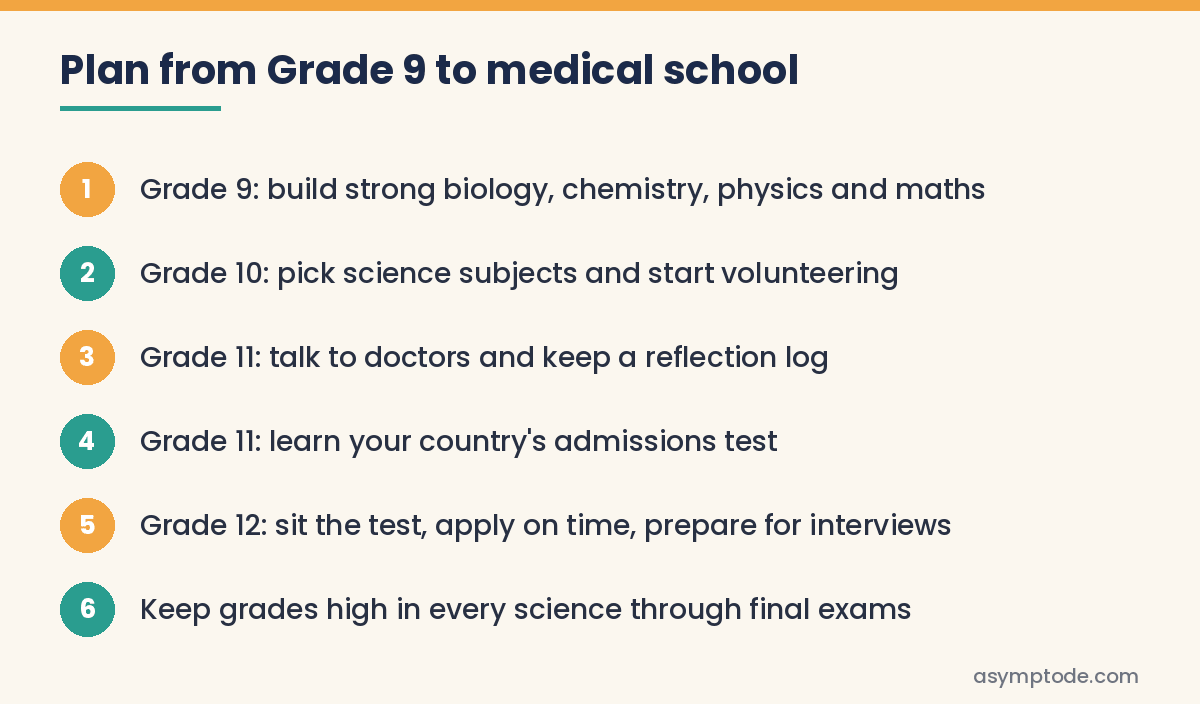
- Grade 9: Build strong biology, chemistry, physics and maths. Fix weak topics now.
- Grade 10: Pick science subjects for the next two years. Start one regular volunteering activity.
- Grade 11: Talk to doctors and keep a reflection log. Research schools and their entry rules.
- Grade 11: Learn your country's admissions test (UCAT, UCAT ANZ, NEET (UG)) and do official practice questions.
- Grade 12: Sit the test, apply on time, and prepare for interviews.
- All years: Keep grades high in every science through final exams.
In the USA and Canada, steps 4 and 5 move to university: you prepare for the MCAT during your degree.
Worked example: a UCAT and MCAT style calculation
Example 1: a dose calculation. A child weighs 24 kg. The dose is 5 mg per kg. The liquid medicine has 40 mg in 5 mL. How many mL?
- Dose = 24 kg x 5 mg/kg = 120 mg.
- Concentration = 40 mg / 5 mL = 8 mg per mL.
- Volume = 120 mg / 8 mg per mL = 15 mL.
Example 2: cardiac output. Heart rate is 70 beats per minute. Stroke volume is 70 mL per beat.
- Cardiac output = heart rate x stroke volume.
- 70 x 70 = 4,900 mL per minute.
- 4,900 mL = 4.9 L per minute.
Want the biology behind example 2? Read our guide to the circulatory system.
Common mistakes to avoid
- Leaving science weak. Gaps in chemistry or maths grow fast in later years.
- Starting the test too late. UCAT, NEET (UG) and MCAT need weeks of timed practice.
- Chasing hours, not learning. A long, steady activity beats many one-day visits.
- Missing deadlines. The UK deadline is mid-October, long before most other courses.
- Trusting rumours. Exam rules (like NExT in India) change only through official notices.
- Ignoring wellbeing. Sleep, sport and breaks help you study better.
How 1-on-1 tutoring helps with becoming a doctor
At Asymptode, every class is 1-on-1 and live online: one student and one dedicated mentor, with no batches. Your mentor follows your own syllabus and exam dates, whether that is AP, GCSE, A level, IB, CBSE or another board.
- Biology, chemistry, physics and maths: We teach method first. Your mentor watches each step of your working and fixes the method, not just the answer. Hard topics become clear when you go step by step.
- NEET (UG) prep: Calm, timed practice across Physics, Chemistry and Biology, with a focus on accuracy because wrong answers cost marks.
- UCAT and MCAT: We help with the quantitative and logical method (rates, percentages, data reading, physics and chemistry calculations), plus planning and a steady practice routine. For verbal and situational parts, we help you build a review habit and a timetable.
- Practical support: Personalised homework with feedback, short updates for parents, flexible times across time zones, and every class recorded so you can rewatch.
Ready to start? Book a free demo class and talk through your route, or see fees.
Facts checked against official sources on 26 October 2026.
Frequently asked questions
Can I become a doctor without biology?
It is hard. NEET (UG) needs biology or biotechnology. Many UK and Australian schools ask for chemistry, and many want biology too. In the USA, you take biology at university as a premed course. Check each school's rules.
How many years does it take to become a doctor?
Roughly 6 to 15 years after school, sometimes longer. India's MBBS is a 54-month course plus a 12-month internship. UK degrees are usually 5-6 years plus a 2-year Foundation Programme. US doctors usually do 4 years of college, 4 years of medical school and 3 to 9 years of residency.
Is the UCAT or MCAT harder?
They test different things. The UCAT is a short aptitude test (just under 2 hours) of reasoning skills, not science facts. The MCAT is about 7.5 hours seated and tests science, reasoning and behaviour topics.
Do I need work experience in a hospital?
Not always. The AAMC says shadowing is not strictly required. The UK Medical Schools Council says long-term work with people can be more valuable than short shadowing.
Has NExT replaced NEET-PG in India?
Not as of 26 October 2026. The NMC Act provides for NExT, but we found no official exam date. NBEMS still lists NEET-PG as the entrance exam for MD/MS seats.
When should I start preparing?
Start building strong science in Grade 9. Begin test-specific practice about a year before you sit the test. Steady weekly work beats last-minute cramming.
Sources
- BLS Occupational Outlook Handbook: Physicians and Surgeons
- AAMC: What's on the MCAT Exam?
- AAMC: Five Ways to Gain Experience Without Shadowing
- USMLE
- UCAS: 2027 entry deadline for Oxford, Cambridge and most medicine courses
- UCAT: Test format
- GMC: Medical Licensing Assessment
- UK Foundation Programme
- Medical Schools Council: Relevant experience for applying to medical school
- NTA: NEET (UG) 2026 Information Bulletin
- NTA: NEET (UG) 2026 result press release
- NMC Act, 2019
- NBEMS: NEET-PG
- Canadian Medical Association: How do you get into medical school in Canada?
- CaRMS
- Medical Council of Canada: MCCQE
- UCAT ANZ
- ACER: GAMSAT
- Medical Board of Australia: Interns