

If you want to know how to become an engineer, the short answer is this: build strong maths and physics in high school, earn an accredited engineering degree, gain real work experience, and then (in most countries) get a professional licence or chartered title. The exact names change by country, but the path has the same shape everywhere. This guide shows that path for the USA, UK, India, Canada and Australia, with a Grade 9-12 plan for students and parents.
Key takeaways
- Maths and physics are the two subjects every engineering degree expects. Chemistry matters for chemical, biomedical and materials routes.
- Choose an accredited degree: ABET (USA), Engineering Council (UK), NBA (India), CEAB (Canada) or Engineers Australia.
- A licence or chartered title comes after the degree and several years of work, not straight out of school.
- The US government projects engineering and architecture jobs to grow much faster than average from 2025 to 2035.
- Start early: Grades 9 and 10 decide which advanced maths and science you can take later.
How do you become an engineer?
Quick answer: Take the most advanced maths and physics your school offers, then get into an accredited engineering degree (usually four years). During and after the degree, gain supervised work experience. In the USA, Canada, the UK and Australia you can then apply for a licence or chartered title, such as PE, P.Eng or CEng.
Here is the whole journey in five stages.
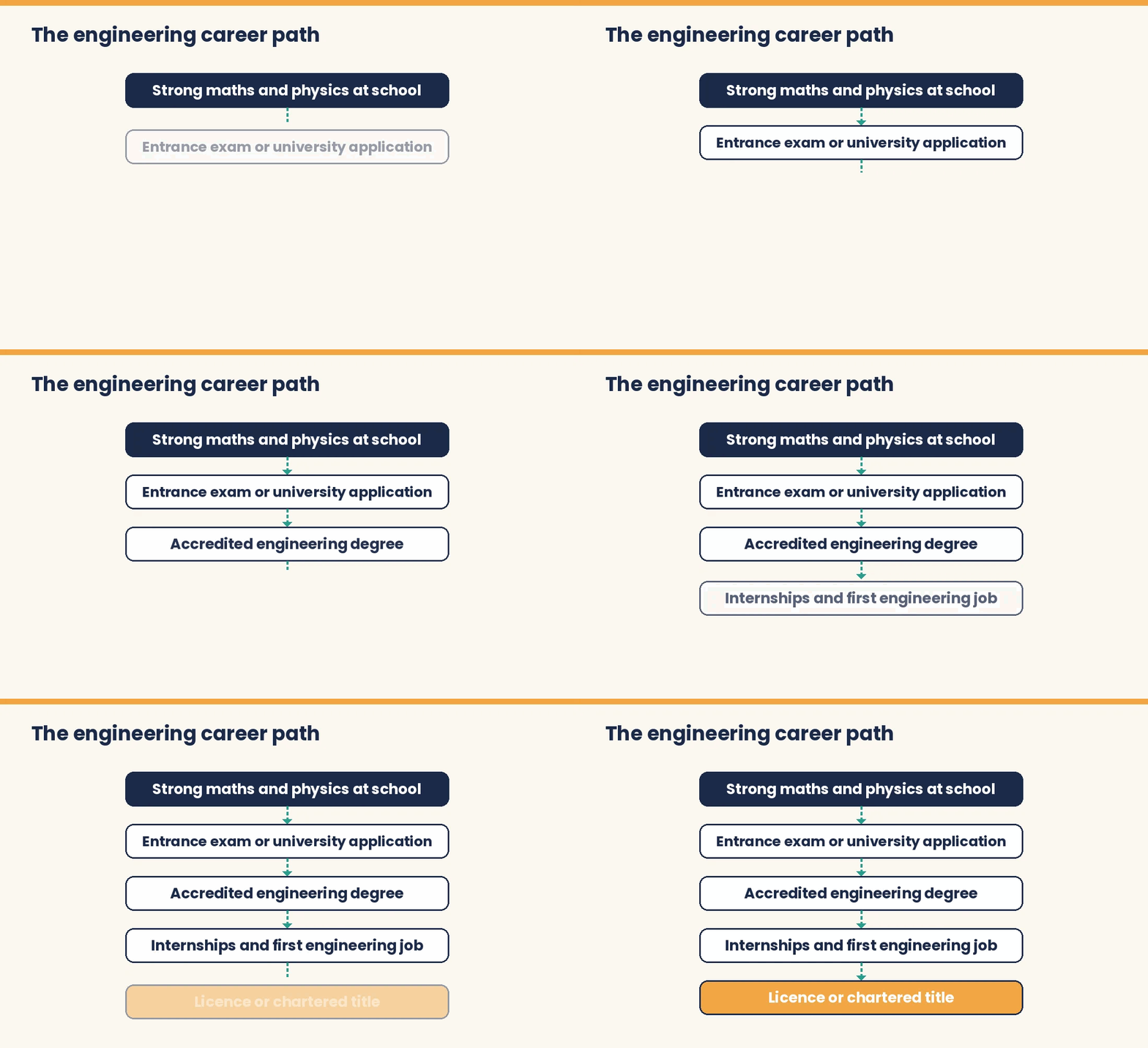
- Strong maths and physics at school.
- Pass the entrance exam or apply to university.
- Finish an accredited engineering degree.
- Do internships, then get your first engineering job.
- Earn a licence or chartered title after several years of work.
What do engineers actually do?
Engineers use maths and science to design things that work safely and at a fair cost. They solve problems: a bridge that must carry trucks, a phone battery that must not overheat, a medical device that must fit inside the body.
Most engineers specialise in one branch. Here are the main ones.
| Branch | What they work on | Example project |
|---|---|---|
| Civil | Roads, bridges, water, buildings | A flood-safe bridge |
| Mechanical | Machines, engines, robots | A car cooling system |
| Electrical | Power, circuits, electronics | A solar power grid |
| Computer / software | Chips, code, systems | A self-driving car's software |
| Chemical | Turning raw materials into products | Cleaner fuel or medicines at scale |
| Aerospace | Aircraft, rockets, satellites | A lighter wing design |
| Biomedical | Medicine plus engineering | An artificial knee joint |
You do not need to pick a branch in Grade 9. Some universities let you start with a common first year and choose later.
If you love the "why" more than the "how", read our guide on how to become a scientist. Scientists discover how the world works. Engineers use that knowledge to build things.
Which school subjects do you need to become an engineer?
Maths and physics are the core. Almost every engineering degree in the world asks for both. For example, the University of Cambridge asks for A level (or IB Higher Level) Mathematics and Physics, and says to take Further Mathematics if your school offers it.
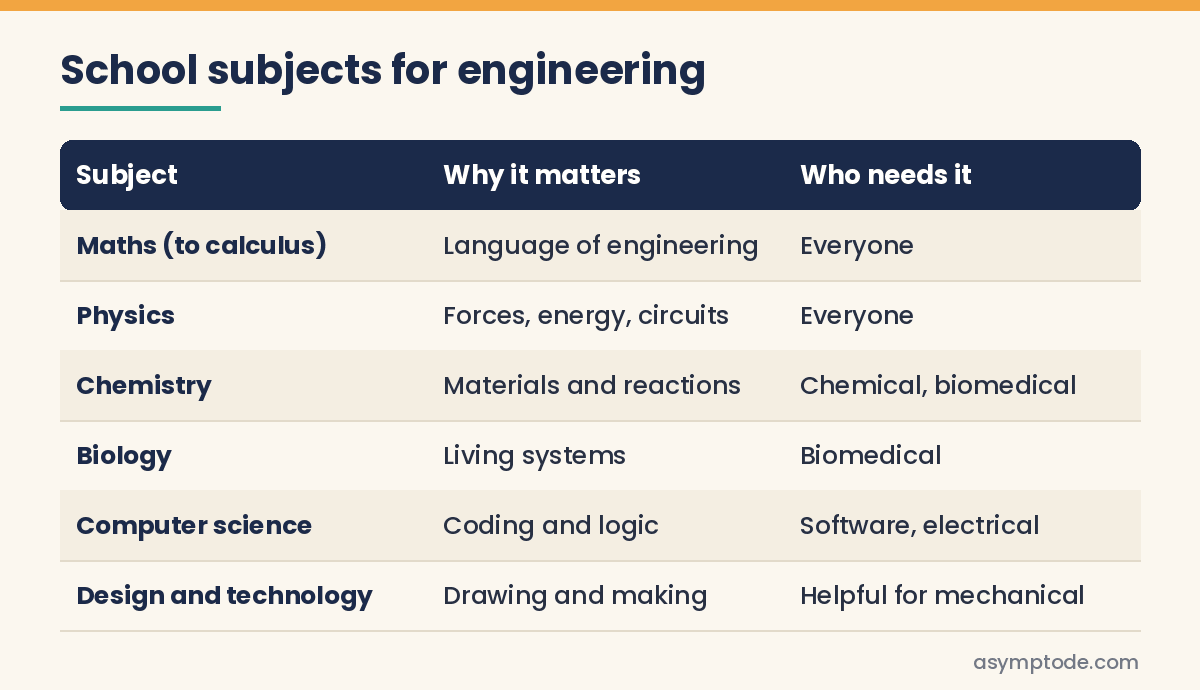
| Subject | Why it matters | Who needs it |
|---|---|---|
| Maths (up to calculus) | The language of all engineering | Everyone |
| Physics | Forces, energy, circuits, waves | Everyone |
| Chemistry | Materials and reactions | Chemical, biomedical, materials |
| Biology | Living systems | Biomedical |
| Computer science | Coding and logic | Software, computer, electrical |
| Design and technology | Drawing and making things | Helpful for mechanical |
Why maths and physics matter: a worked example
Engineers use school physics every day. Here is a small example of the kind of thinking you will do.
Problem: A steel cable must hold a 2,000 kg load. Engineers use a safety factor of 2. What force must the cable be designed for? (Use g = 9.8 m/s^2.)
- Find the weight using Newton's second law: F = m x g.
- F = 2,000 x 9.8 = 19,600 N.
- Apply the safety factor: 19,600 x 2 = 39,200 N.
- Answer: Design the cable to carry at least 39,200 N.
This uses ideas from Newton's three laws. If a student finds this hard in Grade 10, that is the signal to strengthen physics now, not in Grade 12.
How do you become an engineer in different countries?
The path has the same shape everywhere, but the exams and titles differ. Here is the summary, then the detail for each country.
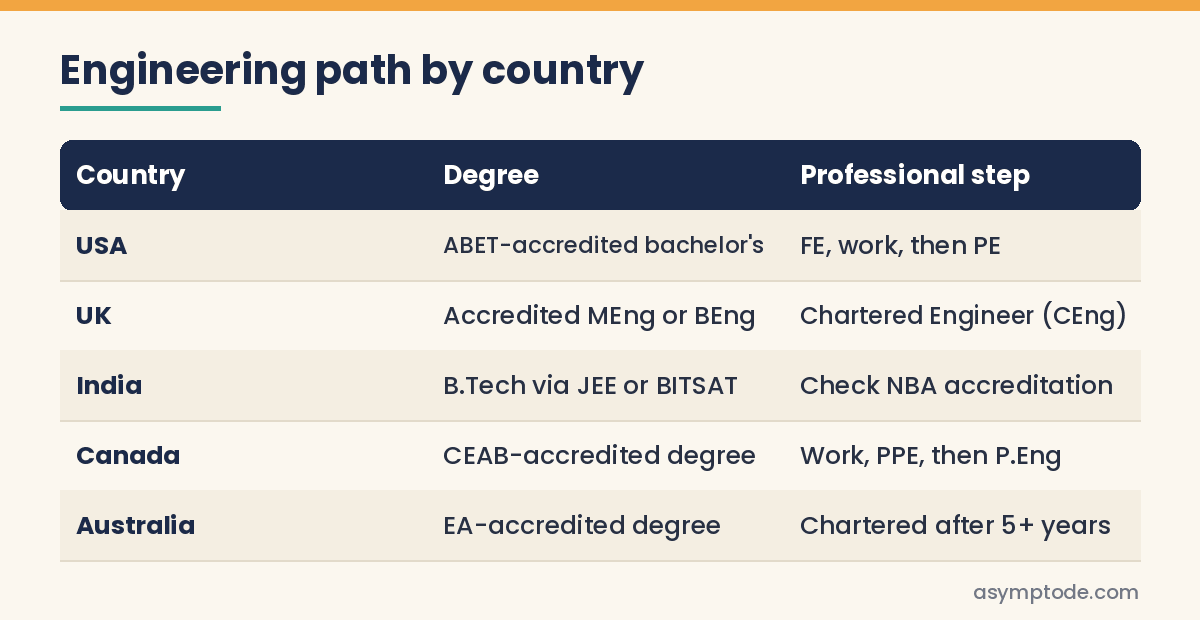
| Country | How you get in | Degree | Professional step |
|---|---|---|---|
| USA | College application | ABET-accredited bachelor's | FE exam, about 4 years' work, PE exam |
| UK | UCAS, A level Maths and Physics | Accredited MEng or BEng | Chartered Engineer (CEng) |
| India | JEE Main/Advanced, BITSAT, state CETs | B.Tech / B.E. | Check NBA accreditation |
| Canada | Apply to university | CEAB-accredited degree | Work experience, PPE, then P.Eng |
| Australia | ATAR plus subject prerequisites | Engineers Australia-accredited degree | Chartered after 5+ years |
How do you become an engineer in the USA?
- Earn an ABET-accredited bachelor's degree. ABET accredits programs, not whole colleges, so check the exact major.
- Pass the FE (Fundamentals of Engineering) exam. NCEES says it is meant for recent graduates and students close to finishing their degree. It is computer-based and offered year-round.
- Gain work experience. NCEES says most states require about four years of progressive, verifiable work experience.
- Pass the PE (Professional Engineer) exam and apply to your state board.
Rules differ by state, so always check the board in the state where you plan to work. NCEES notes that many states also offer other paths besides this common one.
For admissions, US colleges look closely at maths and science grades. Our guides to Digital SAT Math, AP Physics 1 and getting into MIT cover these steps in detail.
How do you become an engineer in the UK?
- Take A level Maths and Physics (Further Maths helps, and some top universities expect it).
- Apply through UCAS. For 2027 entry, the main UCAS deadline is 13 January 2027 at 18:00 UK time. The 15 October 2026 deadline for Oxford and Cambridge has already passed.
- Choose an accredited degree. The Engineering Council says an accredited integrated MEng fully meets the academic requirement for Chartered Engineer. An accredited BEng (Hons) partly meets it, so you would need further learning to master's level.
- Work and apply for CEng through a professional engineering institution, such as one for civil, mechanical or electrical engineers. The Engineering Council sets the standard (UK-SPEC).
For the physics side, see our A level Physics guide.
How do you become an engineer in India?
- Take Physics, Chemistry and Maths (PCM) in Classes 11 and 12.
- Sit the entrance exams. JEE Main is used for NITs, IIITs and other centrally funded institutes, and it is also the qualifying test for JEE Advanced, which is used for IITs. BITSAT is the test for BITS campuses, and many states run their own CETs for state colleges.
- Study a four-year B.Tech or B.E. Check that the programme is accredited by the National Board of Accreditation (NBA). NBA became a permanent signatory of the Washington Accord on 13 June 2014, which helps Indian degrees get recognised abroad.
JEE Main 2027 dates: The NTA public notice of 24 October 2026 says JEE (Main) 2027 has two sessions: January 2027 and April 2027. Session 1 applications run from 24 October to 22 November 2026, and Session 1 exams are on 20, 21, 22, 23, 24 and 28 January 2027. See our full JEE Main 2027 guide. BITSAT 2027 dates were not confirmed on an official page when we checked.
How do you become an engineer in Canada?
- Earn a degree from a CEAB-accredited program (Canadian Engineering Accreditation Board).
- Gain engineering work experience in the province or territory where you apply. The amount is set by each regulator.
- Pass the Professional Practice Examination (PPE) on law and ethics.
- Apply for your P.Eng licence from your provincial or territorial regulator.
Engineers Canada explains that it does not issue licences itself. The provincial and territorial regulators do. You must also show good character and the ability to work in English or French.
How do you become an engineer in Australia?
- Meet the subject prerequisites for your ATAR course. These vary by university. For example, UNSW Sydney lists Mathematics Extension 1 as assumed knowledge, plus Physics or Chemistry for some engineering disciplines.
- Study an accredited degree. Engineers Australia says programs must be fully accredited to be recognised under the international accords. It is a full signatory of the Washington Accord.
- Work and apply for Chartered status. Engineers Australia says you need at least five years of engineering experience and membership.
Not sure which path fits your child? Asymptode's advisors can map your child's current maths and physics level against their target country and degree. Book a free demo class or advisor call, or see our fees.
Is engineering a good career? The honest outlook
Here is what official US data says. The US Bureau of Labor Statistics (BLS) Occupational Outlook Handbook (page last modified 27 August 2026) reports:
- The median annual wage for architecture and engineering occupations was $99,520 in May 2025, compared with $50,980 for all occupations.
- Employment is projected to grow much faster than the average for all occupations from 2025 to 2035.
- About 174,800 openings are projected each year, on average, from growth and from workers leaving the field.
These are US figures. Pay and demand in other countries are different, so check your own government's labour data. Also note that "median" means half earn more and half earn less, and starting pay is usually lower.
Engineering is also demanding. The degree has a heavy maths load, and many first-year students struggle with calculus and mechanics. That is why the school years matter so much.
What can you do outside class to prepare for engineering?
Universities want proof that you enjoy solving real problems. Here are real, well-known options.
| Activity | What it is | Who it is for |
|---|---|---|
| FIRST Robotics Competition | Teams design, build and program full-size robots | Ages 14-18, Grades 9-12 |
| Science Olympiad | Team STEM competition with many events | Division C: Grades 9-12 |
| Personal projects | A robot, an app, a bridge model, a weather station | Anyone |
| Maths competitions | Problem solving beyond the syllabus | Students who enjoy hard maths |
| Internships and job shadowing | A few days or weeks with a real engineer | Usually Grade 11 or 12 |
| University summer programs | Short courses run by universities | Check each university's official page |
A good project beats a long list of activities. Write down what you built, what failed, and what you changed. That story is gold for applications and interviews.
A Grade 9-12 plan to become an engineer
Here is a simple year-by-year plan. Adjust it to your school system (Grades 9-12 are roughly Years 10-13 in the UK and Classes 9-12 in India).
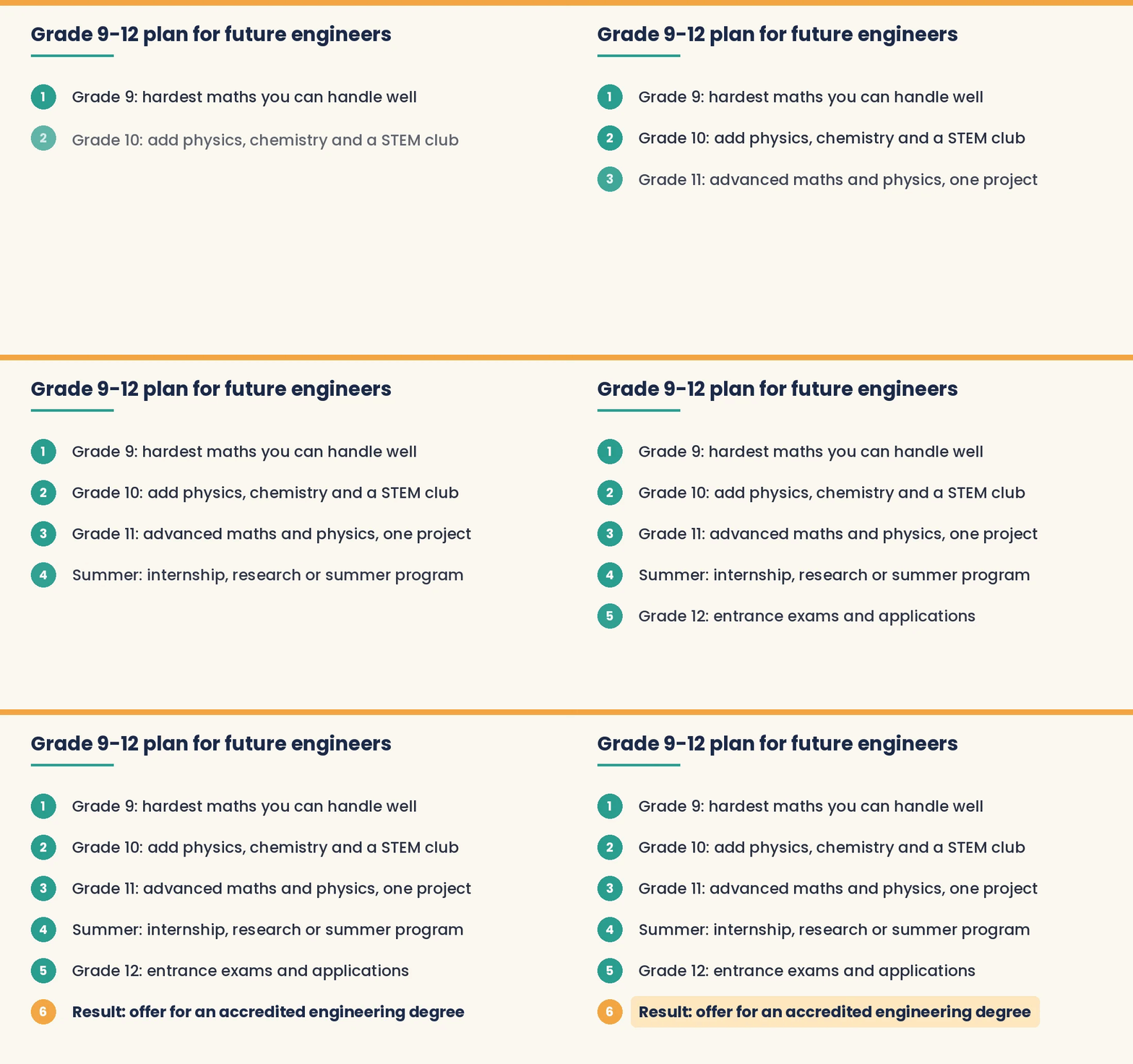
- Grade 9: Take the hardest maths you can handle well. Fix any gaps in algebra now.
- Grade 10: Add physics and chemistry. Join a robotics, coding or science club.
- Grade 11: Take advanced maths and physics (AP, A level, IB HL or PCM). Build one real project.
- Summer after Grade 11: Do an internship, a research project or a summer program.
- Grade 12: Prepare for entrance exams (SAT/ACT, JEE, BITSAT, CETs) and send applications.
- Result: An offer for an accredited engineering degree.
What are the common mistakes students make?
- Dropping advanced maths too early. If you skip calculus-track maths in Grade 10 or 11, some engineering degrees close to you.
- Treating physics as memorising. Engineering physics is about method: draw the diagram, list the knowns, choose the law, then solve.
- Ignoring accreditation. A degree that is not accredited can make licensing much harder later.
- Starting exam prep in the final year. JEE, A levels and AP exams reward steady work over two years.
- Choosing a branch only for salary. Pick the problems you enjoy. You will spend years on them.
- Doing many activities, finishing none. One finished project shows more than five half-done ones.
How 1-on-1 tutoring helps with becoming an engineer
At Asymptode, we teach private, live, 1-on-1 online classes in maths and science. For future engineers, that means building the two foundations every engineering degree depends on: maths and physics.
- One dedicated mentor. Your child works with the same mentor, who assesses their level, makes a plan, teaches, marks homework and reports to you.
- Their syllabus, their exams. We follow your child's own syllabus and exam dates, whether that is AP, A level, IB, CBSE, JEE or state boards.
- Method first. The mentor watches each step of working, so small errors in algebra or free-body diagrams get fixed early.
- Personalised homework with feedback, plus short weekly updates for parents.
- Flexible scheduling across time zones, and every class is recorded for revision.
For exams with non-maths parts, such as essays or verbal sections, we are honest: our mentors help with the maths, physics, logic and study planning, not the essays.
Ready to start? Book a free demo class or advisor call and see how a mentor would plan your child's path to engineering. You can also view our fees.
Facts checked against official sources on 26 October 2026.
FAQ
How many years does it take to become an engineer?
Most engineering bachelor's degrees take about four years, though this varies by country and degree type. A licence or chartered title then needs several more years of work, for example about four years in most US states before the PE, and at least five years for Chartered status with Engineers Australia.
Can I become an engineer without physics?
It is very hard. Nearly all engineering degrees require or strongly expect physics, along with maths. A few universities offer foundation years for students who missed a subject, but these add time.
Is engineering harder than other degrees?
Engineering has a heavy maths and physics workload, especially in the first year. Students with strong school foundations in algebra, calculus and mechanics usually cope much better. Starting early is the best protection.
Which engineering branch pays the most?
Pay depends on the country, the employer and the job. The US BLS lists median pay for each engineering occupation on its Architecture and Engineering page. Choose a branch you enjoy first, because interest helps you get good, and good engineers are paid well.
Do I need a licence to work as an engineer?
It depends on the country and the job. In Canada you need a licence from a provincial or territorial regulator to practise engineering. In the USA, licensing is run by each state board, and the PE is the main licence. In the UK, CEng is a professional title, and whether a job asks for it depends on the employer.
Can an Indian B.Tech graduate work as an engineer abroad?
It can help if the programme is NBA-accredited, because NBA is a permanent signatory of the Washington Accord. Each country still has its own process, so check the regulator in the country where you want to work.
Sources
- BLS Occupational Outlook Handbook: Architecture and Engineering Occupations
- NCEES: Licensure
- NCEES: FE exam
- ABET: What is accreditation?
- Engineering Council: Chartered Engineer
- Engineering Council: AHEP defining characteristics and learning outcomes
- UCAS: 2027 entry deadline
- University of Cambridge: Engineering course
- NTA: JEE (Main) official website and 2027 Session 1 public notice
- National Board of Accreditation brochure
- Engineers Canada: Overview of the licensing process
- Engineers Australia: Accreditation
- Engineers Australia: Chartered
- UNSW Sydney: Engineering (Honours) entry information
- FIRST Robotics Competition
- Science Olympiad: Team size and grade levels