

A-Level Maths is one of the most popular A-Levels in the UK, and one of the most useful for university. It is also a big step up from GCSE. This guide explains the papers for each exam board, what is on the course, a worked example, and a simple plan for Year 13.
Key takeaways
- A-Level Maths has three written exams at the end of Year 13. For AQA, Edexcel and OCR A, each paper is 2 hours and 100 marks.
- About two-thirds is pure maths. The rest is statistics and mechanics.
- A calculator is allowed on every paper, but clear working still earns most of the marks.
- Each board has a large data set for statistics questions. Students need to know it.
- Grades run from A* to E. Steady weekly practice from Year 12 is the best way to a top grade.
What is A-Level Maths?
Quick answer: A-Level Maths is a two-year course taken in Year 12 and Year 13 in England, Wales and Northern Ireland, and by many international students. It covers pure maths (algebra, trigonometry, calculus and more), statistics and mechanics. Students sit three exams at the end of Year 13 and get a grade from A* to E.
Since the reform in 2017, every A-Level Maths course has the same core content, set by the Department for Education. The exam boards write their own papers, but the topics are the same. So a student who moves schools between boards still knows most of the course.
Many students also take AS-Level Maths or A-Level Further Maths. The AS is a separate, smaller qualification. Further Maths is a second, harder A-Level that goes deeper into pure maths and adds more applied options.
What papers do you sit for A-Level Maths?
Every board has three papers at the end of Year 13. Here is how they compare.
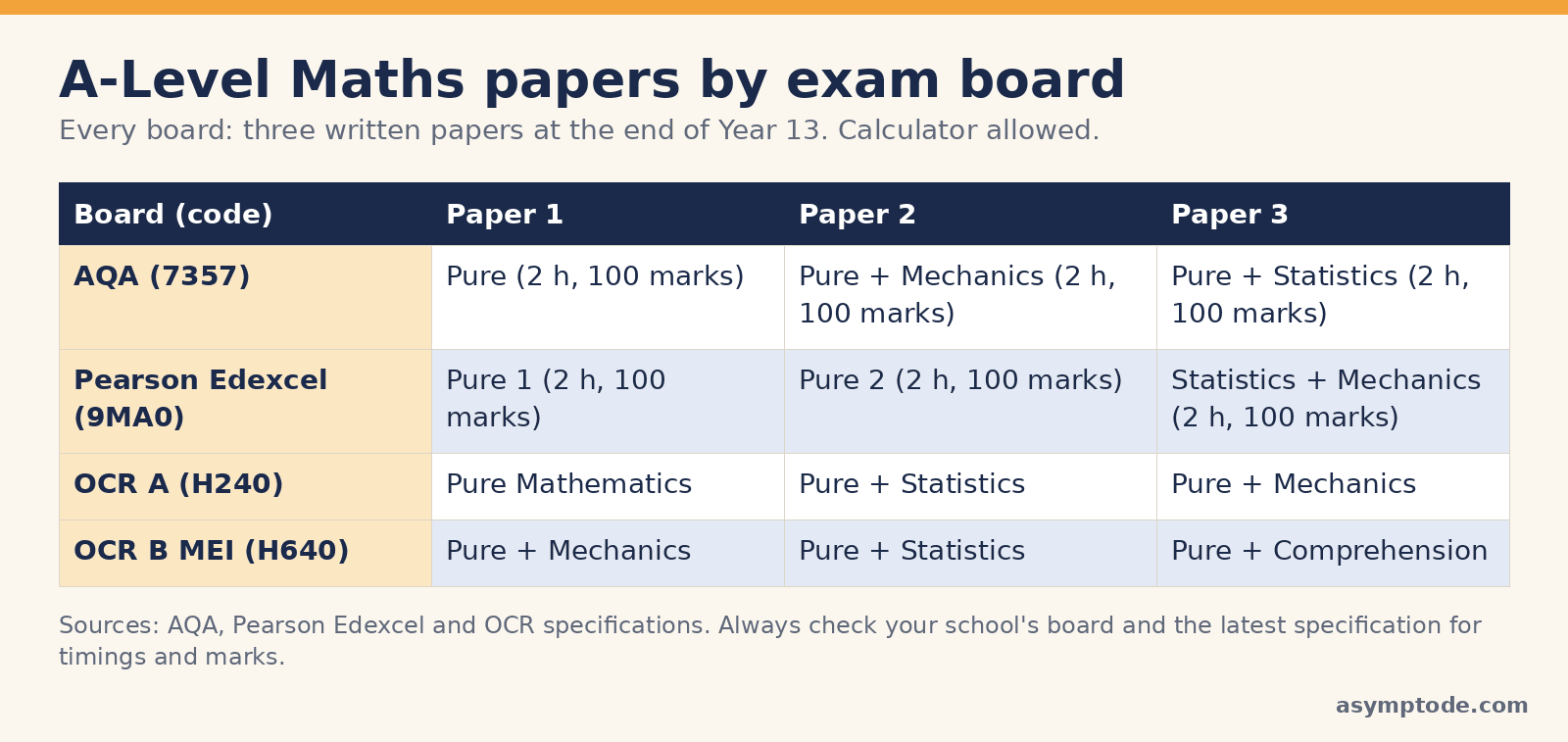
| Board (code) | Paper 1 | Paper 2 | Paper 3 |
|---|---|---|---|
| AQA (7357) | Pure | Pure and Mechanics | Pure and Statistics |
| Pearson Edexcel (9MA0) | Pure Mathematics 1 | Pure Mathematics 2 | Statistics and Mechanics |
| OCR A (H240) | Pure Mathematics | Pure Mathematics and Statistics | Pure Mathematics and Mechanics |
| OCR B MEI (H640) | Pure Mathematics and Mechanics | Pure Mathematics and Statistics | Pure Mathematics and Comprehension |
For AQA, Edexcel and OCR A, each paper is 2 hours and 100 marks, so each paper is worth about one-third of the grade. OCR B (MEI) has a different structure, including a comprehension paper based on a short article. Always check your school's board and the latest specification on the board's website.
Can you use a calculator in A-Level Maths?
Yes. A scientific or graphical calculator is allowed in all A-Level Maths papers, as long as it meets the exam rules. But examiners want to see the method. A correct answer with no working can lose marks, and questions that say "show that" or "prove" need full working.
When are the A-Level Maths exams?
The exams usually take place between late May and mid-June of Year 13. The exact days come from the exam boards and the JCQ timetable each year. Check your board's timetable early in Year 13.
What topics are in A-Level Maths?
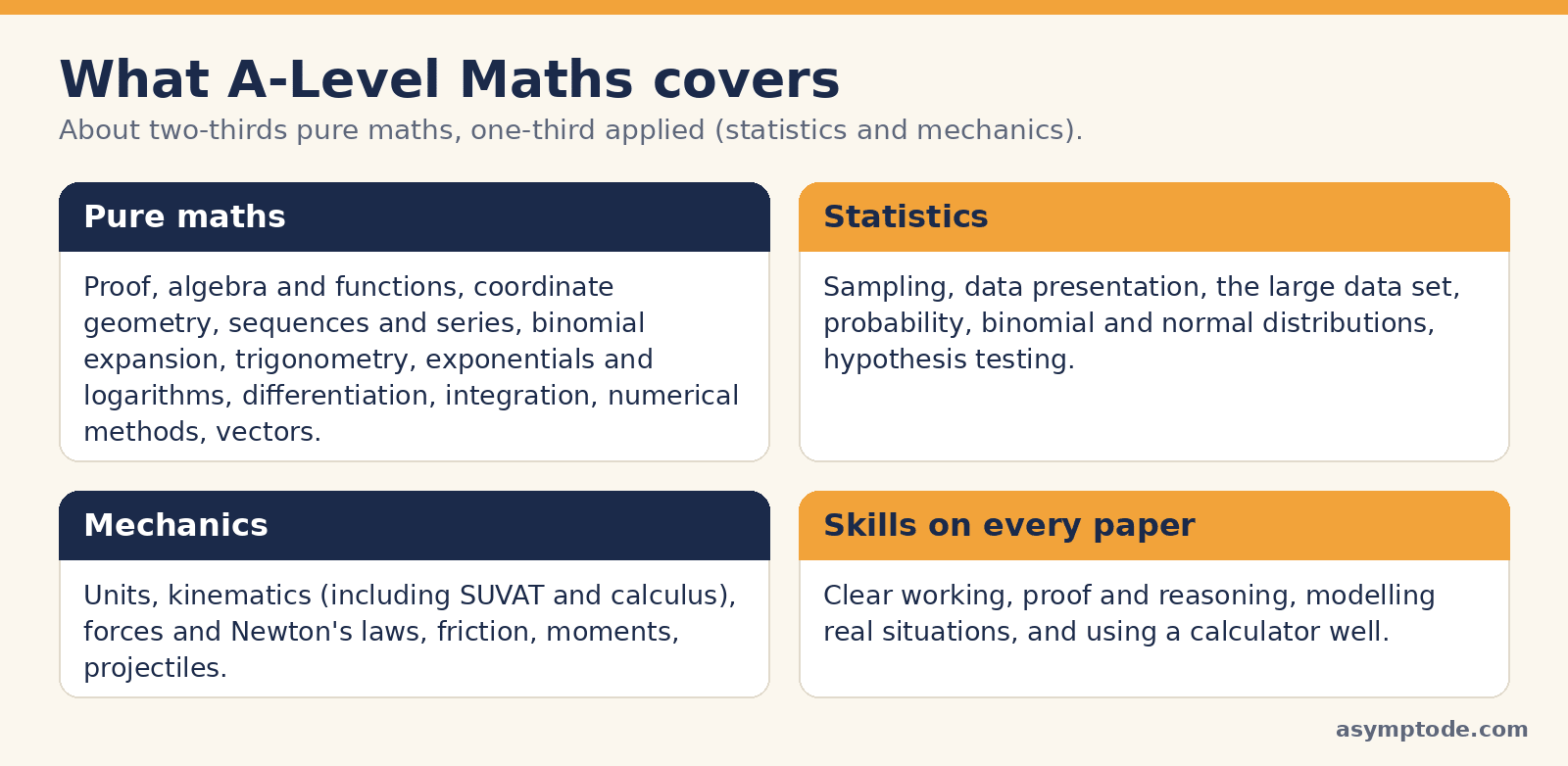
Pure maths (about two-thirds of the marks)
- Proof (including proof by contradiction)
- Algebra and functions, including partial fractions and modulus
- Coordinate geometry and parametric equations
- Sequences and series, including the binomial expansion
- Trigonometry, including radians, identities and R sin(x + α) forms
- Exponentials and logarithms
- Differentiation and integration, including chain, product and quotient rules, integration by parts and substitution
- Numerical methods
- Vectors
Statistics
- Sampling and data presentation
- The board's large data set
- Probability
- Binomial and normal distributions
- Hypothesis testing
Mechanics
- Units and kinematics (including the SUVAT equations and motion using calculus)
- Forces and Newton's laws, including friction
- Moments
- Projectiles
If your child found GCSE algebra hard, start there. A-Level Maths uses GCSE algebra in almost every question. Our guide to GCSE Maths papers is a good place to check which GCSE topics need a refresh.
How big is the jump from GCSE to A-Level Maths?
It is a big jump, and it surprises many strong students. Three things change:
- Algebra is everywhere. At GCSE, algebra is one topic. At A-Level, it is the language of every topic.
- Questions are less guided. Many questions give a situation and leave the student to choose the method.
- Proof and reasoning matter. "Show that" questions need every line of working.
Most students who were confident at GCSE grade 7 or above do well, as long as they practise every week. Students with a grade 6 can also succeed, but they often need extra help with algebra in the first term of Year 12.
Worked example: solving a trig equation
Trigonometric equations come up on every board. Here is a typical one.
Solve 2 sin x = 1 for 0° ≤ x ≤ 360°.
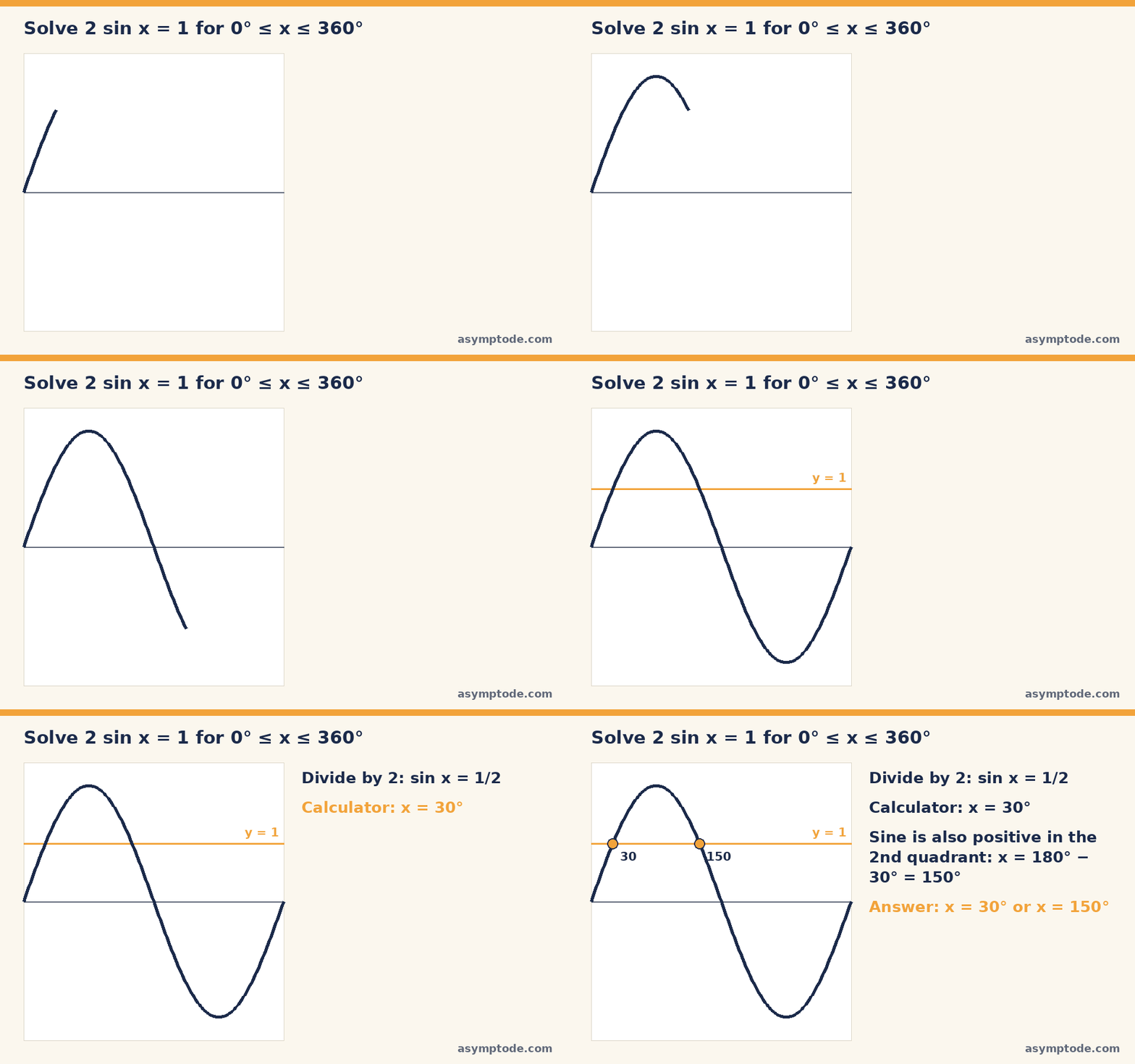
- Divide both sides by 2: sin x = 1/2.
- Use the calculator: x = sin⁻¹(0.5) = 30°.
- Sine is also positive in the second quadrant, so the second answer is x = 180° − 30° = 150°.
- Answer: x = 30° or x = 150°.
The most common mistake is to stop after the calculator answer and miss x = 150°. Drawing a quick sketch of the graph, like the one above, helps students find every solution.
How should students revise for A-Level Maths?
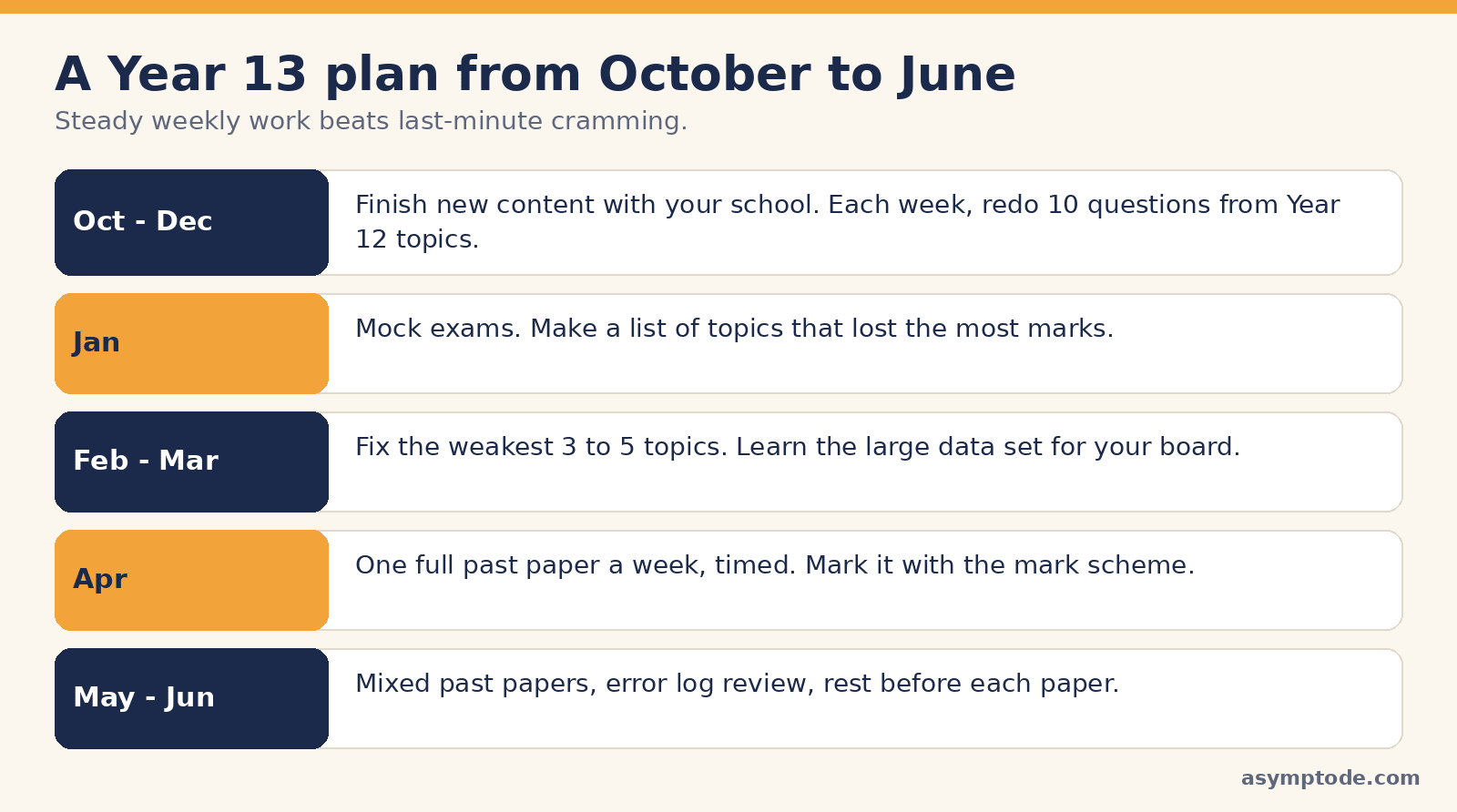
A simple Year 13 plan
| When | What to do |
|---|---|
| October to December | Finish new content with your school. Each week, redo 10 questions from Year 12 topics. |
| January | Mock exams. List the topics that lost the most marks. |
| February to March | Fix the weakest 3 to 5 topics. Learn the large data set for your board. |
| April | One full past paper a week, timed. Mark it with the mark scheme. |
| May to June | Mixed past papers, error-log review and rest before each paper. |
Five habits that help
- Keep an error log. Write down every mistake, the reason, and the correct method. Read it every week.
- Mix topics. Real papers jump between topics. Practise mixed sets, not one chapter at a time.
- Use mark schemes. They show what examiners want to see in the working.
- Practise "show that" questions. These test clear, step-by-step reasoning.
- Do little and often. Forty minutes, five days a week, beats one long Sunday session.
What are the most common A-Level Maths mistakes?
- Weak algebra. Small slips with brackets, fractions and negative signs lose many marks.
- Missing solutions in trig equations (see the example above).
- Mixing degrees and radians. Check the calculator mode on every question.
- Forgetting "+ c" in indefinite integration.
- Not stating the conclusion of a hypothesis test in context.
- Skipping the diagram in mechanics. A clear force diagram prevents most mistakes.
How 1-on-1 tutoring helps with A-Level Maths
At Asymptode, A-Level Maths support happens in live 1-on-1 online classes with one dedicated mentor. Lessons follow your child's own exam board and school timetable.
- Find the real gap. When a topic will not land, the mentor looks for the smaller missing piece, often a GCSE algebra skill, and fixes that first.
- Method-first teaching. The mentor watches every line of working. That is how marks for "show that" and proof questions improve.
- Personalised homework. Exam-style questions on the topics your child needs, approved by the mentor, with feedback.
- Parent updates. Short notes after lessons show what improved and what needs practice.
- Recorded lessons. Every class is recorded and searchable, which is very useful in the April to June revision months.
One-on-one help suits A-Level Maths because every student's gaps are different. One student struggles with integration, another with hypothesis tests. A group class cannot fix both at once.
Want a plan for Year 12 or Year 13? Book a free demo class with an Asymptode advisor, or see our fees. For how much weekly support is sensible, read how many hours of maths tutoring a week.
FAQ
Is A-Level Maths hard?
It is one of the more demanding A-Levels, mainly because it needs strong algebra. Students who practise every week and fix gaps early usually do well.
What GCSE grade do you need for A-Level Maths?
Each school or college sets its own rule. Many ask for at least a grade 6 or 7 in GCSE Maths. Check with your sixth form.
Are all A-Level Maths exam boards the same?
The content is the same for every board, because the Department for Education sets it. The papers, question style and large data set are different, so practise with your own board's past papers.
Do you need to learn formulas for A-Level Maths?
Each board gives a formula booklet in the exam, but many key results are not in it. Students should learn the formulas their board expects them to know, and practise finding the rest in the booklet quickly.
Should my child take Further Maths?
Further Maths is a good choice for students who love maths and plan to study maths, physics, engineering or computer science. It adds a lot of work, so talk to the school about timetable and support.
When should A-Level Maths revision start?
Light review should start in Year 12 and continue every week. Full past-paper practice usually starts in the spring of Year 13.