
The CBSE board exam 2027 is the Class 10 and Class 12 board exam that the Central Board of Secondary Education will hold from February 2027, for students in India and in CBSE schools abroad. This guide explains the dates, the new two-exam rule for Class 10, marks, passing rules, results and how your board marks matter for JEE, NEET, CUET and BITSAT. It also has a solved maths question and a study plan.
Key takeaways
- CBSE has not yet published the 2027 date sheet (as of 29 October 2026). The main exams are planned for February-March 2027.
- Class 10 has two board exams. The first one (February-March) is compulsory. The second one (usually May) is optional, for improving up to 3 subjects.
- The LOC (list of candidates) window with normal fee closed on 21 October 2026. The late-fee window runs to 30 October 2026.
- You need at least 33% in each subject to pass. CBSE does not give divisions or an overall percentage.
- For IITs you need 75% in Class 12 (65% for SC/ST/PwD) or a top-20-percentile rank on your board.
When is the CBSE board exam 2027?
Quick answer: The CBSE board exam 2027 for Class 10 and Class 12 will start in February 2027. CBSE says the first Class 10 exam will be held "during February-March". The exact date sheet is not yet announced. In 2026, both classes started on 17 February. Results usually come out in April (Class 10) and May (Class 12).
CBSE runs the exam. Its official website is cbse.gov.in. Only trust date sheets you find there. Fake PDFs spread on WhatsApp every year.
From official circulars:
- The LOC circular dated 17 September 2026 calls these the "Main Examinations 2027".
- The private candidate circular dated 7 October 2026 says exams will run in "February/March/April 2027".
- In 2026, Class 10 main exams ran from 17 February to 11 March. The Class 10 second exam ran from 15 to 21 May 2026 (CBSE press release, 18 July 2026).
What is the CBSE board exam 2027 date sheet status?
The CBSE date sheet 2027 is not yet announced. Check the "Latest" section on cbse.gov.in every week. When it comes out, note the gap days between your papers.
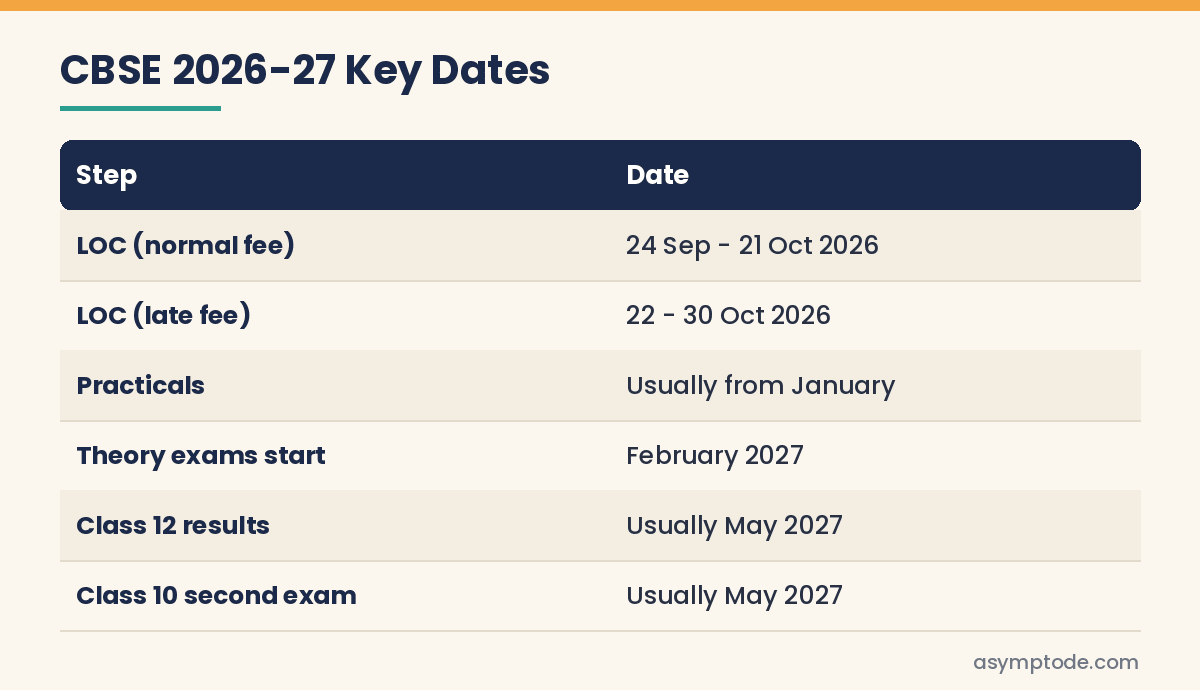
The LOC window with normal fee ran from 24 September to 21 October 2026. The late-fee window runs from 22 to 30 October 2026. Practical exams usually start in January (not yet announced for 2027). Theory exams start in February 2027. Class 12 results usually come in May, and the Class 10 second exam is usually held in May.
How does the CBSE Class 10 two board exam system work?
From 2026, Class 10 students get two board exams in one year. This follows the CBSE notification of 14 February 2026 and the scheme printed in the LOC circular. The rules are:
- The first exam is compulsory. Every Class 10 student must sit it in February-March.
- Both exams cover the full syllabus. The paper pattern stays the same.
- The second exam is optional. Passed students can improve up to 3 subjects out of Science, Maths, Social Science and languages.
- Miss 3 or more subjects and you lose the second chance. You are placed in "Essential Repeat" and wait for the next February.
- Compartment students can take the second exam to clear the subject.
- No subject change between the two exams. The one exception is switching between Maths Standard and Maths Basic.
- The better score counts. For regular students, CBSE uses the better of the two performances.
In 2026, 3,08,095 students (59.95% of those who tried) improved their score in the second exam.
Class 12 still has one main exam plus a supplementary exam in July.
What subjects and marks are in the CBSE board exam?
For Class 10, you take 5 main subjects: two languages (Hindi or English must be one), Mathematics (Standard or Basic), Science and Social Science. A Skill subject is an optional sixth. If you fail Science, Maths or Social Science but pass the Skill subject, the Skill subject replaces it.
For Class 12, you take 5 main subjects from the scheme of studies, often with one additional subject.
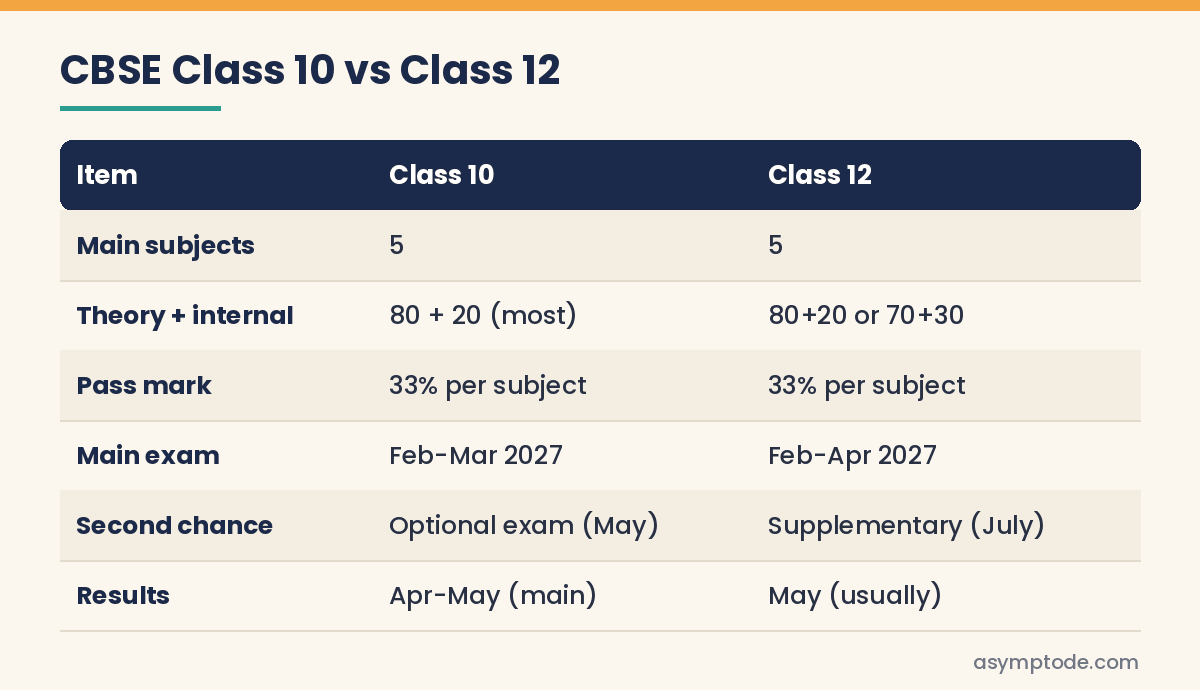
The table shows the usual split. Most Class 10 subjects have 80 marks of theory and 20 marks of internal assessment. Class 12 subjects with practicals often have 70 theory and 30 practical marks, while others use 80 + 20. Both classes need 33% to pass. Class 10 has exams in February-March and an optional May exam. Class 12 has February-April exams and a July supplementary.
The exact theory-practical split is set for each subject in the CBSE curriculum 2026-27. Always check your own subject.
What are the passing marks for CBSE Class 10 and 12?
The CBSE Examination Bye-laws set the pass mark at 33% in each subject. If a subject has practicals, you need 33% in theory and 33% in practicals separately, plus 33% overall.
How is the CBSE percentage calculated?
CBSE gives marks for each subject. It does not print an overall percentage, and it does not give first, second or third divisions. The LOC circular says plainly: "CBSE does not calculate and provide the percentage." Each college or employer uses its own rule.
Many colleges and schools use the best five subjects. Here is how that sum works.
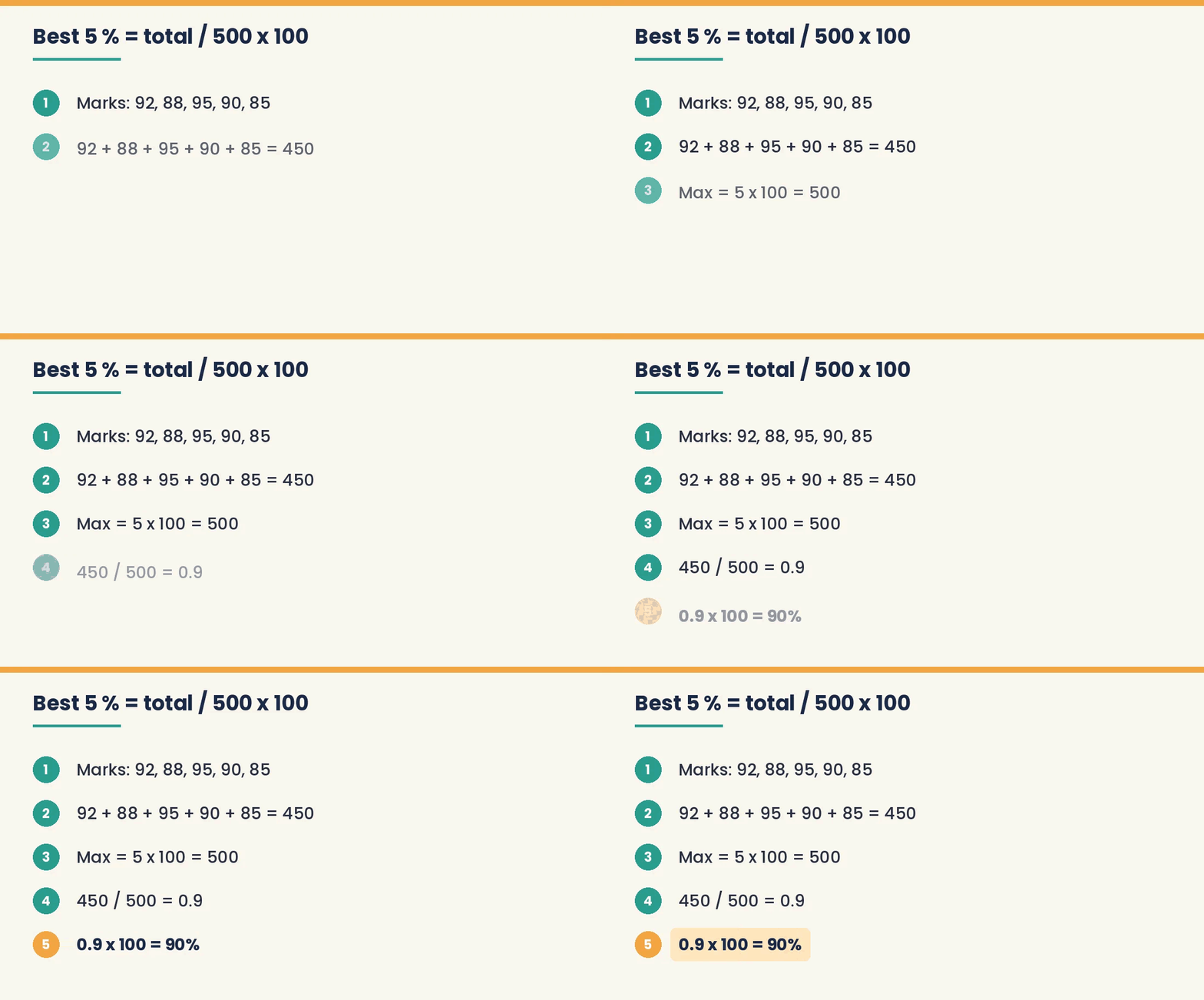
Take five subject marks: 92, 88, 95, 90 and 85. Add them: 92 + 88 + 95 + 90 + 85 = 450. Divide by the maximum, 500, and multiply by 100. The answer is 90%. JEE Advanced and BITSAT have their own rules (see below).
What is the CBSE syllabus for 2026-27?
The syllabus for the 2027 board exams is the CBSE curriculum 2026-27 on cbseacademic.nic.in. Download each subject PDF. It lists units, marks per unit and internal assessment.
Good news for this batch: the new three-language rule does not change anything for students in Class 10 during 2026-27. They do not need a third language (CBSE press release, 29 June 2026).
Where can I get CBSE sample papers 2027?
CBSE posts sample question papers (SQPs) and marking schemes on cbseacademic.nic.in. The 2026-27 papers for Class 10 and Class 12 are already out. As reported by Physics Wallah, the paper design is the same as in 2025-26.
Sample papers show the pattern: MCQs, case-based, assertion-reason and long answers. As reported by CollegeDekho, about half of the Class 10 paper is competency-based. So practise word problems and real-life cases, not only textbook drills.
Worked example: a CBSE Class 10 maths question
Quadratic equations come up every year in Class 10 maths. Here is a typical question, solved step by step.
Question: Find the roots of 2x^2 - 7x + 3 = 0 using the quadratic formula.
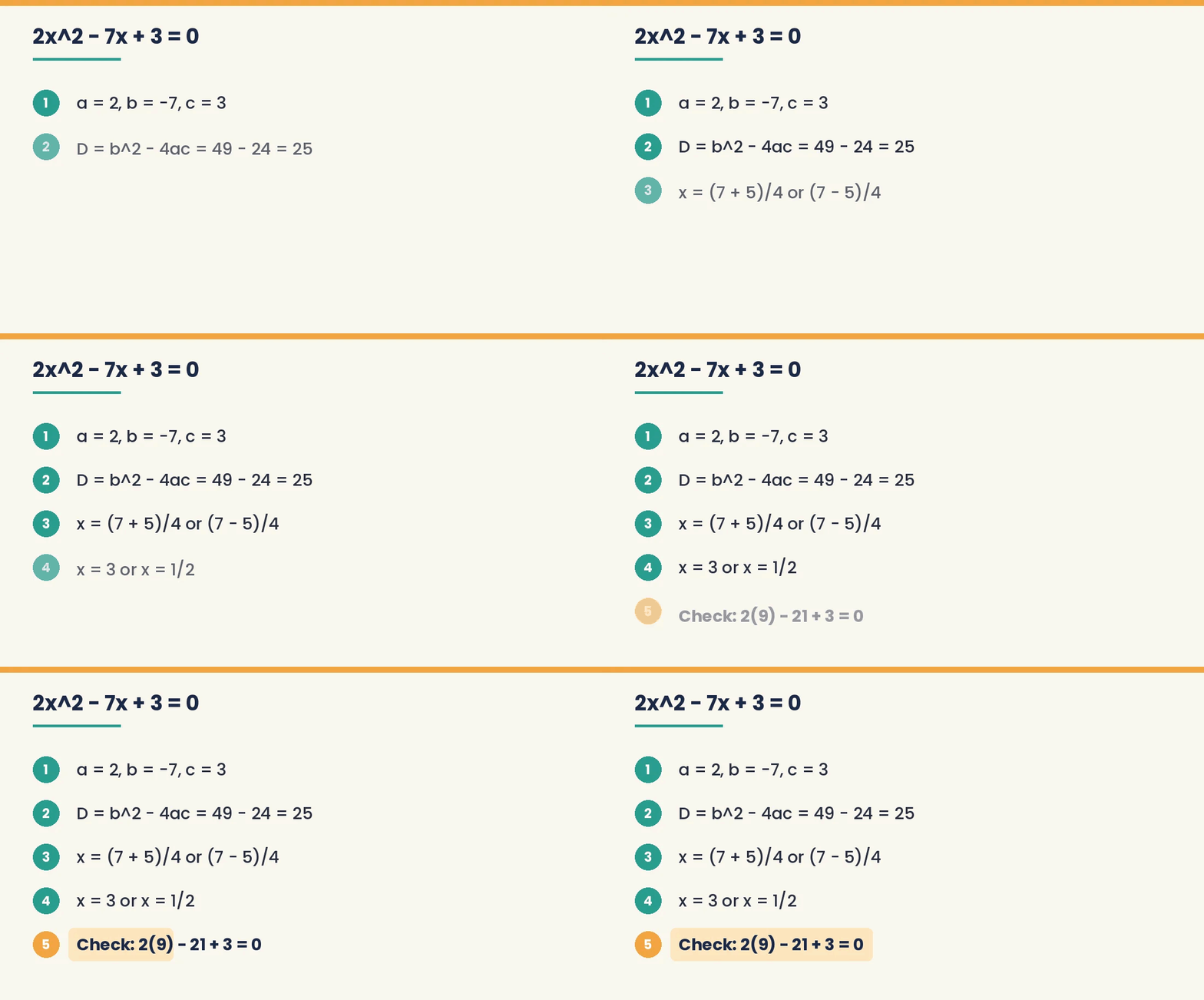
- Read off a, b and c. Here a = 2, b = -7, c = 3.
- Find the discriminant. D = b^2 - 4ac = 49 - 24 = 25.
- Check D. D is more than 0, so there are two different real roots.
- Use the formula. x = (-b ± √D) / 2a = (7 ± 5) / 4.
- Write both roots. x = 12/4 = 3, and x = 2/4 = 1/2.
- Check. Put x = 3 back in: 18 - 21 + 3 = 0. It works.
In the board exam, marks come from each step. Write the formula, show D, and box both answers.
What is the LOC and how do you register for the CBSE board exam?
The LOC (List of Candidates) is the list your school sends to CBSE. Only students on it can sit the 2027 board exams. Your school fills it, but you must check your name, date of birth, parents' names and subject codes before the school submits it. Mistakes here end up on your mark sheet.
The official LOC fees for 2026-27 are:
| Where your school is | Fee for 5 subjects | Each extra subject |
|---|---|---|
| India | INR 1,600 | INR 320 |
| Nepal | INR 5,500 | INR 1,100 |
| Other countries (Gulf, etc.) | INR 11,000 | INR 2,200 |
A late fee of INR 2,000 per student applies from 22 to 30 October 2026. Class 12 also has a practical fee of INR 160 per practical subject in India, INR 175 in Nepal and INR 375 in other countries. Visually impaired students do not pay exam fees. Source: CBSE LOC circular 2026-27.
For Class 10, the LOC for the second exam is filled only after the first exam is over.
Can private candidates sit the CBSE board exam 2027?
Yes, in some cases. Private candidates include students who failed or got "Essential Repeat" in earlier years, compartment students, and 2026 passed students who want to improve. They apply online on the CBSE website. The form window opened on 8 October 2026. Read the Class 10 and Class 12 circulars for the full rules and fees.
When will CBSE board results 2027 come out?
The 2027 result dates are not yet announced. Past patterns:
- Class 10 main exam: declared on 15 April 2026, as reported by India Today NE.
- Class 12: declared on 13 May 2026 (CBSE press release). The pass rate was 85.20%.
- Class 10 second exam: declared on 18 July 2026.
Results appear on cbse.gov.in, results.nic.in, DigiLocker and UMANG. There is no merit list. It gives merit certificates to the top 0.1% of students in each subject.
What is the CBSE supplementary exam?
If you fail one subject in Class 12, you get a compartment chance in the supplementary exam. In 2026 it was a single-day exam on 28 July. Students who passed could also use it to improve one subject. For Class 10, the May second exam does this job.
How do CBSE board marks matter for JEE, NEET, CUET and BITSAT?
| Exam | What board marks you need |
|---|---|
| JEE Advanced (IITs) | 75% in Class 12, or top 20 percentile of your board |
| BITSAT | 75% in PCM total, and 60% in each of P, C, M |
| NEET UG | Pass Class 12 with Physics, Chemistry, Biology and English |
| CUET UG | Pass Class 12; each college sets its own rule |
- IITs: JEE Advanced rules need at least 75% in Class 12 (65% for SC, ST and PwD), or a place in the top 20 percentile of your board. See our JEE Main 2027 guide and how to get into IIT.
- BITS: BITSAT eligibility asks for 75% across Physics, Chemistry and Maths, with at least 60% in each. Theory and practical marks both count. Read our BITSAT 2027 guide.
- Medical: NEET has its own minimum marks in PCB. Check the NTA bulletin, and see our NEET UG 2027 guide.
- Delhi University and others: admission is by CUET score, but you must meet each course's Class 12 rule. See our CUET UG 2027 guide.
What about CBSE schools in the Gulf and abroad?
CBSE has affiliated schools in 27 countries, from Japan to Ghana. Students abroad sit the same papers at Indian Standard Time. Results and mark sheets come through DigiLocker and the school.
In 2026, Class 12 exams in 40 subjects could not be held in West Asia (Bahrain, Iran, Kuwait, Oman, Qatar, Saudi Arabia and UAE). CBSE gave results through a special assessment scheme. It then held special exams in October 2026 for students who wanted to sit them. If you study in the Gulf, follow your school's notices and cbse.gov.in closely.
Need help planning revision across time zones? Book a free demo class with an Asymptode mentor.
How should I study for the CBSE board exam 2027? A month-by-month plan
You have about 3 to 4 months left. Here is a simple plan, from November to February.
| Month | Main goal | Daily target |
|---|---|---|
| November | Finish the syllabus | 1 new chapter every 2-3 days |
| December | First full revision + pre-board | 1 chapter revised + 10 questions |
| January | Sample papers + practicals | 1 timed paper every 2 days |
| February | Final revision and rest | Formula sheets, error log, sleep |
- November: close the gaps. List every chapter. Mark each as done, weak or not started. Finish the "not started" ones first. For maths and science, solve all NCERT examples and exercises.
- December: revise and test. Revise one chapter a day. Write short formula sheets. Take your pre-board seriously; it shows weak areas.
- January: practise like the real exam. Solve the official sample papers in 3 hours, with a timer. Check them with the CBSE marking scheme. Keep an "error log" of every mistake. Prepare well for practicals and viva, since those marks are easy to earn.
- February: polish, do not panic. Read your error log and formula sheets. Do one light paper every few days. Sleep 8 hours.
If you are also preparing for JEE or NEET, merge the plans. Board-style written answers and entrance-style MCQs use the same concepts. Our guides on how to become an engineer and how to become a doctor explain the bigger path.
How 1-on-1 tutoring helps with the CBSE board exam 2027
- One dedicated mentor, live online and 1-on-1. Your Asymptode mentor follows your own CBSE syllabus, your school's pre-board dates and the official date sheet when it comes out.
- Method first. In maths and science, the mentor watches each step of your working. This matters because CBSE gives marks for steps, like in the quadratic example above.
- Personalised homework with feedback. You get sample-paper questions on your weak chapters, and the mentor marks them using the CBSE marking scheme style.
- Planning and calm. For subjects outside maths and science, the mentor helps with planning and study method. Parents get short updates, every class is recorded for revision, and you can start with a free demo class. See our plans and fees.
Related guides
- JEE Main 2027 guide
- NEET UG 2027 guide
- CUET UG 2027 guide
- BITSAT 2027 guide
- How to get into IIT
- Mole concept explained
Facts checked against official sources on 29 October 2026.
FAQ
Is the CBSE 2027 date sheet out?
No. As of 29 October 2026, CBSE has not released the 2027 date sheet. The exams are planned for February-March 2027. Check cbse.gov.in only, because fake date sheets often go viral.
Is the second Class 10 board exam compulsory?
No. Only the first exam in February-March is compulsory. The second exam, usually in May, is optional. You can use it to improve up to 3 subjects out of Science, Maths, Social Science and languages.
What happens if I miss the first Class 10 board exam?
If you miss 3 or more subjects in the first exam, you cannot sit the second exam. You will be placed in the "Essential Repeat" category. You then take the main exam the next February.
What is the passing mark in the CBSE board exam?
You need 33% in each subject. In subjects with practicals, you need 33% in theory and 33% in practicals separately. You also need 33% in the subject overall.
Does CBSE give an overall percentage or division?
No. CBSE shows marks for each subject but no total percentage and no division. Colleges and employers calculate the percentage by their own rules, often using the best five subjects.
Do I need 75% in Class 12 for IIT?
Yes, for IIT admission through JEE Advanced. You need at least 75% in Class 12 (65% for SC, ST and PwD) or a place in the top 20 percentile of your board. Other colleges in JoSAA counselling also have a Class 12 marks rule, so check the JoSAA rules each year.
Ready to start? Book a free demo class and advisor call, or see our plans and fees.
Sources
- CBSE official website
- CBSE LOC circular for Class X and XII Main Examinations 2026-27
- CBSE notification: Two Board Examinations in Class X (14.02.2026)
- CBSE press release: Class X Second Board Examination results 2026
- CBSE press release: Class XII results 2026
- CBSE private candidates Class X 2026-27
- CBSE Scheme of Examinations and Pass Criteria
- CBSE Curriculum 2026-27
- JEE (Advanced) admission criteria
- BITSAT eligibility criteria