
SAT vs ACT is a choice between two college admission tests that US colleges treat the same way. The SAT is a 2-hour-14-minute digital adaptive test with a calculator allowed on all of Math. The ACT is a 2-hour-5-minute test (without Science) with more questions and less time per question. Here is a 2026-27 comparison and a two-week plan to pick one.
Key takeaways
- Colleges that require testing, such as MIT, accept the SAT or the ACT. They do not say they prefer either one.
- SAT: 98 questions in 134 minutes, scored 400-1600, digital and adaptive, with a Desmos calculator built in.
- ACT: 131 questions in 125 minutes, Composite 1-36 from English, Math and Reading. Science and Writing are optional.
- US fees: SAT $68. ACT $70 (or $75 with Science). Outside the US: SAT $111, ACT $188.50.
- Next dates: SAT on 7 November and 5 December 2026. ACT (US) on 12 December 2026.
- Best way to decide: take one official full practice test of each, then compare scores using the official concordance table.
Which is easier, the SAT or the ACT?
Quick answer: Neither test is easier for everyone. The SAT gives more time per question, adapts to you, and lets you use Desmos on every Math question. The ACT is faster, has a fixed form, and adds an optional Science section. Take one official practice test of each and choose the one where you score higher.
SAT vs ACT: side-by-side comparison
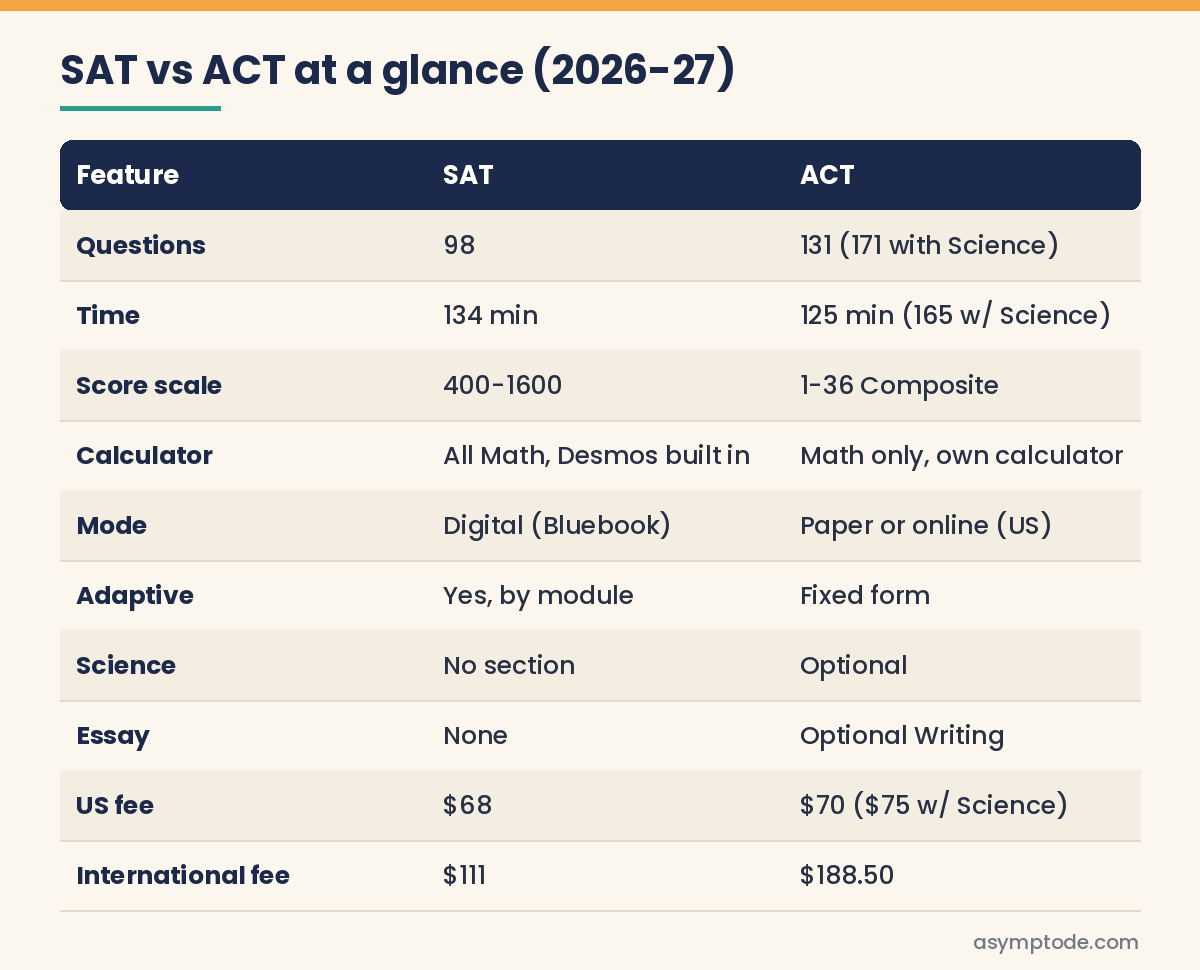
SAT vs ACT at a glance for 2026-27, from College Board and ACT official pages.
| Feature | SAT (2026-27) | ACT (2026-27) |
|---|---|---|
| Sections | Reading and Writing; Math | English; Math; Reading; Science (optional); Writing (optional) |
| Questions | 98 (54 RW + 44 Math) | 131 (50 + 45 + 36); 171 with Science |
| Time | 134 min + 10-min break | 125 min; 165 with Science; +40 for Writing |
| Time per question | About 71 s (RW), 95 s (Math) | About 42 s (English), 67 s (Math), 67 s (Reading) |
| Calculator | All of Math; Desmos built into Bluebook, or your own approved one | Math only; your own permitted calculator |
| Math answer choices | 4 choices, plus some typed-in answers | 4 choices |
| Score scale | 400-1600 (two sections of 200-800) | Composite 1-36 (average of English, Math, Reading) |
| Mode | Digital only (Bluebook app) at a test centre | US: paper or online. Outside the US: test centres, mostly on computer |
| Adaptive? | Yes, by module | No, fixed test form |
| Science | No separate section | Optional; adds a STEM score |
| Essay | None | Optional Writing (2-12 scale) |
| US fee | $68 | $70; $75 with Science; $95 with Writing; $100 with both |
| International fee | $111 ($68 + $43); some centres add $24 | $188.50; $198.50 with Science |
| How often | Weekend dates in Oct, Nov, Dec, Mar, May, Jun | 7 US national dates; 7 international dates |
Sources: SAT structure, calculator, fees, international fees; ACT sections, scores, US fees, non-US fees.
How is SAT Math different from ACT Math?
SAT Math has 44 questions in 70 minutes. It covers four areas: Algebra (13-15 questions), Advanced Math (13-15), Problem-Solving and Data Analysis (5-7), and Geometry and Trigonometry (5-7). Some answers are typed in, and Desmos lets you graph to check. See our digital SAT Math guide.
ACT Math has 45 questions in 50 minutes, about 67 seconds each, with four choices per question. Speed matters more. See our ACT Math test guide.
SAT-style worked example
Question (type-in answer): A line passes through (2, 5) and (6, 13). What is the y-intercept of the line?
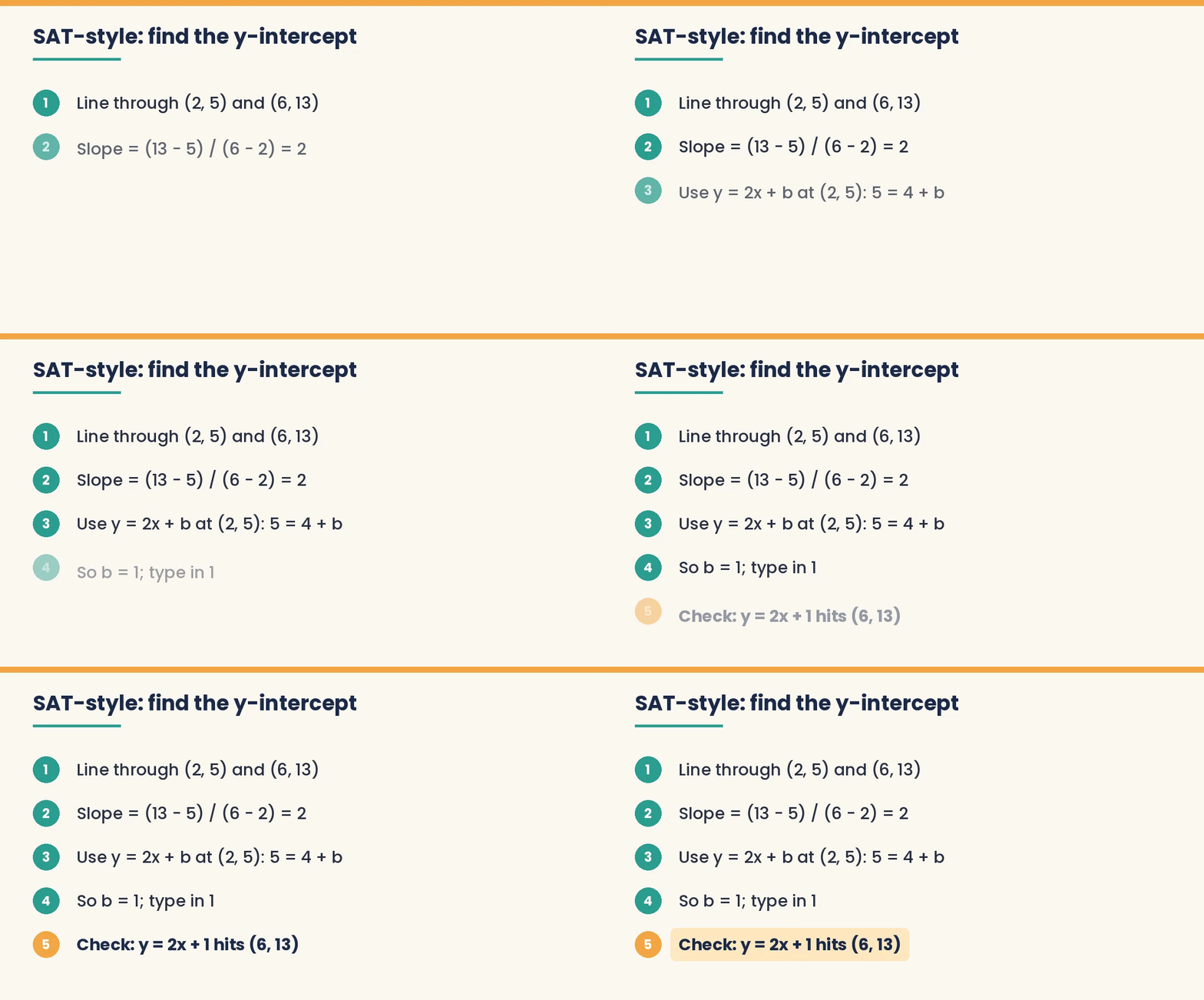
An SAT-style line question, solved one step at a time.
- Slope = (13 - 5) / (6 - 2) = 8 / 4 = 2.
- Use y = 2x + b with the point (2, 5): 5 = 2(2) + b.
- So b = 5 - 4 = 1.
- Type in 1. Check in Desmos: graph y = 2x + 1. It passes through (6, 13).
ACT-style worked example
Question: If log2(x) + log2(x - 2) = 3, what is x? A) 2 B) 4 C) 6 D) 8
- Combine the logs: log2(x(x - 2)) = 3.
- So x(x - 2) = 2^3 = 8, which gives x^2 - 2x - 8 = 0.
- Factor: (x - 4)(x + 2) = 0, so x = 4 or x = -2.
- A log needs a positive input, so x = -2 fails. The answer is B) 4.
Quick check: log2(4) + log2(2) = 2 + 1 = 3.
Which test should I take? Decision steps
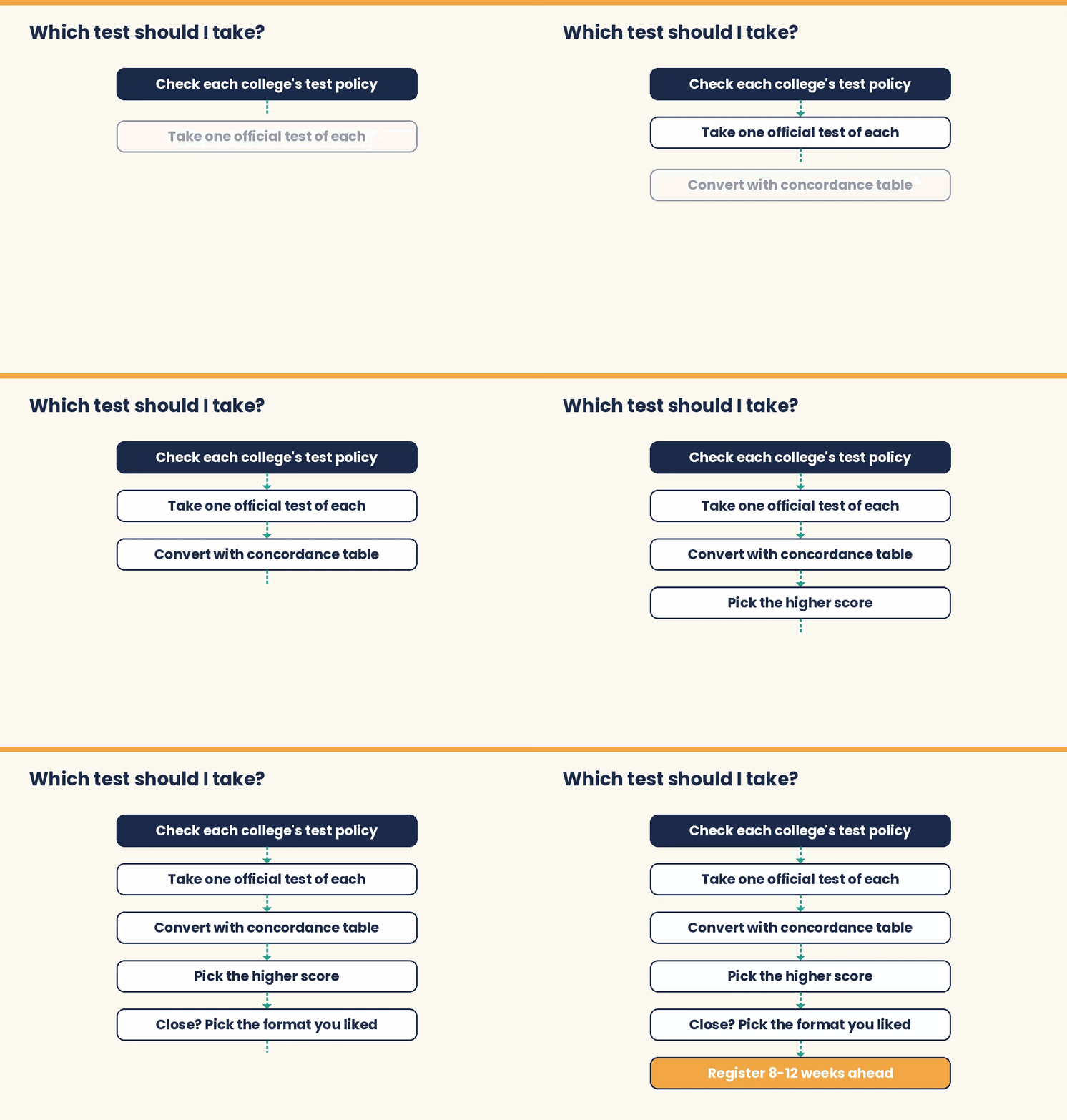
A simple way to choose between the SAT and the ACT.
- Check your colleges. Confirm which ones require, recommend or skip tests. Colleges that require tests accept either one.
- Take one official practice test of each under timed conditions.
- Convert the scores using the official concordance table (see below).
- Pick the higher one. If the scores are close, pick the format you liked.
- Time pressure? If you often run out of time, the SAT may suit you.
- Fast with charts and data? The ACT may suit you.
Took the PSAT/NMSQT? Use it as an extra SAT data point. See our PSAT/NMSQT guide.
Do colleges prefer the SAT or the ACT?
No. US colleges that require or consider scores accept both tests. For example, MIT says: "We require the SAT or the ACT." It states no preference, and it does not require ACT Science or Writing. See how to get into MIT. Always check each college's testing page, because policies change.
How do SAT and ACT scores compare?
College Board and ACT publish the 2018 ACT/SAT concordance tables. ACT says the tables "are not updated annually" and that they compare scores but "do not predict performance on the other test." Sample rows from Table A2 (ACT Composite to SAT Total):
| ACT Composite | SAT Total (concorded) | SAT range |
|---|---|---|
| 36 | 1590 | 1570-1600 |
| 30 | 1370 | 1360-1380 |
| 24 | 1180 | 1160-1190 |
College Board also hosts the tables on its SAT/ACT score comparison page.
SAT and ACT test dates 2026-27
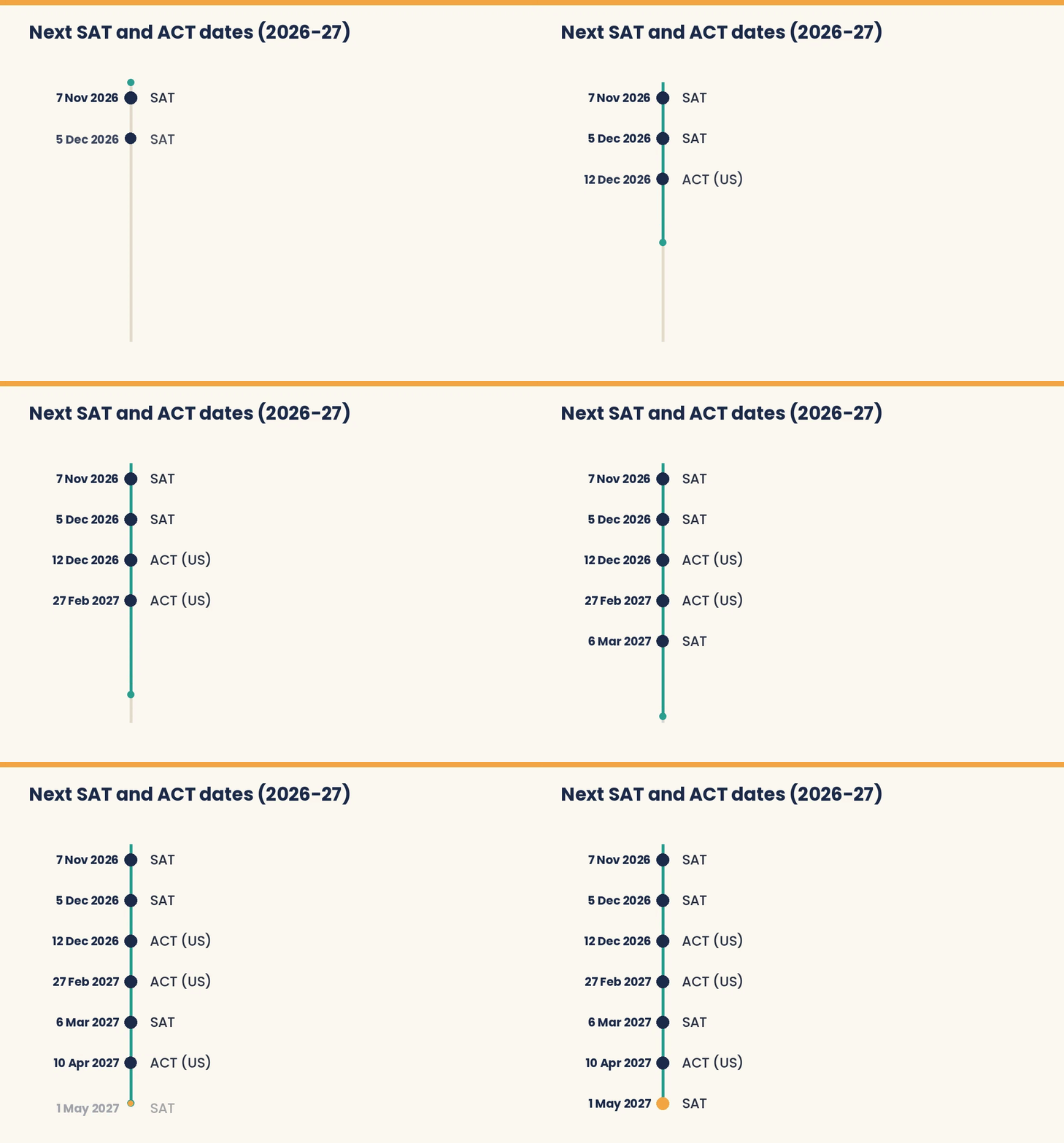
The next seven US weekend test dates across both tests, 2026-27.
| Test date (2026-27) | Test | Register by | Late deadline |
|---|---|---|---|
| 7 Nov 2026 | SAT | 23 Oct (passed) | 27 Oct 2026 |
| 5 Dec 2026 | SAT | 20 Nov 2026 | 24 Nov 2026 |
| 12 Dec 2026 | ACT (US) | 6 Nov 2026 | 29 Nov 2026 |
| 27 Feb 2027 | ACT (US) | 22 Jan 2027 | 9 Feb 2027 |
| 6 Mar 2027 | SAT | 19 Feb 2027 | 23 Feb 2027 |
| 10 Apr 2027 | ACT (US) | 5 Mar 2027 | 23 Mar 2027 |
| 1 May 2027 | SAT | 16 Apr 2027 | 20 Apr 2027 |
Later dates: SAT on 5 June 2027; ACT (US) on 12 June and 10 July 2027. SAT dates are the same worldwide (SAT dates). US ACT dates differ from international ACT dates: 11-12 December 2026, 12-13 February, 2-3 April, 11-12 June and 9-10 July 2027.
Thinking about tutoring? Book a free demo class to plan your test date.
Can you superscore the SAT or ACT?
A superscore combines your best section scores from different dates. For the ACT, it is the average of your best English, Math and Reading scores, as ACT explains in its superscore guide. ACT also says "not every college superscores the ACT." The same is true for the SAT. Each college sets its own rule. MIT, for example, "primarily consider[s] the highest score achieved in each section."
Example: best English 33, best Math 30, best Reading 31. Average = 94 / 3 = 31.33, which rounds to an ACT superscore of 31.
A 2-week plan to decide
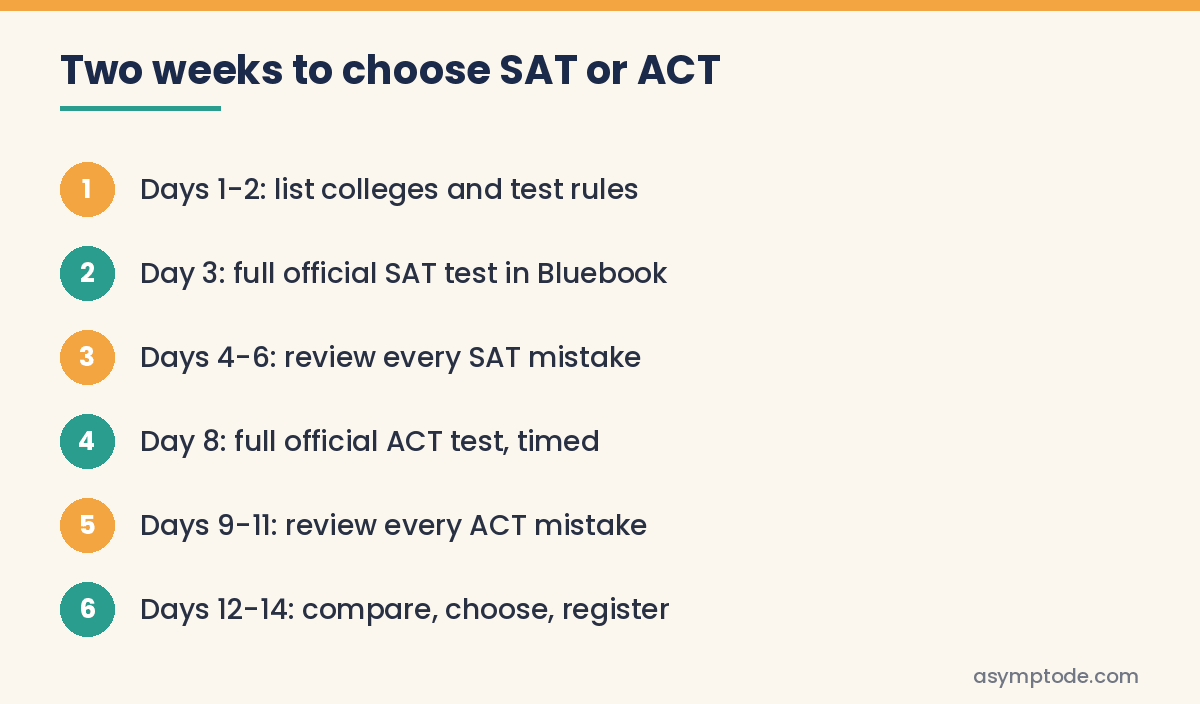
A two-week plan built around one official practice test of each.
- Days 1-2: List your colleges and their testing rules.
- Day 3: Take a full official SAT practice test in the Bluebook app.
- Days 4-6: Review every mistake. Sort them as content, careless or timing.
- Day 8: Take a full official ACT practice test with a timer.
- Days 9-11: Review the ACT mistakes the same way.
- Days 12-14: Compare the scores with the concordance table. Choose a test and register for a date 8-12 weeks away.
Common mistakes when choosing between the SAT and ACT
- Comparing scores without the official concordance table.
- Preparing for both tests for months.
- Skipping Desmos practice for the SAT.
- Ignoring the ACT's time pressure until test day.
- Missing a registration deadline. Late fees are $38 (SAT) and $42 (ACT).
- Assuming every college superscores.
How 1-on-1 tutoring helps with the SAT vs ACT choice
At Asymptode, one student works with one dedicated mentor in live online classes. No batches. Your mentor reviews both practice tests, helps you choose, and plans around your test date. For Math, the mentor watches each step of your working and fixes the method, from SAT Desmos habits to ACT speed. For Reading, Writing and English, the mentor helps with logic, planning and practice routines. You get personalised homework with feedback, flexible times across time zones, recorded classes and short parent updates. Read our SAT guide for parents for more.
Ready to choose? Book a free demo class or see fees.
Facts checked against official sources on 27 October 2026.
FAQ
Is the SAT or ACT better for international students?
Both are accepted by US colleges. The SAT has the same dates worldwide and costs $111 outside the US. The international ACT costs $188.50 and has its own dates. Choose by practice scores and nearby centres.
Is the ACT Science section required?
No. Since the enhanced ACT, Science is optional and is not part of the Composite. Some students take it to get a STEM score. Check whether any of your colleges ask for it.
Can I take both the SAT and the ACT?
Yes, but focusing on one usually works better. Take one practice test of each, then commit to the better fit.
Is the digital SAT adaptive?
Yes. Each section has two modules. How you do on the first module decides whether the second module is harder or easier.
Does the SAT still have an essay?
No. The SAT has only two sections: Reading and Writing, and Math. The ACT has an optional Writing essay scored 2-12, which does not change the Composite.
When should I take my first SAT or ACT?
Many students first test in spring of Grade 11, leaving time for a retake in Grade 12. Regular deadlines fall two to five weeks before test day.
Sources
- College Board: SAT structure
- College Board: SAT Math overview
- College Board: Calculator policy (Desmos in Bluebook)
- College Board: SAT test dates and deadlines 2026-27
- College Board: SAT test fees
- College Board: SAT international fees
- College Board: Understanding SAT scores (PDF)
- College Board: SAT/ACT score comparisons
- ACT: Exam format, sections and structure
- ACT: Test enhancements
- ACT: Understanding your scores
- ACT: How to calculate your ACT superscore
- ACT: US test dates 2026-27
- ACT: International test dates 2026-27 (PDF)
- ACT: US fees
- ACT: Non-US fees
- ACT: ACT/SAT concordance
- ACT: 2018 ACT/SAT concordance tables (PDF)
- MIT Admissions: Tests and scores