
VCE Mathematical Methods ends with two written exams: a technology-free Exam 1 and a CAS-allowed Exam 2. Together they make up 60% of the study score. This guide explains both exams, the 2026 dates, how the score is built and how to use the final weeks well.
Key takeaways
- Exam 1 is technology-free: 15 minutes reading, 1 hour writing, 40 marks. No calculator and no notes.
- Exam 2 allows an approved CAS and one bound reference: 15 minutes reading, 2 hours writing, 80 marks (20 multiple choice + 60 marks of extended answers).
- The study score is built from Unit 3 SACs (20%), Unit 4 SACs (20%), Exam 1 (20%) and Exam 2 (40%).
- In 2026, Exam 1 is on Thursday 5 November and Exam 2 is on Friday 6 November.
- Exam 1 rewards clean algebra by hand. Exam 2 rewards knowing your CAS and interpreting answers.
What are the VCE Maths Methods exams?
Quick answer: VCE Mathematical Methods Units 3 and 4 have two end-of-year exams set by the VCAA. Exam 1 is a 1-hour, 40-mark paper with no technology. Exam 2 is a 2-hour, 80-mark paper with a CAS calculator and a bound reference. Exam 1 is worth 20% of the study score and Exam 2 is worth 40%.
Mathematical Methods (often called "Methods") is the VCE maths subject most students take for science, engineering, health and commerce pathways at university. It covers functions and graphs, algebra, calculus and probability and statistics. Many students take it with Specialist Mathematics, which goes further.
How are Exam 1 and Exam 2 different?
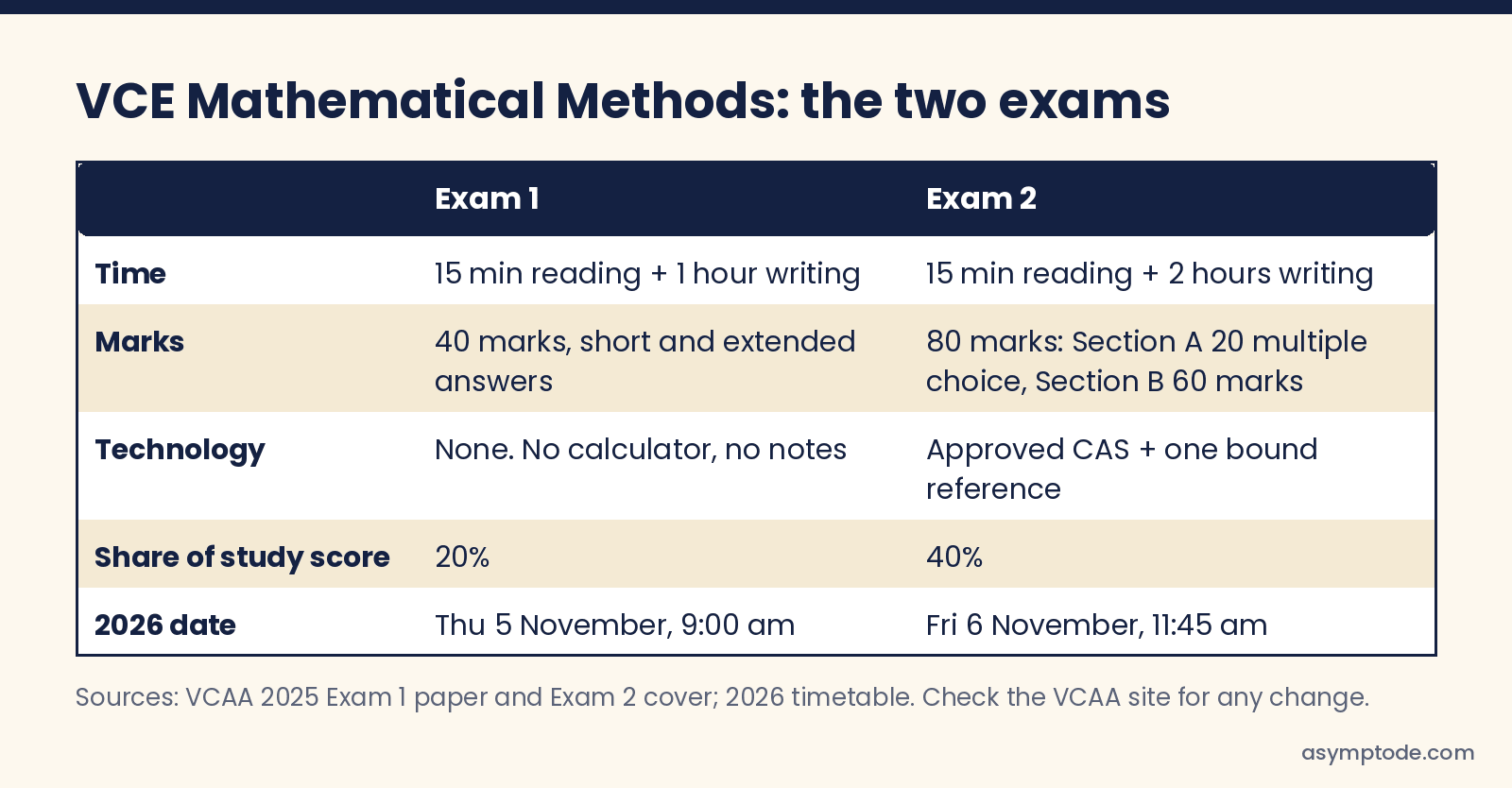
| Exam 1 | Exam 2 | |
|---|---|---|
| Reading time | 15 minutes | 15 minutes |
| Writing time | 1 hour | 2 hours |
| Marks | 40 | 80 (Section A: 20 multiple choice, Section B: 60 marks) |
| Technology | None. No calculator, no notes | Approved CAS (plus an optional scientific calculator) |
| Notes | Not allowed; formula sheet supplied | One bound reference allowed; formula sheet supplied |
| Share of study score | 20% | 40% |
| 2026 date | Thursday 5 November, 9:00 am | Friday 6 November, 11:45 am |
Exam 1 has a small number of questions, most with several parts. The 2025 paper, for example, had 9 questions. They covered differentiation, finding a function from its derivative, a transformed trig graph, discrete and binomial probability, exponential equations and inverse functions, a cubic, and a probability density function. Exact answers are expected, so fractions, surds and π stay as they are.
Exam 2 starts with 20 multiple-choice questions worth 1 mark each. There is no penalty for a wrong answer, so never leave one blank. Section B has longer, linked questions, often built around a real context. Later parts depend on earlier ones, so a clear setup matters.
How is the VCE Methods study score made?
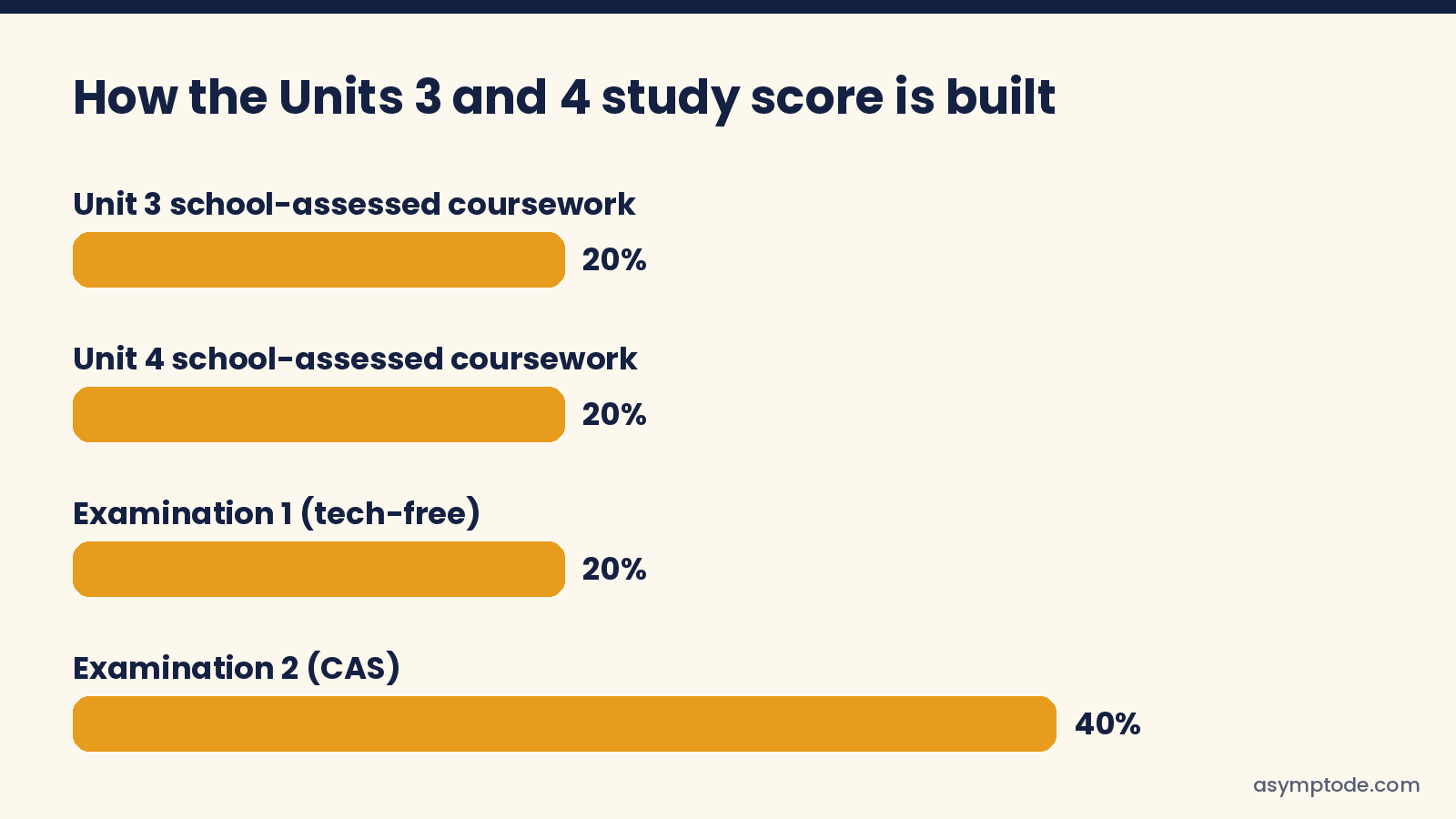
| Graded assessment | Share |
|---|---|
| Unit 3 school-assessed coursework (SAC) | 20% |
| Unit 4 school-assessed coursework (SAC) | 20% |
| Examination 1 (technology-free) | 20% |
| Examination 2 (CAS) | 40% |
SAC results are checked against the exams through statistical moderation. In simple terms, the exams help decide how your school's SAC marks are scaled. Strong exams lift the whole picture. That is why the final weeks before the exams matter so much.
What topics come up in Methods exams?
The four areas of study run through both exams:
- Functions, relations and graphs: polynomials, exponentials, logs, trig functions, transformations, inverses and composite functions.
- Algebra, number and structure: solving equations, including exponential, log and trig equations, and simultaneous equations.
- Calculus: derivatives with the product, quotient and chain rules, tangents, stationary points, anti-derivatives, definite integrals and areas.
- Data analysis, probability and statistics: discrete and continuous random variables, the binomial and normal distributions, and sample proportions.
Worked examples in the Exam 1 style
These are the kinds of skills Exam 1 tests without a calculator. Each step is written out.
Example 1: Product rule
Differentiate f(x) = x² e^(3x).
- Let u = x² and v = e^(3x).
- Then u′ = 2x and v′ = 3e^(3x) (chain rule).
- Product rule: f′(x) = u′v + uv′ = 2x e^(3x) + 3x² e^(3x).
- Factorise: f′(x) = x e^(3x)(2 + 3x).
Example 2: Find a stationary point
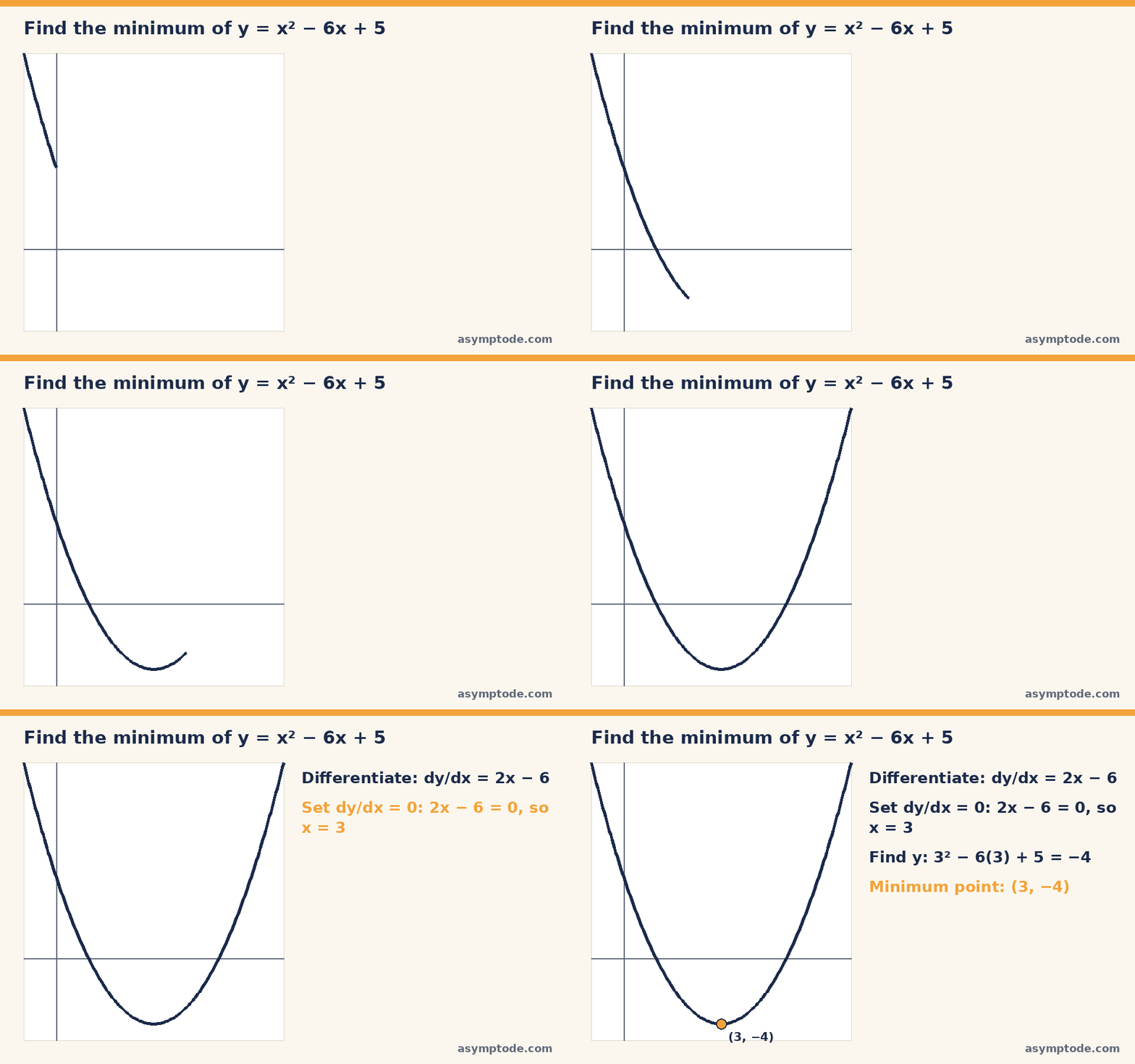
Find the stationary point of y = x² − 6x + 5 and state its nature.
- Differentiate: dy/dx = 2x − 6.
- Set it to zero: 2x − 6 = 0, so x = 3.
- Substitute: y = 9 − 18 + 5 = −4.
- The coefficient of x² is positive, so the graph is a U shape. The point (3, −4) is a local minimum.
Example 3: A definite integral
Evaluate the integral of (3x² − 2x) from x = 0 to x = 2.
- Anti-differentiate: x³ − x².
- Substitute the top limit: 2³ − 2² = 8 − 4 = 4.
- Substitute the bottom limit: 0 − 0 = 0.
- Subtract: 4 − 0 = 4.
Example 4: Binomial probability
X follows a binomial distribution with n = 4 and p = 1/3. Find Pr(X = 2).
- Pr(X = 2) = C(4, 2) × (1/3)² × (2/3)².
- C(4, 2) = 6, (1/3)² = 1/9 and (2/3)² = 4/9.
- Multiply: 6 × 1/9 × 4/9 = 24/81.
- Simplify: 8/27.
What are the most common mistakes in Methods exams?
- Decimals in Exam 1. Exam 1 wants exact answers. Writing 1.41 instead of √2 can cost a mark.
- Missing the domain. When solving trig equations, students give one solution when the domain allows two or more.
- "Show that" questions with gaps. If the answer is given, every step must be shown. Skipping lines loses marks.
- Copying CAS output without thinking. In Exam 2, a CAS can give answers outside the domain or in an awkward form. Students must check and interpret.
- A messy bound reference. A thick folder of everything is slow to use. A short, well-tabbed reference with worked examples is better.
- Running out of time in Section B. Students spend too long on Section A. Aim for about 25 to 30 minutes on the 20 multiple-choice questions.
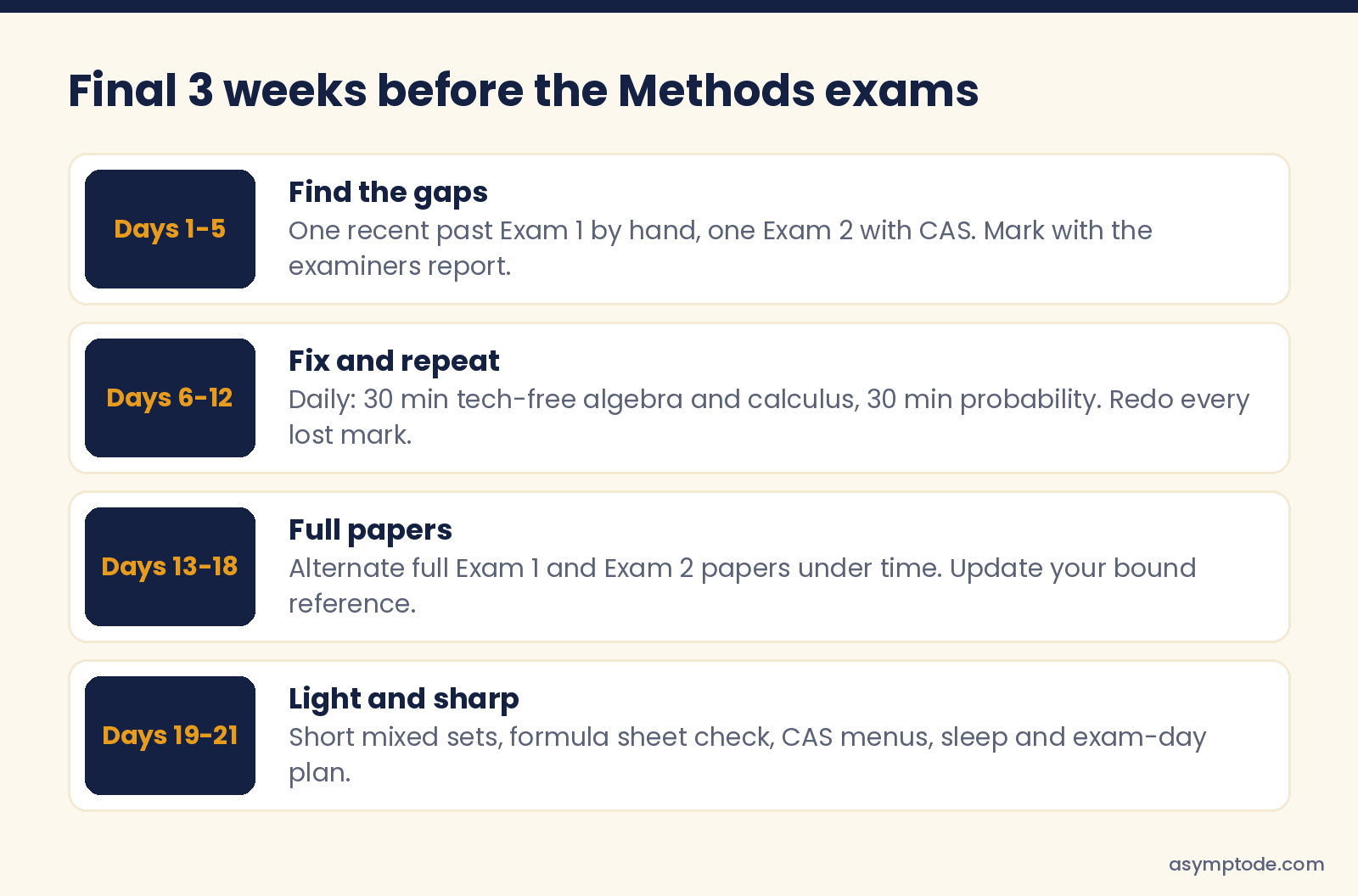
How should students use the final weeks?
| Days | Focus | What to do |
|---|---|---|
| 1-5 | Find the gaps | One recent past Exam 1 by hand and one Exam 2 with CAS. Mark them with the VCAA examiners' report. |
| 6-12 | Fix and repeat | Each day: 30 minutes of tech-free algebra and calculus, 30 minutes of probability. Redo every lost mark. |
| 13-18 | Full papers | Alternate full Exam 1 and Exam 2 papers under exam conditions. Update the bound reference. |
| 19-21 | Light and sharp | Short mixed sets, formula sheet check, CAS menus, sleep and an exam-day plan. |
Use VCAA past papers and examiners' reports. The reports explain where students lost marks each year. They are the single best guide to what examiners want.
Practise with the formula sheet. It is supplied in both exams. Students should know what is on it, so they do not waste time memorising those formulas, and what is not on it.
Starting earlier, in Year 11? Build hand algebra skills first. Many Exam 1 marks are lost to small algebra slips, not hard calculus.
Not sure how much support is enough? Read how many hours of maths tutoring per week.
Want a plan for the final weeks? Book a free demo class and an Asymptode mentor will help your child find the gaps.
How does 1-on-1 tutoring help with VCE Maths Methods?
Methods asks students to switch between two very different skills: neat algebra by hand for Exam 1 and smart CAS use for Exam 2. Many students are strong at one and weak at the other. A 1-on-1 mentor can see which, and plan around it.
At Asymptode, every class is live and 1-on-1, with the same mentor each time:
- We plan back from the exam dates and your child's SAC calendar.
- The mentor watches each line of working, so the habits that lose marks in "show that" and exact-value questions are fixed early.
- Homework is set on what was taught and checked by the mentor before the next class.
- Parents get short updates on progress and on what still needs practice.
- Every class is recorded, so your child can rewatch a method while building their bound reference.
We do not promise an ATAR or a study score. We do give clear, honest feedback and a steady plan. Our sessions run online, so they fit around school and SAC weeks in Melbourne or regional Victoria.
Related guides
- Comparing senior maths courses? See our IB Maths AA vs AI guide and our A-Level Maths guide.
- Younger child in Victoria? See our NAPLAN numeracy guide.
- Planning support: how many hours of maths tutoring per week.
Ready to start? Talk to an Asymptode advisor or see our fees.
FAQ
Can you use a calculator in VCE Methods Exam 1?
No. Exam 1 is technology-free. Calculators, software and notes are not allowed. A formula sheet is supplied.
What can you bring into Methods Exam 2?
One approved CAS (calculator or software), an optional scientific calculator, and one bound reference, such as an annotated textbook or a bound lecture pad. A formula sheet is supplied.
How much is each Methods exam worth?
Exam 1 is worth 20% of the study score and Exam 2 is worth 40%. School-assessed coursework in Units 3 and 4 makes up the other 40%.
When are the 2026 VCE Methods exams?
Exam 1 is on Thursday 5 November 2026 at 9:00 am. Exam 2 is on Friday 6 November 2026 at 11:45 am. Check the VCAA timetable for any change.
Is there a penalty for wrong answers in the multiple-choice section?
No. In Exam 2 Section A, a wrong answer scores 0 and marks are not taken away. Answer every question.
What is the best way to revise for Methods?
Do past VCAA papers under time, mark them with the examiners' reports, and redo every lost mark. Practise Exam 1 skills by hand every day.