The IB Diploma Programme is a two-year course for students aged about 16 to 19, run by the International Baccalaureate (IB). You study six subjects plus a core of three parts, and you can score up to 45 points. This guide covers subjects, points, passing, exams and planning.
Key takeaways
- The IB Diploma Programme lasts two years and is taught only in IB World Schools. You register through your school.
- You take six subjects: 3 or 4 at higher level (HL) and the rest at standard level (SL).
- The core is theory of knowledge (TOK), the extended essay (EE) and creativity, activity, service (CAS).
- Each subject is graded 1 to 7. TOK and EE add up to 3 points. The maximum is 45.
- You need at least 24 points and must meet several other conditions to get the diploma.
What is the IB Diploma Programme?
Quick answer: The IB Diploma Programme (IB DP) is a two-year course, usually taken in Years 12-13 or Grades 11-12. Students study six subjects from six groups, three or four at higher level. They also complete the core: theory of knowledge, the extended essay and CAS. Each subject is graded 1-7, and the top score is 45 points.
Only IB World Schools teach the IB DP. Your school registers you, not the IB. Fees are set by each school, so ask your school.
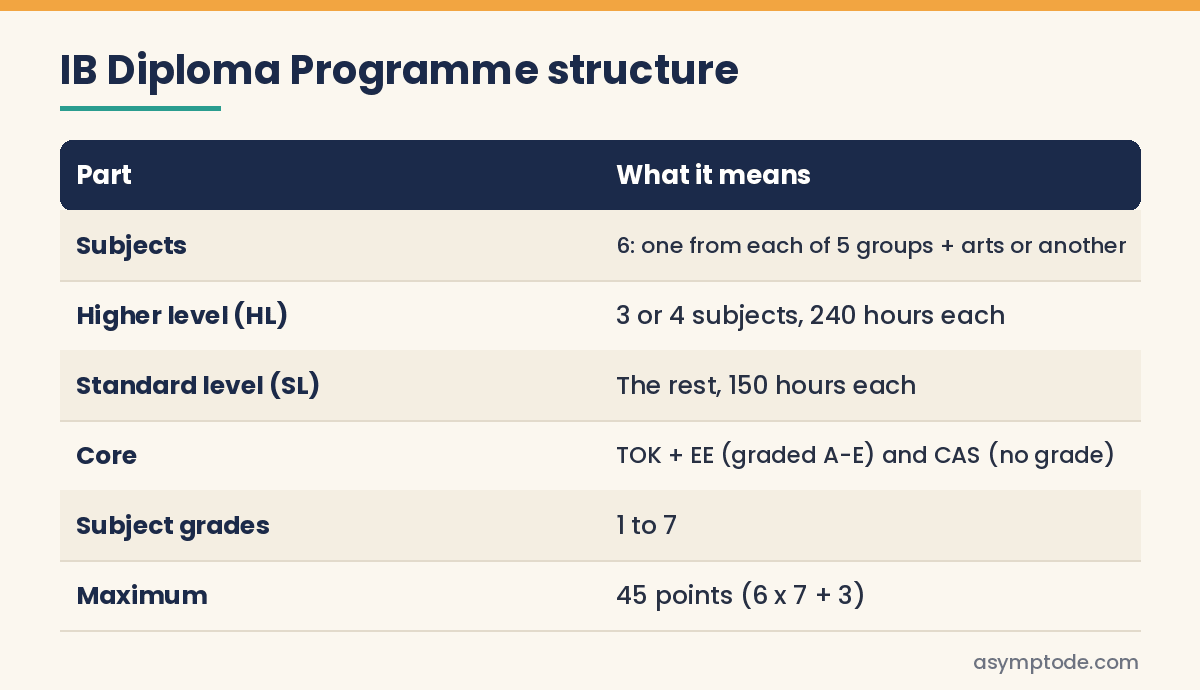
The table shows six subjects: one from each of five groups, plus an arts subject or another subject. HL covers 3 or 4 subjects at 240 teaching hours each. SL covers the rest at 150 hours each. The core is TOK and the EE (graded A-E) plus CAS (no grade). Each subject is graded 1-7, and the maximum is 45 points (6 x 7 + 3).
What subjects can you take in the IB DP?
The curriculum has six subject groups. You can read the full list on the IB DP curriculum page.
| Group | What it covers |
|---|---|
| 1. Studies in language and literature | Language and literature study |
| 2. Language acquisition | Learning another language |
| 3. Individuals and societies | Subjects about people and society |
| 4. Sciences | Biology, Chemistry, Computer science, Design technology, ESS, Physics, Sports exercise and health science |
| 5. Mathematics | Analysis and approaches (AA) or Applications and interpretation (AI) |
| 6. The arts | Creative subjects |
You do not have to take an arts subject. Instead, you can take an extra subject from sciences, individuals and societies, or languages. This is how some students take two sciences.
Some subjects cross two groups. Environmental systems and societies (ESS) counts for sciences and for individuals and societies. Literature and performance is another interdisciplinary subject.
Which IB Maths course should you choose?
There are two maths courses:
- Analysis and approaches (AA), at SL or HL.
- Applications and interpretation (AI), at SL or HL.
The right one depends on your strengths and the courses you want.
For a full side-by-side look, read our guide to IB Maths AA vs AI.
One change to note: the current AA and AI courses run to the November 2028 exams. Revised maths courses start first teaching in August 2027, with first exams in May 2029. If you start the IB DP in August 2027 or later, ask your school which version you will study.
What is the difference between HL and SL?
Each student takes 3 or 4 subjects at higher level and the rest at standard level.
| Standard level (SL) | Higher level (HL) | |
|---|---|---|
| Teaching hours | 150 | 240 |
| Number of subjects | 2 or 3 | 3 or 4 |
| Points it can give | Up to 7 | Up to 7 |
HL and SL are graded on the same descriptors. A 7 at SL counts the same as a 7 at HL in your total. But HL has more teaching time, so it takes more work. Some university offers, like Cambridge's, name grades at HL.
What is the IB DP core (TOK, EE and CAS)?
The core has three parts.
- Theory of knowledge (TOK). You think about how we know what we know. It is graded A to E.
- Extended essay (EE). You write an independent research essay on a topic you choose. It is also graded A to E. If you enjoy deep questions, our guide to research for high school students can help you pick a strong topic.
- Creativity, activity, service (CAS). You take part in creative, active and service projects. CAS has no grade, but you must complete it to get the diploma.
How do TOK and EE give you points?
TOK and EE together give 0 to 3 points. The IB uses a matrix to combine the two grades.
| TOK grade | EE: A | EE: B | EE: C | EE: D | EE: E |
|---|---|---|---|---|---|
| A | 3 | 3 | 2 | 2 | Fail |
| B | 3 | 2 | 2 | 1 | Fail |
| C | 2 | 2 | 1 | 0 | Fail |
| D | 2 | 1 | 0 | 0 | Fail |
| E | Fail | Fail | Fail | Fail | Fail |
For example, TOK grade B with EE grade C gives 2 points. An E in either TOK or EE is a failing condition.
How are IB points calculated?
Each of your six subjects is graded from 1 to 7. Add the six grades, then add your core points. The highest possible score is 45 (6 x 7 = 42, plus 3 core points).
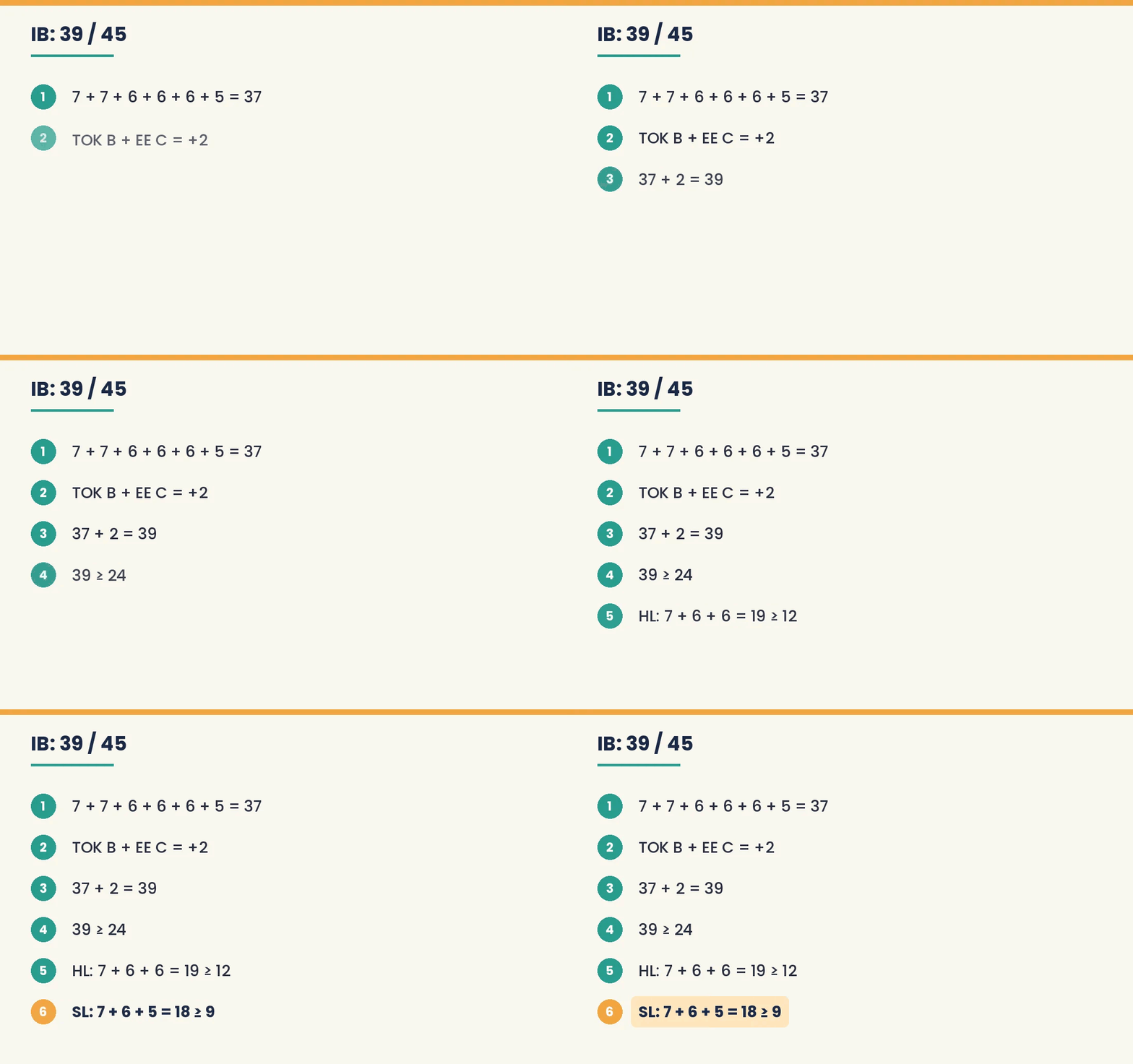
This student has HL grades of 7, 6 and 6, and SL grades of 7, 6 and 5. The six subjects add up to 7 + 7 + 6 + 6 + 6 + 5 = 37. TOK grade B and EE grade C add 2 core points, so 37 + 2 = 39 out of 45. The checks pass: 39 is at least 24, HL points are 7 + 6 + 6 = 19 (at least 12), and SL points are 7 + 6 + 5 = 18 (at least 9).
What do you need to pass the IB Diploma?
Getting 24 points is not enough on its own. You must meet all the conditions on the DP passing criteria page.
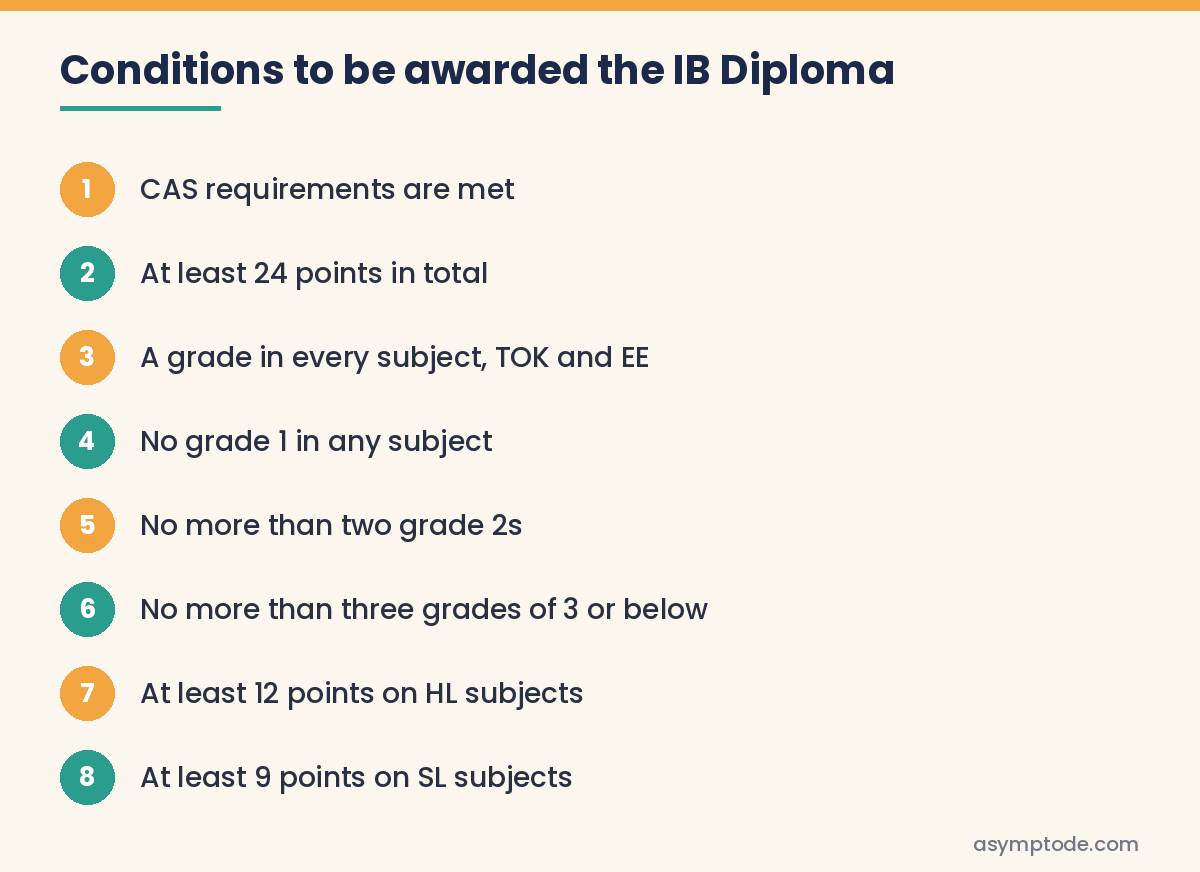
The checklist shows eight conditions. CAS must be met, and you need at least 24 points. You need a grade in every subject, TOK and EE, and no grade 1 in any subject. You can have no more than two grade 2s and no more than three grades of 3 or below. You need at least 12 points on HL subjects and at least 9 points on SL subjects.
A few details matter here:
- If you take 4 HL subjects, the best three count towards the 12 HL points.
- If you take only 2 SL subjects, you need at least 5 points at SL.
- An E in TOK or EE is a failing condition.
What is the IB bilingual diploma?
You can earn a bilingual diploma in one of two ways. You can take two group 1 languages and get grade 3 or higher in both. Or you can take a group 3 or group 4 subject in a language other than your group 1 language, and get grade 3 or higher in both.
How are IB DP exams and coursework marked?
Assessment has two parts. You can read more on the IB's understanding IB assessment page.
- External exams. These include essays, structured problems, short-response, data-response and case-study questions. Multiple choice is rare.
- Internal assessment. Your teachers mark this work, and the IB moderates it. Examples are lab work in sciences and investigations in mathematics.
Results are judged against set standards, not rank order.
The IB will deliver both paper and digital exams, starting with a small number of subjects in 2026. Ask your school which format applies to your subjects.
Here is the kind of step-by-step working an IB Maths AA exam expects.
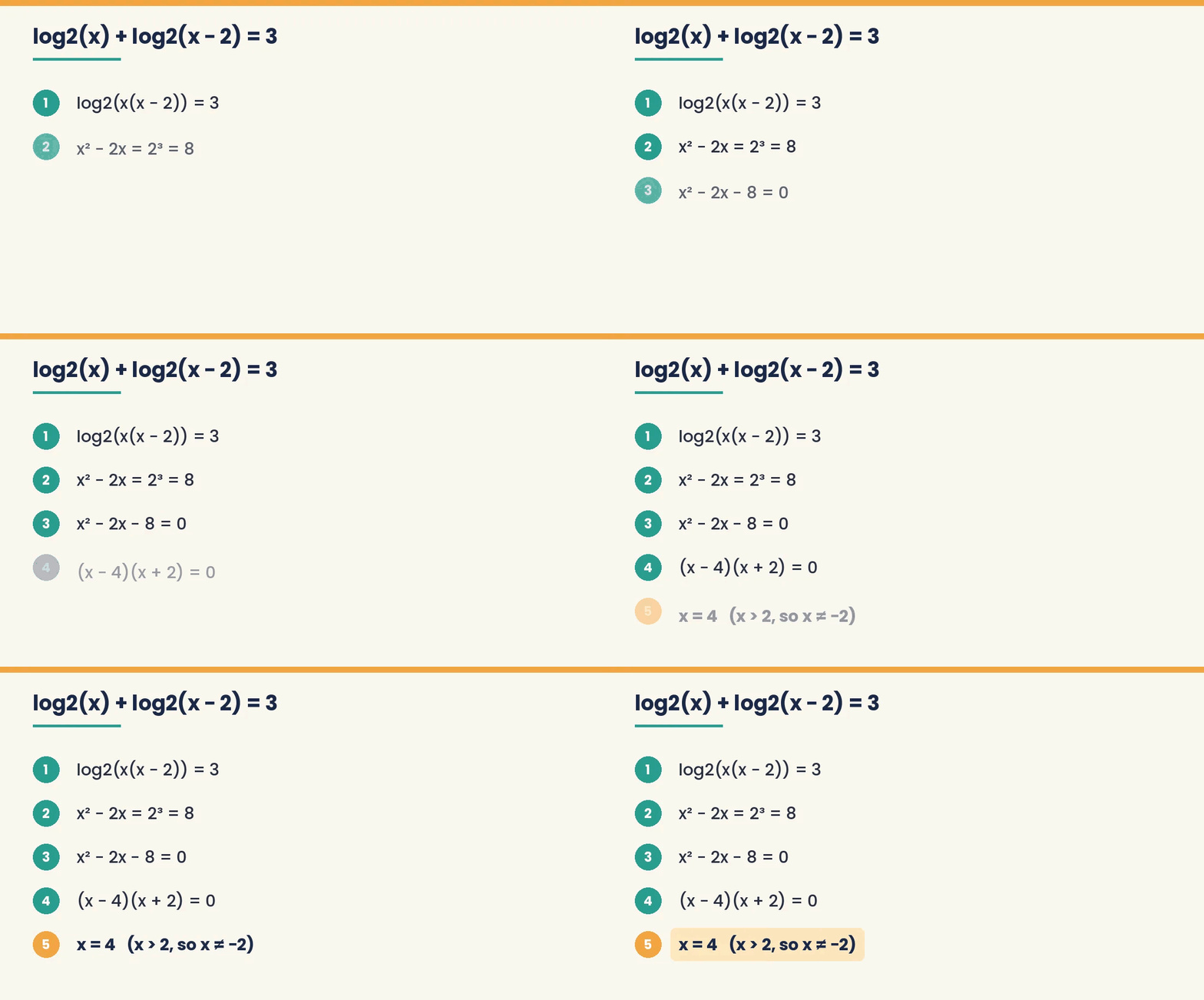
The problem is log2(x) + log2(x - 2) = 3. Combine the logs to get log2(x(x - 2)) = 3. Rewrite as x^2 - 2x = 8, then x^2 - 2x - 8 = 0. Factorise to (x - 4)(x + 2) = 0. The answer is x = 4. Since x must be greater than 2, x = -2 is rejected.
When are IB DP exams and results?
| Item | What we know (28 October 2026) |
|---|---|
| Exam sessions | May and November each year |
| November 2026 schedule | Published on the IB exam schedule page |
| May 2027 schedule | Not yet announced. Check the official page |
| May 2026 results to schools | 5 July 2026 |
| May 2026 results to students | 6 July 2026, on the candidate website |
May 2026 results reached students at 8.00am EDT, 1.00pm BST and 8.00pm SGT. Over 209,000 DP and CP students received May 2026 results, according to the IB results news release.
What can you do after IB results come out?
Before results day, you can ask for your results to be sent to six universities for free. After results come out, your school can request an Enquiry Upon Results, which is a re-mark. Results from May 2018 onwards are on the candidate website. See the getting results page for details.
Book a free demo class with an Asymptode maths or science mentor, or see our plans and fees.
How do universities use the IB Diploma?
Universities around the world accept the IB DP. Each one sets its own offers, so always check each university's page. Here are some examples from our own guides:
- Oxford typical IB offers are 38-40 points. See how to get into Oxford.
- Cambridge typically asks for 41-42 points, with 776 at HL. See how to get into Cambridge.
- NUS has a separate application window for IB students, from 16 December 2026 to 17 February 2027. See how to get into NUS.
Some offers name HL grades, not just a total. So choose your subjects with care.
How do you choose IB subjects?
Choose with your future course in mind, and pick a mix you can manage for two years.
- List the courses you might apply for. Look at what each one asks for.
- Check required HL subjects. Many courses name specific HL subjects.
- Pick your maths course. Decide between AA and AI, and HL or SL.
- Balance your workload. HL subjects take 240 hours each. Four HLs is a lot.
- Play to your strengths. A 7 at SL counts the same as a 7 at HL.
- Talk to your school. Not every school offers every subject.
Which IB subjects are best for engineering or medicine?
A common choice for engineering or medicine is HL Maths AA plus HL Physics or HL Chemistry. But each university and course sets its own rules. Check each course page before you decide. If you dream of a career in research, our guide on how to become a scientist shows the routes.
IB DP vs A-Level: what is the difference?
Both are routes to university. They are built differently.
| IB Diploma Programme | A-Level | |
|---|---|---|
| Number of subjects | Six, plus the core | Usually 3 |
| Grading | 1-7 per subject, up to 45 points | A* to E per subject |
| Core | TOK, EE, CAS | Not part of A-Level |
A-Levels go deep in a few subjects. The IB DP gives breadth plus the core. For more on the A-Level route in maths, read our A-Level Maths guide.
Is the IB harder than A-Levels?
There is no simple answer. The IB DP asks you to keep six subjects going at once, plus the core. A-Levels ask you to go deeper in fewer subjects. Which feels harder depends on you and your school.
What does a good two-year IB DP plan look like?
A plan stops the core and coursework piling up at the end. Your school's deadlines come first.
Year 1 (Year 12 / Grade 11)
- Settle into your six subjects. Fix gaps in maths and science early.
- Start CAS from the first term and keep records.
- Choose an EE subject and research question with your supervisor.
- Review each topic soon after you learn it.
Year 2 (Year 13 / Grade 12)
- Finish your EE and TOK work by your school's deadlines.
- Complete internal assessments, such as lab work and maths investigations.
- Finish CAS and do timed past-paper practice.
- Ask for results to be sent to universities before results day.
What mistakes should IB students avoid?
- Leaving the EE too late. A rushed EE can lower your core points.
- Forgetting CAS. No grade does not mean optional. Without CAS, there is no diploma.
- Ignoring the pass rules. 24 points is not enough if you miss another condition.
- Skipping working in maths. Exams reward clear, step-by-step method.
- Not checking official dates. Always confirm dates on the IB site and with your school.
How 1-on-1 tutoring helps with the IB Diploma Programme
Asymptode gives live online 1-on-1 tutoring in maths and sciences. Here is how we support IB DP students:
- One dedicated mentor, live and 1-on-1. Your mentor follows your own IB syllabus, your HL or SL level, and your exam dates. Every class is recorded so you can watch it again.
- Method first, every step. Your mentor watches each step of your working in Maths AA or AI, Physics, Chemistry or Biology. Small slips get fixed before they become habits.
- Personalised homework with feedback. Practice is set for your weak topics, and each piece gets clear feedback. Parents get short updates on progress.
- Help with planning for the rest. For TOK, the EE and CAS, our mentors help with planning and method, such as setting milestones or shaping a maths or science EE question. Start with a free demo class.
Facts checked against official sources on 28 October 2026.
FAQ
How many points do you need to pass the IB Diploma?
You need at least 24 points out of 45. But you must also meet the other conditions. These include completing CAS, no grade 1, at least 12 HL points and at least 9 SL points.
How long is the IB Diploma Programme?
The IB DP lasts two years. Most students take it at ages 16 to 19, in Years 12-13 or Grades 11-12.
Can I take the IB DP without going to an IB school?
The IB DP is taught only in IB World Schools. Students register through their school. Ask a nearby IB World School about how they handle entry.
Is HL harder than SL in the IB?
HL has more content, with 240 teaching hours compared with 150 for SL. HL and SL are graded on the same descriptors. A 7 at HL and a 7 at SL count the same points.
When is the May 2027 IB exam schedule out?
As of 28 October 2026, the May 2027 schedule is not yet published. The November 2026 schedule is out. Check the official IB exam schedule page for updates.
Can I get my IB exams re-marked?
Yes. After results come out, your school can request an Enquiry Upon Results, which is a re-mark. Speak to your IB coordinator about the process.
Ready to start? Book a free demo class and advisor call, or see our plans and fees.