
If you want to know how to become an aerospace engineer, the path is clear: get strong at maths and physics in school, earn an accredited engineering degree, gain real experience through internships or projects, and then work toward a licence or chartered title where your country offers one. This guide covers the US, UK, India, Canada and Australia, using official sources only.
Key takeaways
- Aerospace engineers design, develop and test aircraft, spacecraft, satellites and missiles.
- Maths and physics are the core school subjects in every country covered here. Chemistry helps too.
- You need a bachelor's degree to start. An accredited degree matters for licences and chartered titles later.
- The BLS lists a median pay of $134,960 (May 2025) and 8% job growth for 2025-35 in the US.
- Start early: rocketry contests, CanSat, free student memberships and internships all build your profile.
How to become an aerospace engineer: what are the steps?
Quick answer: To become an aerospace engineer, take maths and physics to the highest level in school, then study an accredited aerospace or related engineering degree. Add internships, rocketry or satellite projects along the way. After graduating, get your first job and, if you want, work toward a licence such as the US PE or the UK CEng.
 The four big stages of an aerospace engineering career.
The flowchart shows four boxes in a row. Stage 1 is school, where maths and physics come first. Stage 2 is an accredited engineering degree. Stage 3 is an internship or your first job. Stage 4 is a licence or chartered title.
What does an aerospace engineer actually do?
The US Bureau of Labor Statistics (BLS) says aerospace engineers "design, develop, and test aircraft, spacecraft, satellites, and missiles." You can read the full profile on the BLS aerospace engineers page.
The BLS lists these key qualities: analytical, business, communication, interpersonal, math and problem-solving skills. So people skills matter as much as sums.
What is the difference between aeronautical and astronautical engineering?
The BLS splits the field into two branches:
| Branch | What it covers | Examples |
|---|---|---|
| Aeronautical | Aircraft and their propulsion systems; "the theory, technology, and practice of flight within the Earth's atmosphere" | Planes, engines, flight inside the atmosphere |
| Astronautical | Spacecraft and how they perform inside and outside the atmosphere | Small satellites such as cubesats, large traditional satellites |
If space is your dream, our guide on how to become an astronaut shows another way to work in the space world.
Which school subjects do you need for aerospace engineering?
Maths and physics are the core. Every official source we checked agrees:
- The BLS suggests chemistry, physics and math in high school.
- The University of Manchester asks for A-level Mathematics and Physics.
- UNSW Sydney lists Mathematics Extension 1 and Physics as assumed knowledge.
- JEE Advanced in India needs Physics, Chemistry and Mathematics in Class 12.
Computer science is not on the BLS list. Still, we recommend it if your school offers it. This is our own advice, not an official rule.
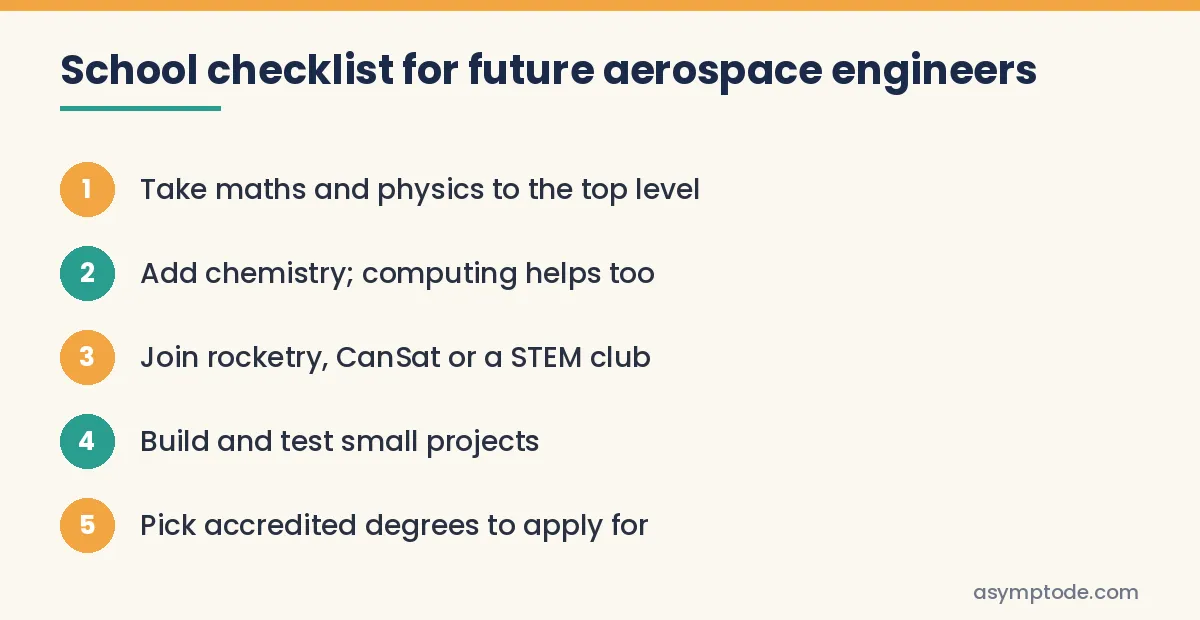 A five-point school checklist for future aerospace engineers.
The checklist has five steps. First, take maths and physics to the top level. Second, add chemistry; computing helps too. Third, join a rocketry, CanSat or STEM club. Fourth and fifth, build and test small projects, then pick accredited degrees to apply for.
Why does physics matter so much?
Forces, motion and energy appear in every flight problem. Our guides on projectile motion and the A-level Physics guide are good places to practise.
 Worked example: finding the Mach number of a plane.
A plane flies at v = 250 m/s. The speed of sound at sea level is about a = 340 m/s (it depends on air temperature). The Mach number is M = v / a, so M = 250 / 340 = 0.74 (rounded). Since M is less than 1, the flight is subsonic.
What degree do you need to become an aerospace engineer?
The BLS says entry-level jobs usually need a bachelor's in aerospace engineering or a related field. Employers may prefer accredited programmes, and an accredited degree is usually needed for a licence later.
For a wider view of all engineering paths, see how to become an engineer.
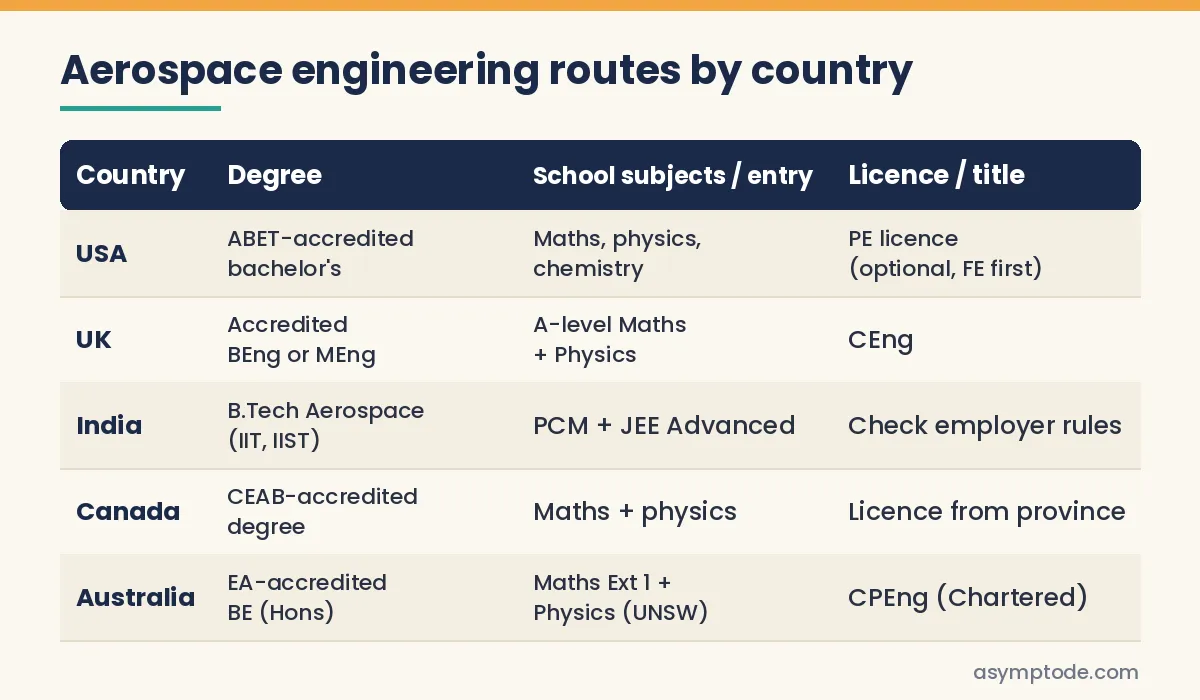 Aerospace engineering routes in five countries at a glance.
The table compares five countries. USA: an ABET-accredited bachelor's after maths, physics and chemistry, with an optional PE licence (FE exam first). UK: an accredited BEng or MEng after A-level Maths and Physics, leading to CEng. India: a B.Tech in Aerospace at an IIT or IIST, after PCM and JEE Advanced. Canada and Australia: an accredited engineering degree after maths and physics, then a licence or chartered title.
How do you become an aerospace engineer in the US?
Choose an ABET-accredited programme
ABET accreditation "provides assurance that a college or university program meets the quality standards of the profession." ABET accredits programmes, not whole universities, and it is voluntary. It has accredited 4,863 programmes at 950 colleges and universities in 42 countries. You can check any programme with the "Find a Program" search on the ABET accreditation page.
Do you need a licence?
No, not to start. The BLS says, "Licensure is not required for entry-level aerospace engineer positions." A PE (Professional Engineer) licence lets experienced engineers oversee other engineers, sign off projects and serve the public directly.
State licensure generally needs four things:
- An accredited degree
- A passed FE (Fundamentals of Engineering) exam
- Several years of relevant work experience
- A passed PE exam
The NCEES FE exam is computer-based, offered year-round at Pearson centres, with 110 questions in a 6-hour appointment. The fee is $225. It is for students close to finishing, or recent graduates of, an EAC/ABET-accredited degree.
There is no "aerospace" FE discipline on the NCEES list. The NCEES PE exam is for engineers with at least 4 years of post-college experience, and it has no aerospace option either. Which discipline an aerospace engineer should take is not something we could verify. Check with your state board.
Can you intern at NASA?
NASA OSTEM internships are for US citizens who are at least 18 by the session start. High school graduates may apply for the summer session only. College students need a cumulative GPA of 3.0 out of 4.0 and must be in an accredited programme at a US school.
Sessions run in spring (15 weeks), summer (10 weeks) and fall (15 weeks). Summer 2027 runs 7 June to 13 August 2027. Interns get a stipend, and you apply through a NASA STEM Gateway profile.
Application deadlines are not listed on the FAQ, so check the official page.
How do you become an aerospace engineer in the UK?
Which A-levels do you need?
Most UK aerospace degrees ask for A-level Maths and Physics. As one example, the University of Manchester BEng (Hons) Aerospace Engineering for 2027 entry asks for A*AA, including Mathematics, Physics and one other subject. The contextual offer is AAA. Further Maths may be considered instead of Physics, case by case. You must also pass the practical element of any science A-level.
Our A-level Maths guide can help you plan for top grades.
How do you become a Chartered Engineer (CEng)?
The Engineering Council sets two routes:
- Accredited degrees: an accredited integrated MEng, or an accredited BEng (Hons) plus an accredited Masters (or further learning to Masters level).
- Work-based route: an individual assessment under UK-SPEC, for people without those degrees.
You apply through a licensed Professional Engineering Institution (PEI). You can check if a course is accredited in the Engineering Council course search.
Should you join the Royal Aeronautical Society?
The Royal Aeronautical Society offers free Student Affiliate membership to full-time students at any level who plan an aerospace career. Benefits include 400+ free lectures and events and free 1-2-1 careers guidance for UK students.
How do you become an aerospace engineer in India?
What is the route through JEE?
For an IIT, you need JEE Main and then JEE Advanced. For JEE Advanced 2026, you had to meet all five rules on the official eligibility page:
- Be in the top 2,50,000 in JEE Main (B.E./B.Tech paper)
- Be born on or after 1 October 2001 (1 October 1996 for SC/ST/PwD)
- Use no more than 2 attempts, in consecutive years
- Appear for Class 12 for the first time in 2025 or 2026, with Physics, Chemistry and Mathematics
- Not have been admitted to an IIT before
The 2027 rules are not yet announced. See our JEE Advanced 2027 guide and how to get into IIT for planning.
Which colleges offer aerospace engineering?
- IIT Bombay: B.Tech (4 years) and a 5-year Dual Degree (B.Tech + M.Tech). Branch depends on your preference and rank.
- IIT Madras: B.Tech (4 years) and a Dual Degree (5 years), through JEE (Advanced) and JoSAA.
- IIST Thiruvananthapuram: a B.Tech in Aerospace Engineering under the Department of Space, with 60 + 3 seats in 2026-27. Admission uses JEE (Advanced) 2026 marks, but you apply on IIST's own portal. For 2026, you also needed at least 75% in Class 12 (65% for SC/ST/PwD).
How do you get into ISRO?
ISRO hires through its ICRB Scientist/Engineer 'SC' exam. In the 2026 FAQ, the Mechanical post covers Aeronautical and Aerospace graduates. You need a first-class BE/B.Tech with at least 65% or a CGPA of 6.84/10, with no relaxation. Selection is a written test after screening, then an interview. DRDO and HAL also employ aerospace engineers; check their official pages.
How do you become an aerospace engineer in Canada?
In Canada, the 12 provincial and territorial regulators issue licences, not Engineers Canada. According to Engineers Canada, you generally need a CEAB-accredited degree (or equal), engineering work experience (years vary by region), a pass in the Professional Practice Exam on law, ethics and professionalism, good character, and English or French.
For hands-on work, the Canadian Space Agency posts co-op and internship terms each semester. You must be a full-time student in a co-op programme where the work term is needed to graduate. Canada is also an ESA Cooperating State, so Canadian graduates can apply to ESA's Young Graduate Trainee scheme.
How do you become an aerospace engineer in Australia?
Take Maths and Physics in Years 11 and 12. As one example, the UNSW Sydney BE (Hons) Aerospace Engineering runs for 4 years. It assumes Mathematics Extension 1 and Physics. Its 2026 Lowest Selection Rank was 95.0. The degree is "fully accredited with Engineers Australia at the level of Professional Engineer."
Engineers Australia offers free student membership. Chartered status needs membership, 5+ years of engineering experience, competency across 16 elements in four areas, and a record of CPD (ongoing learning).
Want help with the maths and physics behind every one of these routes? Book a free demo class with an Asymptode mentor, or see our plans and fees.
Which activities help you get into aerospace engineering?
Hands-on projects show real interest. Try these:
- American Rocketry Challenge (US): open to grades 6-12. Winners go to the International Rocketry Challenge at the Farnborough International Airshow. 2027 registration closes 6 December 2026, 11:59 pm EST. See the official site.
- ESA CanSat (Europe and Canada): teams of students aged 14 to 19 build a satellite the size of a soft drink can. You enter through a national competition. See ESA CanSat.
- AIAA high school membership (US): free for students active in STEM who are thinking about aerospace.
- Research projects: a small study on wing shapes or drones shows real curiosity. Our guide to research for high school students explains how to start.
After a Master's, citizens of ESA Member States, Associate Members, European Cooperating States or Canada can aim for the ESA Young Graduate Trainee scheme. Vacancies are usually published February to March.
What is the job outlook for aerospace engineers?
In the US, the BLS projects growth much faster than average. Here are the official figures:
| Measure | BLS figure |
|---|---|
| Median annual wage (May 2025) | $134,960 ($64.89 per hour) |
| Lowest 10% (May 2025) | Under $86,700 |
| Highest 10% (May 2025) | Over $205,890 |
| Jobs in 2025 | 68,700 |
| Projected jobs in 2035 | 74,400 |
| Growth, 2025-35 projection | 8%, "much faster than the average" |
| Openings each year (average) | About 3,800 |
These are US figures only. We do not quote pay for other countries.
Step-by-step plan from Grade 9
- Grade 9 (Year 10 in the UK and Australia): build strong maths habits. Fix weak spots in algebra now.
- Grade 10: pick the top maths and physics tracks available. Join a rocketry, CanSat or STEM club.
- Grade 11: take advanced maths and physics (A-levels, Class 11 PCM, Maths Extension 1 or AP). Start a small project. Join AIAA or RAeS as a student.
- Grade 12: sit your final exams and entrance tests (JEE in India). Apply only to accredited degrees.
- University: join a design team, apply for internships (NASA OSTEM, CSA co-op and others) and, in the US, consider the FE exam near graduation.
- After graduation: take your first job. Log your experience toward PE, CEng, a provincial licence or Chartered status.
What are common mistakes to avoid?
- Dropping physics or top-level maths early. It can close doors to aerospace degrees.
- Choosing a non-accredited degree. It can make licences and chartered titles harder later.
- Waiting until university to build things. Clubs and projects in school stand out.
- Missing deadlines. Put every contest, internship and university deadline in a calendar.
- Learning formulas without method. Clear working matters, not just answers.
How 1-on-1 tutoring helps future aerospace engineers
Aerospace starts with maths and physics. At Asymptode, we help students build that base early:
- One dedicated mentor, live online 1-on-1: the same mentor works with your child each week. Lessons follow their own school syllabus and their real exam dates.
- Method-first maths and physics: the mentor watches each step of the working on topics like forces, motion and calculus. Small errors are caught before they become habits.
- Personalised homework with feedback: practice is set for your child's weak spots. Parents get short updates, and every class is recorded for revision.
- Help with the wider plan: for non-maths parts, such as choosing clubs or planning applications, the mentor helps with planning and method. Start with a free demo class.
Facts checked against official sources on 1 November 2026.
FAQ
What qualifications do you need to become an aerospace engineer?
You need a bachelor's degree in aerospace engineering or a related field, such as mechanical engineering. Pick an accredited programme, because employers may prefer it and licences usually need it. In the US, a licence is not needed for entry-level jobs.
What subjects should I take in school for aerospace engineering?
Take maths and physics to the highest level you can, plus chemistry. Manchester asks for A-level Maths and Physics, JEE Advanced needs PCM, and UNSW assumes Maths Extension 1 and Physics.
How long does it take to become an aerospace engineer?
A bachelor's degree takes 3 years at Manchester and 4 at UNSW or IIT Bombay. A licence or chartered title takes longer: the US PE exam needs at least 4 years of post-college experience, and Australian Chartered status needs 5+ years.
What is the difference between aeronautical and aerospace engineering?
Aerospace covers both aircraft and spacecraft. Aeronautical engineering deals with aircraft and flight within Earth's atmosphere. Astronautical engineering deals with spacecraft and satellites, inside and outside the atmosphere.
How much do aerospace engineers earn?
In the US, the BLS lists a median annual wage of $134,960 for aerospace engineers (May 2025). The lowest 10% earned under $86,700 and the highest 10% over $205,890. We do not quote figures for other countries.
How can I work at NASA, ESA or ISRO as an aerospace engineer?
NASA OSTEM internships are for US citizens aged 18+ with a 3.0 GPA. ESA's Young Graduate Trainee scheme needs a Master's and citizenship of an ESA Member State, Associate Member, European Cooperating State or Canada. ISRO hires through its ICRB exam and needs a first-class BE/B.Tech with at least 65%.
Ready to start? Book a free demo class and advisor call, or see our plans and fees.
Sources
- BLS Occupational Outlook Handbook: Aerospace Engineers
- ABET: Accreditation
- NCEES: FE Exam
- NASA: Intern Frequently Asked Questions
- Engineering Council: Chartered Engineer (CEng)
- UCAS: University of Manchester BEng Aerospace Engineering
- JEE Advanced 2026: Eligibility
- ISRO ICRB Scientist/Engineer 'SC' 2026 FAQs
- Engineers Canada: Overview of the licensing process
- UNSW Sydney: Bachelor of Engineering (Honours) Aerospace