
Research for high school students means asking a real question, testing it carefully and sharing what you find. You do not need a famous lab or a big budget to start. This guide shows you how to pick a question, find a mentor, run a project step by step, and choose fairs and summer programmes with their official 2027-cycle deadlines.
Key takeaways
- School-level research is a small, honest question answered with a clear method and real data.
- Start with a narrow question and a one-page plan. A mentor helps, but you can begin alone.
- Several top programmes are free to students, such as RSI (deadline 11 December 2026) and MIT PRIMES (deadline 2 November 2026).
- Be careful with programmes that charge high fees and promise publication. Ask what you pay for.
- Basic statistics (mean, standard deviation, a straight-line fit) turns data into a result you can defend.
What does research for high school students actually mean?
Quick answer: Research for high school students is a small, original investigation. You ask a focused question, read what is already known, design a fair test or analysis, collect data, and explain what it shows. It does not need to change the world. It needs to be honest, careful and clearly written up, then shared at a fair, programme or journal.
At school level, "original" usually means one of three things:
- A new test of a known idea in a new setting (for example, your local river or your school's solar panels).
- A new analysis of public data (weather records, sports statistics, open genome data).
- A new proof or pattern in mathematics, often found by exploring small cases first.
A good project is small enough to finish in a few months.
How do you start research in high school?
You start by choosing a question, not a topic. "Climate change" is a topic. "Does shade from trees lower pavement temperature on my street at 3 pm?" is a question.
How do you choose a research question?
Use this quick test. A good question is:
- Specific. It names what you will measure.
- Testable. You can collect data on it with the tools you have.
- Safe and ethical. No danger, no harm to animals, and consent if people are involved.
- Interesting to you. You will spend months on it.
- Not already fully answered. Do a quick search on Google Scholar first.
If you love maths, explore patterns in number sequences or graph colouring. Our guide on how to become a mathematician shows how early problem-solving grows into research. If you lean towards lab science, read how to become a scientist for the longer path.
What are the steps of a research project?
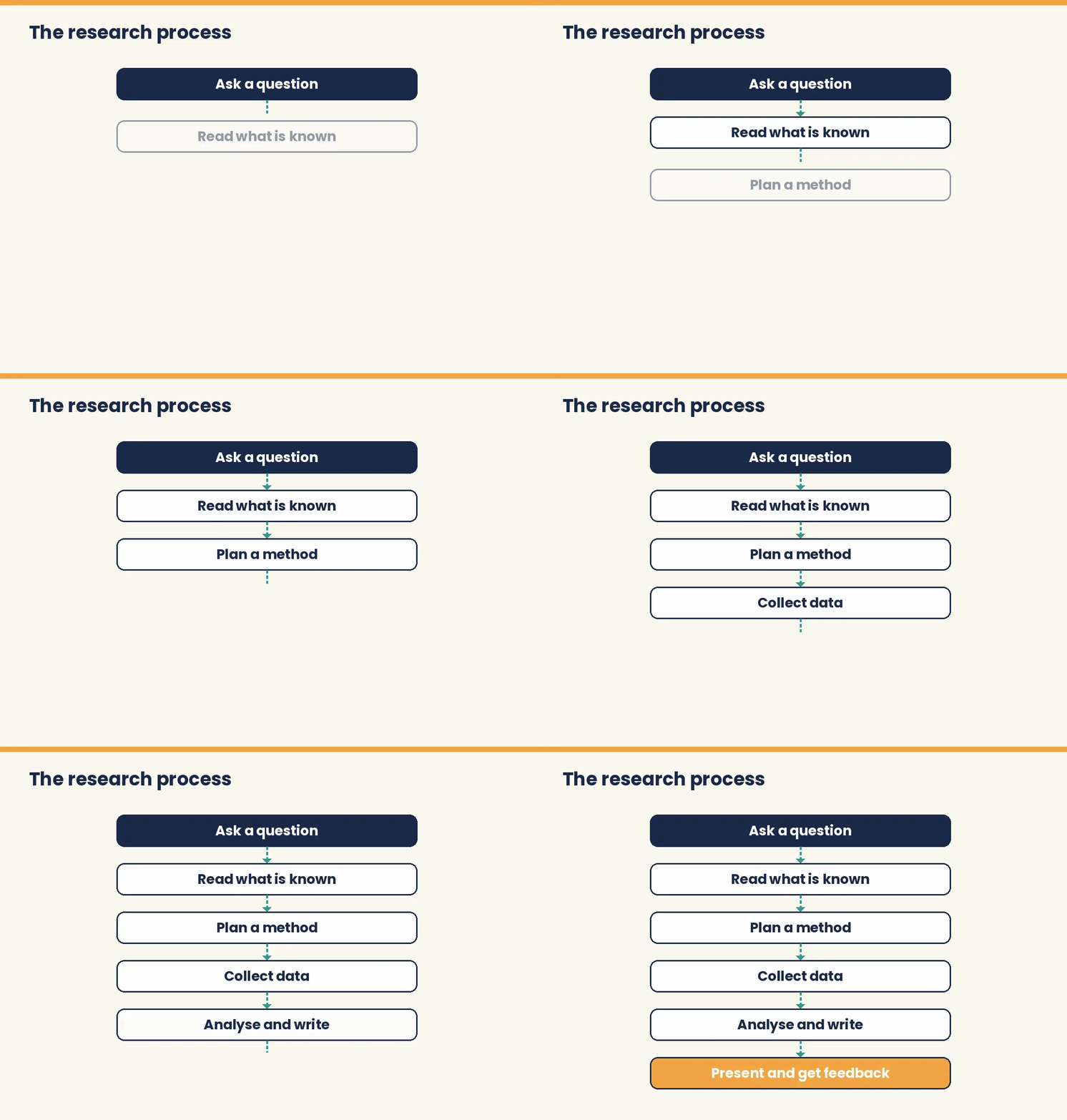
The six steps, in order:
- Ask a question. Write it in one sentence.
- Read what is known. Find 5-10 good sources. Note what they did and what is missing.
- Plan a method. Decide what you will change, what you will measure and what you will keep the same. Plan repeats.
- Collect data. Keep a dated logbook. Record everything, even "failed" runs.
- Analyse and write. Use simple statistics. Write the abstract last.
- Present and get feedback. Show your poster or paper at a fair, club or programme.
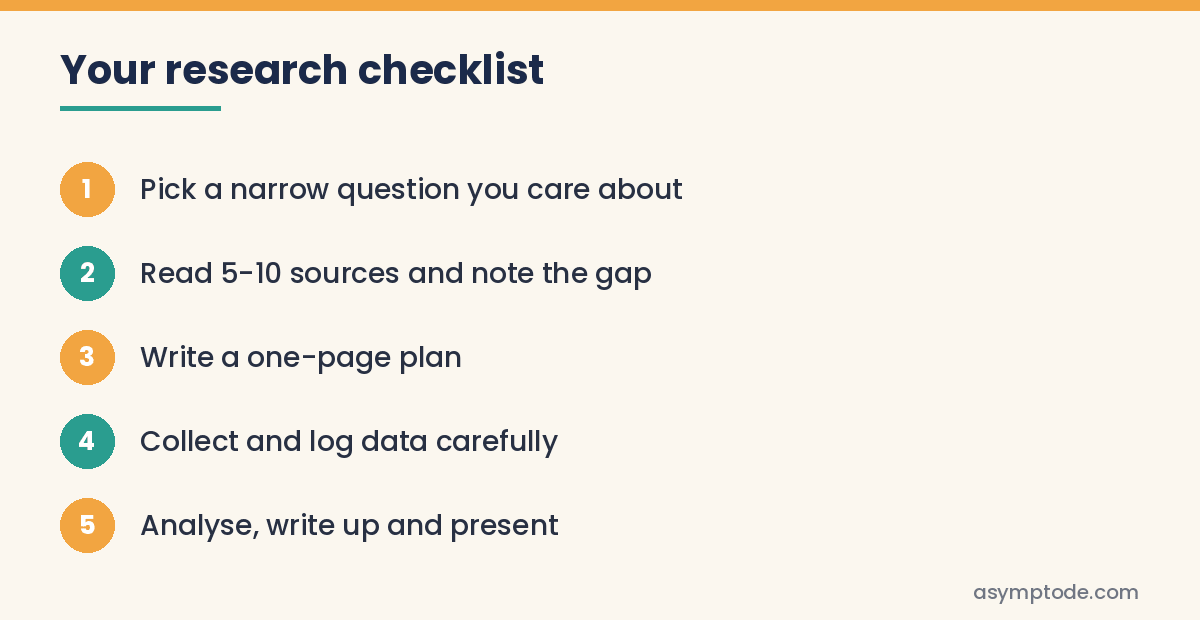
In short: pick a narrow question, read 5-10 sources and note the gap, write a one-page plan, collect and log data carefully, then analyse, write up and present.
How do you find a research mentor as a high school student?
A mentor is someone with more experience who checks your method. It can be a school teacher, a university student, a scientist at a local university, or a professional in industry.
Start close to home. Ask your science or maths teacher first. Then look at university department pages for people whose recent papers match your question.
How do you cold-email a professor politely?
Keep it short, specific and respectful. Professors are busy, so many will not reply. That is normal. Send a polite follow-up after two weeks, then move on.
Here is a sample email you can adapt:
Subject: High school student question about your work on urban heat
Dear Professor [Last name],
I am a Grade 11 student at [School] in [City]. I read your 2025 paper on street trees and surface temperature. I am planning a small project measuring pavement temperature under shade on my street.
I have a one-page plan and some pilot data. Would you be willing to look at my method for 15 minutes, by email or a short call? I would also welcome a suggestion of a student in your group I could ask.
Thank you for your time.
[Your name], [Grade], [School]
Stuck on the maths or statistics in your plan? A 1-on-1 Asymptode mentor can check your method before you email anyone. Book a free demo class.
Where can high school students present or compete with research?
Presenting is part of research. Here are verified routes.
| Route | Who | 2027-cycle key fact |
|---|---|---|
| Regeneron ISEF | Grades 9-12, worldwide | Qualify through an affiliated fair (held by 12 April 2027). ISEF runs 8-14 May 2027 in Los Angeles. |
| Regeneron Science Talent Search | US high school seniors | Apply by 8 pm ET, 5 November 2026. |
| CREST Gold (UK, global) | Age 16+ | About 70 hours of project work. Run by the British Science Association. |
| IRIS National Fair (India) | Classes 5-12 in India | 2026 entries closed 13 October 2026. It is an ISEF affiliated fair. |
| INSPIRE-MANAK (India) | Classes 6-12, school nominates | 2026-27 nominations ran 15 July to 15 September 2026. |
Regeneron ISEF is the big one. You cannot apply directly. A student in Grades 9-12 must win a place at one of nearly 400 Society-affiliated fairs in the US and more than 70 other countries and regions. In Canada, Youth Science Canada sends Team Canada to ISEF 2027. Ask your school which local fair feeds into ISEF.
Regeneron STS is for US seniors with an original research project. About 2,600 students enter each year. In 2026, 300 were named scholars and 40 were finalists. The top award is $250,000. Check the Official Rules for eligibility.
UK students can use CREST Awards. Gold costs £30 + VAT per student in the UK, or £55 globally, and a mentor is recommended.
Indian students have IRIS (run by ExSTEMplar, open to Indian-origin students living in India) and INSPIRE-MANAK, where the school nominates up to five ideas a year.
Which summer research programmes for high school students should you apply to?
These are selective. Many are free or need-blind. Dates below were checked on official pages.
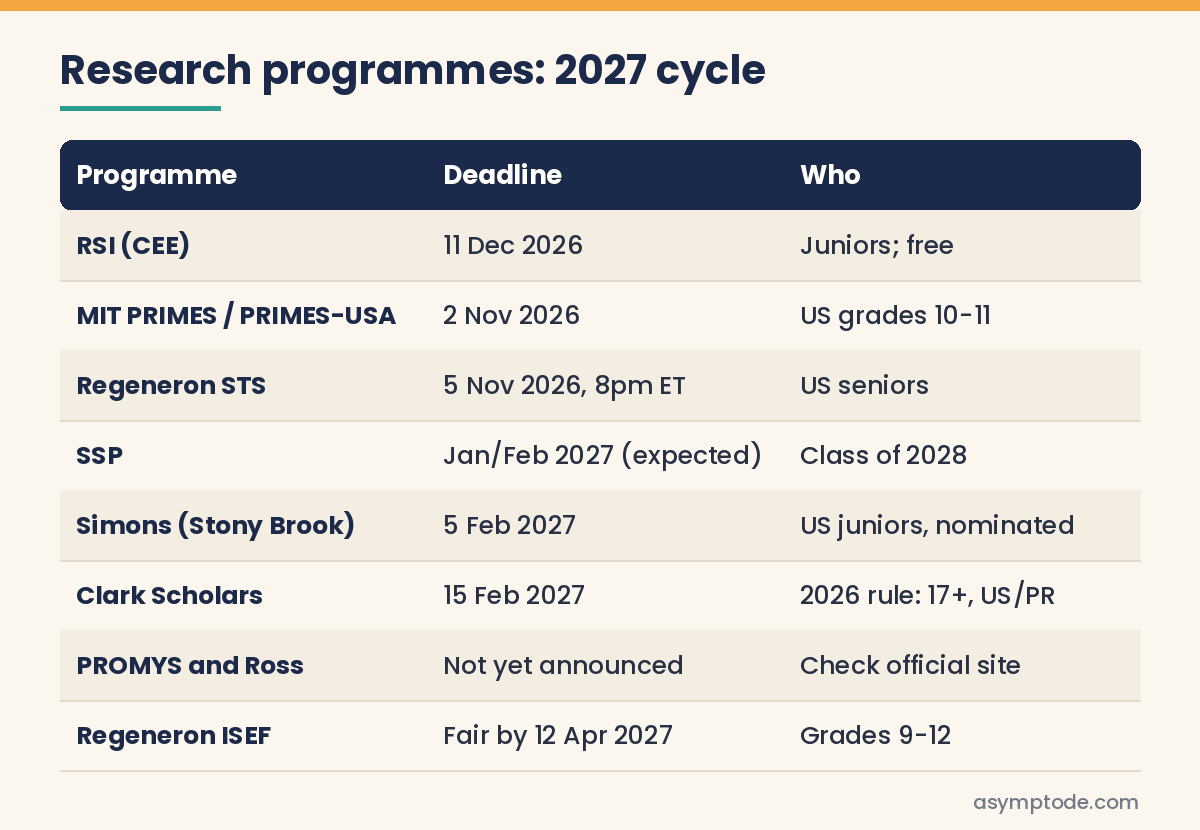
The same information as text:
| Programme | Deadline (2027 cycle) | Who can apply | Cost |
|---|---|---|---|
| RSI (CEE) | 11:59 pm, 11 December 2026 | High school juniors | Free to students |
| MIT PRIMES / PRIMES-USA | 11:59 pm EST, 2 November 2026 | US sophomores and juniors | No fee listed |
| Summer Science Program | Expected January 2027 (international), February 2027 (US); opens December 2026 | Class of 2028 | Free application, need-blind aid |
| Simons Summer Research (Stony Brook) | 11:59 pm EST, 5 February 2027 | US juniors, school-nominated, 16+ | $75 application fee, waivers |
| Clark Scholars (Texas Tech) | Opens 2 January 2027; due 15 February 2027 | 2026 rules: 17+, US citizen or PR | 2026: $750 stipend |
| PROMYS | 2027 not yet announced | Motivated high schoolers, US and worldwide | Need-based aid up to full cost |
| Ross Mathematics Program | 2027 not yet announced | Pre-college students | See Ross aid page |
A few notes:
- RSI takes about 100 students at MIT each summer. For 2027, CEE says it is expanding RSI to Stanford for 50 more scholars.
- PRIMES is a year-long maths research programme. Local students meet mentors in person. PRIMES-USA students work by video. Students outside the US are pointed to CrowdMath. Strong contest results help, so see our AIME 2027 guide.
- Ross 2026 ran 14 June to 24 July 2026 at Otterbein University and Rose-Hulman. Watch its site for 2027 dates.
If you are aiming for a research-heavy university, see how to get into MIT. Research shows curiosity, but it is one part of an application.
Are paid research programmes worth it?
Be honest with yourself about cost. Some strong programmes charge fees. For example, Stony Brook's Garcia summer programme listed a $4,000 lab fee for 2026, not counting housing. Others are free, like RSI.
Some private companies sell "research" packages that promise a published paper or a famous mentor. Before you pay, ask:
- Who exactly is my mentor, and what is their background?
- Will I choose the question and do the work myself?
- Is publication promised? (Real peer review never guarantees acceptance.)
- What do free school or university options offer instead?
Publishing is possible without big fees. The Journal of Emerging Investigators is for middle and high school scientists. It charges a $49 submission fee, with a limited number of fee scholarships, and an adult author submits on the student's behalf.
Worked example: analysing data with a simple linear fit
Here is a short example with made-up sample data (not a real experiment). A student grows five bean plants with different hours of light per day and measures growth in a week.
| Light (hours/day), x | Growth (cm), y |
|---|---|
| 2 | 1.2 |
| 4 | 2.0 |
| 6 | 3.0 |
| 8 | 4.0 |
| 10 | 4.8 |
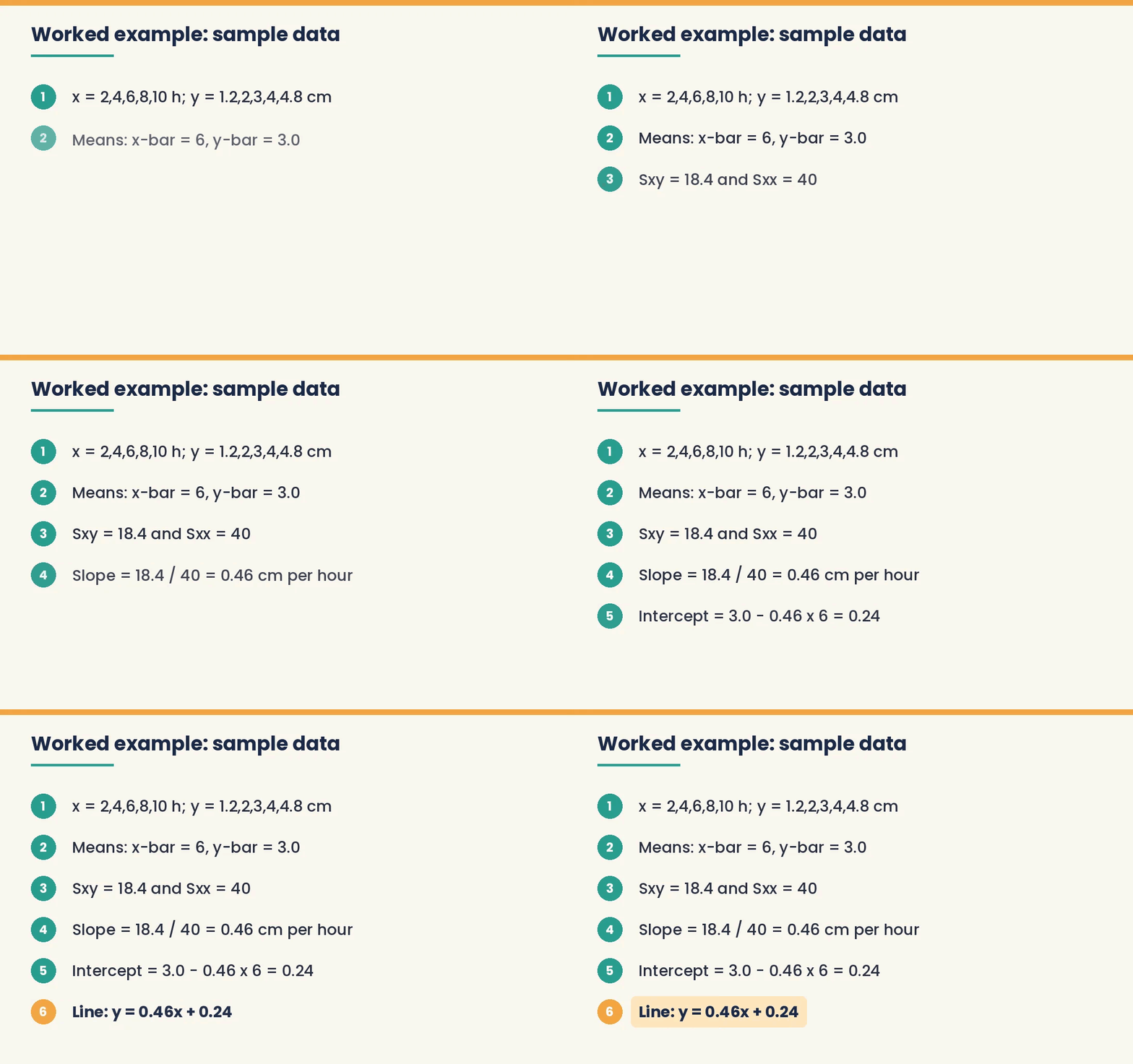
Step by step:
- Means. x-bar = (2+4+6+8+10)/5 = 6. y-bar = (1.2+2.0+3.0+4.0+4.8)/5 = 3.0.
- Deviations. x minus 6 gives -4, -2, 0, 2, 4. y minus 3.0 gives -1.8, -1.0, 0, 1.0, 1.8.
- Sums. Sxy = (-4)(-1.8) + (-2)(-1.0) + 0 + (2)(1.0) + (4)(1.8) = 18.4. Sxx = 16 + 4 + 0 + 4 + 16 = 40.
- Slope. b = 18.4 / 40 = 0.46 cm per extra hour of light.
- Intercept. a = 3.0 - 0.46 x 6 = 0.24.
- Line. y = 0.46x + 0.24.
Standard deviation of growth (sample). Square the y deviations: 3.24 + 1 + 0 + 1 + 3.24 = 8.48. Divide by n - 1 = 4 to get 2.12. The square root is about 1.46 cm.
What this does and does not show: within 2-10 hours, more light goes with more growth. It does not prove light is the only cause. Five plants is a tiny sample, so a real project would repeat each condition several times.
What are the most common mistakes in high school research?
- A question that is too big. Shrink it until you can finish in three months.
- No control or no repeats. One run is a story, not data.
- Skipping the reading. You may repeat work that is already done.
- Changing two things at once. Then you cannot tell which one mattered.
- Hiding "bad" results. Unexpected data is still data. Report it.
- Over-claiming. Say "is linked to", not "proves", unless your design truly tests cause.
- Missing deadlines. Several 2027-cycle deadlines fall in November and December 2026.
A Grade 9-12 research plan
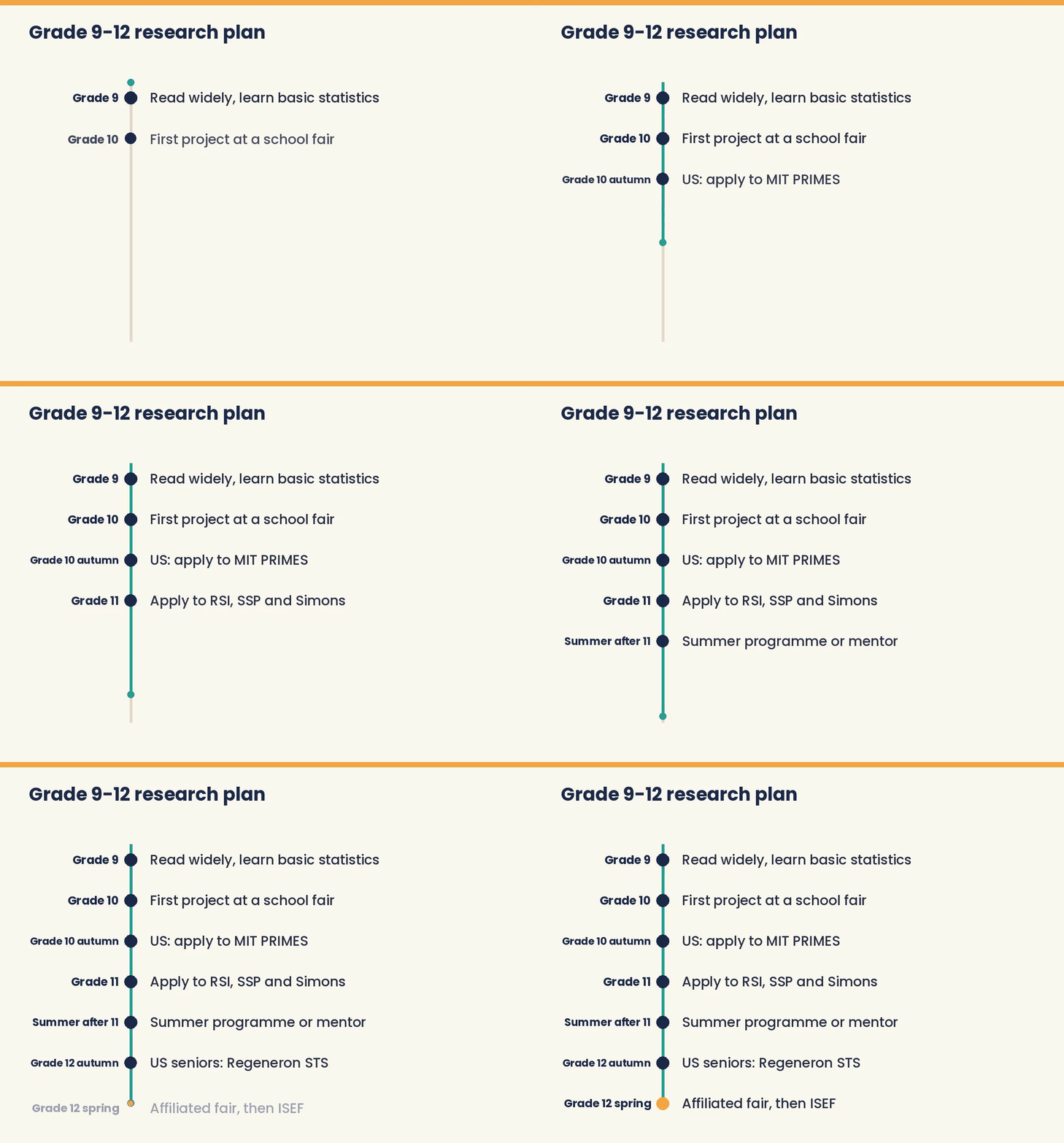
- Grade 9: Read widely. Learn basic statistics and spreadsheets.
- Grade 10: Do a first small project and show it at a school fair.
- Autumn of Grade 10: US students strong in maths can apply to MIT PRIMES (sophomores and juniors are eligible).
- Grade 11 (autumn and winter): Apply to RSI, SSP and Simons.
- Summer after Grade 11: Do a summer programme or work with a mentor.
- Autumn of Grade 12: US seniors can enter Regeneron STS.
- Spring of Grade 12: Compete at an affiliated fair, then Regeneron ISEF.
UK, Indian, Singapore and Australian students can map this to Years 10-13 or Classes 9-12. Use CREST, IRIS or your local ISEF-affiliated fair in place of the US-only steps.
How 1-on-1 tutoring helps with research for high school students
Most research projects stall on method, not ideas. At Asymptode, one dedicated mentor works with your child in live online sessions. The mentor watches every step of the working and fixes the method, whether that is setting up a fair test, choosing the right statistic or checking a proof.
- Maths and statistics method: means, standard deviation, linear fits, error bars and basic probability, taught on your own data.
- Planning: we break the project into weekly goals that fit around your school syllabus and exam dates.
- Writing and presenting: for the written report, the mentor helps with structure, planning and a practice routine for your talk.
- Personalised homework with feedback, short parent updates, and every class is recorded to rewatch.
Want to see how it works? Book a free demo class and advisor call, or view plans on our fees page.
Facts checked against official sources on 28 October 2026.
FAQ
Can a high school student do real research?
Yes. Many students do original projects at school fairs, in programmes like RSI and PRIMES, or with a local mentor. Keep the question small and the method careful. Real research is about honest method, not fancy equipment.
Do I need a mentor to start research in high school?
No, but it helps. You can start alone with a narrow question and public data. A teacher or university mentor can then check your method and point out problems early.
When is the RSI 2027 deadline?
According to CEE, applications for RSI 2027 are open until 11:59 pm on 11 December 2026. High school juniors are eligible and seniors are not. RSI is free to students.
How do I get to Regeneron ISEF?
You must first win a place at a Society-affiliated fair. There are nearly 400 such fairs in the US and over 70 other countries and regions. Regeneron ISEF 2027 runs 8-14 May 2027 in Los Angeles.
Is it worth paying for a research programme?
Sometimes, but check carefully. Ask who the mentor is, whether you choose and do the work, and whether publication is promised. Compare with free options like RSI, PRIMES and SSP's need-blind aid first.
What maths do I need for a science research project?
For most school projects, you need means, standard deviation, graphs and a simple linear fit. Some projects also use basic probability or a t-test. A mentor can teach these on your own data so they make sense.
Sources
- CEE - Research Science Institute (RSI 2027 deadline)
- MIT PRIMES: How to Apply
- PRIMES-USA: How to Apply
- Summer Science Program - Plan your application
- Simons Summer Research Program - How To Apply
- Clark Scholars Program - Application Details
- Clark Scholars Program - Program Details
- Garcia Summer Research Program - Apply (2026)
- PROMYS
- Ross Mathematics Program
- Society for Science - Regeneron ISEF Affiliated Fair Network
- Society for Science - Regeneron Science Talent Search
- Regeneron STS Application Requirements
- Youth Science Canada - Regeneron ISEF 2027
- CREST Awards - Gold Award
- IRIS National Fair (ExSTEMplar)
- DST - Opening of INSPIRE-MANAK nominations 2026-27
- Journal of Emerging Investigators
- JEI - Submission fee and scholarships