
JEE Advanced 2027 is the second-stage entrance exam for the Indian Institutes of Technology (IITs). Only top scorers in JEE Main 2027 can sit it. Based on recent cycles, expect registration in late April and the exam in May 2027, with results in early June. Official 2027 dates are not yet announced on jeeadv.ac.in, so this guide uses the JEE Advanced 2026 brochure as the latest reference.
Key takeaways
- JEE Advanced is the gateway to B.Tech, BS, dual degree and integrated programmes at all 23 IITs.
- In 2026, the top 2,50,000 B.E./B.Tech. candidates from JEE Main qualified to register.
- JEE Advanced 2026 was held on 17 May 2026. Results came out on 1 June 2026.
- You get at most two attempts, in two consecutive years.
- For IIT admission you also need 75% in Class 12 (65% for SC, ST, PwD) or a top-20-percentile rank in your board.
- There are two compulsory computer-based papers of 3 hours each, in English or Hindi.
- JEE Advanced 2027 official dates are not yet announced (checked 26 October 2026).
What is JEE Advanced 2027?
Quick answer: JEE Advanced 2027 is the national entrance test for admission to undergraduate programmes at the IITs in 2027-28. You must first clear JEE Main 2027. The exam has two compulsory 3-hour papers, each with Physics, Chemistry and Mathematics. Ranks are also used by IISc Bengaluru, IISERs and a few other institutes.
JEE stands for Joint Entrance Examination. It has two stages. JEE Main is run by the National Testing Agency (NTA). JEE Advanced is run by the IITs themselves. If you are new to the first stage, read our JEE Main 2027 guide first.
Who conducts JEE Advanced?
Seven zonal IITs run the exam under the Joint Admission Board (JAB). One IIT acts as the organising institute each year, and this role rotates. For 2026 the organising institute was IIT Roorkee, as stated on the official JEE Advanced website. The organising IIT for 2027 has not been announced on the official site yet. The official website is always jeeadv.ac.in.
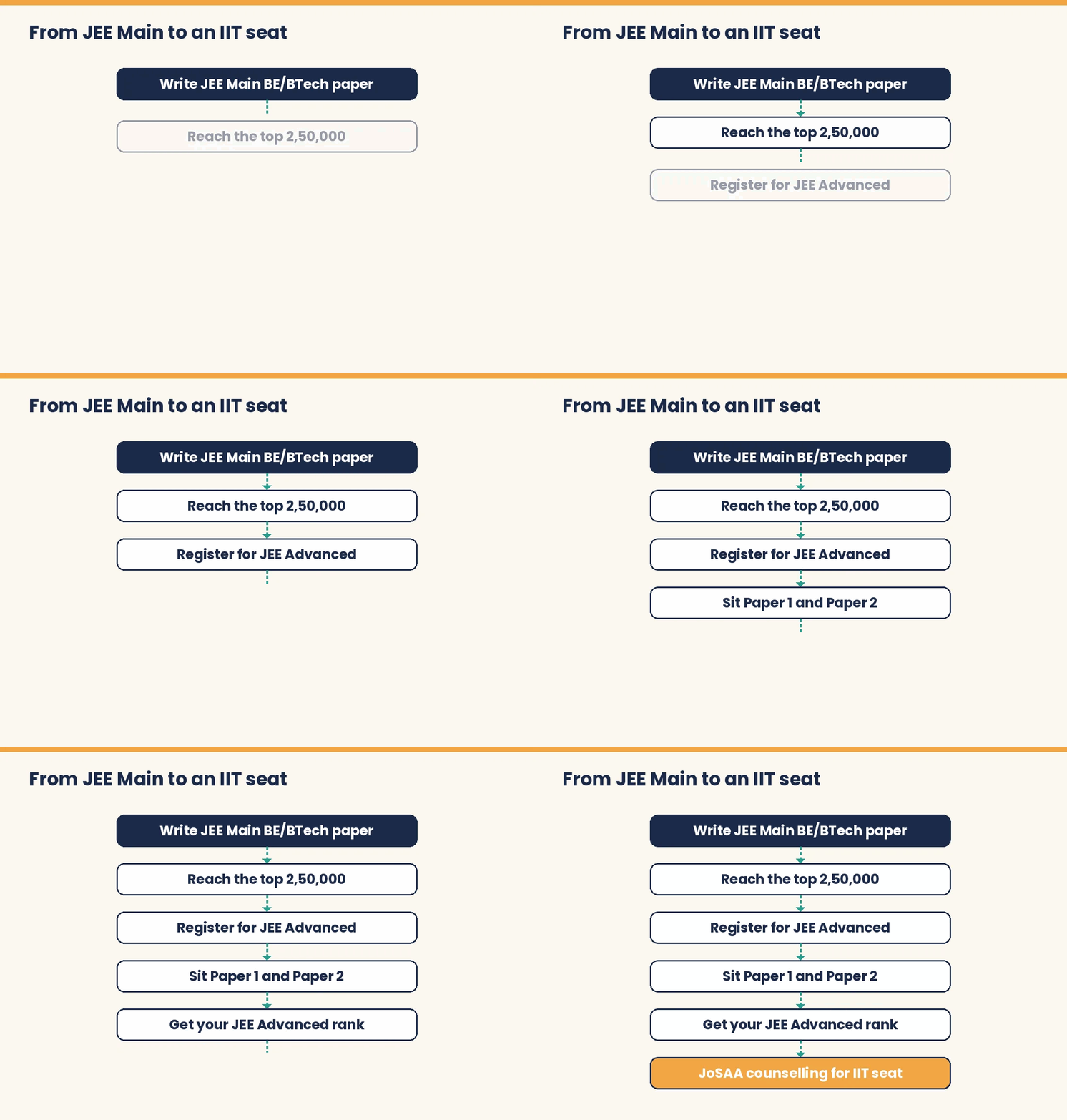
The path in text form:
- Write JEE Main (B.E./B.Tech. paper).
- Rank in the top 2,50,000 (2026 rule).
- Register and pay for JEE Advanced.
- Write Paper 1 and Paper 2 on exam day.
- Get your JEE Advanced rank.
- Register and fill choices in JoSAA counselling for an IIT seat.
When is JEE Advanced 2027?
JEE Advanced is usually held in May, with results in early June. Official 2027 dates are not yet announced. The table below shows the real 2026 dates from the JEE Advanced 2026 Information Brochure and official notices. Use them as a guide to plan your year.
| Event (2026 cycle) | Date |
|---|---|
| Exam date announced | 5 December 2025 |
| Information brochure released | 30 December 2025 |
| Direct registration opens (foreign nationals, OCI/PIO (F)) | 6 April 2026 |
| Registration opens (JEE Main qualified) | 23 April 2026 |
| Registration closes | 2 May 2026 (extended to 5 May 2026) |
| Admit card download | 11 to 17 May 2026 |
| Exam day (Paper 1 and Paper 2) | 17 May 2026 |
| Provisional answer keys | 25 May 2026 |
| Final answer keys and results | 1 June 2026 |
| Architecture Aptitude Test (AAT) | 4 June 2026 |
| AAT results | 7 June 2026 |
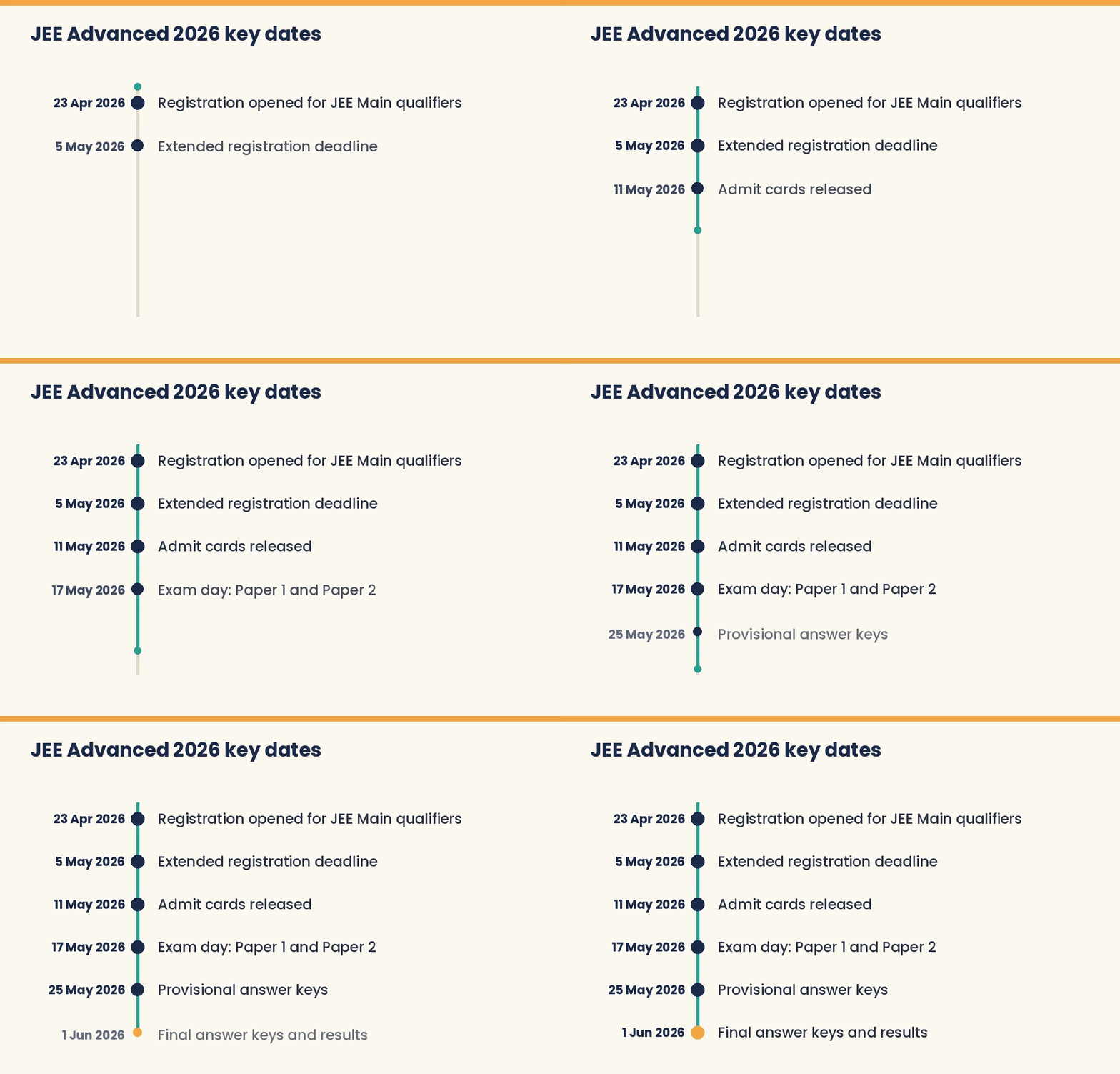
Timeline in text form (all 2026):
- 23 April 2026: registration opened for JEE Main qualifiers.
- 5 May 2026: extended registration deadline.
- 11 May 2026: admit cards released.
- 17 May 2026: Paper 1 (9:00-12:00 IST) and Paper 2 (14:30-17:30 IST).
- 25 May 2026: provisional answer keys.
- 1 June 2026: final answer keys and results.
Because JEE Advanced registration opens only after JEE Main results, keep an eye on our JEE Main 2027 registration guide too.
Who is eligible for JEE Advanced 2027?
The rules below come from the JEE Advanced 2026 brochure and the official eligibility page. The 2027 brochure is not out yet. The rules have stayed very similar for years, but always check the 2027 brochure when it is published.
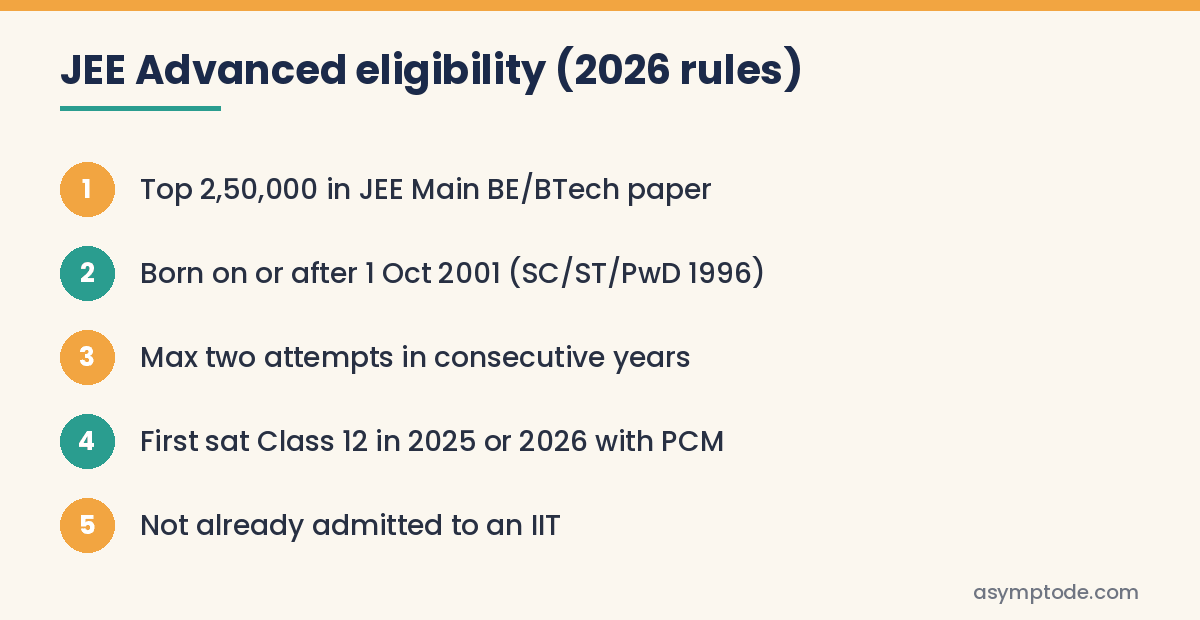
For Indian nationals and OCI/PIO (I) candidates, all five rules must be met (2026 version):
- JEE Main rank: be among the top 2,50,000 successful candidates in the B.E./B.Tech. paper of JEE Main.
- Age: born on or after 1 October 2001 for 2026. SC, ST and PwD candidates get five years of relaxation (born on or after 1 October 1996).
- Attempts: at most two attempts, in two consecutive years.
- Class 12 year: first appeared in Class 12 in 2025 or 2026, with Physics, Chemistry and Mathematics compulsory.
- No earlier IIT admission: you must not have already taken admission at an IIT (some exceptions apply, such as preparatory course students).
If the pattern continues, the 2027 dates in these rules would move forward by one year. Treat that as a likely pattern only, not an official rule, until the 2027 brochure confirms it.
How is the top 2,50,000 split by category?
| Category (2026) | Share | Number of candidates |
|---|---|---|
| OPEN (incl. PwD) | 40.5% | 1,01,250 |
| GEN-EWS (incl. PwD) | 10% | 25,000 |
| OBC-NCL (incl. PwD) | 27% | 67,500 |
| SC (incl. PwD) | 15% | 37,500 |
| ST (incl. PwD) | 7.5% | 18,750 |
Within each category, 5% is reserved for PwD candidates. The total may be slightly higher than 2,50,000 if there are ties.
What Class 12 marks do you need for an IIT seat?
Clearing JEE Advanced is not enough on its own. To get an IIT seat, the 2026 brochure says you must meet one of these two rules, with Physics, Chemistry and Mathematics in Class 12:
- At least 75% aggregate in Class 12 (65% for SC, ST and PwD), or
- Be in the top 20 percentile of successful candidates in your board, by category.
So your board exams still matter a lot.
Can foreign nationals and OCI/PIO candidates apply?
Yes. Under the 2026 rules, foreign nationals do not need to write JEE Main. They register directly on the JEE Advanced portal. OCI/PIO card holders who got their card on or after 4 March 2021 are treated as foreign nationals, called OCI/PIO (F). Those with cards from before that date could choose between OCI/PIO (F) and OCI/PIO (I).
Foreign and OCI/PIO (F) candidates still follow the age, attempts and Class 12 year rules. Their IIT seats are supernumerary, up to 10% of seats in each IIT programme. See the foreign nationals page for details.
Are there exam centres outside India?
Yes, but very few. The 2026 brochure listed two foreign centres: Abu Dhabi and Kathmandu. Candidates choose ten cities when they register. Check the 2027 brochure, as the list can change.
How much is the JEE Advanced registration fee?
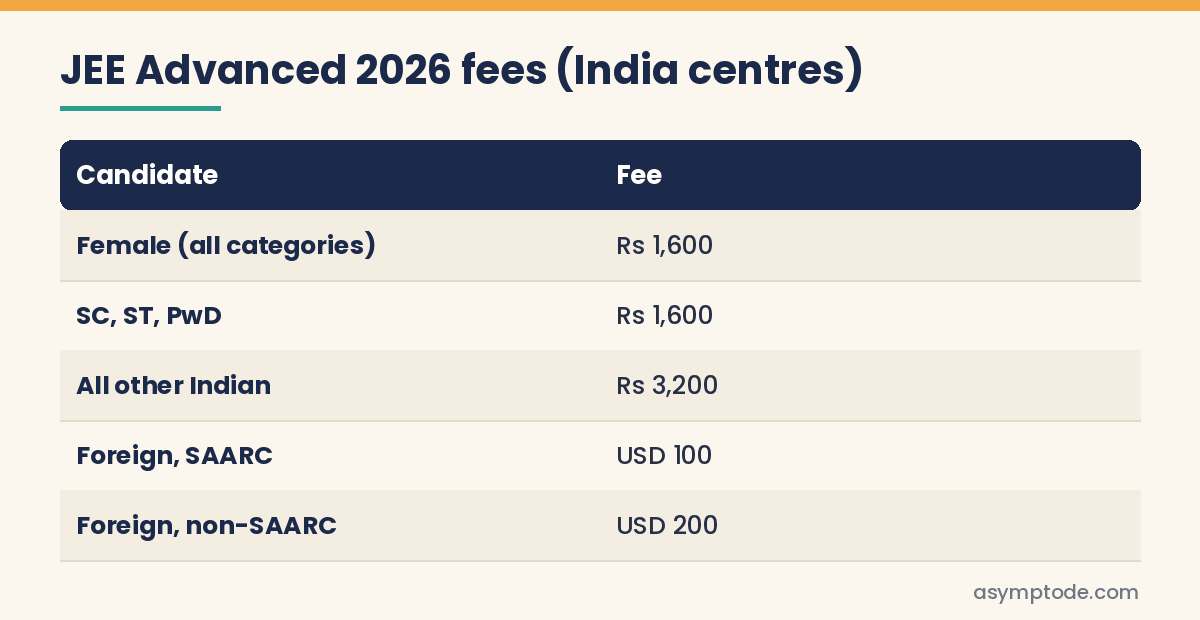
These are the 2026 fees from the brochure. The 2027 fees are not yet announced. Bank and gateway charges are extra, and fees are non-refundable.
| Candidate (2026, centres in India) | Fee |
|---|---|
| Female candidates (all categories) | Rs 1,600 |
| SC, ST and PwD candidates | Rs 1,600 |
| All other Indian candidates | Rs 3,200 |
| Foreign / OCI-PIO (F), living in SAARC country | USD 100 |
| Foreign / OCI-PIO (F), living in non-SAARC country | USD 200 |
For centres abroad in 2026: Indian nationals and OCI/PIO (I) paid USD 200. Foreign nationals and OCI/PIO (F) paid USD 200 (SAARC) or USD 300 (non-SAARC).
What is the JEE Advanced exam pattern?
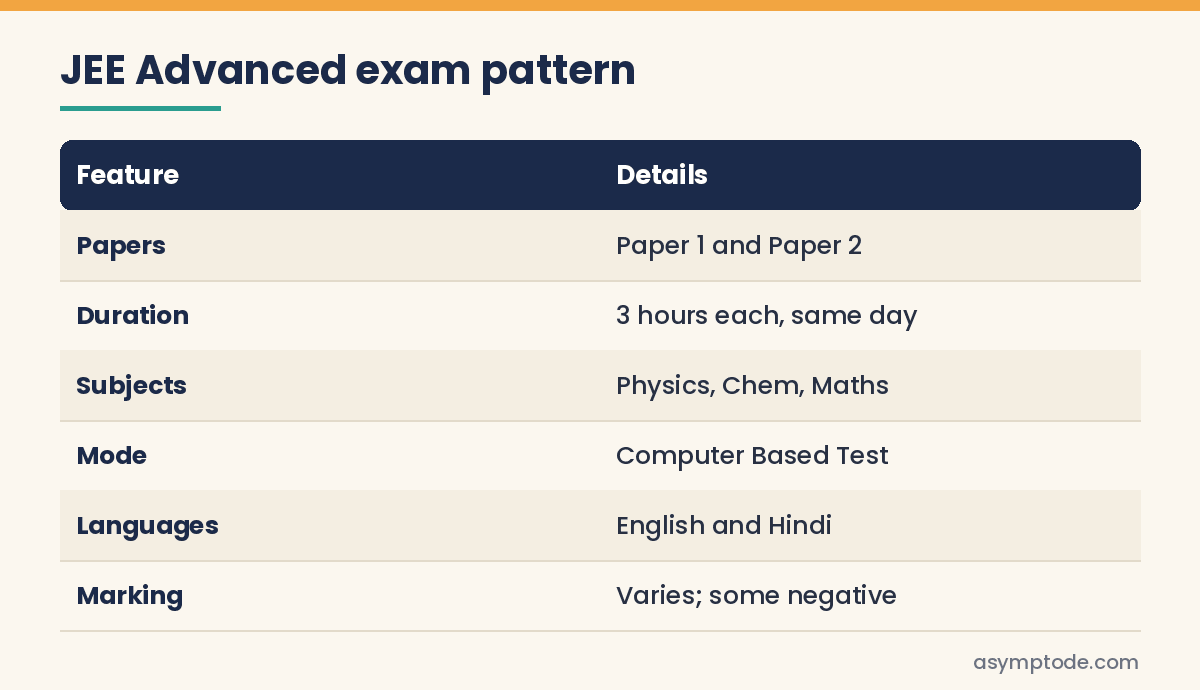
The exam format, per the 2026 brochure:
| Feature | Details |
|---|---|
| Papers | Paper 1 and Paper 2, both compulsory |
| Duration | 3 hours each, on the same day |
| Subjects | Physics, Chemistry, Mathematics in each paper |
| Mode | Computer Based Test (CBT) only |
| Languages | English and Hindi (you can switch any time) |
| Marking | Varies by question type; some carry negative marks |
| Ranking | Total of all six sections |
The marking scheme is shown only in the on-screen instructions on exam day. Question types can change from year to year. That is why practising past papers in the real CBT format is so important. The official site offers free mock tests.
How is your rank decided?
Your Physics score is Paper 1 Physics plus Paper 2 Physics. Chemistry and Maths work the same way. Your total is the sum of all three. You must sit both papers to get a rank.
What is the JEE Advanced 2027 syllabus?
The official syllabus is in Annexure-I of the JEE Advanced 2026 Information Brochure. It covers Physics, Chemistry and Mathematics at Class 11-12 level, but questions test deep reasoning. The 2027 syllabus will appear in the 2027 brochure.
Big topic groups to expect:
- Physics: mechanics, thermal physics, electricity and magnetism, waves, optics, modern physics.
- Chemistry: physical, inorganic and organic chemistry.
- Mathematics: algebra, matrices, probability, trigonometry, coordinate geometry, calculus, vectors and 3D geometry.
What is the AAT for B.Arch?
The Architecture Aptitude Test (AAT) is for students who want the B.Arch. programme at IITs that offer it. In 2026, only students who cleared JEE Advanced could register, from 1 to 2 June 2026. The AAT was held on 4 June 2026 at zonal IITs in India. It is one 3-hour paper in English only. There is no separate AAT rank. You simply pass or fail. Seats are then given using your JEE Advanced rank.
How does JoSAA counselling work?
After results, IIT seats (and seats at other participating institutes) are allotted through JoSAA (Joint Seat Allocation Authority) on josaa.nic.in. In 2026, JoSAA registration began in early June and ran in rounds into July, with the Round 5 seat acceptance deadline on 20 July 2026. You must register and fill choices on the JoSAA portal to get any IIT seat. After each round you accept, freeze, float or slide, and pay the seat acceptance fee by the deadline.
Which other institutes use JEE Advanced ranks?
The 2026 brochure says these centrally funded institutes have used JEE Advanced ranks in the past:
- Indian Institute of Science (IISc), Bengaluru
- IISERs at Berhampur, Bhopal, Kolkata, Mohali, Pune, Thiruvananthapuram and Tirupati
- Indian Institute of Space Science and Technology (IIST), Thiruvananthapuram
- Rajiv Gandhi Institute of Petroleum Technology (RGIPT), Rae Bareli
- Indian Institute of Petroleum and Energy (IIPE), Visakhapatnam
In 2026, IISc Bengaluru's B.Tech programmes were filled through JoSAA using JEE Advanced ranks. Check each institute's own site for its rules. If research appeals to you, read how to become a scientist.
How do you apply for JEE Advanced 2027?
Based on the 2026 process, here is how it works:
- Clear JEE Main 2027 (B.E./B.Tech. paper) and land in the top 2,50,000.
- Watch jeeadv.ac.in for the 2027 brochure and registration dates.
- Log in to the registration portal with your JEE Main details.
- Fill the form and choose ten exam cities.
- Upload documents, such as category or PwD certificates, as needed.
- Pay the fee. Your registration is not complete until you pay.
- Download your admit card and carry it with an original photo ID.
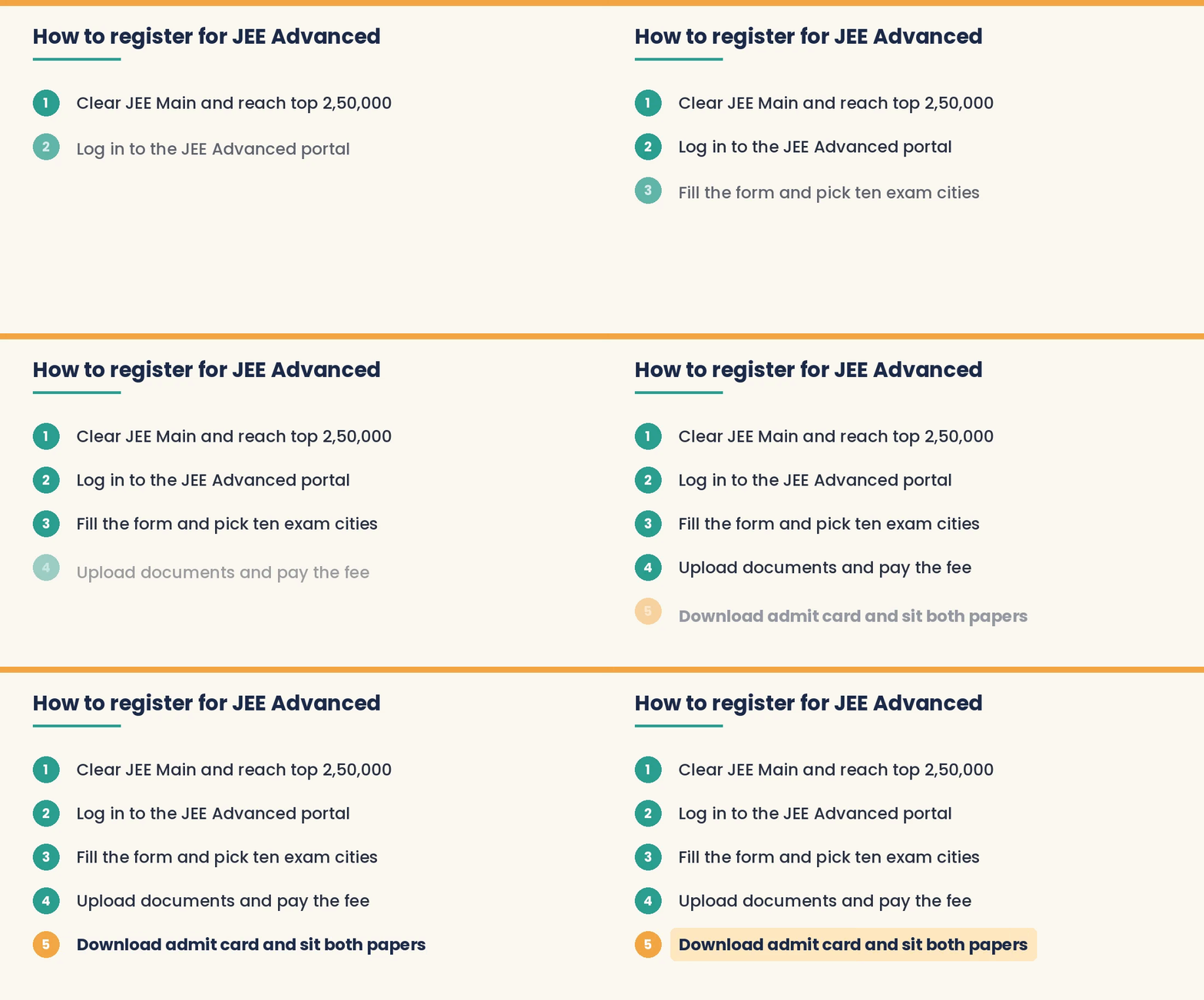
The steps in the animation, as text:
- Clear JEE Main and reach the top 2,50,000.
- Log in to the JEE Advanced portal.
- Fill the form and pick ten exam cities.
- Upload documents and pay the fee.
- Download the admit card and sit both papers.
Want a clear plan for the months ahead? Book a free demo class with an Asymptode mentor, or see our fees.
JEE Advanced 2027 prep plan: October 2026 to May 2027
If 2027 follows the usual pattern, you have about seven months. Here is a simple plan.
| Months | Focus |
|---|---|
| Oct-Nov 2026 | Finish any unfinished Class 12 topics. Fix weak basics. |
| Dec 2026 | Mixed topic practice. Start one full past paper a week. |
| Jan 2027 | JEE Main session 1 focus. Keep board practicals on track. |
| Feb-Mar 2027 | Board exams. Light daily JEE problem practice. |
| Apr 2027 | JEE Main session 2 if needed. Full Advanced papers twice a week. |
| May 2027 | Full mocks in CBT format, paired Paper 1 and 2. Revise errors. |
Tips for each stage:
- Keep an error log. Write down every wrong answer and why.
- Practise both papers on the same day. Stamina matters.
- Do not skip boards. You need 75% or the top 20 percentile.
Worked example: projectile on an inclined plane
Here is a typical JEE-style physics problem. If you need a refresher first, see projectile motion explained.
Problem: A ball is thrown from the bottom of a smooth slope inclined at 30 degrees. Its speed is 20 m/s at 60 degrees above the horizontal. Take g = 10 m/s². Find the time of flight and the distance up the slope where it lands.
Step 1: Choose tilted axes. Put the x-axis along the slope and the y-axis perpendicular to it. The ball's angle to the slope is 60 - 30 = 30 degrees.
Step 2: Split the velocity.
- Along slope: u cos 30 = 20 × (√3/2) = 10√3 m/s
- Perpendicular: u sin 30 = 20 × 0.5 = 10 m/s
Step 3: Split gravity.
- Perpendicular: g cos 30 = 5√3 m/s² (pulls toward slope)
- Along slope: g sin 30 = 5 m/s² (pulls down the slope)
Step 4: Time of flight. The ball lands when its perpendicular distance is zero again: T = 2 × 10 / (5√3) = 4/√3 ≈ 2.31 s
Step 5: Distance along the slope. R = (10√3)(4/√3) - ½ × 5 × (4/√3)² R = 40 - ½ × 5 × 16/3 = 40 - 40/3 = 80/3 ≈ 26.7 m
Check: The standard formula R = 2u² sin α cos(α + β) / (g cos² β), with α = 30 and β = 30, gives 2 × 400 × 0.5 × 0.5 / (10 × 0.75) = 26.7 m. It matches. We also checked it with a step-by-step computer simulation.
The key idea is the tilted axes. Many students lose marks by using horizontal axes and getting lost in algebra.
Common JEE Advanced mistakes to avoid
- Ignoring board marks. A great rank cannot help if you miss the 75% or top-20-percentile rule.
- Missing the fee deadline. In 2026, registration without fee payment was incomplete.
- Not reading the marking scheme. It is shown on screen. Some questions give partial marks; others take marks away.
- Guessing on negative-mark questions. Only attempt when you can narrow it down.
- Skipping CBT practice. Clicking answers on a screen feels different from paper.
- Treating it like JEE Main. Advanced asks fewer, deeper multi-concept questions.
- Using your attempts carelessly. You only get two, in consecutive years.
How 1-on-1 tutoring helps with JEE Advanced
At Asymptode, each student gets private, live 1-on-1 online classes with one dedicated mentor. Your mentor first assesses where you stand in Physics, Chemistry and Maths. Then they build a plan around your own board syllabus and your JEE Main and JEE Advanced dates.
Our teaching is method-first. Your mentor watches each step of your working, so they can spot exactly where a solution goes wrong. That matters in JEE Advanced, where one small slip in a long problem costs the whole answer. You get personalised homework with feedback, and every class is recorded so you can rewatch tricky topics.
Parents get short weekly updates. Scheduling is flexible across time zones, which helps students in the Gulf, Nepal or anywhere else. Ready to start? Book a free demo class or an advisor call, and see our fees.
Facts checked against official sources on 26 October 2026.
FAQ
When will JEE Advanced 2027 be held?
Official JEE Advanced 2027 dates are not yet announced on jeeadv.ac.in. The exam is usually held in May. For reference, JEE Advanced 2026 took place on 17 May 2026, with results on 1 June 2026.
How many students can write JEE Advanced?
In 2026, the top 2,50,000 candidates from the JEE Main B.E./B.Tech. paper could register, split by category. Foreign nationals are counted separately and register directly. Check the 2027 brochure for any change.
How many times can I attempt JEE Advanced?
You can attempt it at most two times, in two consecutive years. This rule appeared in the 2026 brochure. Plan your first attempt seriously.
Is 75% in Class 12 compulsory for IITs?
You need either 75% aggregate in Class 12 (65% for SC, ST and PwD) or a place in the top 20 percentile of your board. Meeting one of the two is enough. This applies to IIT admission, not to sitting the exam.
Can NRI or foreign students take JEE Advanced?
Yes. Foreign nationals and OCI/PIO (F) candidates could register directly in 2026 without JEE Main. Indian citizens living abroad (NRIs) follow the same route as other Indian nationals and must clear JEE Main. In 2026 there were exam centres in Abu Dhabi and Kathmandu.
Is JEE Advanced harder than JEE Main?
Most students find it harder. JEE Main tests speed and breadth. JEE Advanced tests deep, multi-step reasoning, and its question types and marking change between years.