
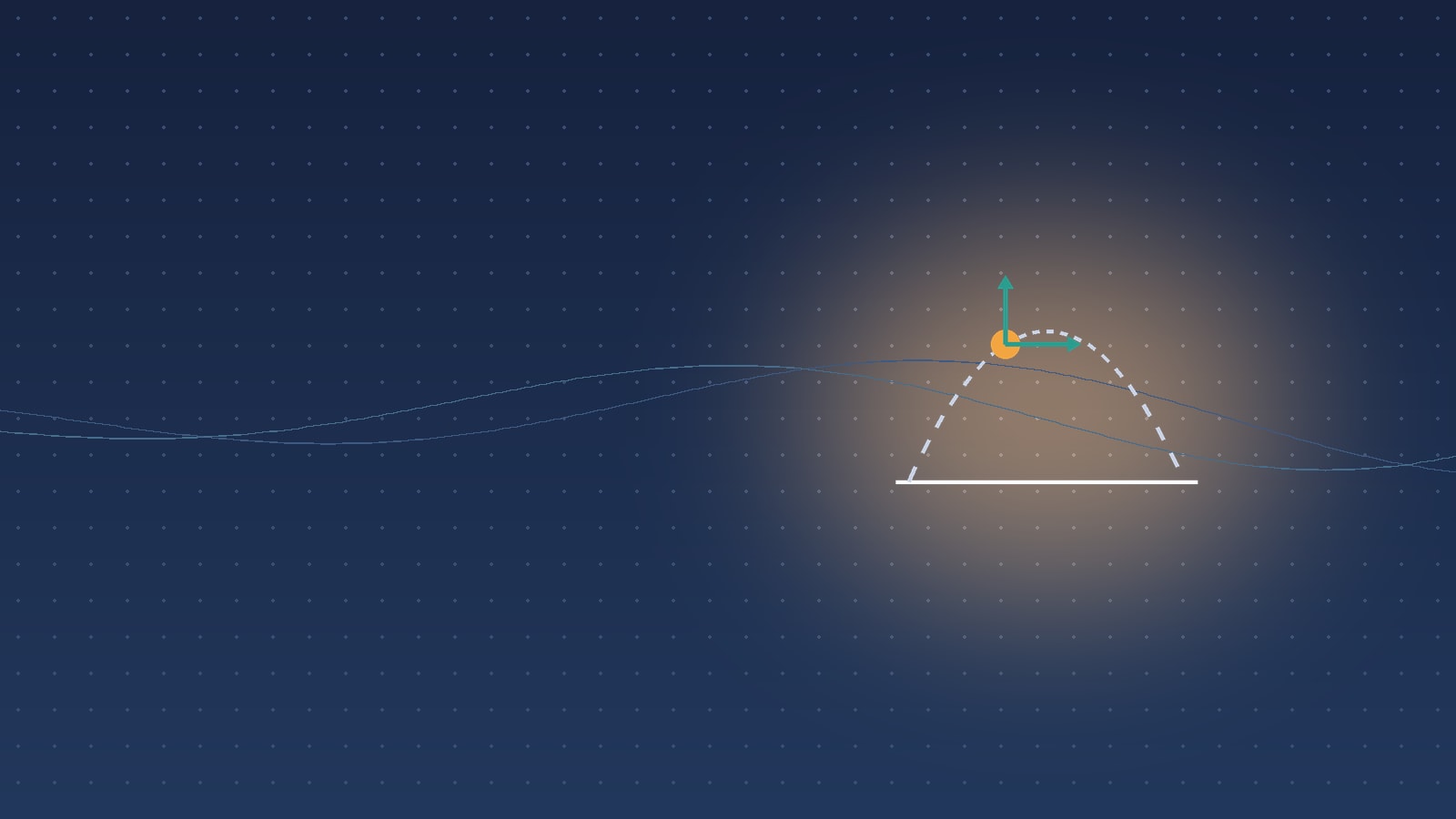
Projectile motion is the curved path an object follows when it is thrown or launched and then moves under gravity alone. The trick to every projectile problem is simple: split the motion into a horizontal part (constant speed) and a vertical part (constant acceleration), solve each one, and join them with time.
Key takeaways
- A projectile moves in a parabola when we ignore air resistance.
- Horizontal velocity stays constant. Vertical velocity changes by 9.8 m/s every second.
- Time is the only quantity shared by both directions. Find it first.
- On level ground, 45° gives the longest range. Angles that add to 90° (like 30° and 60°) give the same range.
- Most lost marks come from mixing the two directions or getting signs wrong.
What is projectile motion?
Quick answer: Projectile motion is two-dimensional motion where the only force acting is gravity. The object keeps a constant horizontal velocity while its vertical velocity changes at a steady rate of g = 9.8 m/s² downward. Together, these two motions produce a curved, parabolic path. Balls, arrows, water jets and long jumpers all follow it.
What assumptions do we make?
School physics uses an ideal model. Exam questions expect you to use it unless they say otherwise.
| Assumption | What it means |
|---|---|
| No air resistance | No drag, so horizontal speed never changes |
| Constant g | g = 9.8 m/s² downward everywhere on the path |
| Flat Earth, small distances | g points straight down and does not change direction |
Some exam boards and textbooks use g = 9.81 m/s². Some questions (and many JEE/NEET problems) say "take g = 10 m/s²" to keep the numbers clean. Always use the value the question gives. In this post we use 9.8 m/s².
Why are horizontal and vertical motion independent?
Gravity acts only downward. It has no horizontal part. So it cannot speed up or slow down the sideways motion. This gives us two separate problems:
- Horizontal: acceleration = 0, so velocity stays the same.
- Vertical: acceleration = g downward, so you use the normal SUVAT (kinematics) equations.
For the force side of this idea, read our guide to Newton's three laws.
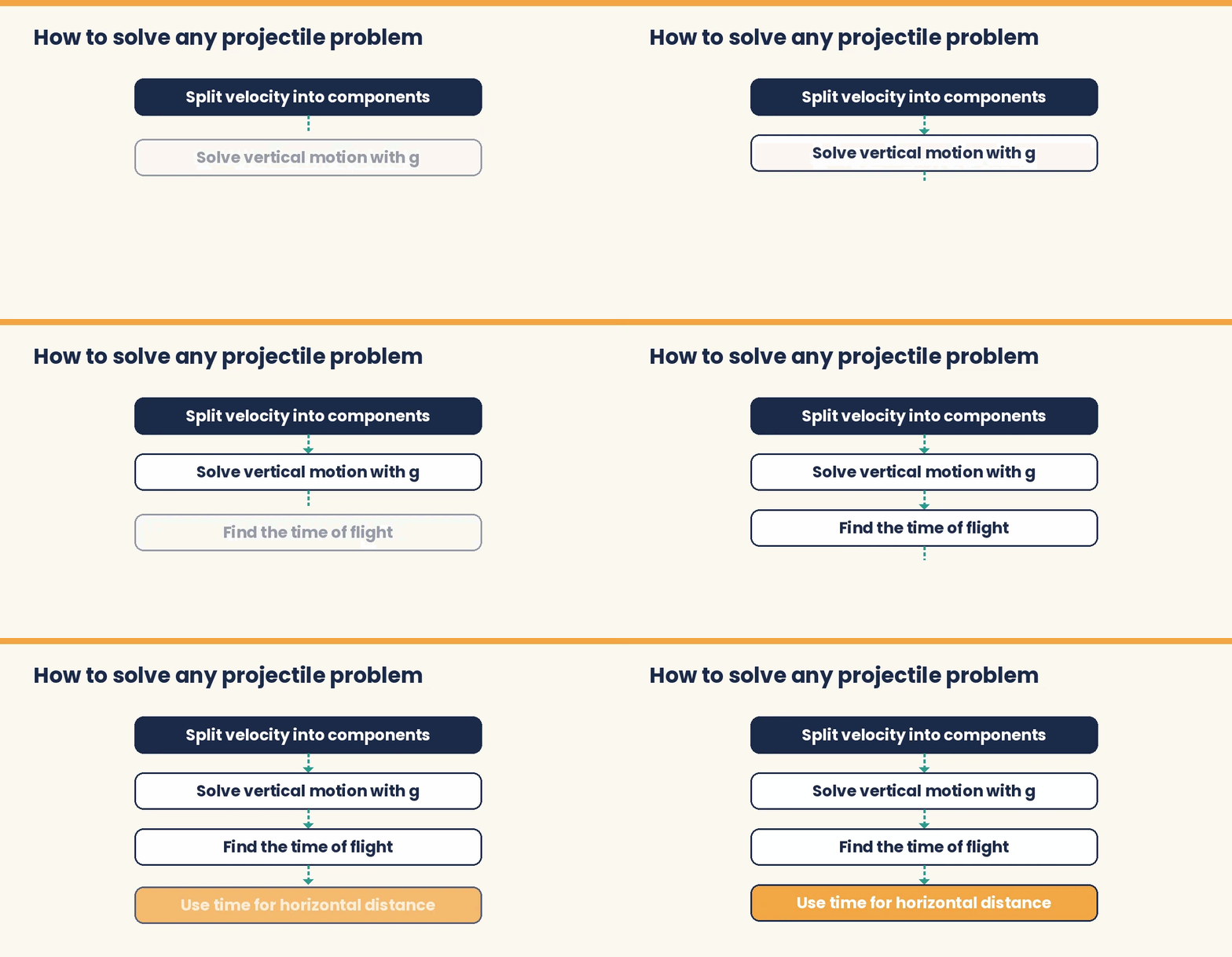
The method, in words:
- Split the launch velocity into horizontal and vertical parts.
- Use the vertical motion (with g) to find what you need.
- Find the time of flight (or the time to the point you care about).
- Use that time to find the horizontal distance.
What are the key projectile motion equations?
Let the launch speed be u, the angle above the horizontal be θ, and g = 9.8 m/s². Take up as positive.
Components of the launch velocity
- uₓ = u cos θ
- u_y = u sin θ
Motion at any time t
- Horizontal: x = (u cos θ) t, and vₓ = u cos θ (never changes)
- Vertical: y = (u sin θ) t − ½ g t², and v_y = u sin θ − g t
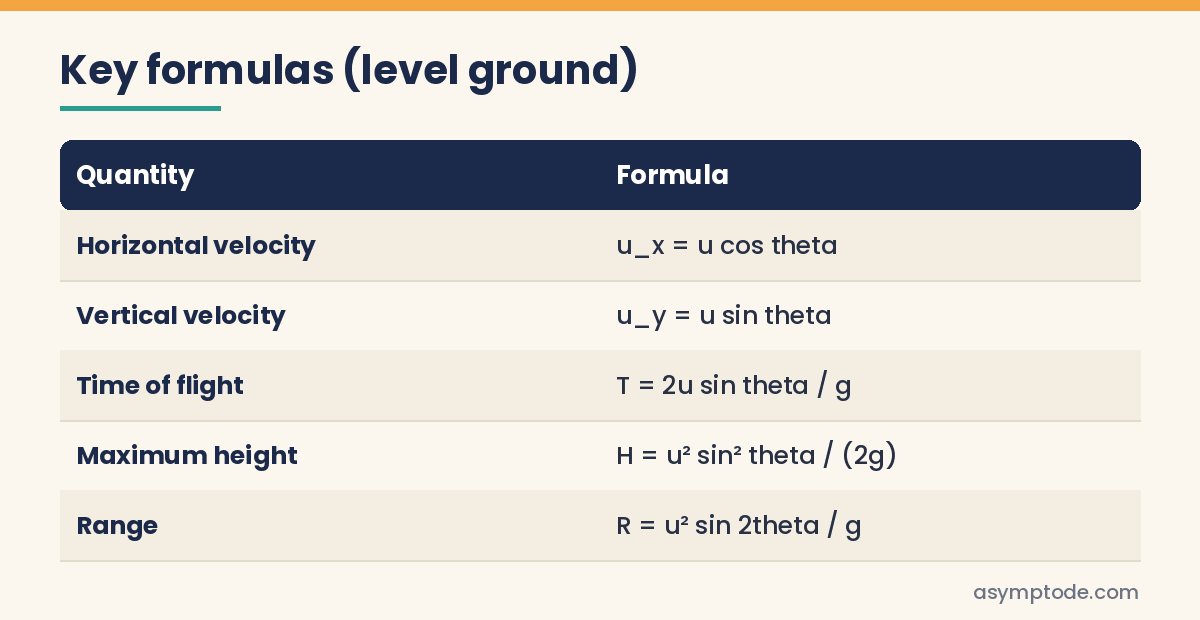
Results for level ground only (lands at launch height)
| Quantity | Formula |
|---|---|
| Time of flight | T = 2u sin θ / g |
| Maximum height | H = u² sin² θ / (2g) |
| Range | R = u² sin 2θ / g |
| Trajectory | y = x tan θ − g x² / (2u² cos² θ) |
The trajectory equation has the form y = ax − bx², which is a parabola.
How do you solve a horizontal launch from a cliff?
When something is launched horizontally, θ = 0. So:
- uₓ = u (all the speed is sideways)
- u_y = 0 (it starts with no vertical speed)
The fall time depends only on the height h: h = ½ g t², so t = √(2h / g). The horizontal distance is then x = u t.
Worked examples
Example 1: A ball kicked at an angle
A ball is kicked at 20 m/s at 30° above level ground. Find the time of flight, maximum height and range.
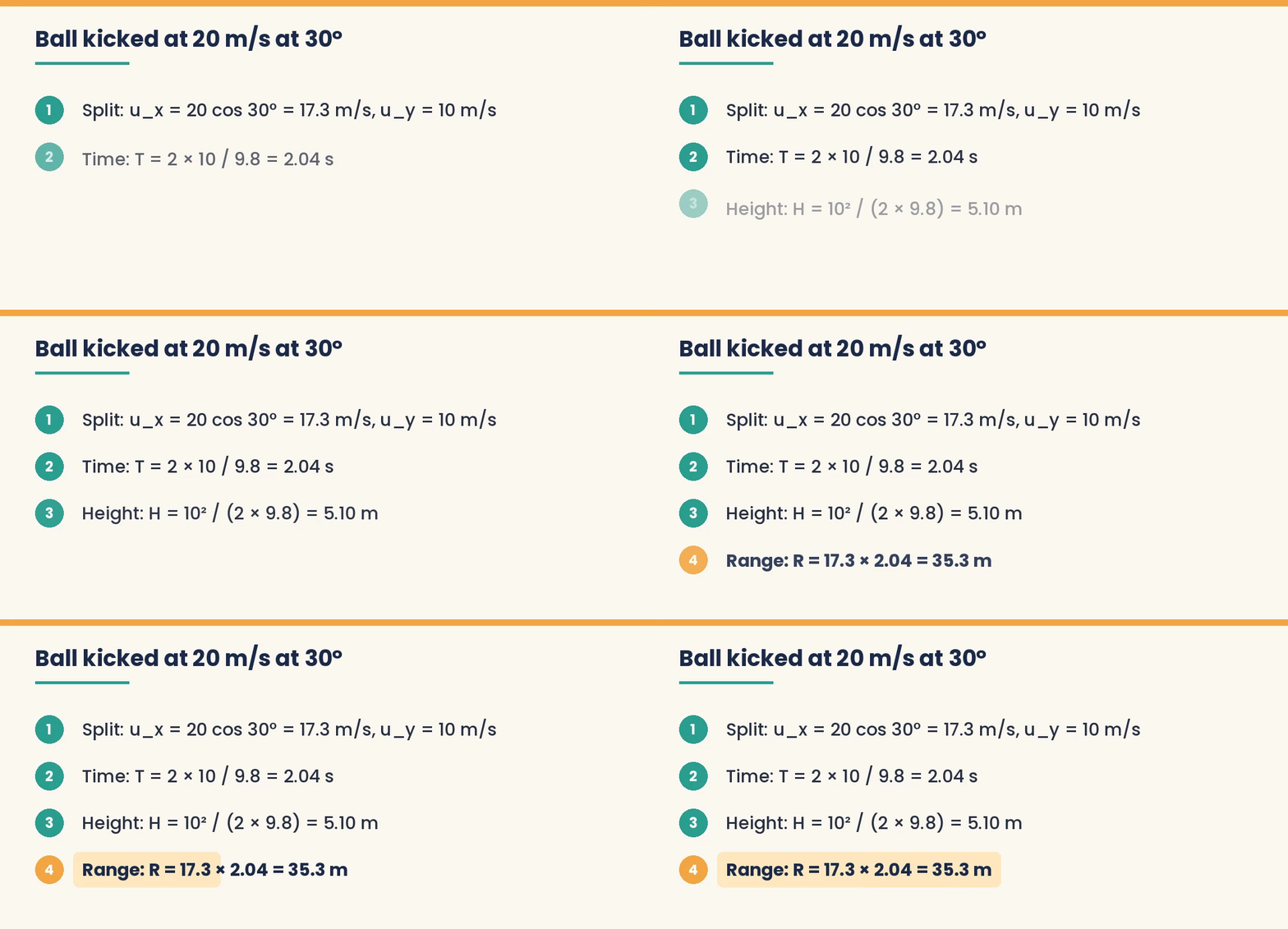
- Split the velocity: uₓ = 20 cos 30° = 17.3 m/s. u_y = 20 sin 30° = 10 m/s.
- Time of flight: T = 2 × 10 / 9.8 = 2.04 s.
- Maximum height: H = 10² / (2 × 9.8) = 100 / 19.6 = 5.10 m.
- Range: R = 17.3 × 2.04 = 35.3 m. (Check: 20² × sin 60° / 9.8 = 35.3 m.)
Example 2: A stone thrown off a cliff
A stone is thrown horizontally at 15 m/s from the top of a 45 m cliff. How far from the base does it land, and how fast is it moving?
- Vertical: u_y = 0, so 45 = ½ × 9.8 × t². That gives t = √(90 / 9.8) = 3.03 s.
- Horizontal: x = 15 × 3.03 = 45.5 m from the base.
- Final vertical speed: v_y = 9.8 × 3.03 = 29.7 m/s (downward).
- Final speed: v = √(15² + 29.7²) = 33.3 m/s, at about 63° below the horizontal.
Example 3: Why 45° gives the longest range
A ball is launched at 25 m/s from level ground. Compare 30°, 45° and 60°.
| Angle | Range | Time of flight | Max height |
|---|---|---|---|
| 30° | 55.2 m | 2.55 s | 7.97 m |
| 45° | 63.8 m | 3.61 s | 15.9 m |
| 60° | 55.2 m | 4.42 s | 23.9 m |
Range depends on sin 2θ. The biggest value of sine is 1, at 90°. So 2θ = 90°, which means θ = 45°.
30° and 60° give the same range because sin 60° = sin 120°. Any two angles that add to 90° (complementary angles) land in the same spot. The steeper one goes higher and stays in the air longer.
The 45° rule is only for level ground with no air resistance.
Example 4: Will it clear the wall?
A ball is thrown at 20 m/s at 40° above the horizontal. A wall stands 30 m away. How high is the ball when it reaches the wall?
- Split: uₓ = 20 cos 40° = 15.3 m/s. u_y = 20 sin 40° = 12.9 m/s.
- Time to reach the wall: t = 30 / 15.3 = 1.96 s.
- Height at that time: y = 12.9 × 1.96 − ½ × 9.8 × 1.96² = 6.4 m.
The trajectory equation gives the same answer. If the wall is shorter than 6.4 m, the ball clears it.
Want someone to watch your working on problems like these? Book a free demo class or see fees.
What are the most common mistakes?
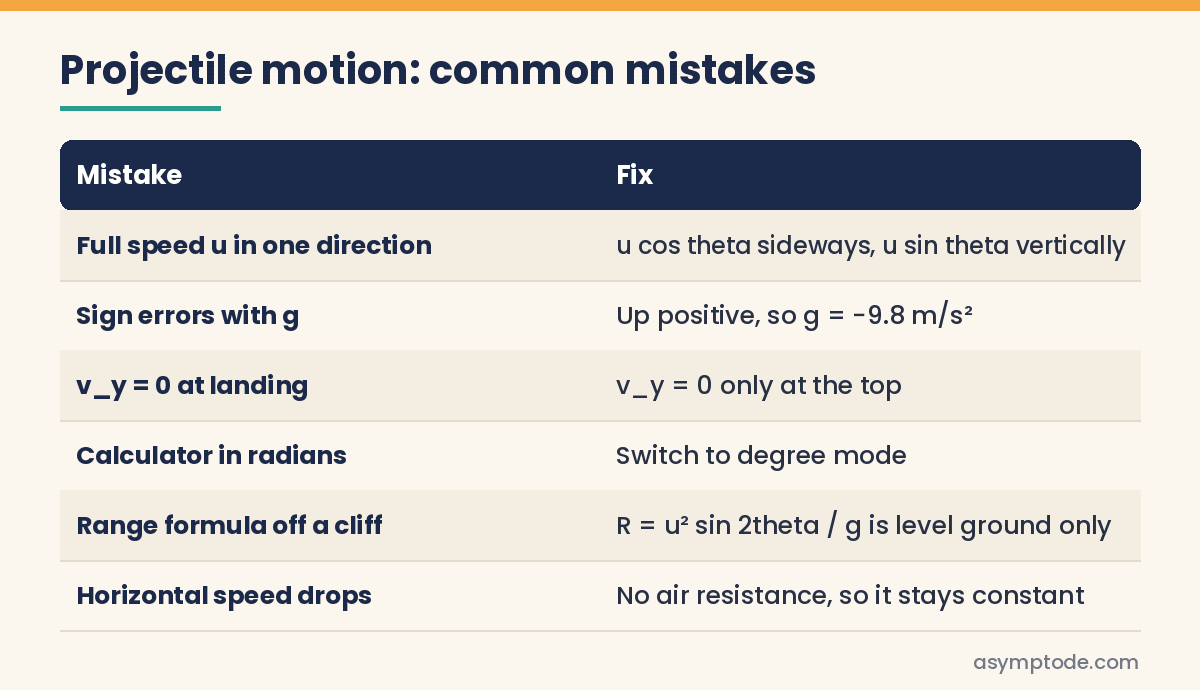
| Mistake | Fix |
|---|---|
| Using the full speed u in one direction | Use u cos θ sideways and u sin θ vertically |
| Sign errors with g | Pick up as positive, then g = −9.8 m/s² |
| Setting v_y = 0 at the landing point | v_y = 0 only at the very top |
| Calculator in radians | Switch to degree mode before using sin and cos |
| Using R = u² sin 2θ / g off a cliff | That formula is for level ground only |
| Thinking horizontal speed drops | With no air resistance, it stays constant |
When a ball lands below its launch point, the vertical equation becomes a quadratic in t. Use the quadratic formula and keep the positive root.
A simple study plan for projectile motion
- Day 1: Practise splitting velocities into components.
- Day 2: Horizontal launches (cliffs, tables).
- Day 3: Angled launches on level ground. Derive T, H and R once.
- Day 4: Mixed problems: launches from heights, clearing walls.
- Day 5: Timed past-paper questions, then list every mistake.
Practice set (with answers)
Use g = 9.8 m/s².
- A ball is kicked at 10 m/s at 30° on level ground. Find its range.
- A marble rolls off a 20 m high roof at 12 m/s horizontally. How far from the wall does it land?
- A projectile is launched at 30 m/s at 45°. Find its maximum height and range.
- A ball is thrown straight up at 15 m/s. How high does it go, and how long is it in the air?
Answers
- R = 10² × sin 60° / 9.8 = 8.84 m
- t = √(40 / 9.8) = 2.02 s, so x = 12 × 2.02 = 24.2 m
- H = 23.0 m, R = 91.8 m
- H = 15² / 19.6 = 11.5 m, T = 2 × 15 / 9.8 = 3.06 s
Which exams test projectile motion?
- AP Physics 1: part of Unit 1, Kinematics, in the College Board's AP Physics 1 course description. See our AP Physics 1 exam guide.
- A-Level Physics: in the mechanics section. For example, AQA lists it as topic 3.4.1.4 in its A-Level Physics specification. See our A-Level Physics guide.
- GCSE Physics: builds the base (speed, velocity, acceleration, forces) that projectile work needs.
- IB Physics: covered in the mechanics/kinematics topic.
- JEE and NEET: a core kinematics topic, often with g = 10 m/s².
Check your own syllabus. Good free references are OpenStax College Physics 2e, section 3.4 and University Physics Volume 1, section 4.3.
How 1-on-1 tutoring helps with projectile motion
At Asymptode, each class is 1-on-1 and live online: one student and one dedicated mentor, no batches. The mentor follows your own syllabus and exam dates, whether that is AP, A-Level, IB, GCSE or JEE/NEET.
Projectile motion is a method topic. The mentor watches each step of your working and calmly fixes the method where you mix directions or drop a sign. You get personalised homework with feedback, and parents get short updates. Every class is recorded so you can rewatch a tricky derivation. Scheduling is flexible across time zones.
Ready to start? Book a free demo class or see fees.
Frequently asked questions
What shape is the path of a projectile?
A parabola, as long as air resistance is ignored. The trajectory equation y = x tan θ − g x² / (2u² cos² θ) has the form of a parabola.
Is the velocity zero at the top of the path?
No. Only the vertical velocity is zero at the top. The horizontal velocity is still u cos θ, so the object keeps moving sideways.
Why does 45° give the maximum range?
Range on level ground is R = u² sin 2θ / g. sin 2θ is largest (equal to 1) when 2θ = 90°, so θ = 45°.
Should I use g = 9.8, 9.81 or 10 m/s²?
Use whatever the question or formula sheet gives. Many textbooks use 9.8 or 9.81 m/s². Some exams, including many JEE/NEET problems, use 10 m/s² for simpler numbers.
Can I use the range formula for a ball thrown off a cliff?
No. R = u² sin 2θ / g only works when the object lands at its launch height. For cliffs, find the time from the vertical motion, then use x = uₓ t.