

If you want to know how to become an astronaut, the honest answer is this: study maths and science well at school, earn a STEM degree (usually a master's), build a few years of real work experience, stay very fit, and then apply when your country's space agency opens a selection. This guide covers NASA, ESA, Canada, India and Japan, plus a school plan and a physics example.
Key takeaways
- Most agencies want a STEM degree (often a master's), about 3 years of work experience and a strict medical pass.
- You must usually be a citizen of the country (or group of countries) that runs the agency.
- Selections are rare: NASA picked 10 people from more than 8,000 applicants in 2025.
- In school, focus on maths, physics, chemistry or biology, and computer science.
- Plan a strong "backup" career you would enjoy anyway, such as engineering, medicine or science.
How to become an astronaut: what is the basic path?
Quick answer: To become an astronaut, take maths and physics in high school, earn a degree in science, engineering, maths, computer science or medicine, and usually a master's. Work for about 3 years in a related job or as a jet pilot. Pass a tough medical exam. Then apply when your space agency announces a selection round.
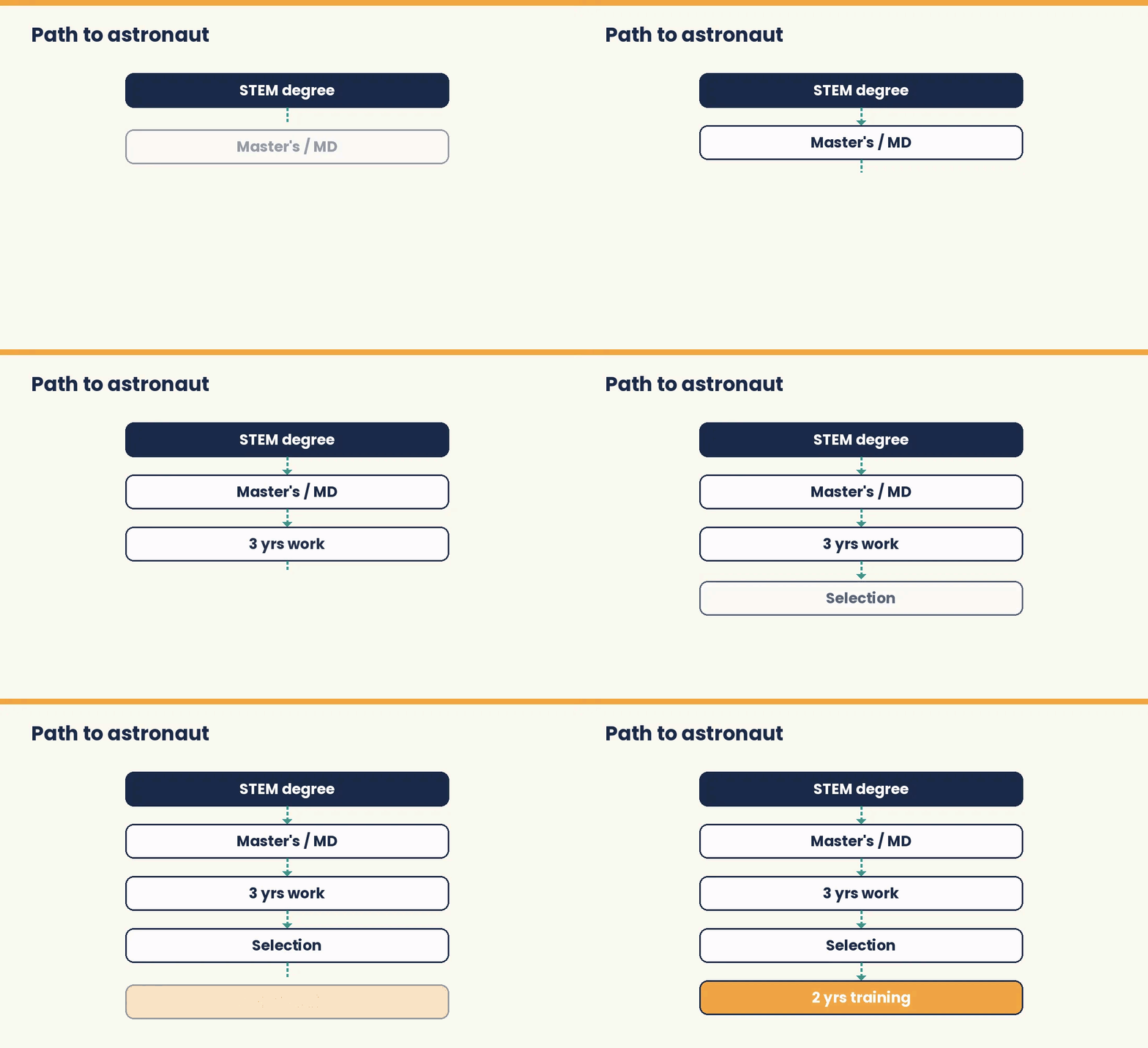
The animation shows five steps. First a STEM degree. Then a master's degree or a medical degree. Then about 3 years of related work. Then a selection process with tests and interviews. Last comes basic training, which takes about 2 years at NASA and about 1 year at ESA.
What do astronauts actually do?
Astronauts live and work in space, but most of their career happens on the ground. They train, test equipment and support other crews.
Here are the main programmes today:
- International Space Station (ISS): Crews run science experiments, fix equipment and do spacewalks.
- Artemis (NASA and partners): The plan to send people back to the Moon. NASA's 2025 class trains for both ISS and Artemis missions.
- Gaganyaan (India): ISRO's first human spaceflight programme to low Earth orbit.
- Commercial missions: Private companies now fly crews too. For example, Indian astronaut Shubhanshu Shukla flew to the ISS as pilot of Axiom Mission 4, launched on 25 June 2025, according to ISRO.
What are the NASA astronaut requirements?
NASA's official "become an astronaut" page lists these basic requirements:
- U.S. citizenship.
- A master's degree in a STEM field, such as engineering, biological science, physical science, computer science or maths. NASA also accepts 2 years of work toward a STEM PhD, a medical degree (MD or DO), or completing a test pilot school programme.
- At least 3 years of related professional experience after the degree, or at least 1,000 hours as pilot-in-command, with 850 of those hours in high-performance jet aircraft.
- Pass the NASA long-duration flight astronaut physical.
After you apply, a selection board reviews applications. Top applicants are interviewed at Johnson Space Center in Houston. About half of them are invited back for a second round. NASA selects astronauts only when it needs them, so there is no fixed yearly date.
How many people get in? NASA's 2025 class had 10 astronaut candidates, chosen from more than 8,000 applicants. It is NASA's 24th class. NASA says it has picked 370 astronaut candidates since the Mercury Seven in 1959.
What are the ESA astronaut selection requirements in Europe?
The European Space Agency (ESA) ran its last selection in 2021-22. Applications opened on 31 March 2021 and closed on 18 June 2021, according to the ESA selection FAQs. Key rules were:
- Be a national of an ESA Member State or Associate Member State.
- Hold at least a master's degree in natural sciences, medicine, engineering, maths or computer science, or be a qualified experimental test pilot or flight test engineer.
- Have at least 3 years of professional experience after graduation.
- Speak English at CEFR level C1. Russian was an asset, not a must.
- Height between 150 and 190 cm for mission assignment, and be no older than 50 when applying.
More than 22,500 people applied. ESA picked 5 career astronauts and 11 reserve astronauts. It also chose John McFall for a Parastronaut Feasibility Project. This project studies how people with a physical disability can fly in space. The five career astronauts finished one year of basic training at the European Astronaut Centre in Cologne on 22 April 2024. ESA has not announced a date for its next selection.
How do you become an astronaut in Canada?
The Canadian Space Agency (CSA) lists its requirements here. The rules are slightly different from NASA's:
- Canadian residents and Canadian citizens abroad can apply (citizens get priority).
- A bachelor's degree in engineering or science, or a doctorate in medicine or dentistry.
- At least 3 years of relevant experience. A master's counts as 1 year and a PhD as 3 years.
- English or French. Both is a plus.
- Vision 20/20 in each eye (glasses allowed), not colour blind, height 149.5 to 190.5 cm, weight 50 to 95 kg.
In the 2017 campaign, 3,772 people applied and 2 were chosen: Joshua Kutryk and Jenni Gibbons.
How to become an astronaut in India?
India's astronauts so far come from the Indian Air Force. ISRO's Gaganyaan FAQ says that for the first crewed mission, trainees were chosen from a pool of test pilots. ISRO and the IAF set the criteria together: flying experience, fitness, psychological tests, aeromedical checks and body measurements.
The four astronaut-designates were named on 27 February 2024: Group Captain Prashanth Balakrishnan Nair, Group Captain Ajit Krishnan, Group Captain Angad Pratap and Wing Commander (now Group Captain) Shubhanshu Shukla.
Is there a civilian route in India? Not yet. ISRO has not announced any public astronaut selection for civilians, such as scientists or engineers. For now, the only known route is through the Indian Air Force and test pilot training. Watch isro.gov.in for official news.
If you are in India and want this path, two options make sense. One is joining the IAF as a pilot (through the routes the armed forces announce). The other is a strong engineering or science career, for example through our IIT admission guide.
What about JAXA and commercial astronauts?
Japan's space agency JAXA announced two new astronaut candidates, SUWA Makoto and YONEDA Ayu, on 28 February 2023. JAXA's page lists 4,127 applicants in its age breakdown.
Commercial astronauts fly with private companies. Some are paying customers, some are company employees and some are agency astronauts on a commercial flight, like Shukla on Axiom Mission 4. There is no single public set of rules or prices for this route. If a company runs a programme, check its official site for current details.
How do the astronaut requirements compare by agency?
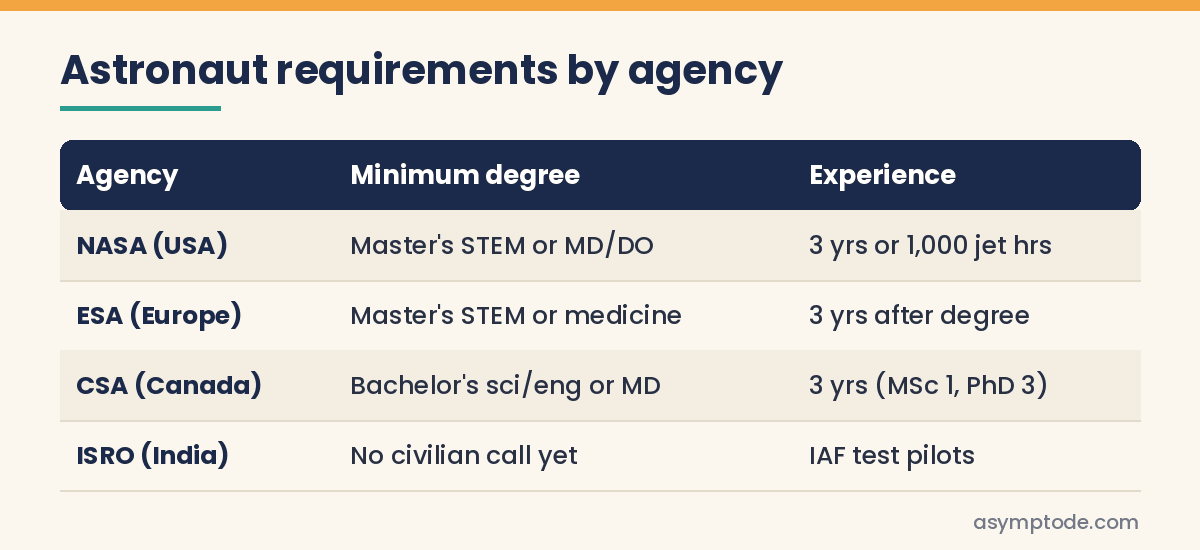
The table compares four agencies side by side:
| Agency | Minimum degree | Experience | Last selection |
|---|---|---|---|
| NASA (USA) | Master's in STEM, MD/DO or test pilot school | 3 years or 1,000 jet hours | 2025: 10 from 8,000+ |
| ESA (Europe) | Master's in science, engineering, maths, CS or medicine | 3 years | 2022: 5 career + 11 reserve |
| CSA (Canada) | Bachelor's in science/engineering, or MD/DDS | 3 years | 2017: 2 from 3,772 |
| ISRO (India) | No public call yet | IAF test pilots | 2024: 4 named |
What degree do you need to be an astronaut?
There is no single "astronaut degree". Agencies want a STEM field. Good choices include:
- Engineering: aerospace, mechanical, electrical or computer engineering. See how to become an engineer.
- Physical sciences: physics, chemistry, geology, astronomy.
- Biological sciences and medicine: biology, or a medical degree. See how to become a doctor.
- Maths and computer science: both are accepted by NASA and ESA.
Pick the subject you love most. You need a great career in it even if you are never selected.
What school subjects do you need to become an astronaut?
These are the subjects to become an astronaut that matter most:
- Maths: algebra, trigonometry and calculus are used in every STEM degree.
- Physics: forces, motion, energy and orbits. Our circular motion guide covers the basics of orbits.
- Chemistry and/or biology: chemistry for engineering and science, biology if you lean toward medicine.
- Computer science: coding helps in every space job.
- English and a second language: ESA wants C1 English, and crews work across countries.
What is a good Grade 9 to 12 plan?
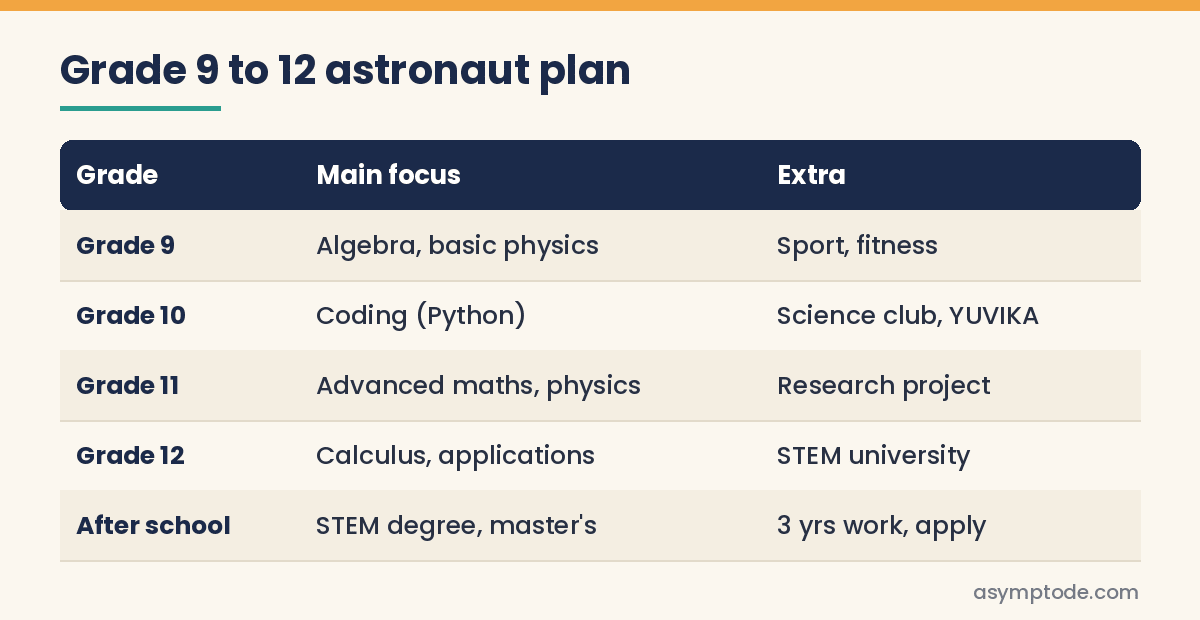
The picture shows one goal per school year. Grade 9 builds maths and science basics, Grade 10 adds coding and clubs, Grade 11 adds advanced physics and research, and Grade 12 is for university applications.
- Grade 9: Get very solid in algebra and basic physics. Start a sport or regular exercise. Read about real missions.
- Grade 10: Learn to code (Python is a great start). Join a science club, robotics team or maths contest. In India, students who have passed Class 9 can apply for ISRO's YUVIKA programme, a two-week residential camp.
- Grade 11: Take the hardest maths and physics you can handle. Try a research project. Our research for high school students guide shows how.
- Grade 12: Choose a university with strong STEM. See our MIT admission guide for one example. Keep grades high and stay fit.
- After school: Earn your degree, then a master's or MD, then work 3 or more years. Keep healthy, learn to fly or scuba dive if you can, and apply when a call opens.
Book a free demo class if your child wants a clear maths and physics plan for these years.
Are there space programmes and internships for school students?
Yes, but check the age rules on official pages.
- YUVIKA (ISRO, India): For school students in India who have passed Class 9. The 2026 camp ran from 11 to 22 May 2026. 1,06,530 students registered and 456 were selected, according to ISRO. YUVIKA 2027 dates are not yet announced, so watch the ISRO site early in the year.
- ISRO START: An online course, but it is for postgraduate and final-year undergraduate students, not school students (ISRO).
- NASA internships (USA): You must be a U.S. citizen. Pathways interns must be at least 16 and enrolled at least half-time in a degree or certificate programme. OSTEM interns must be at least 18 by the start date (NASA intern FAQ). Apply through intern.nasa.gov.
- ESA Graduate Trainee (Europe): For people finishing or within a year of a master's degree (ESA).
What is astronaut training like?
NASA's basic training lasts about 2 years. Candidates learn spacewalks, ISS systems, robotics with the station's robotic arm, and fly T-38 training jets. The 2025 class also covers land and water survival, geology, foreign languages and space medicine. ESA's basic training lasts about one year in Cologne. After basic training, astronauts can be assigned to a mission.
Worked example: how fast does the ISS move?
Astronaut work is full of physics. Here is a simple orbital speed problem.
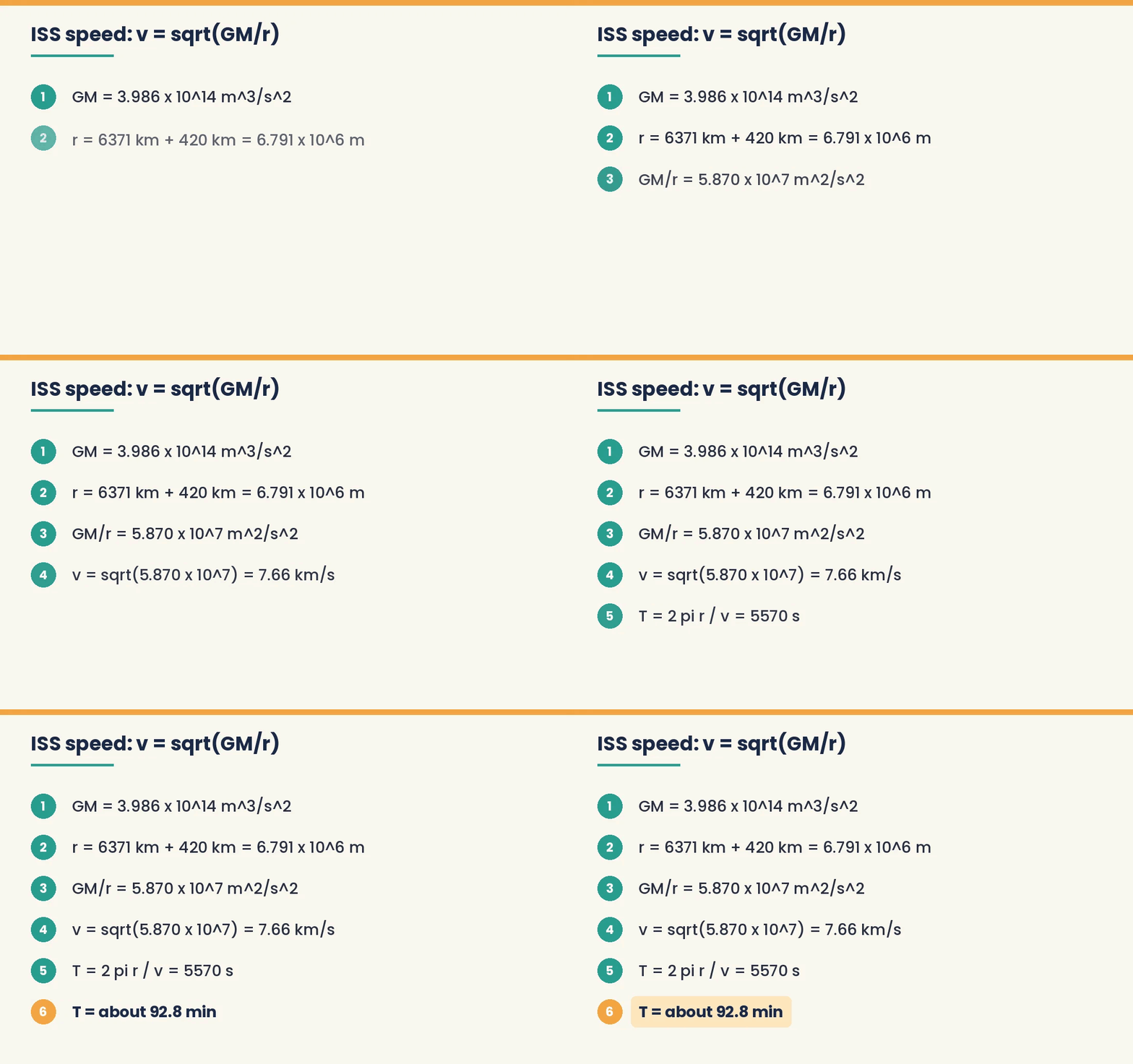
The animation adds the ISS height to Earth's radius, takes sqrt(GM/r), then finds the time for one orbit.
Question: The ISS orbits about 420 km above Earth. Earth's radius is 6,371 km and GM = 3.986 x 10^14 m^3/s^2. Find its speed and orbit time.
- Orbit radius: r = 6,371 km + 420 km = 6,791 km = 6.791 x 10^6 m.
- For a circular orbit, gravity gives the centripetal force: GMm/r^2 = mv^2/r, so v = sqrt(GM/r).
- GM/r = 3.986 x 10^14 / 6.791 x 10^6 = 5.870 x 10^7 m^2/s^2.
- v = sqrt(5.870 x 10^7) = about 7,660 m/s, or 7.66 km/s.
- Period: T = 2 x pi x r / v = 2 x 3.1416 x 6.791 x 10^6 / 7,661 = about 5,570 s, which is about 92.8 minutes.
So the ISS goes round Earth about 15 to 16 times a day. Notice the speed does not depend on the mass of the station.
What is the honest career outlook?
Astronaut jobs are very few. Selections happen only every few years, and each one picks a small group from thousands. NASA chose 10 from more than 8,000. Canada chose 2 from 3,772. India has not opened a civilian call. You can do everything right and still not be chosen.
So pick a career you love that also fits an astronaut application. Related careers include:
- Aerospace engineer: designs rockets, spacecraft and satellites.
- Flight surgeon: a doctor who looks after astronauts' health.
- Planetary scientist: studies the Moon, Mars and other worlds. See how to become a scientist.
- Mission controller: guides missions from the ground.
What are common mistakes to avoid?
- Skipping maths: weak algebra or calculus will block a STEM degree later.
- Picking a degree only for the badge: choose a field you enjoy, since most of your career may be in it.
- Ignoring health: vision, blood pressure and fitness matter. Build good habits early.
How 1-on-1 tutoring helps with becoming an astronaut
Asymptode cannot get anyone into a space agency. What we can do is help students build the maths and physics that every astronaut path needs.
- One dedicated mentor, live online 1-on-1: the same mentor follows the student's own syllabus and exam dates, from Grade 9 algebra to calculus and orbital physics.
- Method-first teaching: the mentor watches each step of the working, so mistakes in problems like v = sqrt(GM/r) are caught early.
- Personalised homework with feedback: practice sets match the student's weak spots, with short parent updates after classes.
- Planning help: for subject choice, research projects and university planning, the mentor helps with structure and method. Every class is recorded, and the first demo class is free. See our plans and fees.
Related guides
- How to become an engineer
- How to become a scientist
- Research for high school students
- Circular motion explained
- How to get into MIT
Facts checked against official sources on 29 October 2026.
FAQ
How many years does it take to become an astronaut?
From the end of high school, it usually takes 10 years or more. That includes about 4 years for a bachelor's degree, 1 to 2 years for a master's, and about 3 years of work. Then you need a selection to open, plus about 2 years of basic training at NASA.
Can I become a NASA astronaut if I am not American?
No. NASA requires U.S. citizenship. Students from other countries should look at their own agency, such as ESA in Europe, CSA in Canada, JAXA in Japan or ISRO in India.
Do astronauts need to be pilots?
No. Pilots are one route, but scientists, engineers and doctors are also selected. NASA accepts 3 years of professional experience instead of flight hours. India is different for now, as its astronauts so far are Air Force test pilots.
What is the age limit to become an astronaut?
NASA's list of basic requirements does not include an age limit. ESA said in 2021 that applicants older than 50 could not go further.
Can I wear glasses and still be an astronaut?
Often yes. The CSA, for example, needs 20/20 vision in each eye with or without correction, and you must not be colour blind.
When is the next astronaut selection?
No new selection date has been announced by NASA, ESA, CSA, JAXA or ISRO on the pages we checked. Agencies select only when needed, often years apart, so follow their official websites.
Ready to start? Book a free demo class and advisor call, or see our plans and fees.
Sources
- NASA: Become an Astronaut
- NASA Selects All-American 2025 Class of Astronaut Candidates
- ESA Astronaut Selection 2021-22 FAQs
- ESA presents new generation of ESA astronauts
- CSA: Requirements and conditions of employment for astronauts
- CSA: 2017 Astronaut Recruitment Campaign
- ISRO: FAQ Gaganyaan
- PIB: PM visits VSSC, astronaut-designates named (27 Feb 2024)
- ISRO: YUVIKA 2026
- JAXA: Astronaut candidates selected (28 Feb 2023)