

A-Level Physics is one of the hardest and most respected A-Levels in the UK. It opens doors to engineering, physics, medicine and computer science. This guide explains the papers for each exam board, the topics, the maths you need, worked examples and a clear plan for Year 13.
Key takeaways
- A-Level Physics is linear: all exams are sat at the end of Year 13, in May and June.
- AQA (7408) has three 2-hour papers: 85, 85 and 80 marks. Edexcel and OCR use different paper lengths.
- AQA says at least 40% of the marks need Level 2 maths or above, and at least 15% test practical skills.
- The practical endorsement is reported separately as Pass or Not Classified. It does not change the A* to E grade.
- Most lost marks come from weak maths, unclear explanations and poor exam technique, not from missing facts.
What is A-Level Physics?
Quick answer: A-Level Physics is a two-year UK course, usually taken in Years 12 and 13. Students study mechanics, electricity, waves, fields, particles and nuclear physics. They sit three exam papers at the end of Year 13. The grade is A* to E. Practical skills are also assessed by teachers for a separate endorsement.
The main boards in England are AQA, Pearson Edexcel and OCR (which has two courses, Physics A and Physics B). The physics is very similar across boards. The paper shapes are different, so always check which board and course your school uses.
How many papers are in A-Level Physics?
Every main board uses three exam papers. Here is how they compare.
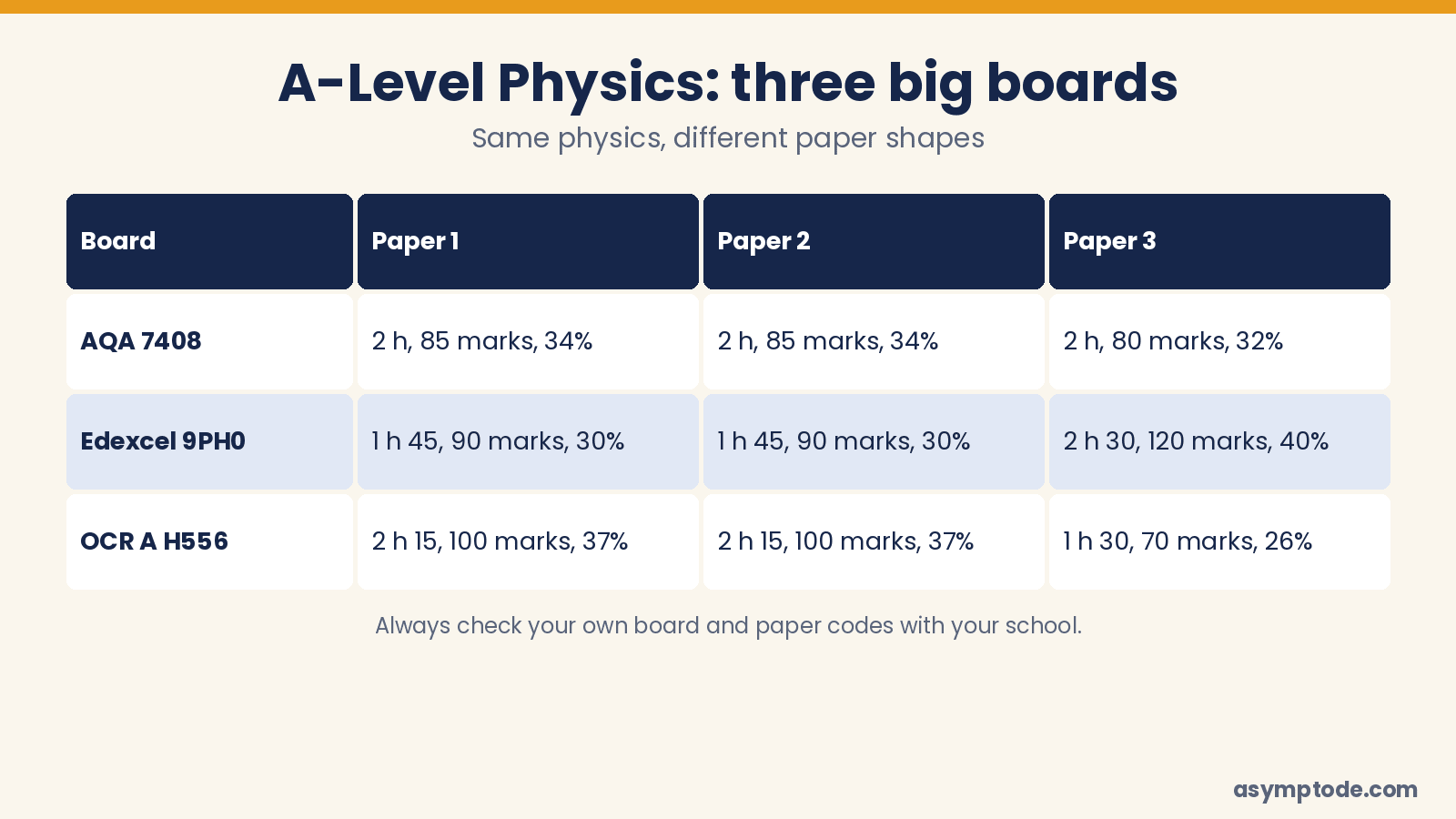
| Board | Paper 1 | Paper 2 | Paper 3 |
|---|---|---|---|
| AQA 7408 | 2 h, 85 marks, 34% | 2 h, 85 marks, 34% | 2 h, 80 marks, 32% |
| Edexcel 9PH0 | 1 h 45, 90 marks, 30% | 1 h 45, 90 marks, 30% | 2 h 30, 120 marks, 40% |
| OCR A H556 | 2 h 15, 100 marks, 37% | 2 h 15, 100 marks, 37% | 1 h 30, 70 marks, 26% |
What is in each AQA paper?
AQA is the most common board, so here is its full breakdown from the AQA 7408 specification.
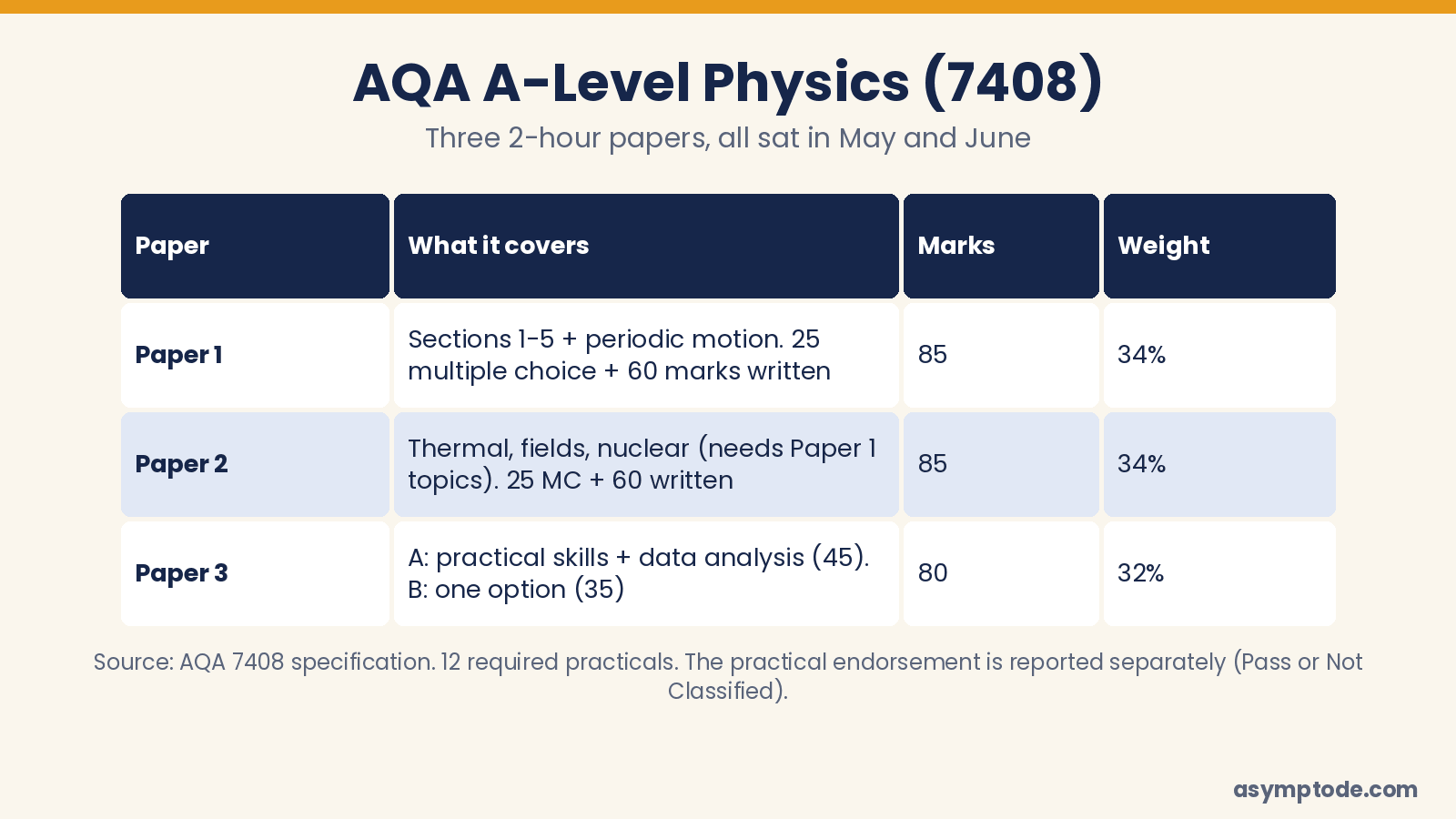
| Paper | What it covers | Questions | Marks |
|---|---|---|---|
| Paper 1 | Sections 1 to 5 and periodic motion (6.1) | 60 marks of short and long answers + 25 multiple choice | 85 |
| Paper 2 | Thermal physics (6.2), fields (7), nuclear (8), using earlier topics | 60 marks of short and long answers + 25 multiple choice | 85 |
| Paper 3 | Section A: practical skills and data analysis. Section B: one option | 45 + 35 marks | 80 |
For Paper 3 Section B, students study one option: Astrophysics, Medical physics, Engineering physics, Turning points in physics or Electronics. Your school usually picks the option.
What about Edexcel and OCR?
- Edexcel 9PH0: Papers 1 and 2 each test a block of the course. Paper 3 is synoptic. It draws on the whole course and on the 16 core practicals.
- OCR A H556: Paper 1 is Modelling physics, Paper 2 is Exploring physics and Paper 3 is Unified physics, which pulls topics together. Practical work is organised into 12 Practical Activity Groups.
What topics are in A-Level Physics?
These are the eight core sections in the AQA course. The other boards cover the same big ideas in a different order.
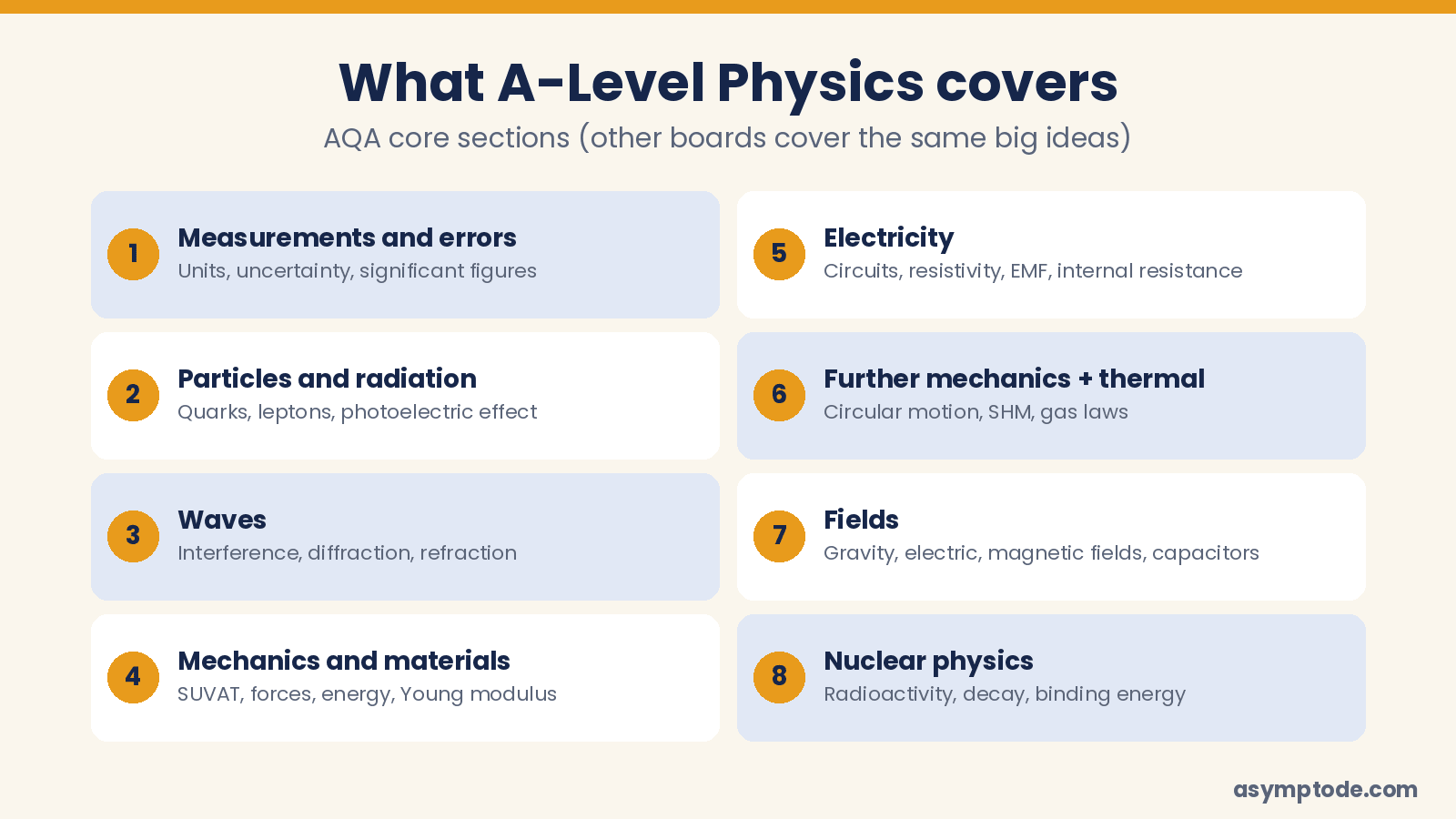
| Section | Key ideas |
|---|---|
| 1. Measurements and their errors | SI units, uncertainty, significant figures |
| 2. Particles and radiation | Quarks, leptons, antiparticles, photoelectric effect |
| 3. Waves | Stationary waves, interference, diffraction, refraction |
| 4. Mechanics and materials | SUVAT, forces, momentum, energy, Young modulus |
| 5. Electricity | Circuits, resistivity, EMF and internal resistance |
| 6. Further mechanics and thermal physics | Circular motion, simple harmonic motion, gas laws |
| 7. Fields and their consequences | Gravitational, electric and magnetic fields, capacitors |
| 8. Nuclear physics | Radioactivity, decay, mass and binding energy |
Sections 1 to 5 are also in the AS course. Sections 6 to 8 are A-Level only.
How much maths is in A-Level Physics?
A lot. AQA says at least 40% of the overall assessment uses maths at Level 2 (GCSE) or above. That includes rearranging equations, using standard form, logs and exponentials, graphs and gradients, areas under graphs and trigonometry.
Students who also take A-Level Maths often find physics easier, because mechanics and calculus ideas overlap. It is not required, but strong algebra is essential.
Worked examples: A-Level Physics style questions
These are our own questions, written in the style of A-Level exam papers. Show every step in the exam: method marks are given for correct working.
Example 1: SUVAT (mechanics)
Question: A car moving at 4 m/s speeds up at 2 m/s² for 5 s. Find its final speed and the distance it travels.
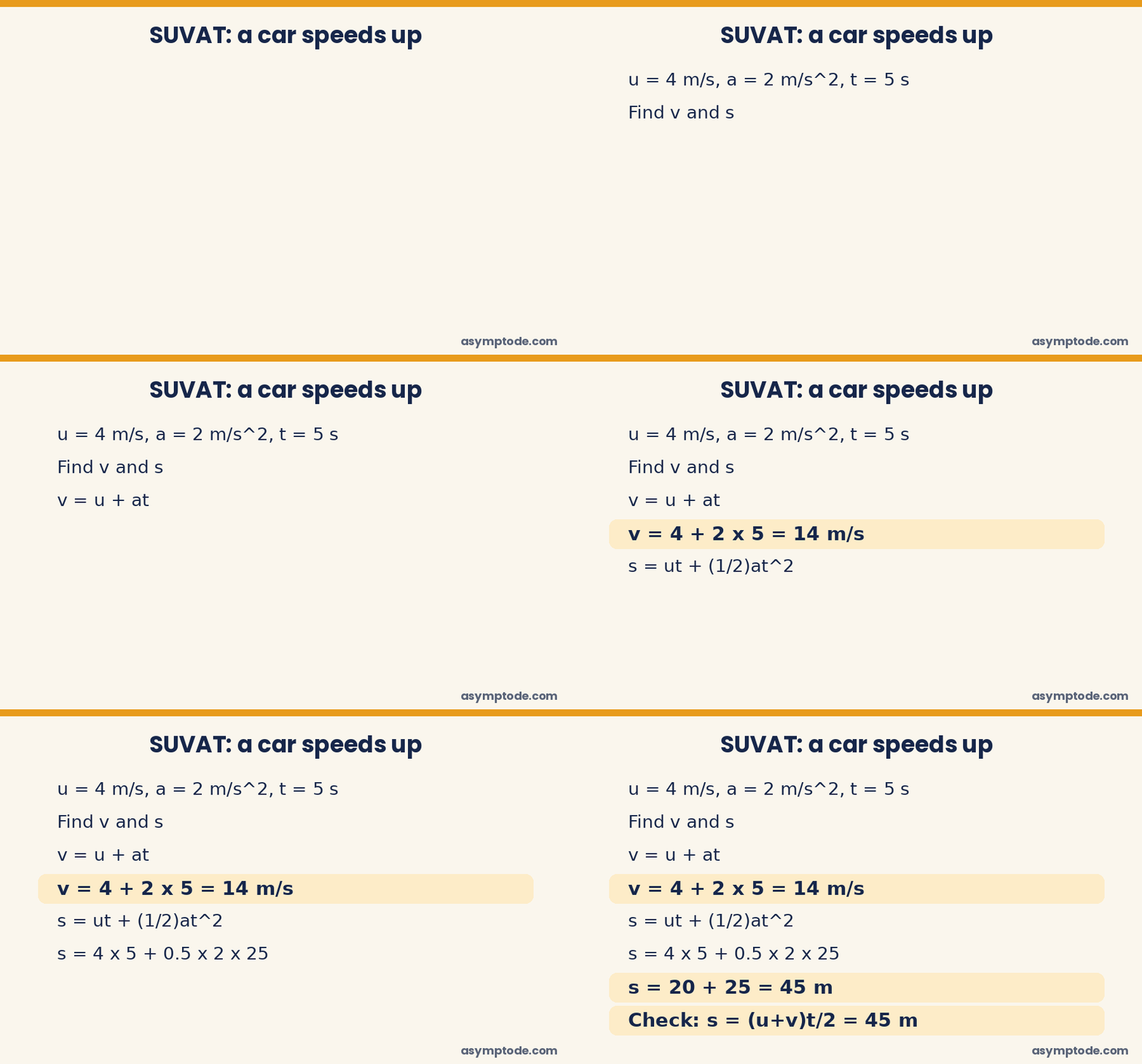
- List what you know: u = 4 m/s, a = 2 m/s², t = 5 s.
- Use v = u + at: v = 4 + 2 × 5 = 14 m/s.
- Use s = ut + ½at²: s = 4 × 5 + 0.5 × 2 × 25 = 20 + 25 = 45 m.
- Check with s = ½(u + v)t: 0.5 × (4 + 14) × 5 = 45 m. Same answer.
Answer: v = 14 m/s, s = 45 m
Example 2: energy (mechanics)
Question: A 0.50 kg ball is dropped from rest from a height of 20 m. Ignore air resistance. Find its speed just before it hits the ground. Use g = 9.81 m/s².
- Loss of gravitational potential energy = gain in kinetic energy.
- mgh = ½mv². The mass cancels, so v² = 2gh.
- v² = 2 × 9.81 × 20 = 392.4.
- v = √392.4 ≈ 19.8 m/s.
Answer: about 19.8 m/s. Note the mass did not matter.
Example 3: circuits (electricity)
Question: A 6 Ω resistor and a 3 Ω resistor are in parallel. This pair is in series with a 4 Ω resistor and a 12 V supply with no internal resistance. Find the current from the supply.
- Parallel pair: 1/R = 1/6 + 1/3 = 1/6 + 2/6 = 3/6. So R = 2 Ω.
- Total resistance: 2 + 4 = 6 Ω.
- Current: I = V/R = 12/6 = 2 A.
Answer: 2 A
What are the most common A-Level Physics mistakes?
- Losing method marks. Writing only the final answer can throw away most of the marks. Write the equation, substitute, then solve.
- Unit and prefix slips. Forgetting to change mm to m or kJ to J is very common. Convert first, then calculate.
- Too many significant figures. Match the data given, usually 2 or 3 significant figures.
- Vague explanations. In 6-mark questions, use precise physics words and a clear chain of reasoning.
- Weak graph skills. Many marks need a gradient, an intercept or an area under a graph. Practise drawing large tangents.
- Leaving Paper 3 practical skills to the end. Uncertainties and data analysis need regular practice, not one week of revision.
Struggling with fields, SHM or 6-mark answers? A mentor can find the exact gap. Book a free demo class.
When are the A-Level Physics exams in 2027?
The 2027 summer exam season is expected to run from about Monday 10 May to Friday 18 June 2027, with A-Level results day on Thursday 12 August 2027. Exam boards publish provisional timetables first. Always check the final timetable on your board's website and with your school.
How should I revise for A-Level Physics in Year 13?
A steady plan beats last-minute cramming. Here is a simple plan from autumn term to the exams.
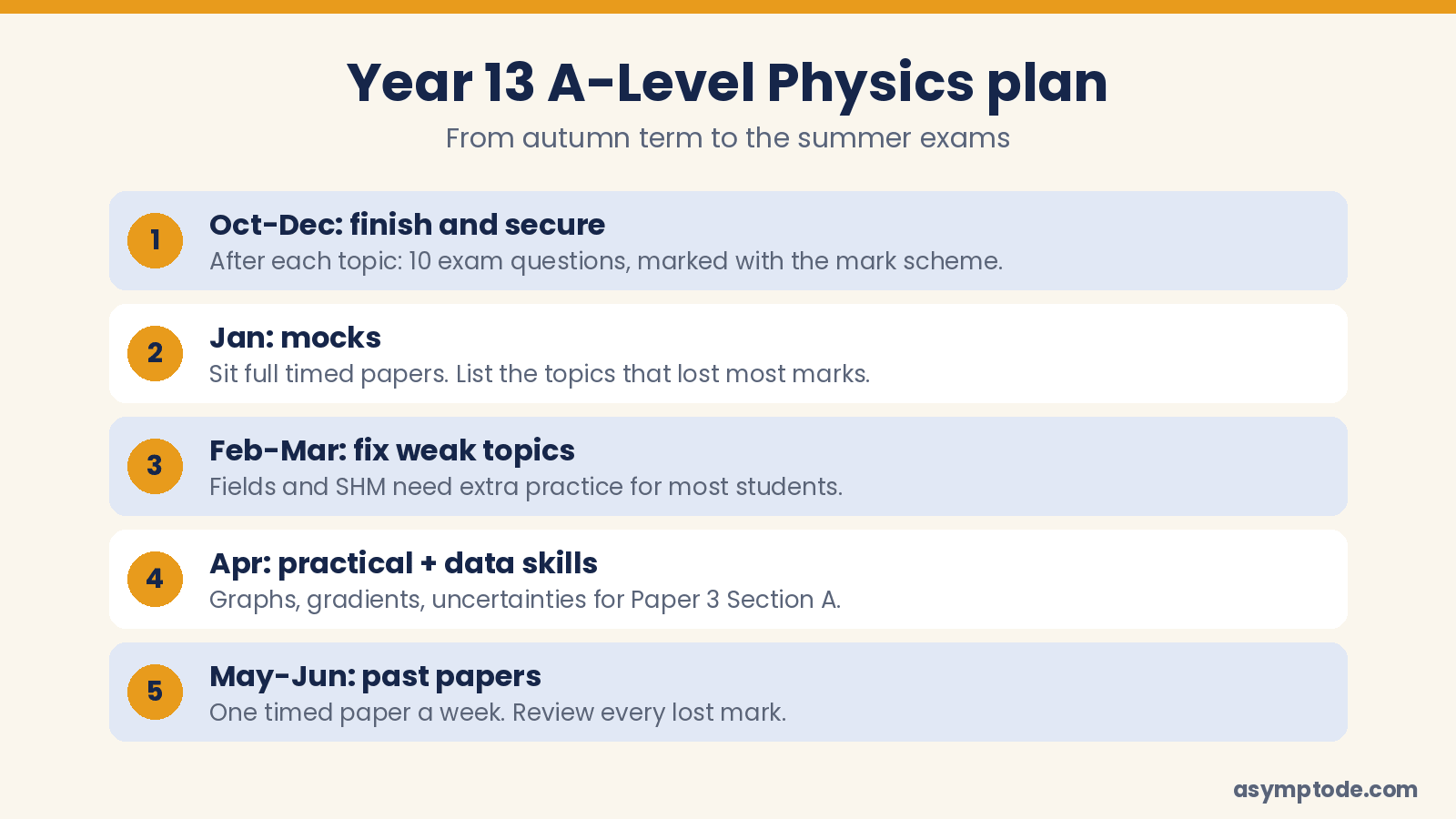
| When | Focus | What to do |
|---|---|---|
| October to December | Finish and secure | After each new topic, do 10 exam questions and mark them with the mark scheme. |
| January | Mocks | Sit full, timed papers. List the topics that lost the most marks. |
| February to March | Fix weak topics | Fields, SHM, capacitors and gas laws need extra work for many students. |
| April | Practical and data skills | Uncertainties, graphs and gradients for Paper 3. |
| May to June | Past papers | One timed paper a week. Review every lost mark. |
Good habits to build:
- Make an equation sheet and learn it. Know what every symbol means and its unit.
- Use mark schemes to learn the wording. Examiners reward specific phrases.
- Mix topics. Real papers jump between topics. Mixed practice prepares you for that.
- Explain it out loud. If you can teach a topic in two minutes, you understand it.
If you are still choosing courses, our GCSE Combined Science guide explains the step before A-Level, and our Newton's three laws explainer is a good refresher on forces.
How 1-on-1 tutoring helps with A-Level Physics
At Asymptode, lessons are live, online and 1-on-1, with one dedicated mentor. For A-Level Physics this helps in a few clear ways:
- We follow your board and your school's timeline. AQA, Edexcel or OCR, the plan matches your papers and your mock dates.
- We fix the maths inside the physics. Many physics problems are really algebra or graph problems. The mentor watches each step and fixes the method.
- We practise exam wording. Students write extended answers and get feedback on structure and key terms.
- Homework is targeted. Exam-style questions on the topics you need, marked by the same mentor.
- Parents stay informed. Short updates show what improved and what needs more practice.
- Every class is recorded, so you can rewatch a hard derivation before the exam.
We never promise grades. We focus on clear understanding and steady practice. View our fees or talk to an advisor to book a free demo class.
FAQ
Is A-Level Physics hard?
It is one of the more demanding A-Levels because it combines ideas, maths and practical skills. With steady practice, strong algebra and lots of exam questions, students can do very well.
Do I need A-Level Maths to take A-Level Physics?
Not always, but most schools strongly recommend it. AQA says at least 40% of the assessment uses Level 2 maths or above, so strong algebra and graph skills are essential.
How many papers are in A-Level Physics?
Three. For AQA, each paper is 2 hours: Paper 1 and Paper 2 are 85 marks each and Paper 3 is 80 marks. Edexcel and OCR also have three papers with different lengths.
What is the practical endorsement?
It is a separate result based on practical work in class, assessed by teachers against common criteria. It is reported as Pass or Not Classified and does not change the A* to E grade. Some universities ask for a Pass.
Which Paper 3 option should I choose for AQA?
The options are Astrophysics, Medical physics, Engineering physics, Turning points in physics and Electronics. Most schools choose one for the whole class. Ask your teacher which one you are studying.
When is A-Level results day 2027?
A-Level results day is expected to be Thursday 12 August 2027. Check with your school for collection details.