

If you want to know how to get into IIT, the short answer is this: clear JEE Main, rank in the top 2,50,000 in Paper 1, then do well in JEE Advanced, and finally win a seat through JoSAA counselling. Each step has its own rules and dates. This guide covers the full route, for Indian students, parents, and NRI, OCI and foreign families.
Key takeaways
- The route to an IIT B.Tech is JEE Main, then JEE Advanced, then JoSAA counselling, then a seat.
- Only the top 2,50,000 candidates in JEE Main Paper 1 (all categories) can register for JEE Advanced.
- For an IIT seat you also need 75% in Class 12 (65% for SC/ST/PwD) or a place in the top 20 percentile of your board.
- JEE Advanced allows a maximum of two attempts, in consecutive years (2026 rules).
- Foreign nationals and some OCI/PIO card holders compete for supernumerary seats, up to 10% of seats in each IIT programme.
How to get into IIT: what is the full process?
Quick answer: To get into an IIT, you write JEE Main Paper 1 and aim for the top 2,50,000. That lets you register for JEE Advanced. Your JEE Advanced rank is then used in JoSAA counselling, where you fill choices and get a seat. You must also meet the age, attempt and Class 12 marks rules.
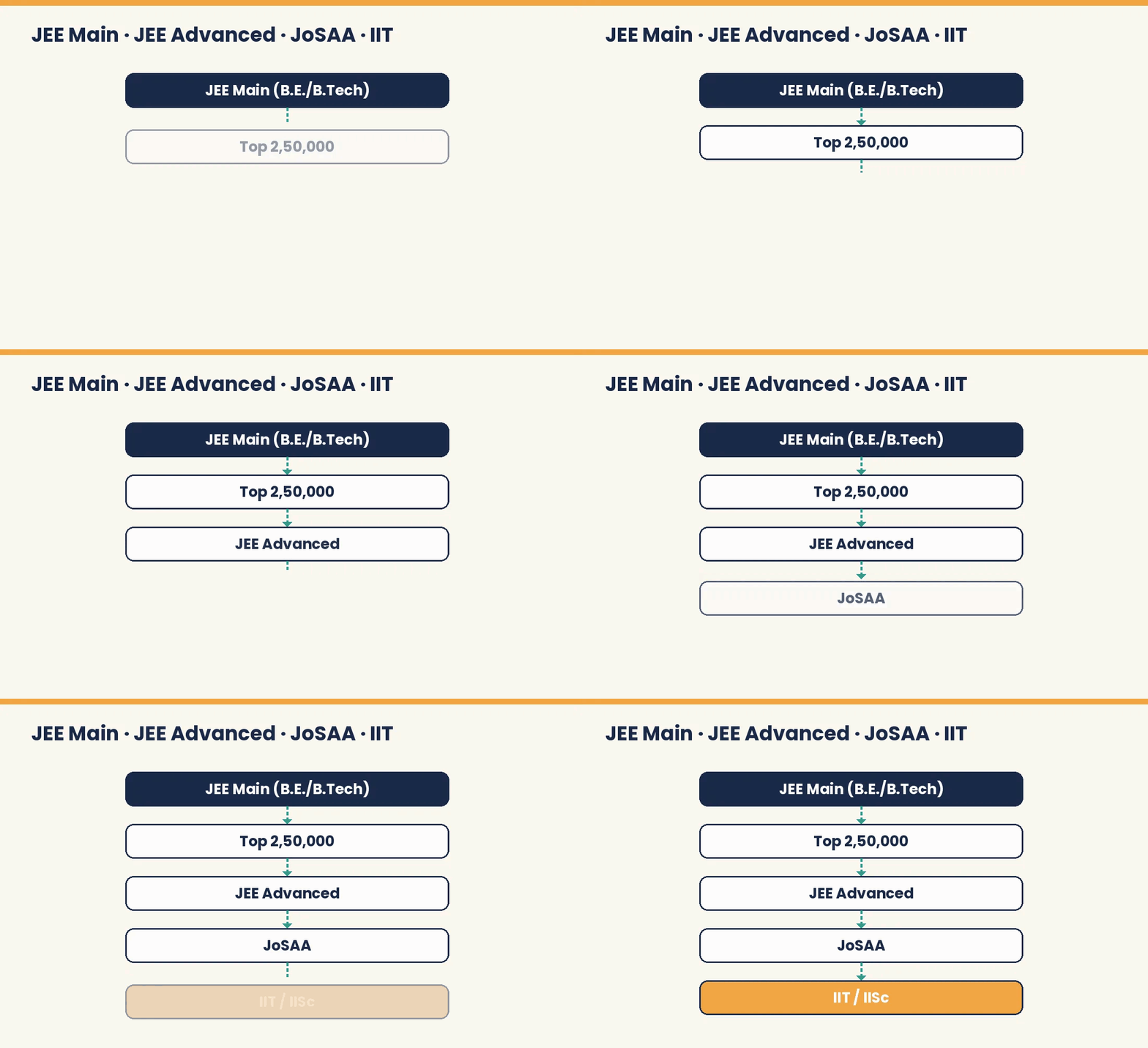
The animation shows five boxes, from top to bottom. It starts with JEE Main (B.E./B.Tech). Then comes the top 2,50,000 cut. Then JEE Advanced. Then JoSAA counselling. The last box is a seat at an IIT or IISc.
JoSAA 2026 handled seats for 138 institutes for 2026-27. That included 23 IITs, IISc Bengaluru, 31 NITs, IIEST Shibpur, 26 IIITs and 56 Other-GFTIs. IIT and IISc seats need a JEE (Advanced) rank. NIT and similar seats use your JEE (Main) rank. So one JEE Main score can open many doors, not only the IITs. For a wider look at engineering careers, read our guide on how to become an engineer.
What is JEE Main, and when is it in 2027?
JEE Main is run by the National Testing Agency (NTA). The official site is jeemain.nta.nic.in. NTA released the JEE Main 2027 notice and bulletin on 24 October 2026.
What are the JEE Main 2027 dates?
| Event | Session 1 | Session 2 |
|---|---|---|
| Registration | 24 Oct - 22 Nov 2026 | 5 Jan - 3 Feb 2027 |
| Late fee window | 23 - 26 Nov 2026 | 4 - 7 Feb 2027 |
| Exam dates | 20-24 and 28 Jan 2027 | 2-7 Apr 2027 |
Session 1 registration is open now. Our step-by-step JEE Main 2027 registration guide shows each screen of the form.
What is the JEE Main Paper 1 pattern?
Paper 1 is for B.E. and B.Tech. It has 75 questions for 300 marks. Each right answer gives +4. Each wrong answer takes away 1. Guessing has a cost. Exam centres are in India and abroad.
Who can write JEE Main 2027?
You can write JEE Main 2027 if you passed Class 12 in 2025 or 2026, or are writing Class 12 in 2027. For more detail on syllabus and prep, see our full JEE Main 2027 guide.
Who is eligible for JEE Advanced and an IIT seat?
Doing well in JEE Main is not enough. You must pass five more checks. The rules below are from the JEE Advanced 2026 brochure. The 2027 rules are not yet announced, so check jeeadv.ac.in when they come out.
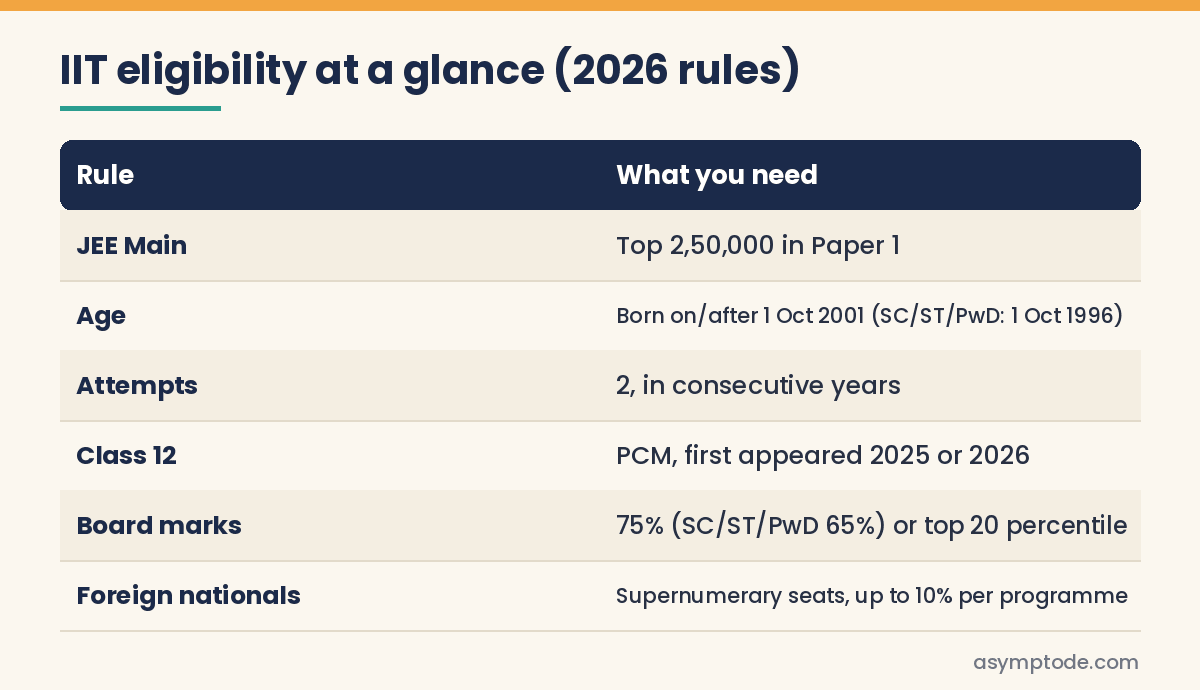
The table lists six rules. JEE Main: you must be in the top 2,50,000 in Paper 1. Age: born on or after 1 October 2001 (1 October 1996 for SC, ST and PwD). Attempts: two, in consecutive years. Class 12: PCM, first appeared in 2025 or 2026. Marks: 75% (65% for SC/ST/PwD) or top 20 percentile. Foreign nationals: supernumerary seats, up to 10% per programme.
How is the top 2,50,000 split by category?
Under the 2026 rules, the 2,50,000 places were split like this. Within each group, 5% is for PwD candidates.
| Category | Places in top 2,50,000 |
|---|---|
| OPEN | 1,01,250 |
| GEN-EWS | 25,000 |
| OBC-NCL | 67,500 |
| SC | 37,500 |
| ST | 18,750 |
What is the 75% rule for IIT?
To take an IIT seat, you need one of two things. Either 75% in Class 12 (65% for SC, ST and PwD). Or a place in the top 20 percentile of your board. Miss both, and even a good JEE Advanced rank will not get you an IIT seat.
How many attempts do you get at JEE Advanced?
You get a maximum of two attempts, in two years in a row. Under the 2026 rules, you must have first appeared for Class 12 with Physics, Chemistry and Maths in 2025 or 2026. Plan for both from the start.
What is the JEE Advanced exam like?
JEE Advanced has two papers of 3 hours each. Both are compulsory. Both are computer-based. In 2026, Paper 1 ran from 9 am to 12 noon and Paper 2 from 2:30 pm to 5:30 pm.
The 2026 exam was on Sunday 17 May. It was run by IIT Roorkee, and the result came out on 1 June. The dates and organising IIT for 2027 are not yet announced as of 28 October 2026. The exam is usually held in mid or late May. Our JEE Advanced 2027 guide will track the dates as they come.
How much is the JEE Advanced fee?
| Centre | Candidate | Fee (2026) |
|---|---|---|
| India | Women, SC, ST, PwD | Rs 1,600 |
| India | Others | Rs 3,200 |
| Abroad | SAARC countries | USD 100 |
| Abroad | Non-SAARC countries | USD 200 |
In 2026, the centres abroad were Abu Dhabi and Kathmandu.
Which other institutes use JEE Advanced ranks?
IISc, the IISERs, IIST, RGIPT and IIPE also use JEE Advanced ranks, some through their own portals. If you want B.Arch at an IIT, you also write the Architecture Aptitude Test (AAT) after the result. In 2026, AAT was on 4 June and results came on 7 June.
Book a free demo class with an Asymptode mentor to build a JEE plan around your own exam dates, or see our plans and fees.
How does JoSAA counselling work?
JoSAA runs one common counselling for IITs, NITs, IIITs and more. The official site is josaa.nic.in. The full rules are in the JoSAA Business Rules 2026 PDF.
What was the JoSAA 2026 schedule?
| Step | Date (2026) |
|---|---|
| JEE Main ranks | 20 Apr |
| JEE Advanced result | 1 Jun |
| Registration and choice filling | 2 - 11 Jun |
| Mock allocations | 8 and 10 Jun |
| Round 1 | 13 Jun |
| Rounds 2, 3, 4 | 30 Jun, 6 Jul, 10 Jul |
| Round 5 (final round for IITs/IISc) | 16 Jul |
Round 4 was the last round in which you could withdraw from an IIT seat. Use the mock allocations to test your choice list.
What do Freeze, Float and Slide mean?
After you get a seat, you must pick one of three options.
- Freeze. You keep this seat and stop. You will not move up.
- Float. You keep this seat but stay open to any higher choice, in any institute.
- Slide. You keep this seat but stay open to a higher choice in the same institute only.
If you get your first choice, only Freeze is offered.
How much is the JoSAA seat acceptance fee?
The seat acceptance fee is Rs 30,000. For SC, ST and all PwD candidates, it is Rs 15,000. This includes a Rs 5,000 JoSAA processing charge. The rest is adjusted against your admission fee. If you do not pay in time, your seat is rejected.
Are there special seats for girls?
Yes. Female supernumerary seats exist in IITs, IISc, NITs and other institutes. They come from a 2017 Ministry of Education decision to reach at least 20% female students in undergraduate courses.
What is the IIT preparatory course?
IITs also publish preparatory course rank lists for SC, ST and PwD candidates. To be on this list, you need at least 2.5% in each subject and 8.75% in aggregate in JEE (Advanced).
How much does it cost to study at an IIT?
Fees differ from IIT to IIT. Always check the fee page of the IIT you want. Here is one real example, from the IIT Bhubaneswar fee structure 2026-27 for freshers.
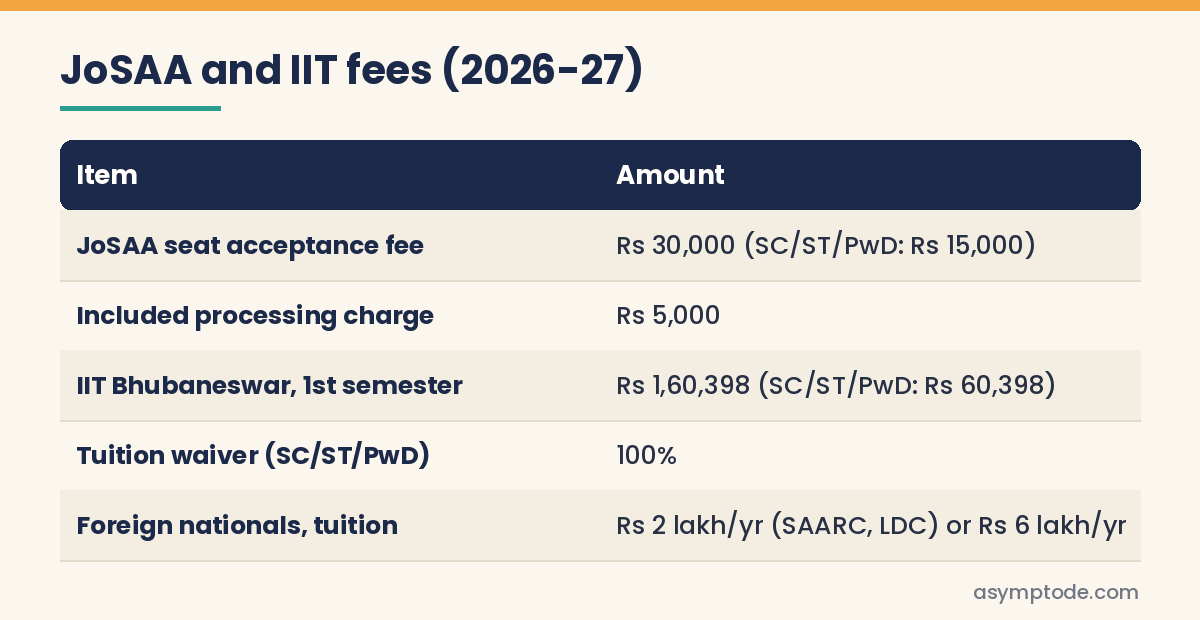
The table shows the JoSAA seat acceptance fee of Rs 30,000, or Rs 15,000 for SC, ST and PwD. It shows the IIT Bhubaneswar first semester total of Rs 1,60,398, or Rs 60,398 for SC, ST and PwD. SC, ST and PwD students get a 100% tuition waiver. Foreign nationals pay tuition of Rs 2 lakh or Rs 6 lakh per year.
| IIT Bhubaneswar, first (Autumn) semester 2026-27 | Amount |
|---|---|
| Institute fee (GEN/OBC-NCL/GEN-EWS) | Rs 1,32,898 |
| Hostel mess advance | Rs 27,500 |
| Total (GEN/OBC-NCL/GEN-EWS) | Rs 1,60,398 |
| Total (SC/ST/PwD) | Rs 60,398 |
Foreign-national tuition is Rs 2.0 lakh per year (SAARC and least developed countries) or Rs 6.0 lakh per year (others), plus other charges.
Can NRI, OCI and foreign students get into IIT?
Yes. The rules depend on your nationality and, for OCI/PIO card holders, your card date.
What is the foreign tag in JoSAA?
The foreign tag is for candidates who are not Indian nationals, and for OCI/PIO (F) candidates. Here is what it means:
- You are eligible for IITs and IISc only.
- Your seats are supernumerary, up to 10% of seats in each programme.
- You get no reservation benefits.
- You must be in the Common Rank List and meet the GEN eligibility rules.
- You get a seat if your rank is equal to or better than the OPEN gender-neutral closing rank.
Foreign-tag candidates are not eligible for NITs and similar institutes through JoSAA. They use a different scheme called DASA.
Is an OCI card holder treated as Indian or foreign?
It depends on when the card was issued. Under the JEE Advanced rule, an OCI/PIO card issued on or after 4 March 2021 means you are treated as a foreign (F) candidate. Cards issued before that are treated as Indian (OCI/PIO (I)). Check your card date early, because it changes which seats you can get.
Are there IIT campuses outside India?
Yes, with their own routes. Check the official pages.
- IIT Delhi-Abu Dhabi admits B.Tech students through CAET (its own test in Physics, Chemistry and Maths) or through JEE Advanced. CAET 2026 had four sessions: 23 Nov 2025, 8 Feb, 7 Jun and 12 Jul 2026. The best of up to two attempts counts. See IIT Delhi-Abu Dhabi undergraduate programs.
- IIT Madras Zanzibar admits through its own screening test and an interview. See IIT Madras Zanzibar admission.
If you are also looking at colleges abroad, our guide on how to get into MIT covers a very different process.
How should you prepare for IIT from Class 9?
Start early, with the basics.
- Class 9-10: build the base. Master your NCERT maths and science. Get fast and clean with algebra and arithmetic. Olympiads like the NSEs are optional, but they train you to think.
- Class 11: cover the full JEE syllabus. Keep pace with the JEE syllabus, not just school. Topics like projectile motion and the mole concept come up again and again. Start timed mock tests.
- Class 12: balance boards and JEE. Aim for 75% in boards (or the top 20 percentile). Write JEE Main Session 1 in January and Session 2 in April. Then JEE Advanced in May and JoSAA in June.
What does a JEE-style warm-up look like?
JEE rewards clear steps, not tricks. Try this one: how many three-digit numbers are divisible by 7?
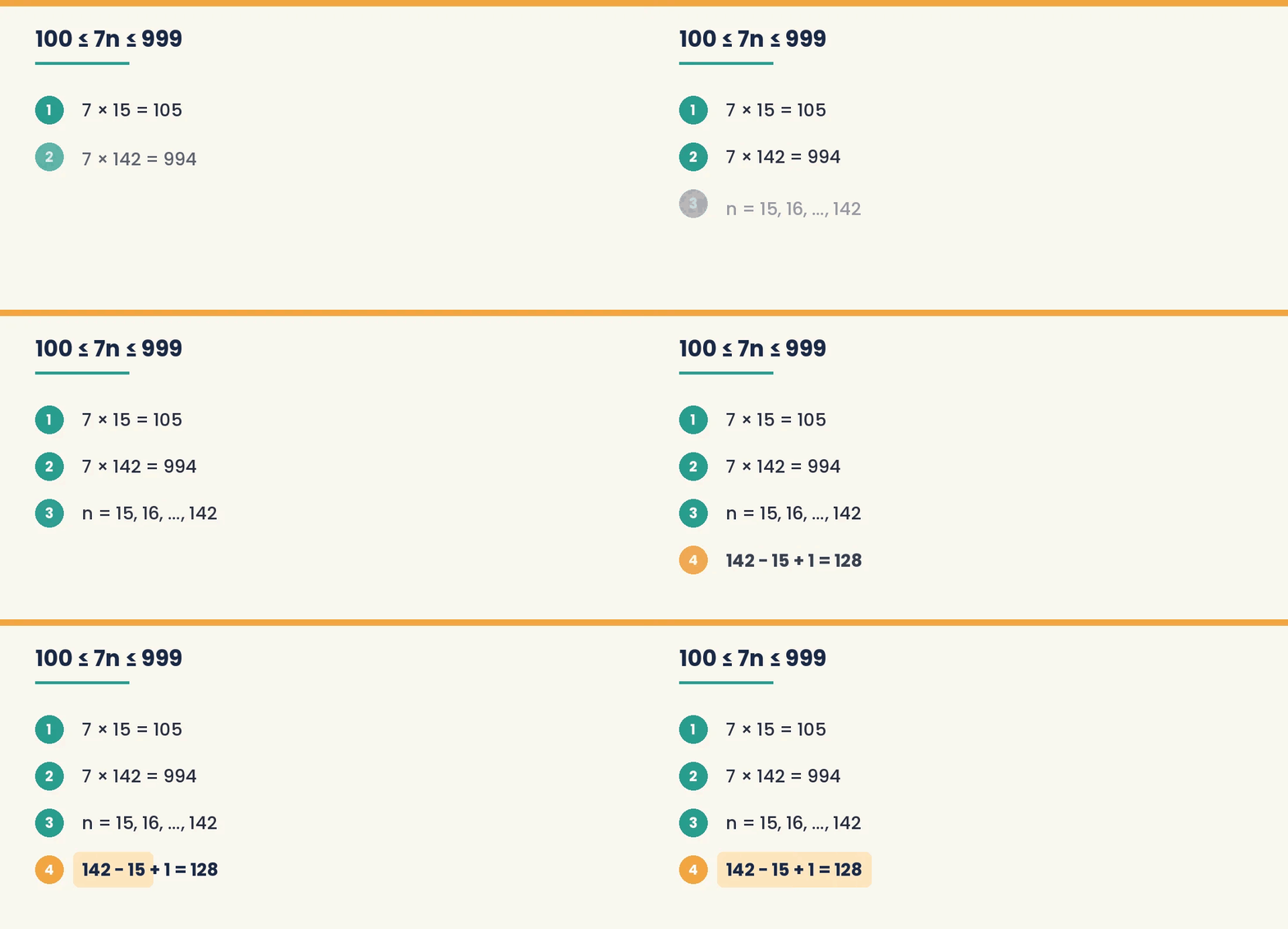
The animation writes 100 ≤ 7n ≤ 999. The smallest three-digit multiple is 7 × 15 = 105. The largest is 7 × 142 = 994. So n runs from 15 to 142. The count is 142 − 15 + 1 = 128. There are 128 three-digit numbers divisible by 7.
Notice the "+ 1" at the end. Forget it, and a wrong answer costs you 5 marks: the 4 you missed plus the 1 taken away.
Should you also try other exams?
Yes. Your JEE Main rank alone can open NIT, IIIT and GFTI seats through JoSAA. BITSAT is another option. See our BITSAT 2027 guide.
What are the most common mistakes students make?
- Ignoring the 75% board rule. A great JEE rank cannot save you if you miss it.
- Missing the JoSAA fee deadline. If you do not pay the seat acceptance fee, the seat is rejected.
- Picking the wrong option. Choosing Freeze when you wanted Float, or the other way round, can lock you out of a better branch.
- Not checking the OCI card date. A card issued on or after 4 March 2021 makes you a foreign (F) candidate.
- Planning for only one attempt. You get two attempts in consecutive years. Plan for both.
How 1-on-1 tutoring helps with getting into IIT
At Asymptode, we help students prepare for the maths and science side of JEE, and we help with planning the rest.
- One dedicated mentor, live online 1-on-1. Your mentor follows your own syllabus and your own exam dates, from boards to JEE Main and JEE Advanced.
- Method first. Your mentor watches each step of your working, so slips like the "+ 1" error get caught early.
- Personalised homework with feedback. Practice is set for your weak topics, and every answer gets feedback. Parents get short updates.
- Every class recorded, and a free demo class. You can rewatch any lesson. For forms, dates and JoSAA choices, your mentor helps with planning and method, while the official pages stay the final word.
Facts checked against official sources on 28 October 2026.
FAQ
What is the first step to get into IIT?
The first step is JEE Main Paper 1. Registration for Session 1 of JEE Main 2027 runs from 24 October to 22 November 2026. You need a place in the top 2,50,000 to register for JEE Advanced.
Is JEE Main enough to get into IIT?
No. JEE Main only lets you register for JEE Advanced. IIT and IISc seats are given on your JEE Advanced rank. JEE Main ranks are used for NITs, IIITs and other GFTIs.
Can I get into IIT with less than 75% in Class 12?
Yes, if you are in the top 20 percentile of your board. Otherwise you need 75% (65% for SC, ST and PwD). These are the 2026 rules, so check jeeadv.ac.in for 2027.
When is JEE Advanced 2027?
The date and organising IIT are not yet announced as of 28 October 2026. The exam is usually held in mid or late May. In 2026 it was on 17 May.
Can foreign students and OCI card holders apply to IIT?
Yes. Foreign nationals and OCI/PIO (F) candidates compete for supernumerary seats, up to 10% per programme, at IITs and IISc only. An OCI/PIO card issued on or after 4 March 2021 means you are treated as foreign. Foreign-tag candidates use DASA, not JoSAA, for NITs.
What happens if I do not pay the JoSAA seat acceptance fee?
Your seat is rejected. The fee is Rs 30,000, or Rs 15,000 for SC, ST and PwD candidates. It includes a Rs 5,000 processing charge, and the rest is adjusted against your admission fee.
Ready to start? Book a free demo class and advisor call, or see our plans and fees.