If you want to know how to become a scientist, the short path is: strong maths and science in school, a science bachelor's degree, then research training, usually a master's and a PhD. The details change by country, but the habits that matter start early. This guide is for school students and parents in the USA, UK, India, Canada, Australia and beyond.
Key takeaways
- Most research scientists finish a PhD. Some science jobs start after a bachelor's or master's degree.
- In school, take maths every year, plus at least two of physics, chemistry and biology. Add computing if you can.
- The route differs by country. The USA often goes bachelor's to PhD. The UK has short degrees. India has 5-year BS-MS and Integrated MSc programmes through IAT and NEST.
- You can start real research before university: science fairs, olympiads, summer programmes and citizen science.
- Curiosity, careful notes, writing and resilience matter as much as top marks.
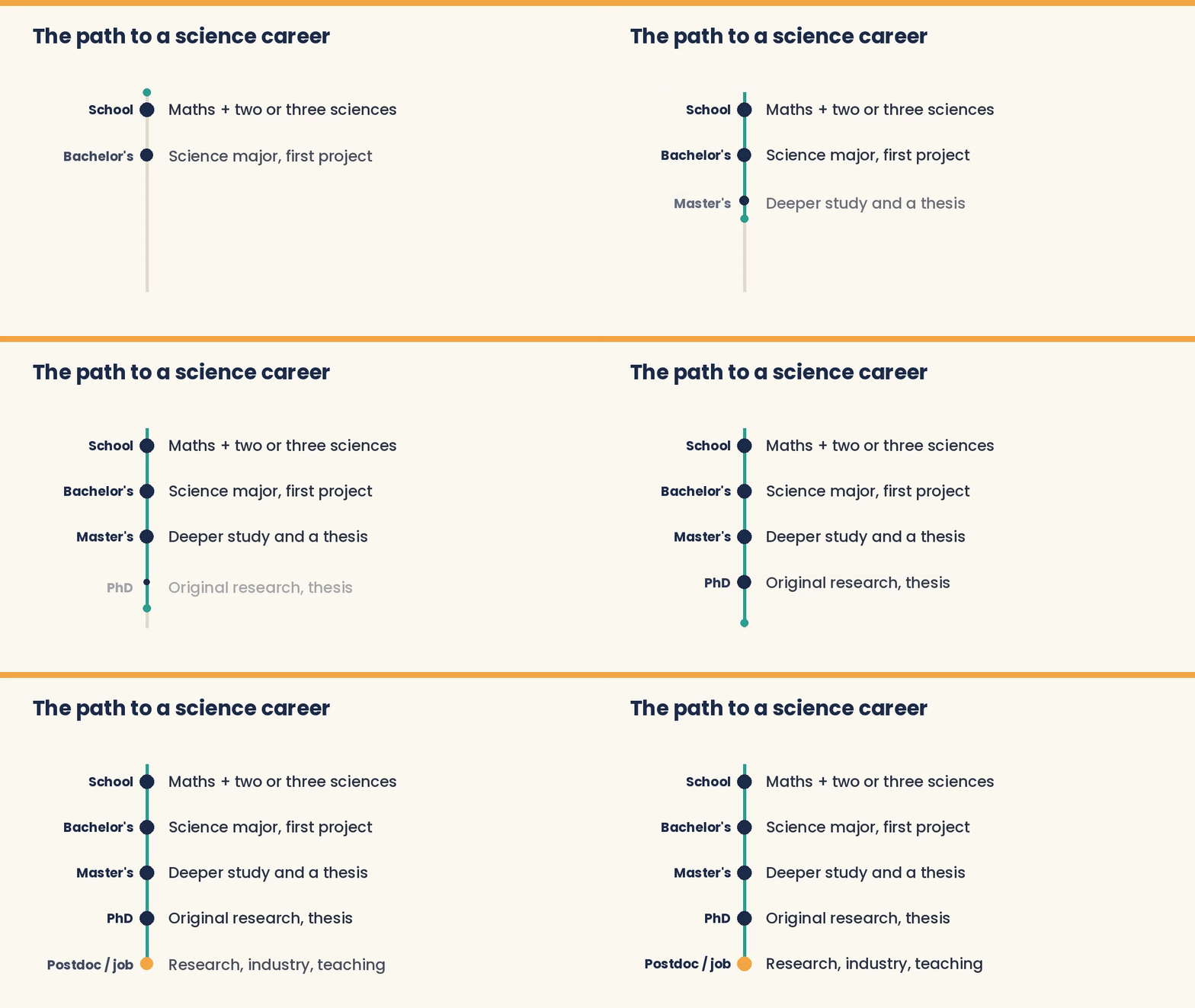
- School (Grades 9-12): Maths plus two or three sciences.
- Bachelor's degree: Major in one science. Try a research project.
- Master's degree: Deeper study and a thesis. Optional in some countries.
- PhD: Several years of original research. You write a thesis.
- Postdoc or job: Research posts, industry labs, government or teaching.
How do you become a scientist?
Quick answer: To become a scientist, study maths and at least two sciences in school, then earn a bachelor's degree in a science subject. Most research scientists then complete a PhD, often after a master's. Many also do a postdoc. Start early with projects, science fairs or olympiads. They show you what research really feels like.
Think of it as a ladder. Each step trains you to ask better questions and test them more carefully. You do not need to be a genius. You need to be curious, patient and willing to be wrong many times.
What does a scientist actually do?
A scientist asks a question about how the world works. Then they design a careful way to test it, collect data, and share what they found so others can check it. Most of the job is planning, measuring, coding, reading, writing and fixing things that did not work.
Scientists work in universities, government labs, hospitals, companies and field sites. Some spend all day at a computer. Others are in a lab, on a ship or on a mountain.
What are the main types of scientists?
| Field | What they study | Example work |
|---|---|---|
| Physics | Matter, energy, forces, space | Lasers, particle detectors, astronomy |
| Chemistry | Substances and reactions | New materials, medicines, batteries |
| Biology | Living things | Genetics, ecology, disease research |
| Earth and environmental science | Rocks, oceans, air, climate | Earthquakes, weather, water supply |
| Data and computational science | Patterns in large data sets | Models, simulations, machine learning |
| Mathematics | Structure, proof, number | Cryptography, modelling, theory |
| Interdisciplinary | Mixes of the above | Biophysics, neuroscience, materials |
You do not have to choose your field at 14. Many scientists switch fields during their degree or PhD. A strong maths base makes switching much easier.
Which school subjects should you take to become a scientist?
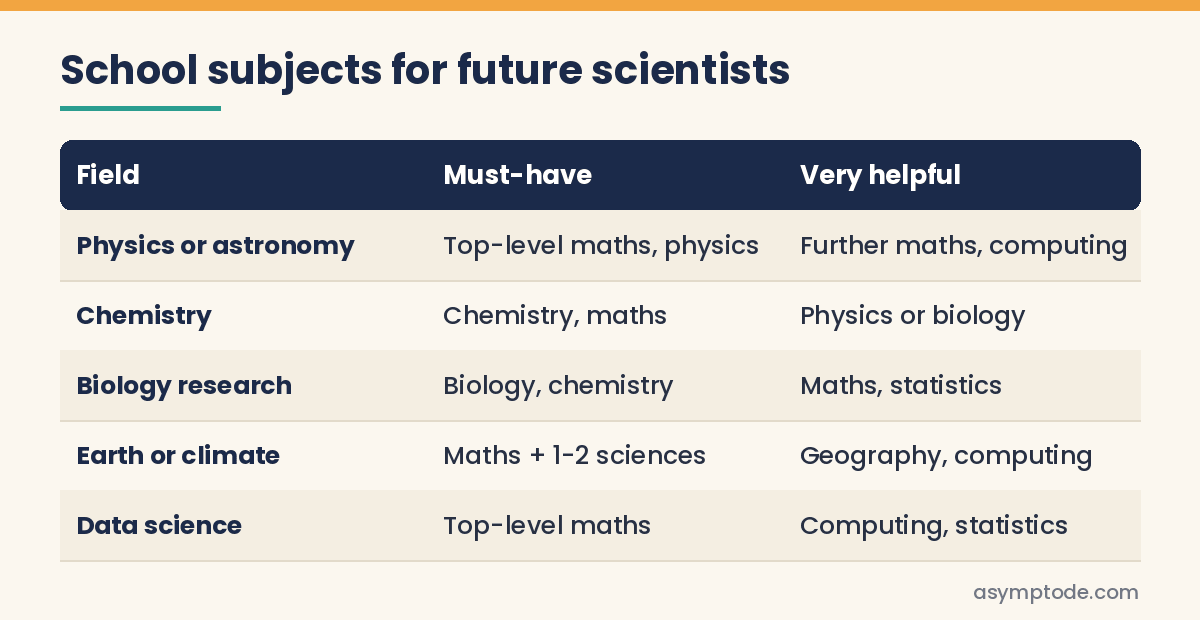
Take maths every year. Then take at least two of physics, chemistry and biology. Computing or computer science is a big plus, because almost every field now uses code.
| If you are drawn to... | Must-have subjects | Very helpful |
|---|---|---|
| Physics or astronomy | Maths (highest level), physics | Further maths, computing |
| Chemistry | Chemistry, maths | Physics or biology |
| Biology or medical research | Biology, chemistry | Maths, statistics |
| Earth or climate science | Maths, one or two sciences | Geography, computing |
| Data science | Maths (highest level) | Computing, statistics |
What this looks like in different systems:
- USA: Take the most advanced maths your school offers, plus physics, chemistry and biology. AP courses such as AP Physics 1, AP Chemistry and AP Biology show readiness. See our AP guide for parents.
- UK: A-level Maths plus one or two sciences is the usual base. Further Maths helps for physics and maths degrees. Read our A-level Maths and A-level Physics guides.
- India: Choose the science stream (PCM, PCB or PCMB) in Classes 11-12. IAT and NEST both ask for at least three of physics, chemistry, maths and biology in Class 12.
- IB: Choose Maths AA (or AI for some life sciences) plus sciences at Higher Level. Our Maths AA vs AI guide explains the choice.
Always check the entry rules of the universities you like. They set the final requirements.
What is the degree path to become a scientist?
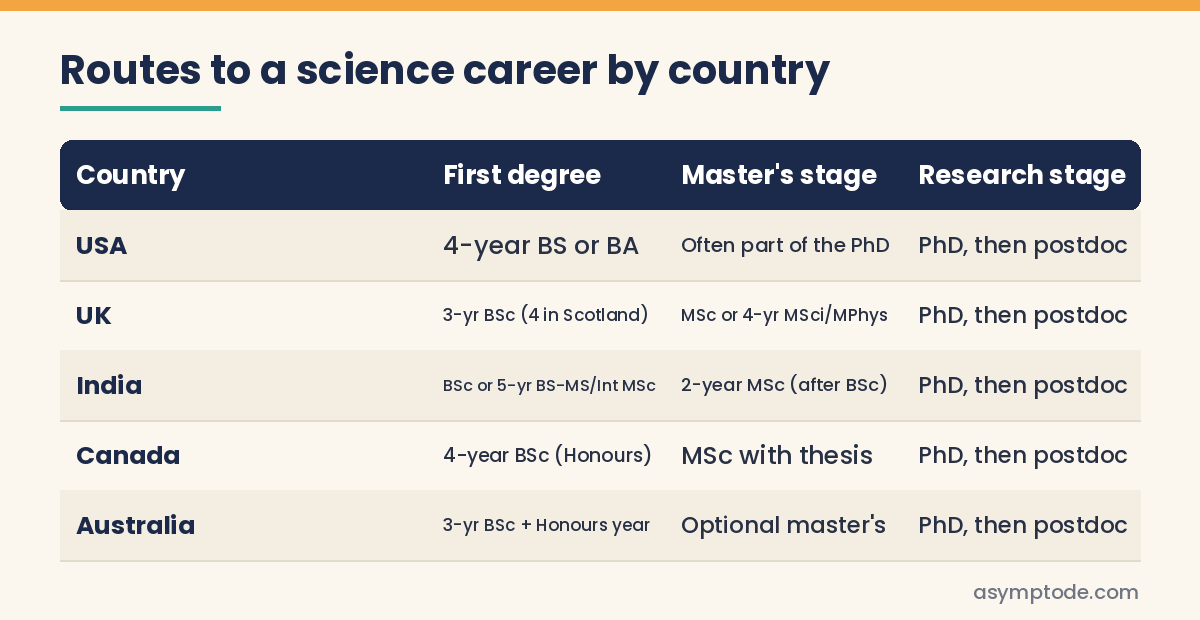
The usual order is bachelor's, then master's, then PhD, then a postdoc or job. But the length and shape of each step changes by country.
| Country | First degree | Master's stage | Research stage |
|---|---|---|---|
| USA | 4-year BS or BA | Often part of the PhD | PhD, then postdoc |
| UK | 3-year BSc (4 in Scotland) | MSc, or 4-year MSci/MPhys | PhD, then postdoc |
| India | BSc, or 5-year BS-MS / Int. MSc | 2-year MSc (if BSc) | PhD, then postdoc |
| Canada | 4-year BSc (Honours) | MSc with thesis | PhD, then postdoc |
| Australia | 3-year BSc + Honours year | Optional master's | PhD, then postdoc |
How does the path work in the USA?
Students usually do a four-year bachelor's degree with a science major. Many go straight from the bachelor's into a PhD programme. A master's is often earned along the way. Undergraduate research in a professor's lab is very common and highly valued for PhD applications.
The US Bureau of Labor Statistics says it plainly for one field. Its Occupational Outlook Handbook page on physicists and astronomers states: "Physicists and astronomers typically need a Ph.D. for jobs in research and academia." It also notes that "entry-level physicist jobs in the federal government typically require a bachelor's degree in physics." Other science fields have their own pages in the same handbook.
How does the path work in the UK?
Most English, Welsh and Northern Irish bachelor's degrees take three years. In Scotland they usually take four. Many science departments also offer a four-year integrated master's, such as an MPhys, MChem or MSci. After that, students apply for a PhD. Funded PhD places are often called studentships. Undergraduate applications go through UCAS.
How does the path work in India?
India has special routes for students who want research careers from day one.
- IISERs through IAT: The seven Indian Institutes of Science Education and Research (Berhampur, Bhopal, Kolkata, Mohali, Pune, Thiruvananthapuram and Tirupati) offer a 5-year BS-MS dual degree. Admission is through the IISER Aptitude Test (IAT). The KVPY and JEE Advanced channels into IISERs no longer exist. IAT 2026 was held on 7 June 2026 (as reported by Careers360). IAT 2027 is usually held in May or June; official dates not yet announced. Check the official IISER admissions site.
- NISER and UM-DAE CEBS through NEST: The NEST 2026 brochure lists a 5-year Integrated MSc in biology, chemistry, maths and physics. It is residential and comes with a stipend. NEST 2026 was held on 6 June 2026. NEST 2027 is usually held in June; official dates not yet announced. See nestexam.in.
- KVPY is over: The KVPY aptitude test was discontinued by the Department of Science and Technology in 2022, as reported by The Wire. Older guides that tell you to "prepare for KVPY" are out of date.
- INSPIRE scholarship: The DST's INSPIRE-SHE scholarship supports students in natural and basic science degrees (BSc, BS, BS-MS, Integrated MSc). Under the 2024 call, eligibility included being in the top 1% of your Class 12 board, or holding certain ranks such as a JEE or NEET rank within the top 10,000. Rules can change each year, so check online-inspire.gov.in.
- Regular BSc route: You can also do a BSc at a good college, then an MSc, then a PhD. Many strong scientists took this path.
What about Canada and Australia?
In Canada, a four-year BSc, often with an Honours thesis, is the usual start. Students then do a research MSc and a PhD. In Australia, a three-year BSc is often followed by a one-year Honours research year. Honours is a common way into a PhD.
Not sure which subjects or exams fit your child's plan? Book a free demo class and talk it through with an Asymptode advisor, or see our fees.
How can a school student start doing research?
You can start real research before university. You do not need a fancy lab. You need a good question, a simple method and someone to give you feedback.
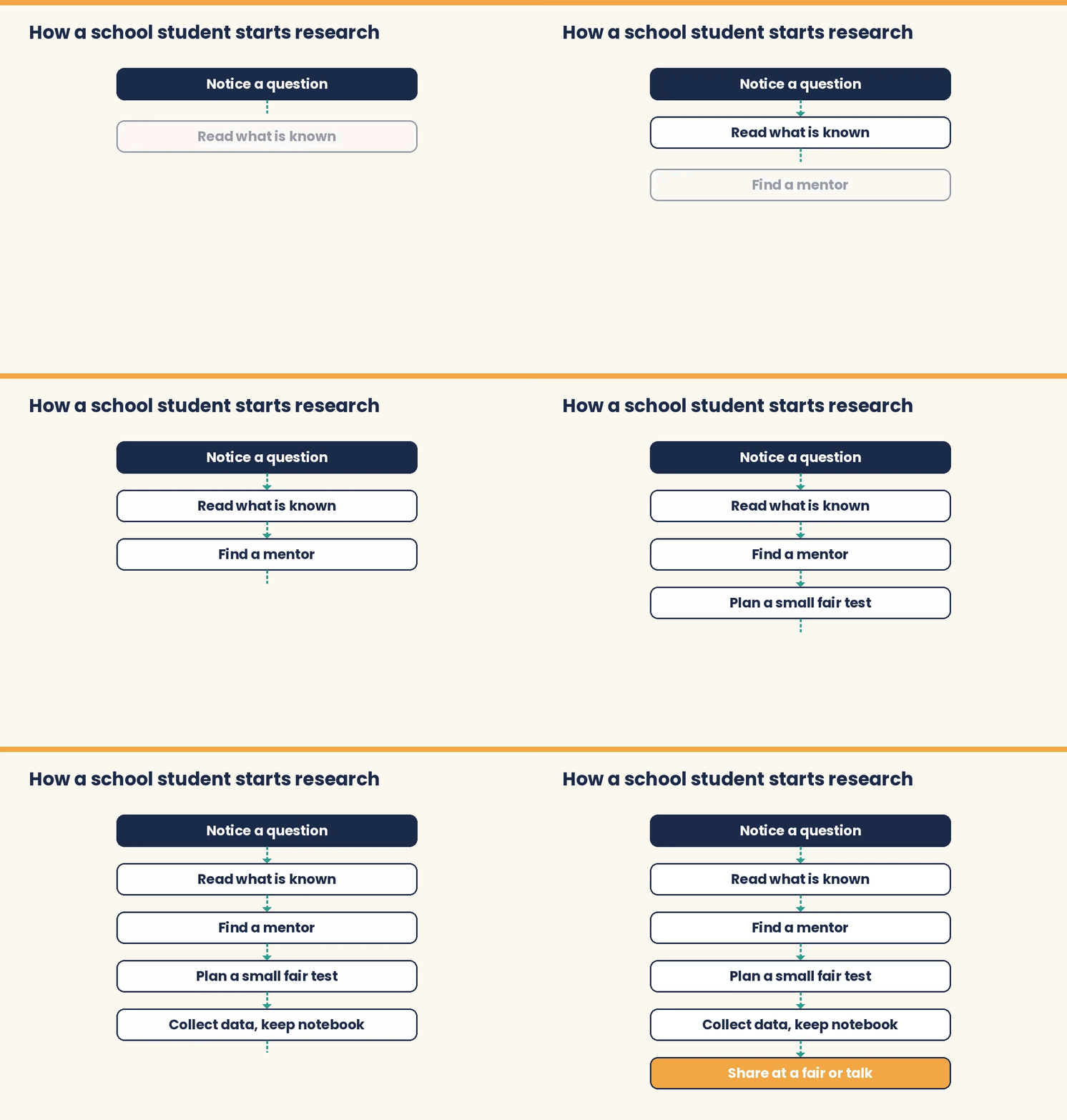
- Notice a question you care about, at home, at school or outside.
- Read what is already known in books, articles and review papers.
- Find a mentor, such as a teacher, local professor or club leader.
- Plan a small, fair test with one changing variable and a control.
- Collect data and keep a lab notebook with dates and mistakes.
- Share it at a science fair, competition or school talk.
Which science fairs and competitions are worth it?
- Regeneron ISEF: The International Science and Engineering Fair, run by Society for Science. Affiliated fairs involve more than 60 countries, regions and territories. You qualify by winning at a Society-affiliated local, regional, state or national fair. Regeneron ISEF 2027 is planned for Los Angeles in May 2027, per Society for Science.
- National fairs: Many countries have their own, such as the Canada-Wide Science Fair run by Youth Science Canada.
- Olympiads: These test deep problem solving. In India, the HBCSE National Olympiad Programme has five stages. Stage I (the National Standard Examinations in physics, chemistry, biology and astronomy) is run by IAPT. For the 2026-27 cycle, it is scheduled for 21-22 November 2026, and enrolment has closed. In the USA and UK, national olympiads feed into international ones such as the International Mathematical Olympiad. Younger students can start with contests like the AMC 8 or Canada's CEMC contests.
What summer research programmes are real?
- Research Science Institute (RSI): A six-week summer programme hosted at MIT by the Center for Excellence in Education (CEE). Students do research with a mentor. US applicants usually apply in the middle of Grade 11; seniors cannot apply. The RSI 2027 deadline is 11:59 pm on 11 December 2026, per CEE. International students apply through their country's own selection process, so contact RSI first.
- University outreach programmes: Many universities run school summer schools. Check the outreach page of universities near you. Only trust programmes listed on a university's own website.
Be careful with paid "research" programmes that promise a published paper. A real mentor will never guarantee a result.
How do you read a science paper as a teenager?
Start with the abstract and the figures. Then read the introduction and the conclusion. Skip the hard methods on your first read. Write down every word you do not know and look it up. Review articles and science news written for the public are good first steps.
What is citizen science?
Citizen science lets anyone help real research projects online. On Zooniverse, volunteers classify galaxies, animals and old records for working scientists. NASA also lists projects on its citizen science page. It is free, and it shows you how real data looks.
What skills do you need to become a scientist?
- Maths: Algebra, graphs, statistics and, later, calculus. Every science uses them.
- Experimental skills: Planning fair tests, measuring carefully, spotting errors.
- Coding: Python or R for data. Start with small projects.
- Writing and speaking: Science only counts if you can explain it.
- Reading: Understanding papers and checking sources.
- Resilience: Most experiments fail at first. Good scientists learn from that.
- Teamwork: Modern science is done in teams, often across countries.
What is the job outlook for scientists?
The honest answer: it depends on the field, the country and the degree level. Some areas grow fast. Others have more PhD graduates than permanent university jobs. That is why many scientists work in industry, government, healthcare, data and teaching, not only universities.
For one official example, the US BLS handbook states: "Overall employment of physicists and astronomers is projected to grow 7 percent from 2025 to 2035," which it calls "much faster than the average for all occupations." That figure is for the USA and for that field only. Check your own country's official career data before you decide.
We do not quote salary numbers here. Pay varies hugely by country, sector and stage. Use official sources such as the BLS handbook, and talk to working scientists.
What is a good Grade 9-12 action plan?
| Grade | Main focus | Research and extras |
|---|---|---|
| Grade 9 | Strong maths habits, all three sciences | Science club, one citizen science project |
| Grade 10 | Choose next subjects carefully | First science fair project, a starter olympiad |
| Grade 11 | Advanced maths and sciences | Bigger project with a mentor; RSI if eligible |
| Grade 12 | Exams and applications | Present your work; apply to IAT/NEST/UCAS etc. |
Week by week, the plan is simple:
- Do maths practice four or five days a week, even 30 minutes.
- Keep one "question notebook" for ideas you want to test.
- Read one science article each week and summarise it in five lines.
- Learn a little code each month.
- Ask one teacher or scientist for feedback each term.
What are the common mistakes?
- Dropping maths too early. It closes more doors than any other choice.
- Chasing certificates, not understanding. Judges and professors can tell.
- Following outdated advice. For example, KVPY no longer exists.
- Paying for "guaranteed publication" schemes. Real research has no guarantees.
- Waiting for the "perfect" project. Start small and improve.
- Ignoring writing. A great result explained badly gets little attention.
- Thinking a PhD is the only win. Many science careers start after a bachelor's or master's.
How 1-on-1 tutoring helps with becoming a scientist
At Asymptode, every student works with one dedicated mentor in live 1-on-1 online sessions. We teach maths, physics, chemistry and biology, the subjects every future scientist needs.
- Your syllabus, your dates: We follow the student's own syllabus, whether AP, A-level, IB, IGCSE, CBSE or another board, and plan around their exam dates.
- Method first: The mentor watches each step of the working and fixes the method, not just the final answer. This is exactly the habit research needs.
- Personalised homework with feedback, so weak spots get fixed early.
- Short parent updates, so families know what is improving.
- Every class recorded for revision before tests.
- Flexible times across time zones.
For science fairs and research projects, a mentor can help with the maths and science behind the project, such as statistics, graphs and checking reasoning. The project and ideas must stay the student's own. Wondering how much support is right? Read how many hours of maths tutoring per week and how to choose an online maths tutor.
Facts checked against official sources on 25 October 2026.
FAQ
How many years does it take to become a scientist?
It depends on the country and the route. Add up a 3- or 4-year bachelor's (or a 5-year BS-MS in India), any master's, and a PhD of several years. A postdoc adds more. Some science jobs start right after a bachelor's degree.
Do I need a PhD to be a scientist?
For independent research and university jobs, usually yes. The US BLS says physicists and astronomers "typically need a Ph.D. for jobs in research and academia." Many lab, data and government science jobs accept a bachelor's or master's.
Can I become a scientist if I am not top of my class?
Yes. Steady work, curiosity and good research habits matter a lot. Strong maths helps, so work on weak spots early.
Is KVPY still available in India?
No. The KVPY aptitude test was discontinued in 2022. IISERs now admit students through IAT, and NISER and UM-DAE CEBS through NEST.
Which olympiad should I start with?
Start with the one that matches your favourite subject and your country's official programme. In India, that is the HBCSE programme, starting with the NSEs. Maths contests like the AMC 8 are a friendly first step.
When should I start research as a school student?
Any time from Grade 9. Begin with citizen science or a small science fair project. Aim for a bigger mentored project in Grade 10 or 11.
Ready to build the maths and science base for a research career? Book a free demo class with an Asymptode mentor, or see our fees.
Sources
- BLS Occupational Outlook Handbook: Physicists and Astronomers
- IISER Admissions (IAT)
- NEST 2026 Information Brochure
- INSPIRE Scholarship (DST)
- HBCSE National Olympiad Programme 2026-27 Brochure
- Regeneron ISEF - Society for Science
- Research Science Institute - Apply (CEE)
- RSI at MIT Mathematics
- UCAS
- Zooniverse
- NASA Citizen Science