

The AMC 8 is the best-known maths contest for middle school students in the USA and Canada. It is short, it is fun, and it rewards clear thinking more than speed with sums. This guide explains the format, the 2027 dates, what is tested and a calm 8-week way to prepare.
Key takeaways
- The AMC 8 has 25 multiple-choice questions in 40 minutes. No calculator is allowed.
- It is for students in Grade 8 and below who are under 15.5 years old on the day of the contest.
- The 2027 AMC 8 takes place on one day chosen by each school between January 21 and 27, 2027.
- Students do not sign up with the MAA themselves. A school or registered site enters them, and school deadlines start in late October.
- Good prep is about problem solving, not more worksheets. Steady practice with past problems works best.
What is the AMC 8?
Quick answer: The AMC 8 is a 40-minute, 25-question multiple-choice maths contest run by the Mathematical Association of America (MAA). It is for students in Grade 8 and below. The questions use middle school maths, but they ask students to think in new ways. It is the first step in the AMC series that leads on to the AMC 10, AMC 12 and AIME.
The MAA calls it the leading maths competition for middle school students in the USA. Many strong students take it every year from Grade 5 or 6. The early questions are friendly. The later ones are real puzzles that even top students find hard.
The score is not a school grade, and it does not go on a report card. That is part of its value. Students can try hard problems with low stakes, and they learn what it feels like to be stuck and then find a way in.
AMC 8 format at a glance
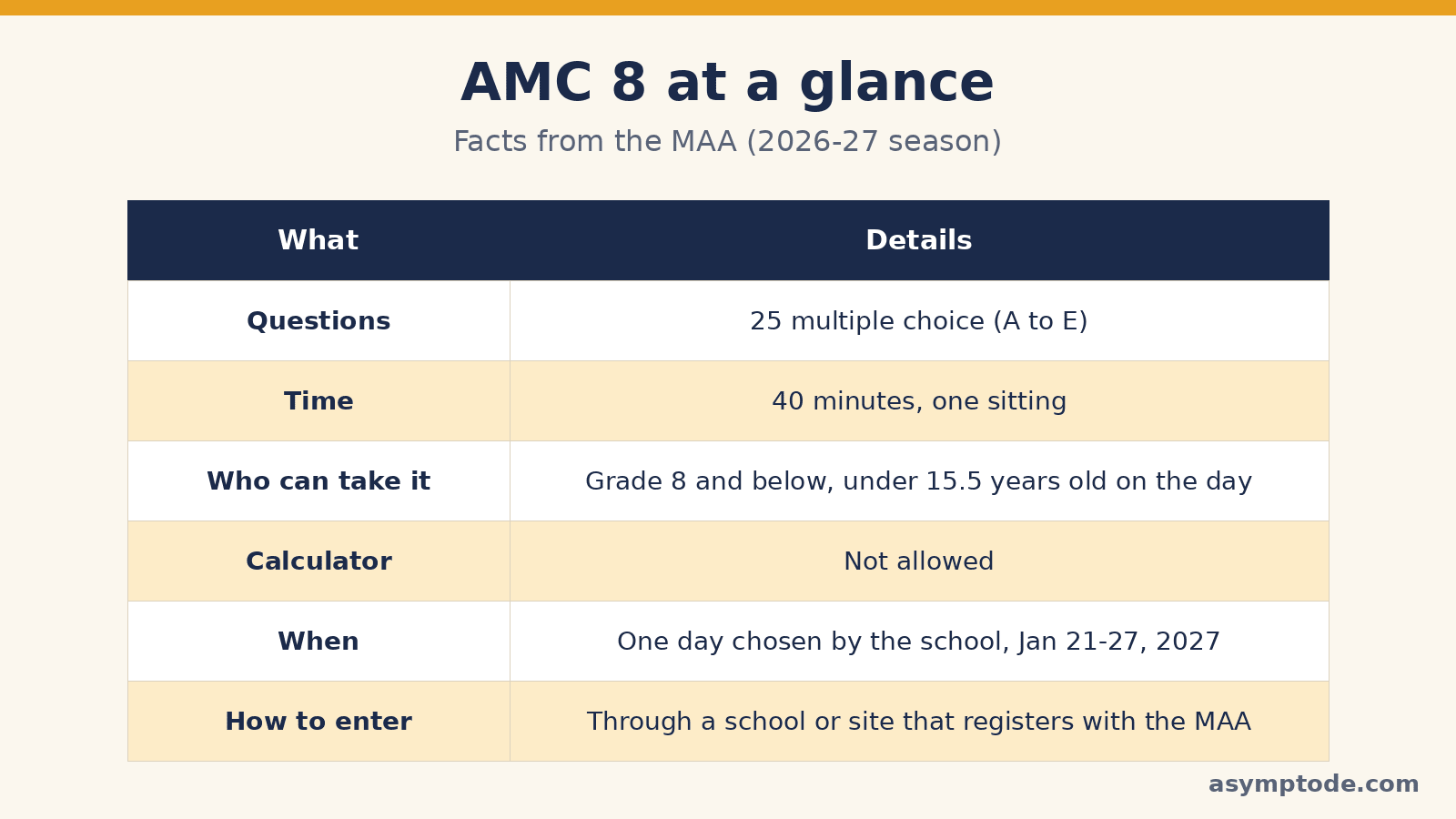
| What | Details |
|---|---|
| Questions | 25 multiple choice, answers A to E |
| Time | 40 minutes, one sitting |
| Who can take it | Grade 8 and below, under 15.5 years old on contest day |
| Calculator | Not allowed |
| 2027 date | One day chosen by the school, January 21-27, 2027 |
| How often | Once per year |
| How to enter | Through a school or site that registers with the MAA |
Each correct answer earns one point, so the top score is 25. The questions get harder as the numbers go up. A student who answers the first 15 questions carefully and correctly is doing very well.
When is the AMC 8 in 2027, and how do you register?
Quick answer: The 2027 AMC 8 runs from January 21 to 27, 2027. Each school picks one day in that week. Schools, not parents, register with the MAA. School registration deadlines start in late October 2026, so ask your child's maths teacher now.
Here is what parents should do:
- Ask the school first. Many middle schools run the AMC 8. Ask the maths department if they plan to offer it and when their internal sign-up closes.
- If the school does not offer it, ask whether a teacher could register the school, or look for a nearby school, maths circle or learning centre that hosts it.
- Mark the date. Once the school picks its day in the January window, add it to your calendar and plan a quiet evening before.
Students in Canada can take the AMC 8 through schools or sites registered with the MAA, under the same rules as US students. Families in other countries should ask their school, because the MAA licenses its contests through partners outside North America.
What topics are on the AMC 8?
Quick answer: The AMC 8 tests middle school maths: counting and probability, number sense, ratios and percent, geometry (including the Pythagorean theorem), spatial thinking and reading graphs and tables. Later questions can use early algebra and coordinate geometry. The topics are familiar. The thinking is not.
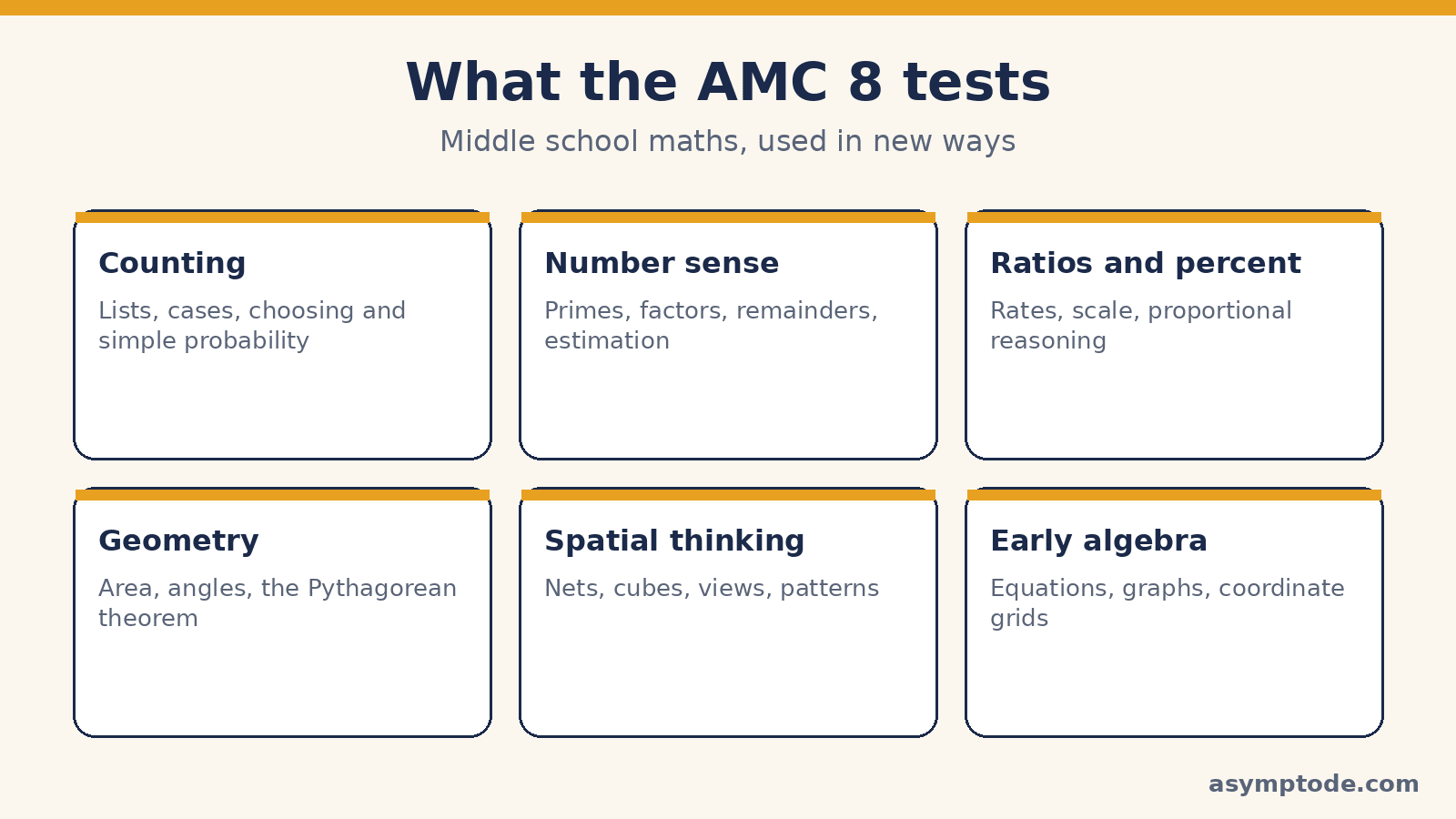
The MAA describes the content as middle school topics such as estimation, proportional reasoning, elementary geometry, spatial visualisation and graphs. In practice, the topics that trip students up most are:
- Counting: listing cases without missing or double-counting any.
- Number theory: primes, factors, multiples and remainders. Our guide to prime, composite and coprime numbers is a good warm-up.
- Geometry: areas of odd shapes, angle chasing and right triangles. See our visual proof of the Pythagorean theorem.
- Algebra: setting up an equation from words. If variables still feel shaky, start with understanding variables in Grades 7 and 8.
Worked AMC 8-style examples
These are original practice questions in the style of the contest. Work through each step before you read the answer.
Example 1: Counting with overlap
How many whole numbers from 1 to 99 are multiples of 3 or 5?
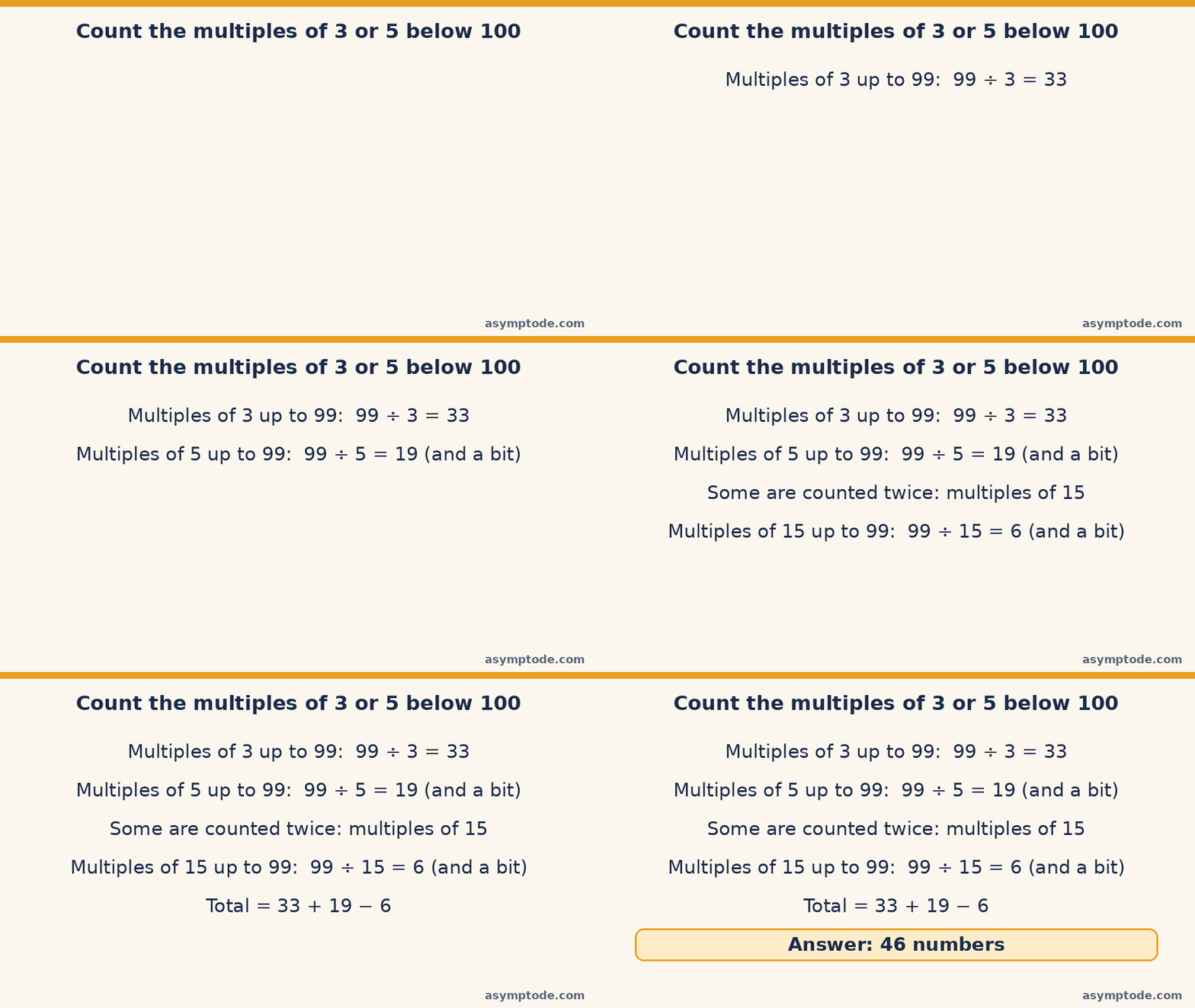
- Multiples of 3 up to 99: 99 ÷ 3 = 33, so there are 33.
- Multiples of 5 up to 99: 99 ÷ 5 = 19.8, so there are 19.
- Numbers like 15, 30 and 45 are multiples of both. They were counted twice.
- Multiples of 15 up to 99: 99 ÷ 15 = 6.6, so there are 6.
- Total = 33 + 19 − 6 = 46.
Lesson: when two groups overlap, add them and then take away the overlap once.
Example 2: Right triangles
A right triangle has legs of 6 cm and 8 cm. What is its perimeter?
- Use the Pythagorean theorem: hypotenuse² = 6² + 8² = 36 + 64 = 100.
- Hypotenuse = √100 = 10 cm.
- Perimeter = 6 + 8 + 10 = 24 cm.
Lesson: learn the common right triangles (3-4-5, 6-8-10, 5-12-13). They appear again and again and save time.
Example 3: Probability
Two fair dice are rolled. What is the probability that the total is 7?
- There are 6 × 6 = 36 equally likely results.
- Pairs that make 7: (1,6), (2,5), (3,4), (4,3), (5,2), (6,1). That is 6 pairs.
- Probability = 6/36 = 1/6.
Lesson: count the total outcomes first, then the ones you want. Order matters with two different dice.
How is the AMC 8 scored, and what is a good score?
Quick answer: Each correct answer is worth 1 point and the maximum is 25. A "good" score depends on age and experience. For a first-time Grade 6 student, solving the first 10 to 12 questions well is a strong start. Students aiming for national recognition need to solve most of the later problems too.
The MAA recognises top scorers with certificates and honour rolls. The cut-off scores change every year, so check the MAA website after results come out rather than chasing a fixed number. A better target is personal: beat last year's score, or solve one more of questions 16 to 25 than in your last practice paper.
How to prepare for the AMC 8: an 8-week plan
Quick answer: Start about 8 weeks before the contest with 2 to 3 hours a week. Take one timed past paper, sort the mistakes by topic, fix those topics, then practise the first 15 questions for accuracy and the last 10 for depth. Finish with two timed papers in the final week.
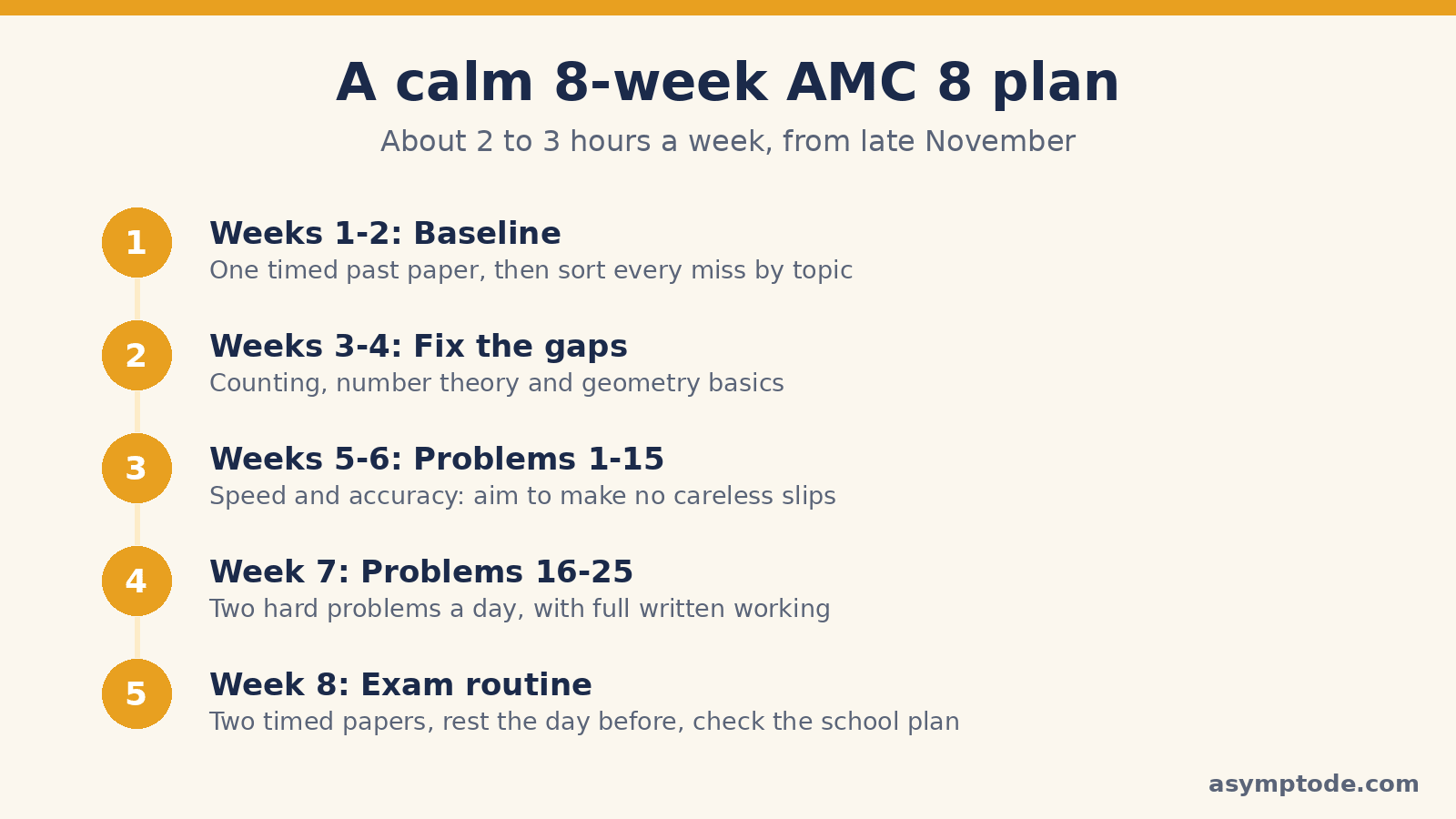
| Weeks | Focus | What to do |
|---|---|---|
| 1-2 | Baseline | One timed past paper. Sort every miss: careless, did not know, ran out of time. |
| 3-4 | Fix the gaps | Short lessons on the weakest topics, usually counting, number theory or geometry. |
| 5-6 | Questions 1-15 | Aim for zero careless errors. Check units and re-read the question. |
| 7 | Questions 16-25 | Two hard problems a day with full written working. Talk through the method. |
| 8 | Exam routine | Two timed papers. Rest the evening before. Know the school's time and room. |
Smart test-day habits
- Read every word. Many errors come from missing "not", "at least" or "different".
- Use the answer choices. Sometimes testing the choices is faster than solving from scratch.
- Draw a picture. For geometry and counting, a quick sketch often shows the answer.
- Do not get stuck. If a question takes more than 3 minutes, mark it and move on.
- Guess at the end. If time is almost up, a sensible guess is better than a blank.
Common AMC 8 mistakes (and how to avoid them)
| Mistake | Fix |
|---|---|
| Rushing the easy questions | Slow down on questions 1-10. They are worth the same as the hard ones. |
| Double-counting | Write the full list or use "add, then take away the overlap". |
| Only doing worksheets | Practise real contest problems that need more than one idea. |
| Giving up on hard problems | Try small cases, draw, or work backwards before stopping. |
| No review | Keep an error log and redo every missed problem a week later. |
How 1-on-1 tutoring helps with the AMC 8
Contest maths is very personal. One student needs help with counting. Another can solve anything but makes three silly slips. A group class cannot fix both at once.
At Asymptode, every class is live and 1-on-1 with the same mentor. For the AMC 8 this means:
- A short assessment first. The mentor sees which topics and habits cost marks, then plans to the contest date.
- Method, not just answers. The mentor watches each step of the working and fixes the thinking behind a mistake.
- Homework at the right level. Practice sets are chosen by the mentor for your child's level, so they are hard enough to stretch but not so hard they put your child off.
- Recordings for revision. Every class is recorded, so your child can replay a tricky solution before the contest.
- Clear updates for parents. You get short notes on what improved and what to practise next.
Contest practice also builds skills that pay off in school maths, the SAT and later the AMC 10 and 12. If you are not sure how much time to give it, read our guide to how many hours of maths tutoring per week make sense.
Want a plan for the AMC 8? Book a free demo class with an Asymptode advisor, or see our fees.
FAQ
Who can take the AMC 8?
Students in Grade 8 and below who are under 15.5 years old on the day of the contest. Younger students can take it too, but each school decides whether to let them.
When is the AMC 8 in 2027?
The 2027 AMC 8 is held between January 21 and 27, 2027. Each school chooses one day in that week. A student can take the AMC 8 only once a year.
Can you use a calculator on the AMC 8?
No. Calculators are not allowed. The numbers are chosen so that careful mental maths and written working are enough.
How do I register my child for the AMC 8?
Ask your child's school. Schools and other sites register with the MAA, and students sign up through them. School deadlines start in late October, so ask early.
What comes after the AMC 8?
Strong students move on to the AMC 10 (Grade 10 and below) and AMC 12. High scores on those can lead to the AIME and, for a very small group, the USA(J)MO.
Is the AMC 8 worth it if my child is not a "maths star"?
Yes. Early questions are open to any student who is secure in middle school maths. The contest builds problem-solving and resilience, and there is no penalty on the school record for a modest score.