

How many hours of math tutoring does your child need each week? For most students, one or two hours a week is a good start. The right number depends on the goal, the time left before a test, and how much practice happens between sessions.
Key takeaways
- 1 hour a week usually works to stay on track in class.
- 2 hours a week suits most students who need to fill gaps.
- 2 to 3 hours a week is common for SAT, ACT or AP prep.
- Short practice between sessions matters as much as session time.
- Review the plan every 4 weeks and adjust hours up or down.
How many hours of math tutoring per week is enough?
Quick answer: Most students do well with 1 to 2 hours of 1-on-1 math tutoring a week, split into one or two sessions. Students preparing for a big exam often use 2 to 3 hours. A short exam sprint may need 3 to 4 hours for a few weeks.
These are starting points, not rules. Every child learns at a different pace. The best plan is the smallest amount of time that still shows steady progress.
What does the goal change?
The goal is the biggest factor. Here is a simple guide we use when we talk with families:
| Goal | Hours a week | Typical length |
|---|---|---|
| Stay on track in class | 1 | Ongoing, through the school year |
| Fill learning gaps | 2 | About 8 to 12 weeks, then review |
| SAT, ACT or AP prep | 2 to 3 | About 8 to 12 weeks before the test |
| Exam sprint | 3 to 4 | 2 to 4 weeks, then reduce |
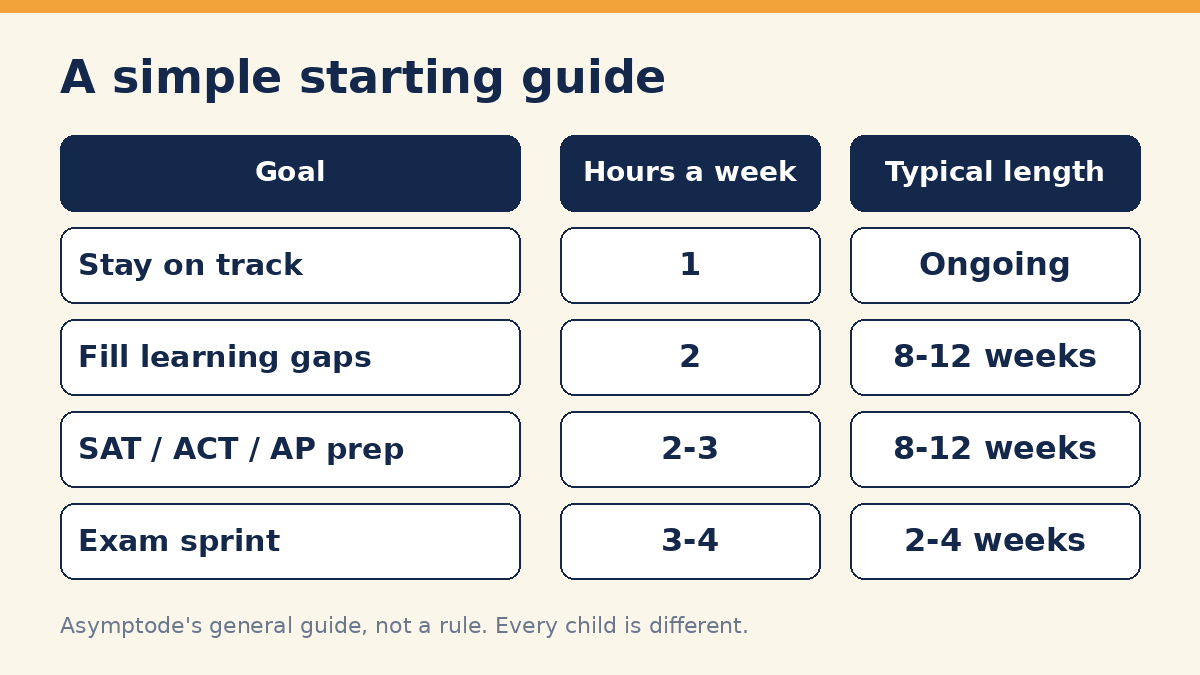
This is Asymptode's general guidance from planning lessons, not a research result. Your child's tutor should adjust it after the first few sessions.
Staying on track
If your child understands class but wants support, one hour a week is often enough. The session can preview the next topic, check homework and clear up small doubts before they grow.
Filling learning gaps
Math builds on itself. A gap in fractions can make algebra hard. A gap in algebra can make calculus hard. Two shorter sessions a week give time to go back, fix the gap, and then catch up with class.
Preparing for a test
For tests like the SAT, ACT or AP exams, students need content review plus timed practice. Two to three hours a week, over about two to three months, gives room for both.
Is one long session better than two short ones?
For most students, two shorter sessions are better than one long one. Here is why:
- Children focus better in 45 to 60 minute blocks.
- Seeing a topic twice in a week helps it stick.
- The tutor can check homework sooner and fix mistakes early.
One 60 to 90 minute session can still work for older students with busy schedules. The key is regular contact, not a single long block.
What should happen between sessions?
The hours with a tutor are only part of the plan. Short practice between sessions makes the learning last.
A simple pattern for a 2-session week:
- Monday: 60-minute session
- Tuesday and Wednesday: 15 minutes of practice each day
- Thursday: 60-minute session
- Friday: 15 minutes of practice
- Saturday: rest
- Sunday: 10-minute review of the week
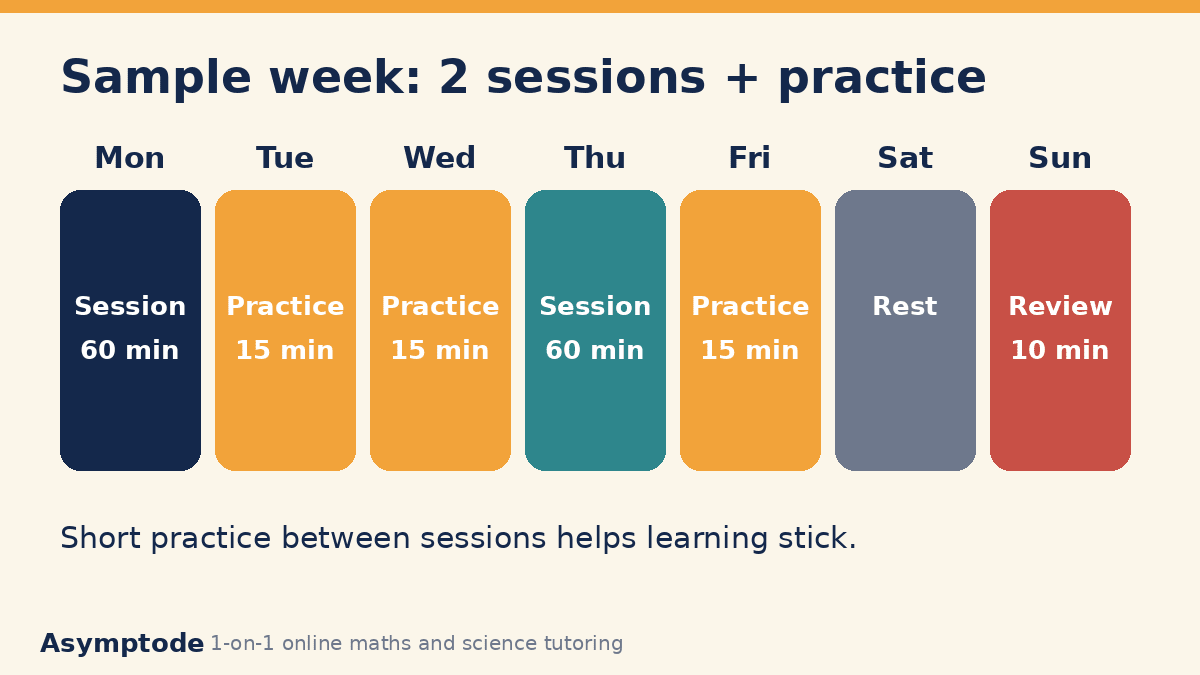
That adds up to about 2 hours of tutoring and under an hour of practice. It is a light load, but it is steady, and steady practice is what builds skill.
When should you add or reduce tutoring hours?
Watch for signs that the plan needs to change.
Consider adding time when:
- Grades keep slipping after a month of tutoring
- A big exam is less than a month away
- Homework takes far longer than it should
- The tutor finds gaps from past years
Consider reducing time when:
- Your child does homework alone with confidence
- Test scores have been steady for a while
- Your child is less anxious about math
- The original goal has been reached
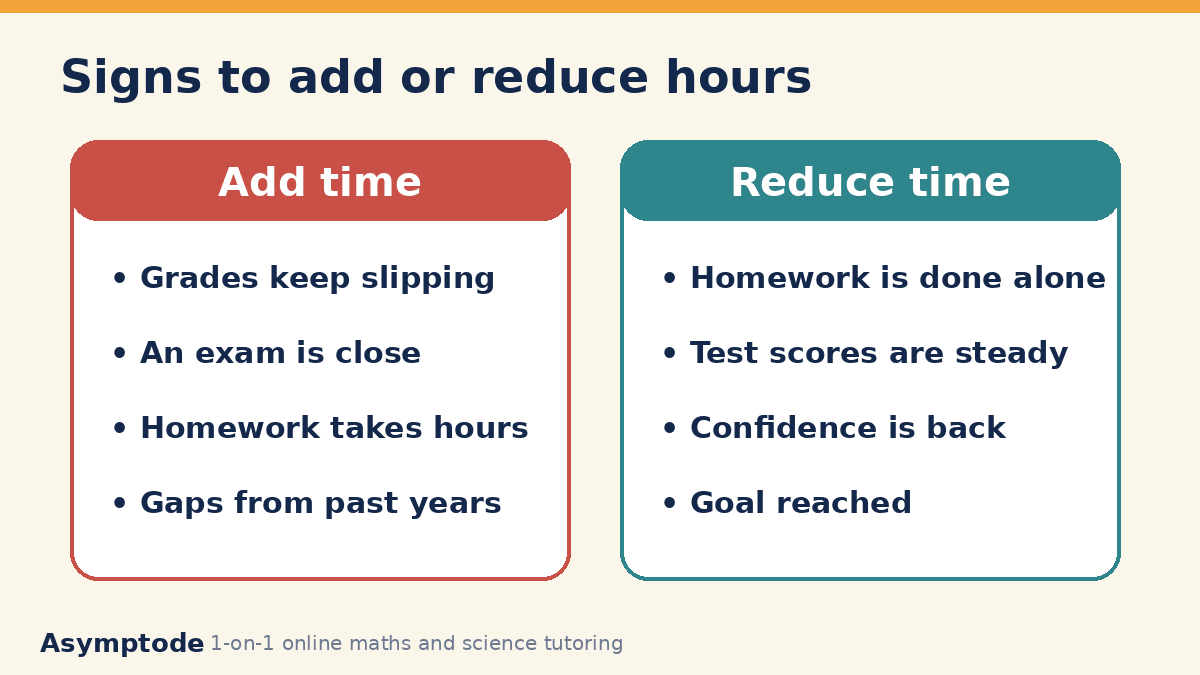
Reducing hours is a good sign. The goal of tutoring is an independent learner, not endless sessions.
How do you build a weekly tutoring plan?
Use these four steps:
- Name the goal. For example, "pass Algebra 1 with a B" or "reach our target SAT Math score".
- Check the time left. Count the weeks until the test or the end of term.
- Pick the number of sessions. One, two or three a week, based on the table above.
- Add short practice. Plan 10 to 15 minutes on most non-session days.
Then review every 4 weeks. Look at homework, quiz scores and confidence. Adjust the hours if needed.

Want help choosing the right number of hours? Talk to an Asymptode advisor. We will suggest a plan based on your child's goal and schedule.
Can too much tutoring backfire?
Yes. Too many hours can lead to tiredness and less time for independent practice. Some students start to wait for the tutor instead of trying problems themselves.
Signs of too much tutoring:
- Your child seems tired or bored in sessions
- Homework is never tried before the session
- There is no time left for rest, sports or hobbies
If you see these signs, cut back a little and add short independent practice instead.
How does Asymptode plan tutoring hours?
At Asymptode, every student learns in live 1-on-1 online sessions with a math or science tutor. Tutors set personalized homework with feedback, so the time between sessions counts. Parents can see progress, which makes the 4-week review simple and clear.
You can choose a plan that fits your goal and budget. See the options on our fees page.
If you are still deciding on a tutor, our guide on how to choose an online math tutor can help. If worry about math is part of the problem, read about overcoming math anxiety.
FAQ
Is one hour of math tutoring a week enough?
For a student who is mostly on track, one hour a week is often enough. Students with bigger gaps or an exam coming up usually need more.
How long should a math tutoring session be?
Most sessions work well at 45 to 60 minutes. Younger children may do better with shorter sessions. Older students can manage up to 90 minutes.
How many weeks of tutoring does it take to see results?
Many families start to see changes in homework and confidence within a few weeks. Bigger changes in grades often take longer. It depends on the size of the gap and how regular the practice is.
Should my child have tutoring during the summer?
Summer is a good time to fill gaps or get ahead. One or two hours a week can stop the summer slide without taking over the holiday.
Can we change the number of hours later?
Yes. A good plan is flexible. Review progress every 4 weeks and move hours up or down as needed.
Ready to find the right plan? Book a free chat with an advisor or see our fees.