
AP Physics 1 is one of the most popular AP science courses in the USA, and one of the hardest to score well on. This guide explains the May 2027 exam format, the 8 units, the 4 free-response question types, and how to prepare step by step.
Key takeaways
- The AP Physics 1 exam is on Wednesday, May 5, 2027 (afternoon session), according to the College Board exam calendar.
- It lasts 3 hours: 42 multiple-choice questions in 1 hour 25 minutes, then 4 free-response questions in 1 hour 35 minutes. Each section is worth 50%.
- From fall 2026 the multiple-choice section grew from 40 to 42 questions. The free-response time dropped from 100 to 95 minutes.
- The course has 8 units, including Fluids, which moved in from AP Physics 2.
- A calculator and an equation sheet are allowed on the whole exam.
What is AP Physics 1?
Quick answer: AP Physics 1: Algebra-Based is a college-level introductory physics course run by the College Board. It covers motion, forces, energy, momentum, rotation, oscillations and fluids. It uses algebra and trigonometry, not calculus. Students take a 3-hour exam in May and get a score from 1 to 5.
Many colleges give credit or placement for a qualifying score, but each college sets its own policy. Check the college's website or the College Board's AP credit search before you rely on credit.
AP Physics 1 is often a student's first real physics course. That is why it feels hard. It asks students to explain why things happen, not just plug numbers into a formula. If your child is planning a full set of AP courses, our AP guide for parents explains how the program works.
What is the AP Physics 1 exam format in 2027?
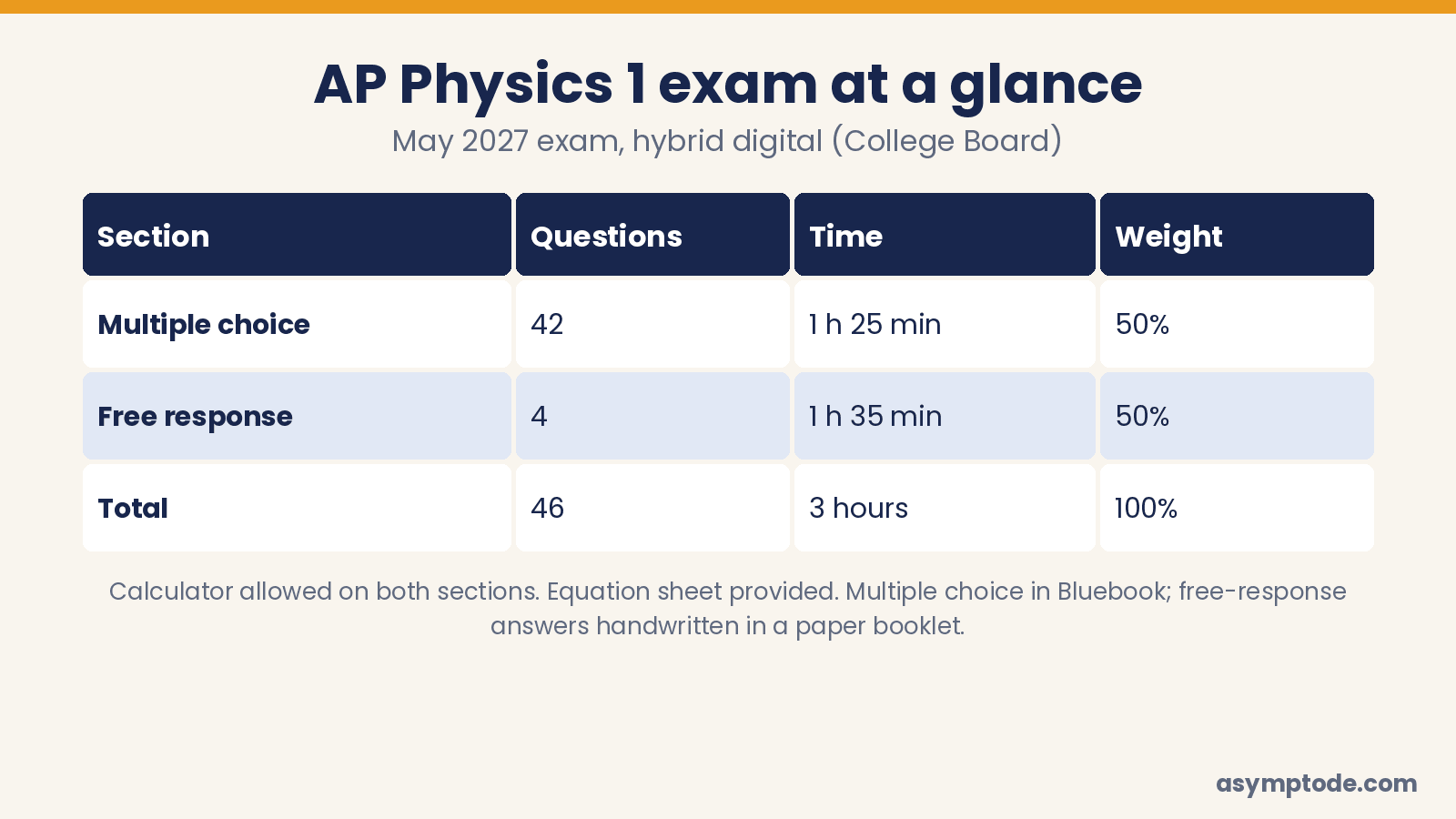
The exam is hybrid digital. Students answer multiple-choice questions and read the free-response questions in the Bluebook app. They then handwrite their free-response answers in a paper booklet.
| Section | Questions | Time | Weight |
|---|---|---|---|
| I: Multiple choice | 42 | 1 hour 25 minutes | 50% |
| II: Free response | 4 | 1 hour 35 minutes | 50% |
| Total | 46 | 3 hours | 100% |
What changed for 2026-27?
The College Board published clarifications to the course and exam description, effective fall 2026:
- Multiple choice: 42 questions in 85 minutes (was 40 questions in 80 minutes).
- Free response: 95 minutes (was 100 minutes).
The total time stays at 3 hours. Older prep books and websites may still show 40 questions. Use the College Board's current numbers.
Can you use a calculator on AP Physics 1?
Yes. A calculator is allowed on both sections. It must be on the College Board's approved list. Students also get an equation sheet and reference tables. The equation sheet helps, but it does not tell you which equation to use. That skill comes from practice.
What are the 8 units of AP Physics 1?
The course was revised for 2024-25. It now has 8 units. Fluids moved in from AP Physics 2.
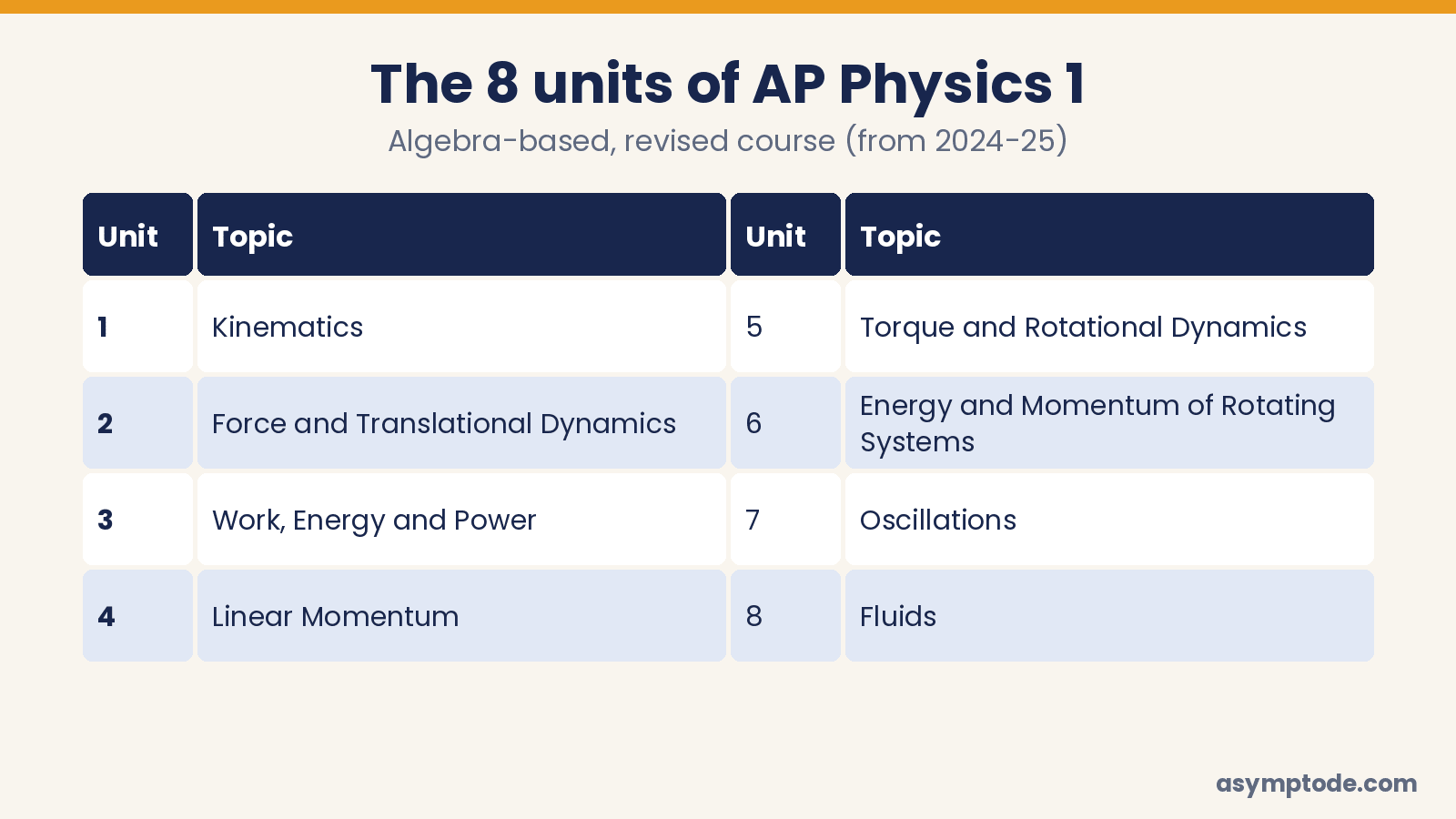
| Unit | Topic | What students learn |
|---|---|---|
| 1 | Kinematics | Position, velocity, acceleration, motion graphs, projectiles |
| 2 | Force and Translational Dynamics | Newton's laws, free-body diagrams, friction, circular motion, gravity |
| 3 | Work, Energy and Power | Kinetic and potential energy, work, conservation of energy, power |
| 4 | Linear Momentum | Impulse, momentum, collisions |
| 5 | Torque and Rotational Dynamics | Torque, rotational inertia, angular motion |
| 6 | Energy and Momentum of Rotating Systems | Rotational kinetic energy, angular momentum, rolling |
| 7 | Oscillations | Springs, pendulums, simple harmonic motion |
| 8 | Fluids | Density, pressure, buoyancy, fluid flow |
Units 1 to 3 are the base for everything else. If a student is weak in forces or energy, the later units feel twice as hard. For a refresher on forces, read our post on Newton's three laws.
What are the 4 free-response question types?
Each exam has one question of each type. Knowing the types in advance takes away a lot of fear.
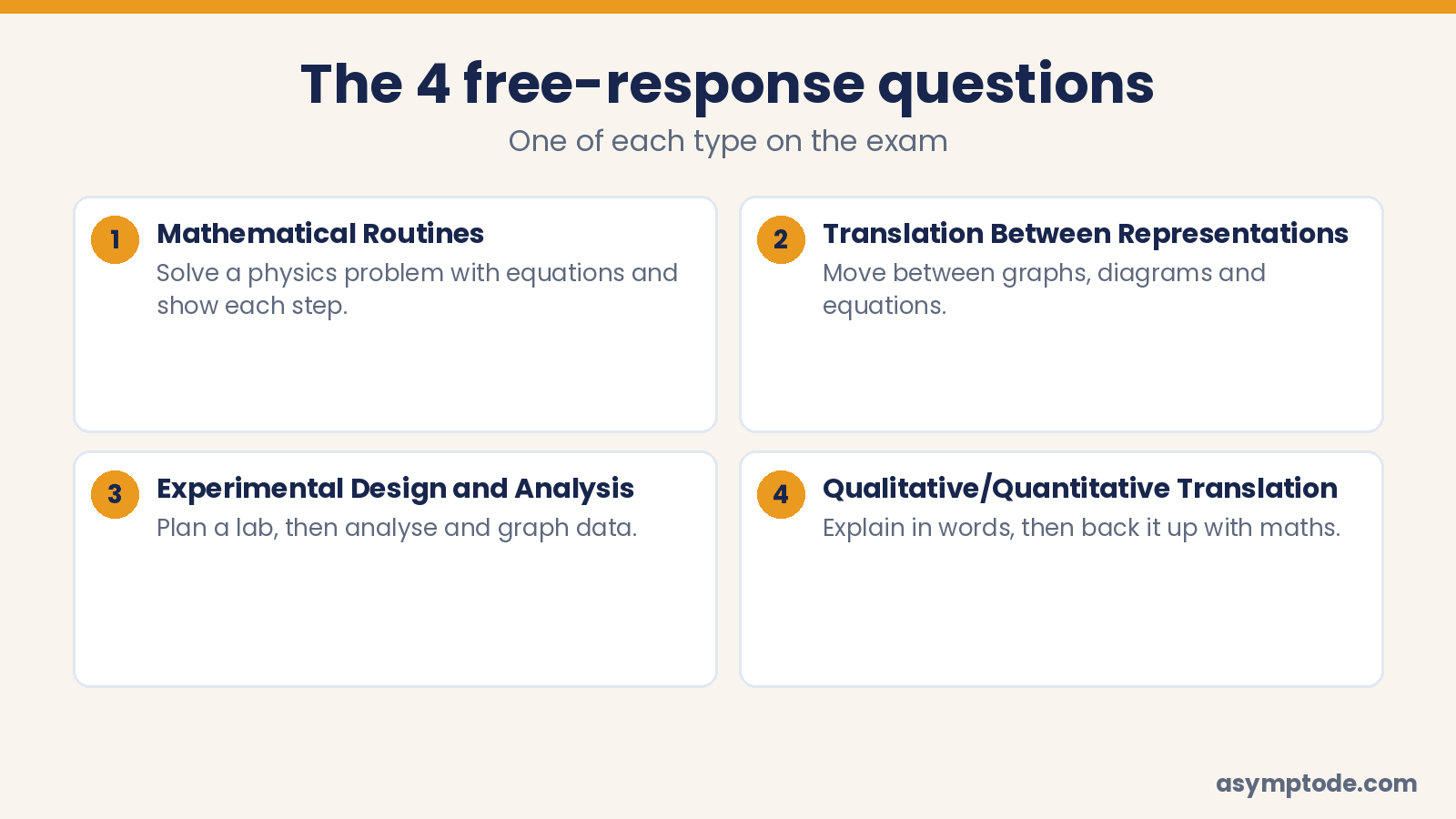
- Mathematical Routines. Solve a problem with equations. Show each step and the units.
- Translation Between Representations. Move between a diagram, a graph and an equation. For example, draw a free-body diagram, then write the matching equation.
- Experimental Design and Analysis. Plan an experiment, say what to measure and with what tools, then analyse data, often by drawing a best-fit line.
- Qualitative/Quantitative Translation. Explain something in words, then show the same idea with maths. The two answers must agree.
Free-response questions reward clear reasoning. A correct number with no explanation can earn few points. A clear method with a small slip can still earn most of them.
Worked examples: how AP Physics 1 problems work
Example 1: Newton's second law
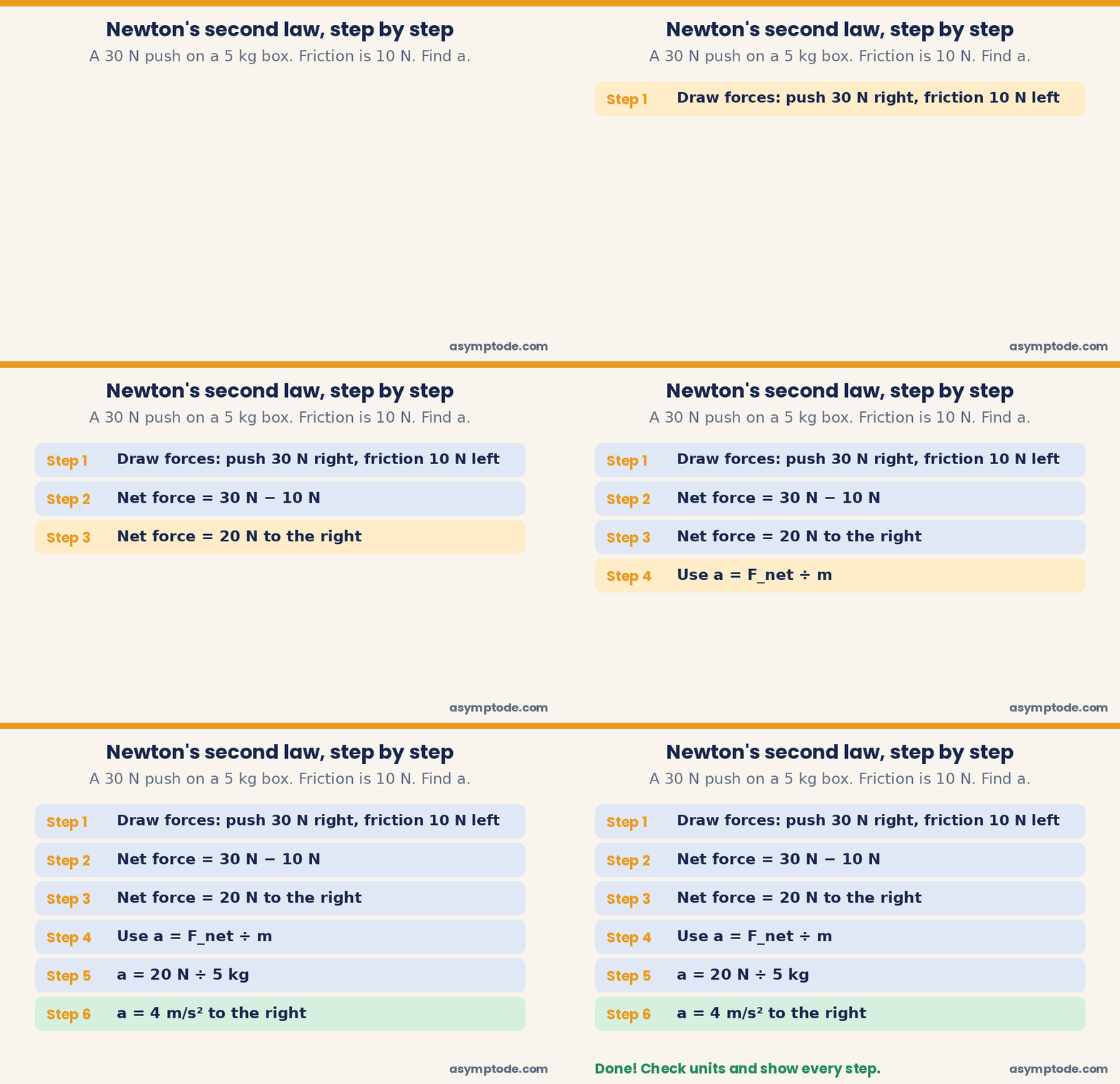
Question: A student pushes a 5 kg box across the floor with a force of 30 N. Friction on the box is 10 N. Find the acceleration.
- Draw the forces: 30 N to the right, 10 N to the left. (Weight and the normal force cancel.)
- Net force = 30 N − 10 N = 20 N to the right.
- Use a = F_net ÷ m.
- a = 20 ÷ 5 = 4 m/s² to the right.
The most common mistake here is using 30 N instead of the net force. Always find the net force first.
Example 2: Conservation of energy
Question: A ball is dropped from rest from a height of 5 m. Ignore air resistance. How fast is it moving just before it hits the ground? Use g = 9.8 m/s².
- At the top, all energy is potential: mgh.
- At the bottom, all energy is kinetic: ½mv².
- Set them equal: mgh = ½mv². The mass cancels.
- v² = 2gh = 2 × 9.8 × 5 = 98.
- v = √98 ≈ 9.9 m/s.
Notice that the mass cancels. A heavy ball and a light ball land at the same speed if air resistance is ignored. AP questions often test exactly this idea in words.
Example 3: Momentum in a collision
Question: A 2 kg cart moving at 3 m/s hits a 1 kg cart at rest. They stick together. Find their speed after the collision.
- Momentum before = (2 × 3) + (1 × 0) = 6 kg·m/s.
- Momentum is conserved, so momentum after = 6 kg·m/s.
- Mass after = 2 + 1 = 3 kg.
- v = 6 ÷ 3 = 2 m/s.
Kinetic energy is not conserved here. Before: ½ × 2 × 3² = 9 J. After: ½ × 3 × 2² = 6 J. The "missing" 3 J became heat and sound. This is a classic qualitative question.
What are the most common AP Physics 1 mistakes?
- Skipping the free-body diagram. Most force errors start here.
- Mixing up mass and weight. Weight is a force (mg), measured in newtons.
- Using the wrong conservation law. Momentum is conserved in collisions. Mechanical energy is conserved only when there is no friction or other energy loss.
- Reading graphs wrongly. The slope of a position-time graph is velocity. The area under a velocity-time graph is displacement.
- Writing numbers with no reasoning. In free response, explain each step in one short sentence.
- Leaving Fluids and Oscillations to the end. They are smaller units, but they still appear on the exam.
How to prepare for AP Physics 1: a 10-week plan
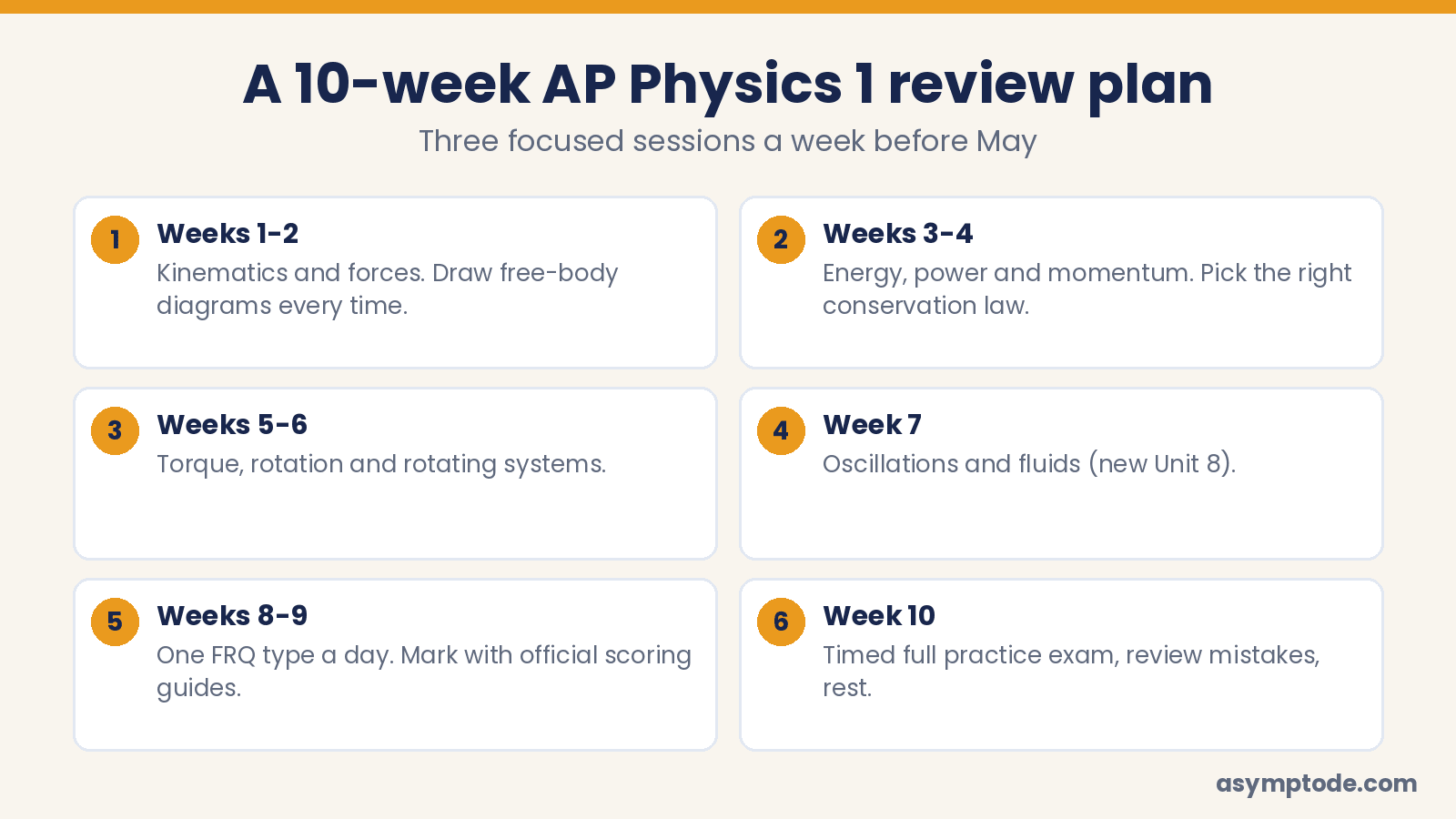
Start about 10 weeks before May 5. Three focused sessions a week of 45 to 60 minutes is enough for most students who keep up in class.
| Weeks | Focus | Goal |
|---|---|---|
| 1-2 | Kinematics and forces | Draw a free-body diagram for every problem |
| 3-4 | Energy, power and momentum | Choose the right conservation law fast |
| 5-6 | Torque, rotation and rotating systems | Link rotation to straight-line motion |
| 7 | Oscillations and fluids | Cover the newest unit with care |
| 8-9 | One free-response type per day | Mark answers with official scoring guidelines |
| 10 | Full timed practice exam | Review mistakes, then rest before exam day |
Use the official College Board free-response questions and scoring guidelines on AP Central. They show exactly what earns points. Keep a "mistake log" and review it every week.
If your child also takes AP math, our AP Precalculus guide and AP Calculus AB vs BC guide explain those exams. Strong algebra and trigonometry make AP Physics 1 much easier.
Want a plan built around your child's weak units? Talk to an advisor and book a free demo class.
How 1-on-1 tutoring helps with AP Physics 1
At Asymptode, every class is live, online and 1-on-1. One mentor works with one student. Here is how that helps with AP Physics 1:
- We find the real gap. Many "physics" problems are really algebra or graph-reading problems. A mentor watches each step of the working and finds the smaller missing piece.
- We teach the "why". AP Physics 1 asks students to explain. In a 1-on-1 lesson, your child explains out loud, and the mentor fixes the reasoning, not just the answer.
- We practise each free-response type. The mentor sets questions of each type and gives feedback in the style of the official scoring guidelines.
- Homework fits the gap. Practice is on the units your child needs, checked by the same mentor.
- Parents see progress. You get short updates on what improved and what needs work.
- Every class is recorded. Your child can rewatch a tricky method, like a torque problem, before the exam.
We follow your child's school course and exam date. See our fees or talk to an advisor to book a free demo class.
FAQ
When is the AP Physics 1 exam in 2027?
The College Board lists AP Physics 1 on Wednesday, May 5, 2027, in the afternoon session. Your school's AP coordinator confirms the exact time and room.
How many questions are on the AP Physics 1 exam?
From the 2026-27 school year, there are 42 multiple-choice questions in 85 minutes and 4 free-response questions in 95 minutes. Each section is worth half the score.
Is AP Physics 1 hard?
Many students find it hard because it tests reasoning, not memorising. Students who are strong in algebra and who practise explaining their answers usually do much better.
Do you need calculus for AP Physics 1?
No. AP Physics 1 is algebra-based. Students need algebra, graphs and basic trigonometry. Calculus is used in AP Physics C.
Is there an equation sheet on the AP Physics 1 exam?
Yes. Students get an equation sheet and reference tables, and may use an approved calculator on both sections.
What units are on AP Physics 1?
There are 8 units: Kinematics; Force and Translational Dynamics; Work, Energy and Power; Linear Momentum; Torque and Rotational Dynamics; Energy and Momentum of Rotating Systems; Oscillations; and Fluids.