

The Pascal, Cayley and Fermat contests are among the best-known maths contests for high school students in Canada. They are run by the Centre for Education in Mathematics and Computing (CEMC) at the University of Waterloo, and schools in many other countries take part too. This guide explains who can write each contest, the 2027 dates, how scoring works and how to prepare.
Key takeaways
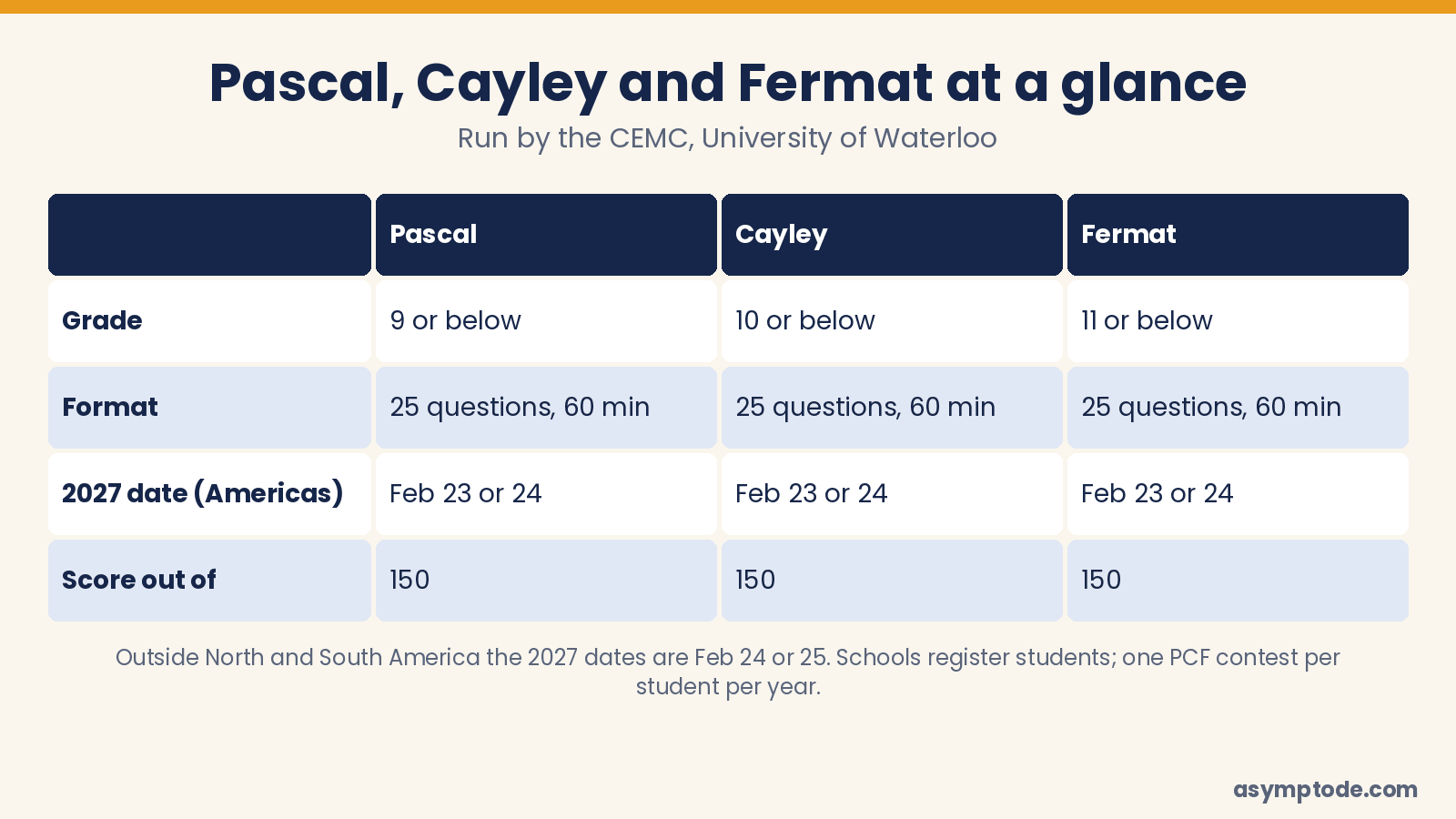
- Pascal is for Grade 9 or below, Cayley for Grade 10 or below and Fermat for Grade 11 or below.
- Each contest has 25 multiple-choice questions in 60 minutes, scored out of 150.
- The 2027 contests are on February 23 or 24 in North and South America, and February 24 or 25 elsewhere.
- Schools register students. In Canada the 2027 ordering deadline is February 9; outside Canada it is earlier.
- There is no pass or fail. The top 25% earn a Certificate of Distinction.
What are the Pascal, Cayley and Fermat contests?
Quick answer: Pascal, Cayley and Fermat (often called PCF) are 60-minute maths contests from the CEMC at the University of Waterloo. Each has 25 multiple-choice questions and is scored out of 150. Pascal is for Grade 9 or below, Cayley for Grade 10 or below and Fermat for Grade 11 or below. Students write at school in February.
The CEMC says these contests are not tests or exams. They are a chance to enjoy problem solving and stretch beyond the school course. Many students write them every year from Grade 9 to Grade 11.
Which contest should my child write?
| Contest | For students in | Typical next step |
|---|---|---|
| Pascal | Grade 9 or below | Cayley the next year |
| Cayley | Grade 10 or below | Fermat the next year |
| Fermat | Grade 11 or below | Euclid in Grade 12 |
A few important rules from the CEMC:
- A student may write only one PCF contest in a school year.
- A student may write a contest above their grade, but their result only counts as official in the contest for their own grade.
- Keen younger students may write Pascal early.
Younger students in Grades 7 and 8 usually start with the CEMC's Gauss contest. In the USA, many of the same students also write the AMC 8.
When are the PCF contests in 2027?
| Contest days | Ordering deadline | |
|---|---|---|
| Schools in North and South America | Tuesday, February 23 or Wednesday, February 24, 2027 | Canada: February 9, 2027 |
| Schools outside North and South America | Wednesday, February 24 or Thursday, February 25, 2027 | Outside Canada: February 2, 2027 |
Schools order the contest, not parents. The CEMC lists a contest fee of $6 per student plus order fees, paid by the school. If your child's school does not take part, ask the maths department early. Deadlines come in early February.
Students write at school, under supervision, either on paper or online through the CEMC platform.
How are the Pascal, Cayley and Fermat contests scored?
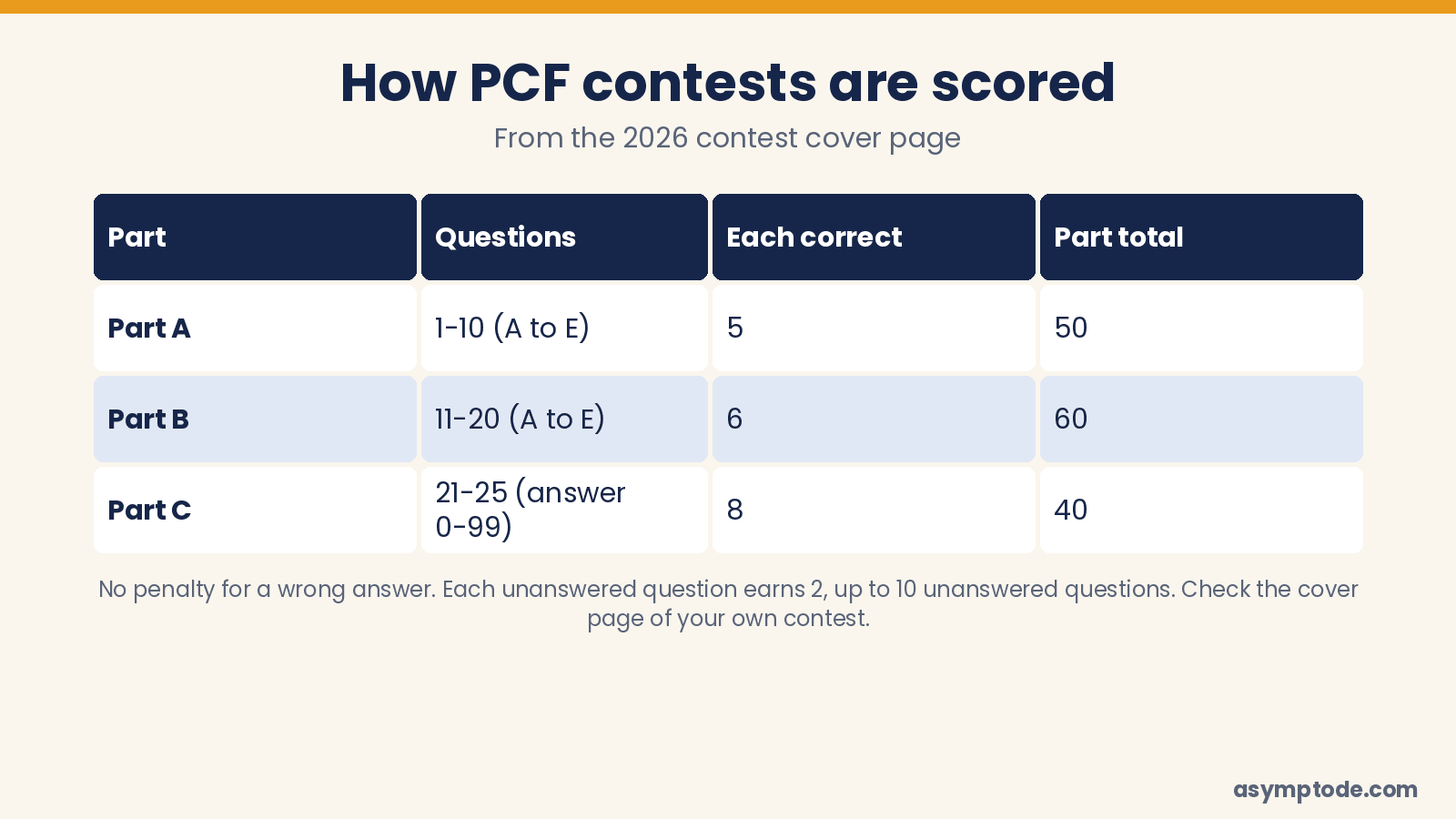
Each contest has three parts. Later parts are harder and worth more.
| Part | Questions | Answer type | Marks each | Part total |
|---|---|---|---|---|
| Part A | 1 to 10 | Choose A to E | 5 | 50 |
| Part B | 11 to 20 | Choose A to E | 6 | 60 |
| Part C | 21 to 25 | A whole number from 0 to 99 | 8 | 40 |
Scoring rules from the 2026 Pascal cover page:
- There is no penalty for a wrong answer.
- Each unanswered question earns 2 marks, up to a maximum of 10 unanswered questions.
What does this mean for strategy? A blank answer is worth 2 marks. A random guess on a 5-choice question is worth about 1 mark on average (a 1 in 5 chance of 5 or 6 marks). So wild guessing is not helpful. But if your child can rule out two or three choices, a guess becomes a good bet. Always check the rules printed on your own contest, as they can change.
Calculators
Calculating devices are allowed, as long as they cannot connect to the internet or other devices, do not store student information, and have no computer algebra system or dynamic geometry software. Most problems are designed so a calculator does not help much. Clear thinking does.
What is a good score on Pascal, Cayley or Fermat?
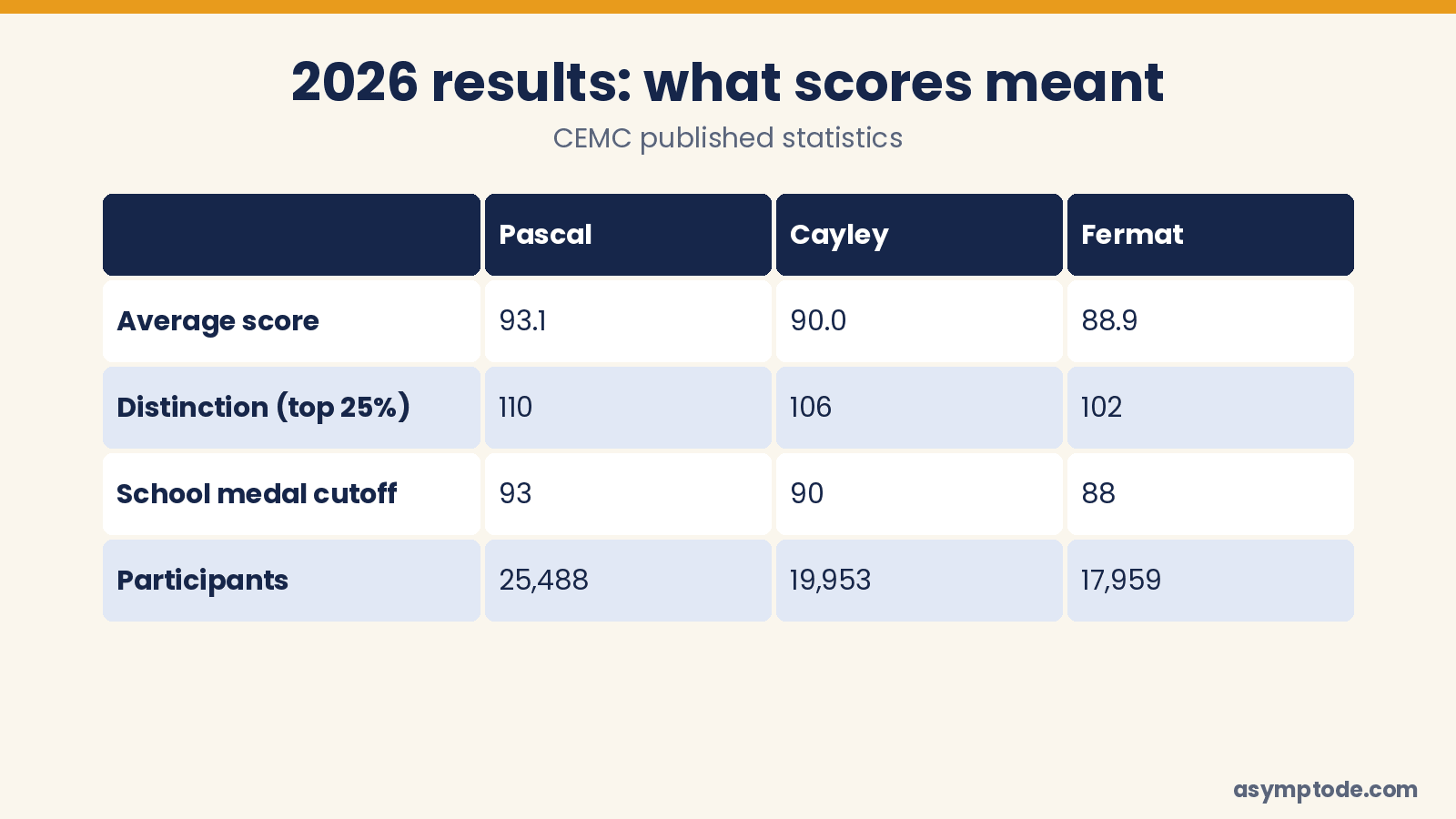
The CEMC publishes statistics each year. Here are the 2026 numbers.
| 2026 | Pascal | Cayley | Fermat |
|---|---|---|---|
| Average score | 93.1 | 90.0 | 88.9 |
| Certificate of Distinction cutoff (top 25%) | 110 | 106 | 102 |
| School medal cutoff | 93 | 90 | 88 |
| Participants | 25,488 | 19,953 | 17,959 |
So in 2026, a Pascal score of 110 or more put a student in the top 25%. Cutoffs change every year with the difficulty of the paper.
What awards are there?
- Certificate of Distinction: for students in the top 25% of all competitors.
- School Champion medal: for the top scorer at each school who meets the medal cutoff.
- Team score: the sum of a school's three highest scores.
From 2026, the CEMC no longer gives team honour rolls or awards at the zone, provincial or national level.
What topics come up in PCF contests?
The questions use school maths, but in new and clever ways. Common topics include:
- Number sense: primes, divisors, remainders, digits, fractions and percents
- Counting and probability: careful listing, simple arrangements, patterns
- Algebra: equations, ratios, averages, sequences
- Geometry: angles, areas, Pythagoras, circles, coordinates
- Logic: puzzles that reward careful reading and organised cases
Strong Grade 9 and 10 foundations help a lot. Our Ontario Grade 9 math guide covers many of the skills Pascal builds on.
Worked examples: PCF-style problems
These are our own practice problems written in the PCF style. Each one shows a habit that wins marks.
Example 1 (Part A style): percent of a percent
Question: What is 20% of 30% of 200?
- 30% of 200 = 0.3 × 200 = 60.
- 20% of 60 = 0.2 × 60 = 12.
Answer: 12. Habit: work from the inside out.
Example 2 (Part B style): careful listing
Question: How many two-digit whole numbers have digits that add up to 9?
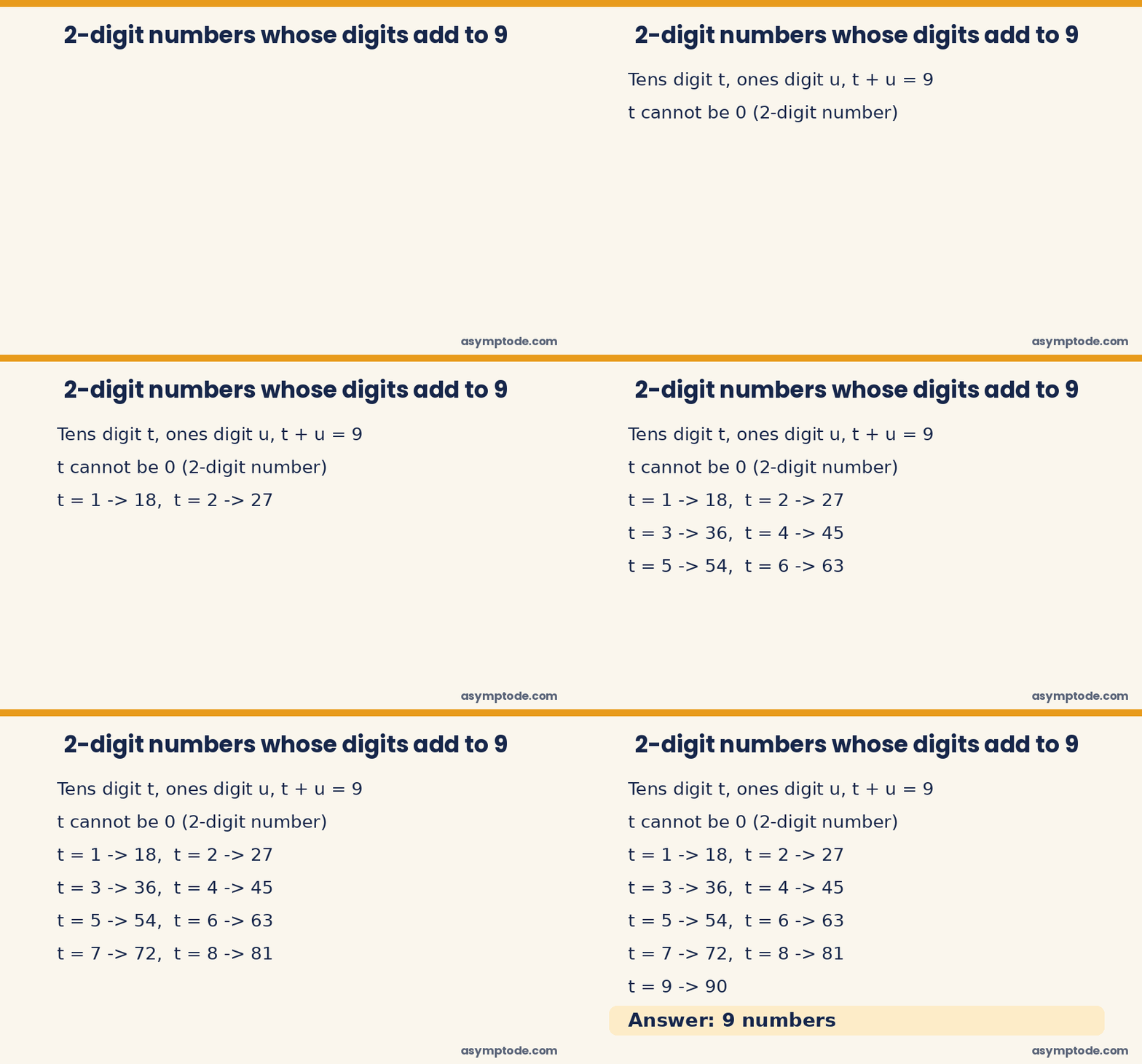
- Call the tens digit t and the ones digit u. We need t + u = 9.
- The tens digit cannot be 0, so t is 1 to 9.
- For each t there is exactly one u = 9 − t: 18, 27, 36, 45, 54, 63, 72, 81, 90.
Answer: 9. Habit: list cases in order so none are missed or counted twice.
Example 3 (Part C style): counting divisors
Question: How many positive whole numbers divide 72 exactly?
- Write 72 as a product of primes: 72 = 2³ × 3².
- A divisor uses 2 to the power 0, 1, 2 or 3 (4 choices) and 3 to the power 0, 1 or 2 (3 choices).
- Number of divisors = 4 × 3 = 12.
- Check by listing: 1, 2, 3, 4, 6, 8, 9, 12, 18, 24, 36, 72. That is 12.
Answer: 12. Part C answers are whole numbers from 0 to 99, so a quick check like this is worth the time.
What are the most common mistakes in PCF contests?
- Spending too long on one question. 25 questions in 60 minutes is about 2.4 minutes each. Move on and come back.
- Wild guessing. With 2 marks for a blank (up to 10), random guesses usually lose marks. Guess only after ruling out choices.
- Misreading the question. "At least", "exactly" and "not" change everything. Underline them.
- Messy case lists. Organised lists and tables prevent double counting.
- Never doing past contests. The CEMC publishes past contests and solutions for free. They are the best practice there is.
Want a mentor to work through past contests with your child, one problem at a time? Book a free demo class with Asymptode.
How should my child prepare for Pascal, Cayley or Fermat?
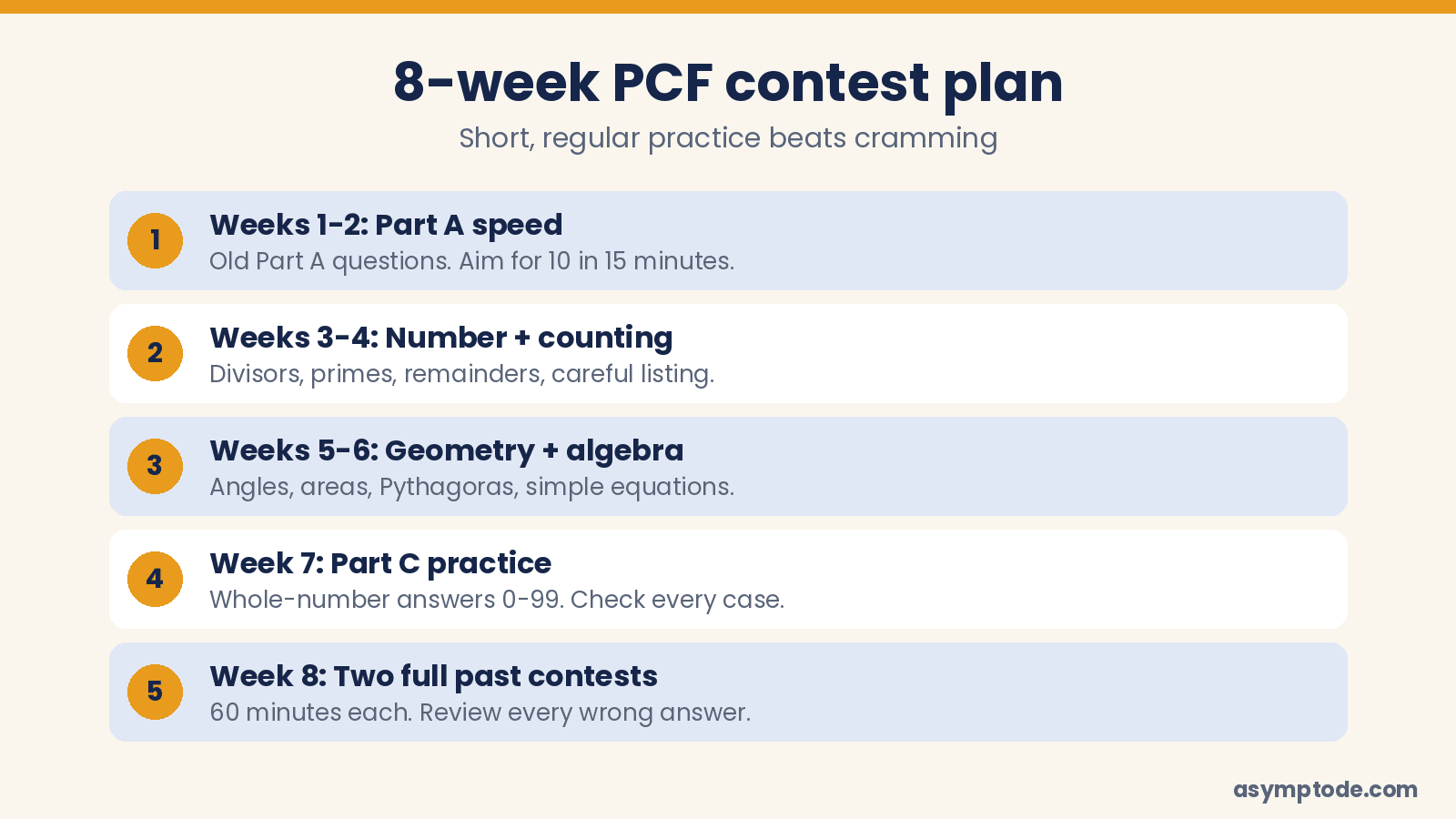
There is time before February. Here is a simple eight-week plan.
| Weeks | Focus | What to do |
|---|---|---|
| 1 to 2 | Part A speed | Old Part A questions. Aim for 10 questions in about 15 minutes. |
| 3 to 4 | Number and counting | Divisors, primes, remainders, organised listing. |
| 5 to 6 | Geometry and algebra | Angles, areas, Pythagoras, equations and ratios. |
| 7 | Part C practice | Whole-number answers. Check every case. |
| 8 | Two full past contests | 60 minutes each, then review every wrong or blank answer. |
Tips for parents:
- Use the CEMC's free past contests and solutions. Read the official solution even when the answer was right. There is often a faster method.
- Keep a "nice ideas" notebook. Each week, write down one trick that worked.
- Praise the thinking, not the score. Contest problems are meant to be hard. Struggle is part of learning.
- Think beyond one contest. Strong contest skills help with school maths, the Alberta Math 30-1 diploma and later contests like Euclid.
How 1-on-1 tutoring helps with PCF contests
At Asymptode, every class is live, online and 1-on-1, with a dedicated mentor. Contest maths suits this style well:
- The mentor watches the thinking. Contest problems are solved by method. A mentor sees where the reasoning goes wrong and fixes that step.
- Practice matches the level. A Grade 9 student aiming for a Pascal distinction needs different problems from a student writing their first contest.
- Homework comes with feedback. Past-contest problems are set, marked and discussed by the same mentor.
- Parents see progress. Short updates show which topics are improving.
- Classes are recorded, so students can rewatch a clever solution before contest day.
We work with students in Canada, the USA, the UK, Australia and the UAE, and fit lessons around school hours and time zones. We never promise awards. We build real problem-solving skill. See our fees or talk to an advisor to book a free demo class.
FAQ
What grade is the Pascal contest for?
Pascal is for students in Grade 9 or below. Cayley is for Grade 10 or below and Fermat is for Grade 11 or below.
When are the 2027 Pascal, Cayley and Fermat contests?
In North and South America they are on February 23 or 24, 2027. Outside North and South America they are on February 24 or 25, 2027. Schools choose the day.
Is there a penalty for wrong answers?
No. A wrong answer scores 0. But each unanswered question earns 2 marks, up to 10 unanswered questions, so random guessing is usually not worth it.
What score do you need for a Certificate of Distinction?
The top 25% earn a Certificate of Distinction. In 2026 the cutoffs were 110 for Pascal, 106 for Cayley and 102 for Fermat. Cutoffs change every year.
Can students outside Canada write the PCF contests?
Yes. Schools outside Canada can order the contests. They have different contest dates and an earlier ordering deadline. Ask your child's school to check the CEMC website.
Can you use a calculator on Pascal, Cayley and Fermat?
Yes, but only devices without internet access, communication features, stored information, computer algebra or dynamic geometry software.