
Here is how to become a mathematician: take the hardest maths your school offers, learn proofs early, try contests, earn a maths or statistics degree, then a master's or PhD. The US Bureau of Labor Statistics says most of these jobs need at least a master's degree. This guide shows the route by country, with a Grade 9-12 plan.
Key takeaways
- Most mathematicians and statisticians need at least a master's degree. Research and university jobs usually need a PhD.
- BLS (2025 data): median pay $105,720 a year. Jobs are projected to grow 10% from 2025 to 2035, with about 2,000 openings a year.
- Most of those jobs are for statisticians (about 31,300 jobs) rather than "mathematicians" (about 2,200 jobs).
- Contests build proof skills: AMC to AIME to USAMO (US), SMC to BMO (UK), IOQM to RMO to INMO (India), COMC to CMO (Canada).
- Entrance routes differ: TMUA and STEP for Cambridge, TMUA for Oxford, ISI and CMI entrance tests in India, IIT JAM for an MSc.
- Start proofs in Grade 9. Proof is what makes university maths different.
How do you become a mathematician?
Quick answer: Study as much maths as you can in school, and practise proofs and problem solving. Then take a bachelor's degree in mathematics or statistics. Most jobs need at least a master's degree, and research or university posts need a PhD. Contests, summer programs and early research help a lot, but they are not required.
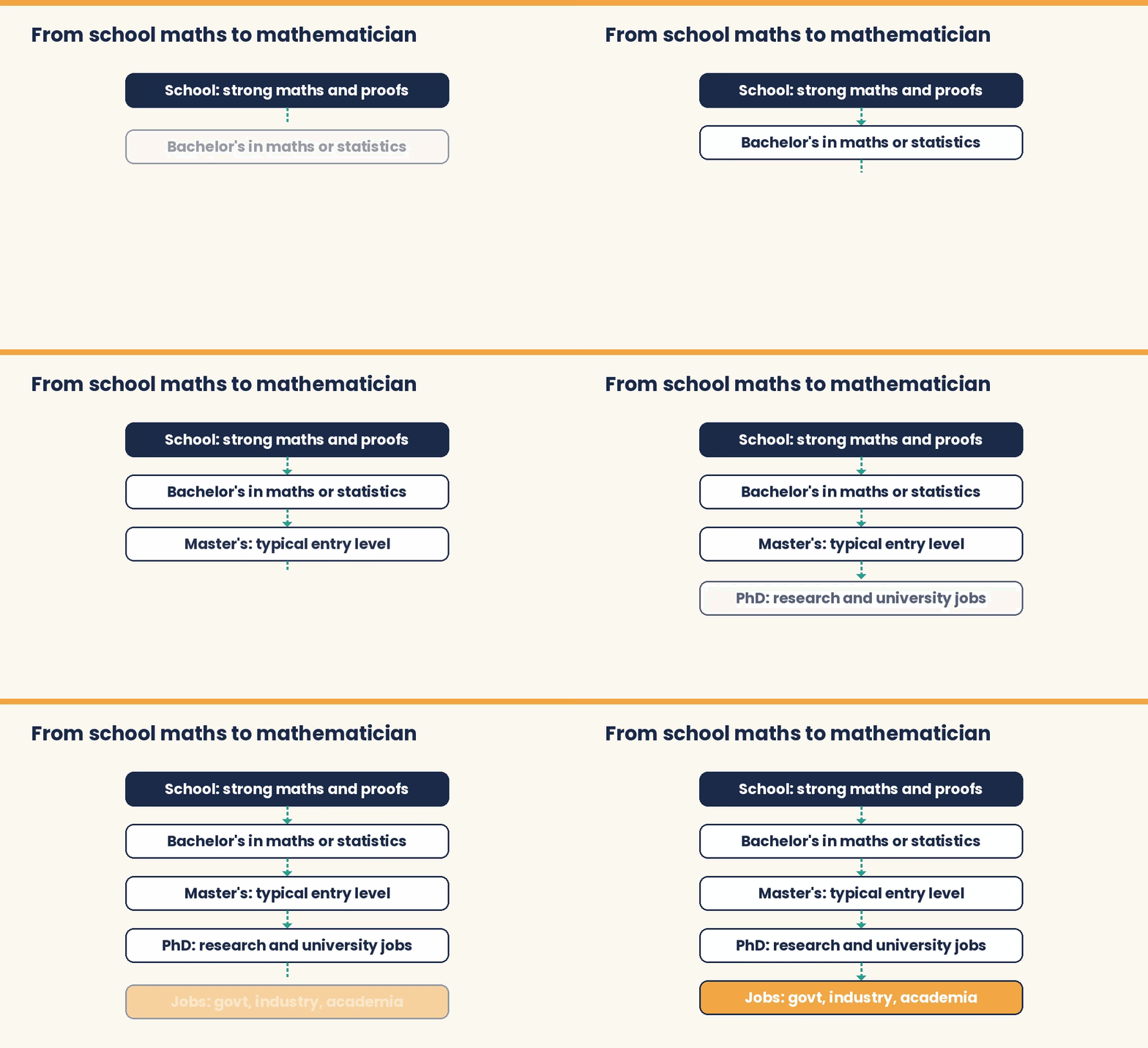
The usual path from school maths to a job as a mathematician or statistician.
- School: strong maths, plus early practice with proofs.
- Bachelor's degree in mathematics or statistics (3-4 years).
- Master's degree: the BLS says this is the typical entry-level education.
- PhD: needed for research and most university teaching jobs.
- Jobs: government, industry, universities and research labs.
What does a mathematician actually do?
Mathematicians and statisticians solve problems and build new ideas. There are two broad types.
- Pure mathematics studies ideas for their own sake: number theory, algebra, geometry, topology and analysis. Most pure mathematicians work in universities, teaching and doing research.
- Applied mathematics and statistics use maths on real problems: weather models, medicine trials, cryptography, finance, engineering and AI.
Where do mathematicians work?
Per the BLS Occupational Outlook Handbook, the federal government employs 53% of mathematicians; state universities and technical services employ 12% each. For statisticians, the top employers are the federal government (16%) and scientific research and development (15%).
What related careers use a maths degree?
Many maths graduates work in close cousins of the field:
- Actuary or quant: measures risk in insurance, or builds models in finance.
- Data scientist: statistics plus code. See how to become a data scientist.
- Scientist or engineer: see how to become a scientist.
Is being a mathematician a good career? What BLS says
The honest BLS outlook, as stated (page updated 27 August 2026):
| BLS measure | Figure |
|---|---|
| Median pay, 2025 | $105,720 per year ($50.83 per hour) |
| Median pay, mathematicians (May 2025) | $126,710 |
| Median pay, statisticians (May 2025) | $105,650 |
| Jobs, 2025 | 33,500 (about 2,200 mathematicians, 31,300 statisticians) |
| Growth, 2025-35 | 10%, "much faster than average" |
| Mathematicians alone, 2025-35 | 1% |
| Statisticians alone, 2025-35 | 11% |
| Openings | About 2,000 a year on average |
| Typical entry-level education | Master's degree |
What this means: the job title "mathematician" is rare and barely growing. The growth is in statistics and data. A student who loves pure maths can still aim for a PhD. But learning statistics and programming too keeps more doors open. These are US figures; other countries differ.
Which school subjects should you choose to become a mathematician?
Take the most advanced maths course your school offers, every year. Then add subjects that use maths.
| Curriculum | Best maths choice | Good partners |
|---|---|---|
| US | Calculus (AP Calculus BC if offered), statistics | Physics, computer science |
| UK A level | Mathematics and Further Mathematics | Physics, computer science |
| IB | Maths: Analysis and Approaches HL | Physics HL, computer science |
| India (CBSE/ISC/state) | PCM stream (Physics, Chemistry, Maths) | Computer science |
| Canada (Ontario) | Advanced Functions; Calculus and Vectors | Computer science, physics |
| Australia (VCE) | Mathematical Methods and Specialist Mathematics | Physics |
- UK: Cambridge asks A level applicants for Mathematics and Further Mathematics. See our A level Maths guide.
- IB: compare the options in our IB Maths AA vs AI guide.
- India: ISI says B.Math and B.Stat need higher secondary with Mathematics and English, so PCM is the safe stream.
- Canada: Waterloo Mathematics lists Advanced Functions and Calculus and Vectors among six Grade 12 U/M courses.
- Australia: at Melbourne, a Specialist Mathematics score of 29+ opens the Standard first-year stream. Methods alone (25+) starts with Calculus 1.
Which maths contests should you take?
Contests are not required. But they teach what universities value most: solving new problems and proving your answer.
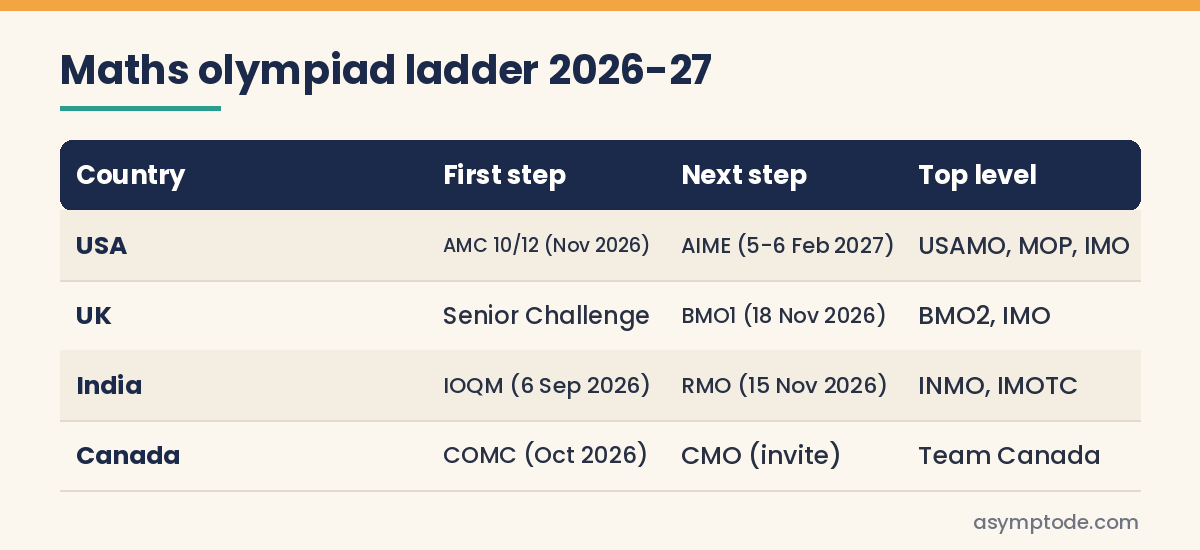
The 2026-27 olympiad ladder in four countries, from the official contest bodies.
| Country | First step | Next step | Top level |
|---|---|---|---|
| USA | AMC 10/12 (5 and 13 Nov 2026) | AIME (5-6 Feb 2027) | USAMO/USAJMO, then MOP and IMO team |
| UK | Senior Maths Challenge (7 Oct 2026) | BMO Round 1 (18 Nov 2026) | BMO Round 2 (20 Jan 2027), then IMO |
| India | IOQM (6 Sep 2026, done) | RMO (15 Nov 2026) | INMO (17 Jan 2027), then IMOTC |
| Canada | COMC (29 Oct 2026), CEMC contests | CMO (by invitation) | Team Canada training |
USA: AMC to AIME to USAMO
The MAA runs the AMC 10 (Grade 10 and below) and AMC 12 (Grade 12 and below): the A tests on 5 November 2026 and the B tests on 13 November 2026. The AMC 8 runs 21-27 January 2027.
The MAA invitational page says an AMC 10 score of 100+ or AMC 12 score of 85+ qualifies for the AIME (5-6 February 2027, at Pearson centres). For 2027, USAMO places depend mainly on AIME, and "AMC scores will no longer be a factor." Top USAMO students go to MOP, which leads to the IMO team.
Read more in our AMC 10 and AMC 12 guide, AIME 2027 guide and AMC 8 guide.
UK: UKMT challenges to the British Mathematical Olympiad
The UKMT competition calendar lists the Senior Mathematical Challenge on 7 October 2026. BMO Round 1 is on 18 November 2026, and BMO Round 2 on 20 January 2027.
India: IOQM to RMO to INMO
The HBCSE brochure for 2026-27 sets out the stages:
- IOQM (Classes 8-12) was held on 6 September 2026, run by the Mathematics Teachers' Association (India).
- RMO is back as Stage 2 on 15 November 2026: six proof problems in three hours.
- INMO is on 17 January 2027: six proof problems in 4.5 hours.
- IMOTC: INMO awardees train in April-May 2027. Six students form the IMO team.
The IMO 2027 will be held in Budapest, Hungary, on 16-26 July 2027.
Canada: CEMC and CMS contests
The CEMC at the University of Waterloo runs the Pascal, Cayley and Fermat contests (tentatively 24 February 2027) and the Euclid contest (tentatively 6 April 2027). The Canadian Mathematical Society runs the COMC (29 October 2026) and the invitational Canadian Mathematical Olympiad. See our CEMC Pascal, Cayley and Fermat guide.
Want help with proof-style problems? Book a free demo class.
What degree do you need to become a mathematician? Routes by country
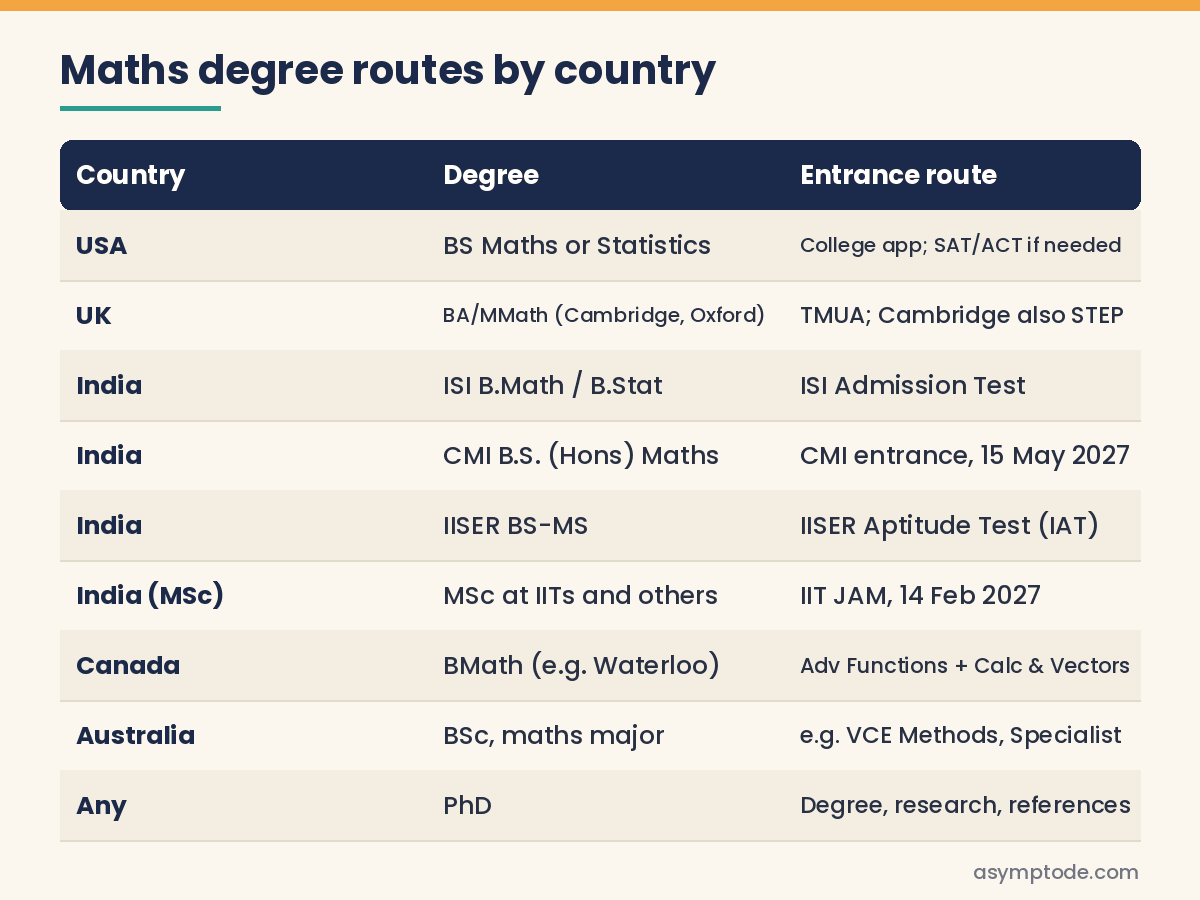
Main maths degree routes and entrance tests by country, from official admissions pages.
| Country | Degree | Entrance route |
|---|---|---|
| USA | BS in Mathematics or Statistics | College application; SAT/ACT where required |
| UK | BA/MMath (e.g. Cambridge, Oxford) | TMUA; Cambridge also uses STEP |
| India | ISI B.Math (Bengaluru) / B.Stat (Kolkata) | ISI Admission Test |
| India | CMI B.S. (Hons) Mathematics | CMI entrance, 15 May 2027 |
| India | IISER BS-MS (Mathematical Sciences) | IISER Aptitude Test (IAT) |
| India (master's) | MSc at IITs and others | IIT JAM, 14 Feb 2027 |
| Canada | BMath (e.g. Waterloo) | Grade 12 Advanced Functions, Calculus and Vectors |
| Australia | BSc with a maths major | e.g. VCE Methods (Specialist opens faster streams) |
| Any | PhD | Strong degree, research, references |
United States
Most students take a BS in mathematics or statistics. The BLS says these programs usually cover calculus, differential equations, and linear and abstract algebra. Many go straight on to a PhD.
United Kingdom: Cambridge, Oxford, TMUA and STEP
The Cambridge Mathematics page (2027 entry) says:
- The typical A level offer is A*A*A, and IB is 41-42 points with 776 at Higher Level.
- All applicants must take the TMUA (Test of Mathematics for University Admission).
- The offer usually includes grade 1 in STEP 2 and STEP 3. Some colleges offer alternatives.
STEP is run by OCR and is normally taken in June after you apply. Grades are S, 1, 2, 3 and U.
Oxford Mathematics also switched: for the 2026 admissions round (2027 entry), the MAT did not run, and all applicants took the TMUA. The test window was 12-16 October 2026. See our guides on getting into Cambridge and getting into Oxford.
India: ISI, CMI, IISER and IIT JAM
- ISI B.Math (Hons) is at Bengaluru, and B.Stat (Hons) at Kolkata. Both are 3-year courses with a stipend of Rs 5,000 per month, per the ISI 2026 admission notice. The 2026 test was on 10 May 2026. The 2027 date is not yet announced. ISI also listed a separate channel for INMO-qualified candidates in 2026.
- CMI now offers 4-year B.S. (Hons) degrees in Mathematics, Mathematics and Computer Science, and Mathematics and Physics, with a 3-year B.Sc exit option. The 2027-28 entrance exam is on Saturday, 15 May 2027. Applications are expected to open around 1 March 2027. Students who reached the IMOTC or EGMOTC in Class 11 or 12 have a direct route.
- IISERs offer a BS-MS with Mathematical Sciences as a major, through the IISER Aptitude Test. Check iiseradmission.in for 2027 dates, which are not yet announced.
- IIT JAM is the entrance for MSc courses after a bachelor's degree. JAM 2027 is organised by IIT Kharagpur. Mathematics (MA) is on 14 February 2027 (morning), and Mathematical Statistics (MS) the same afternoon.
Canada and Australia
Waterloo's Faculty of Mathematics admits typically from the mid-80s. The Euclid contest is not required for admission, but it is used for some scholarships. In Australia, most students take a Bachelor of Science with a maths major, then honours, then a PhD.
What summer programs and research can school students do?
Summer programs give a taste of real mathematics. Four well-known ones, from their official sites:
| Program | Where | 2027 status (as of 27 Oct 2026) |
|---|---|---|
| PROMYS | Boston University, 6 weeks | 27 June-7 August 2027; deadline "end of February 2027 TBD" |
| Ross Mathematics Program | Ohio and Indiana sites (2026) | 2027 not yet announced; 2026 ran 14 June-24 July |
| Canada/USA Mathcamp | Champlain College, Vermont (2026) | 2027 not yet announced; 2026 deadline was 23 Feb 2026 |
| RSI | MIT and Stanford | Deadline 11 Dec 2026, 11:59 pm ET |
PROMYS is for ages 14-18 who have finished Grade 9, and is free for US families earning under $80,000. Mathcamp took ages 13-18 in 2026. RSI is free; students usually apply in Grade 11. It runs 20 June-31 July (MIT) and 27 June-7 August 2027 (Stanford).
How long does it take to become a mathematician? The PhD path
A typical research path is:
- Bachelor's: 3 years (UK, ISI) or 4 years (US, CMI B.S.).
- Master's: many US PhD programs include it.
- PhD: several years of courses, exams and an original thesis.
- Postdoc: one or more short research jobs before a permanent post.
Industry and government jobs can start after a bachelor's or master's.
Worked example: a short proof, step by step
Claim: For every whole number n ≥ 1, the sum of the first n odd numbers is n².
1 + 3 + 5 + ... + (2n - 1) = n²
Small cases: 1 = 1², 1 + 3 = 4 = 2², 1 + 3 + 5 = 9 = 3². Now we prove it for every n by induction.
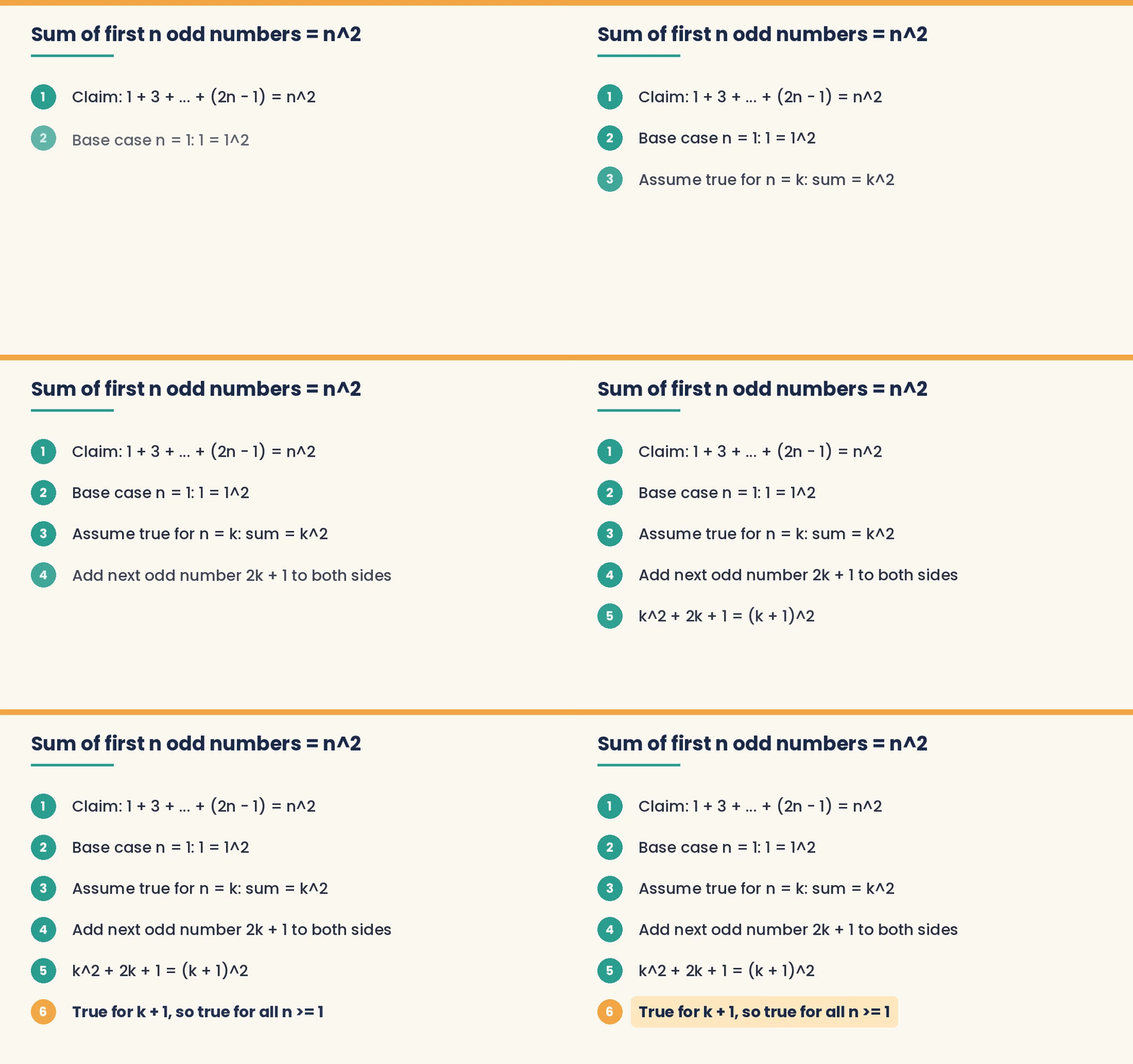
An induction proof that the first n odd numbers add up to n squared.
- The claim: 1 + 3 + ... + (2n - 1) = n² for every n ≥ 1.
- Base case (n = 1): the left side is 1. The right side is 1² = 1. They match.
- Assume it is true for n = k: 1 + 3 + ... + (2k - 1) = k².
- Add the next odd number. After 2k - 1, the next odd number is 2k + 1. Add it to both sides: 1 + 3 + ... + (2k - 1) + (2k + 1) = k² + 2k + 1.
- Factor: k² + 2k + 1 = (k + 1)². So the sum of the first k + 1 odd numbers is (k + 1)².
- Conclude: it is true for n = 1, and whenever it is true for k it is true for k + 1. So it is true for every n ≥ 1.
Picture proof: each odd number adds an L-shaped layer to a square of dots. A 2 x 2 square plus 5 dots makes 3 x 3.
A Grade 9-12 plan to become a mathematician
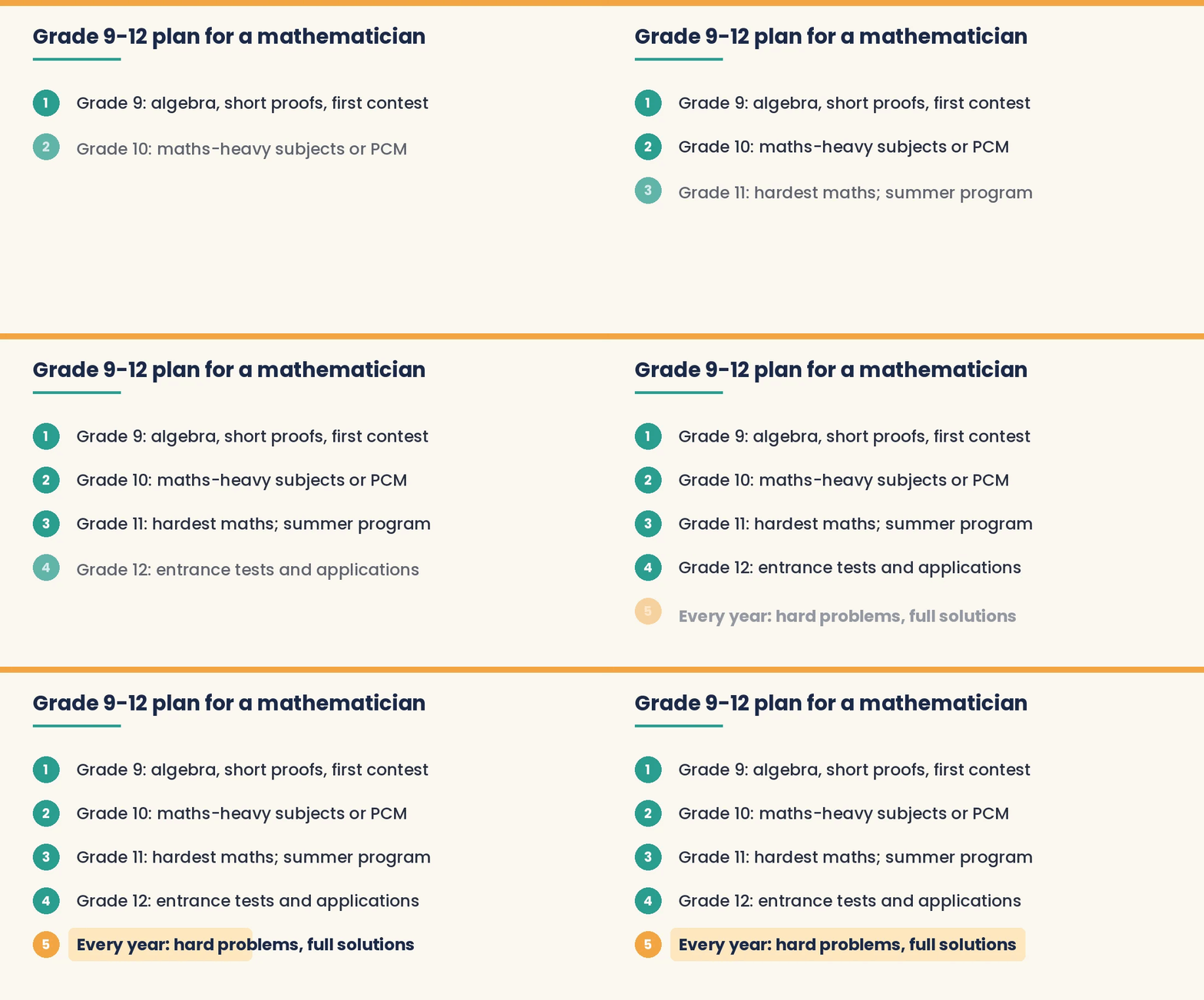
A year-by-year school plan for a future mathematician.
- Grade 9: master algebra. Start writing short proofs. Try your first contest (AMC 10, UKMT, IOQM or CEMC).
- Grade 10: choose maths-heavy subjects: PCM in India, AA HL in IB, Further Maths for A level.
- Grade 11: take the hardest maths course offered. Apply to a summer program such as PROMYS, Mathcamp or RSI.
- Grade 12: prepare for entrance tests (TMUA, STEP, ISI, CMI) and apply.
- Every year: solve a few hard problems each week and write full solutions.
Common mistakes students make
- Chasing speed, not proof. School tests reward quick answers. University maths rewards clear, complete reasoning.
- Skipping Further Maths, AA HL or PCM. Dropping the top maths course closes doors to maths degrees.
- Missing contest and test registration. RMO 2026 registration is expected in late October 2026. RSI closes on 11 December 2026.
- Ignoring statistics and coding. The BLS figures show most jobs are in statistics. Python and data skills widen your options.
How 1-on-1 tutoring helps with becoming a mathematician
At Asymptode, one student works with one dedicated mentor in live online classes, with no batches. For a future mathematician, the mentor follows your child's own syllabus (Further Maths, IB AA HL, CBSE PCM, AP Calculus) and exam dates. The mentor watches each line of a proof or contest solution and fixes the method, not just the answer. Homework is personalised, with feedback on written proofs, and the mentor helps plan practice for AMC, IOQM, TMUA, STEP, ISI or CMI. Classes run at flexible times across time zones, every class is recorded, and parents get short updates.
Ready to start? Book a free demo class or see fees.
Facts checked against official sources on 27 October 2026.
Related guides on Asymptode
- How to become a scientist
- How to become a data scientist
- AMC 10 and AMC 12 guide
- AIME 2027 guide
- IB Maths AA vs AI
- A level Maths guide
FAQ
What qualifications do you need to be a mathematician?
Usually at least a master's degree in mathematics or statistics, says the BLS. Research and university jobs need a PhD. Some government and statistics jobs accept a bachelor's degree.
How much does a mathematician earn?
In the US, the BLS gives a May 2025 median of $126,710 for mathematicians and $105,650 for statisticians. The combined median for 2025 is $105,720. Pay differs by country and sector.
Do I need to win olympiads to become a mathematician?
No. Contests build proof and problem-solving skills, and some help with admissions, such as CMI's direct route for IMOTC students. But a strong degree and research matter far more.
Which stream should I choose in India to become a mathematician?
Choose PCM (Physics, Chemistry, Mathematics) in Class 11. Then aim for ISI, CMI or an IISER, or a strong BSc followed by IIT JAM for an MSc.
Is Cambridge STEP still required for maths?
Yes. For 2027 entry, Cambridge Mathematics offers usually include grade 1 in STEP 2 and STEP 3, and all applicants must also take the TMUA.
Sources
- BLS Occupational Outlook Handbook: Mathematicians and Statisticians
- MAA: American Mathematics Competitions
- MAA: Invitational Competitions (AIME, USAMO)
- UKMT: Competition calendar 2026-27
- HBCSE: Mathematical Olympiad 2026-2027
- HBCSE: Maths Olympiad 2026-27 brochure (PDF)
- IMO: Future and past organizers
- CEMC: Tentative contest dates 2026-2027 (PDF)
- Canadian Mathematical Society: Competitions
- University of Cambridge: Mathematics course
- University of Cambridge: STEP
- University of Oxford Mathematics: TMUA
- ISI: Admission notice 2026 (PDF)
- Chennai Mathematical Institute: Admissions
- IIT Kharagpur: JAM 2027 test schedule
- University of Waterloo: Mathematics admission
- University of Melbourne: First-year mathematics and statistics
- PROMYS: For students
- Ross Mathematics Program
- Canada/USA Mathcamp: Apply
- CEE: Applications being accepted for 2027 RSI