
If you want to know how to become a data scientist, the path is clear: build strong maths (especially statistics, probability and calculus) at school, learn to code in Python and SQL, earn a degree in statistics, maths, computer science or data science, and show your skills with real projects. This guide is for students in Grades 8-12 and their parents in the US, UK, India, Canada and Australia. It explains the job in plain words, which school subjects to pick in each country, the degree routes, a worked statistics example and a year-by-year plan.
Key takeaways
- A data scientist collects data, cleans it, finds patterns with statistics and code, and explains what the data means so people can make better decisions.
- The core school subject is maths. Add statistics and computer science wherever your school offers them.
- Most data scientists hold at least a bachelor's degree in mathematics, statistics, computer science or a related field, says the US Bureau of Labor Statistics (BLS).
- BLS reports a median pay of $120,230 per year (2025) and projects 35% growth from 2025 to 2035, with about 24,800 openings a year in the US.
- Free tools such as Kaggle Learn, Harvard's CS50 Python course and Google Colab let school students start real projects now.
- The most common mistake is learning tools before learning statistics. Tools change. Maths does not.
What does a data scientist do?
Quick answer: A data scientist turns raw data into useful answers. They decide which data is useful, collect and clean it, analyse it with statistics and code, build models that predict things, and present findings with charts. In short, they ask good questions of data and explain the answers clearly to people who make decisions.
The BLS says data scientists typically determine which data are useful, collect and analyse data, create and test models and algorithms, use visualisation software to present findings, and make recommendations based on the analysis (BLS Occupational Outlook Handbook: Data Scientists).
What does a typical day look like?
Here is what a day might involve for a data scientist at a food delivery company:
- Morning: A manager asks, "Why did orders drop last week in one city?"
- Pull the data: Write an SQL query to get last month's orders.
- Clean it: Fix missing values, remove duplicate rows, check dates.
- Explore: Plot orders by day and by area in Python. Spot a dip on rainy days.
- Test: Use a statistical test to check if the dip is real or just chance.
- Model: Build a simple model that predicts orders from weather.
- Explain: Share three charts and one clear recommendation with the team.
Much of the job is cleaning data and explaining results, not just building fancy models.
How is a data scientist different from a data analyst, ML engineer or statistician?
These four jobs overlap, but each has a different focus.
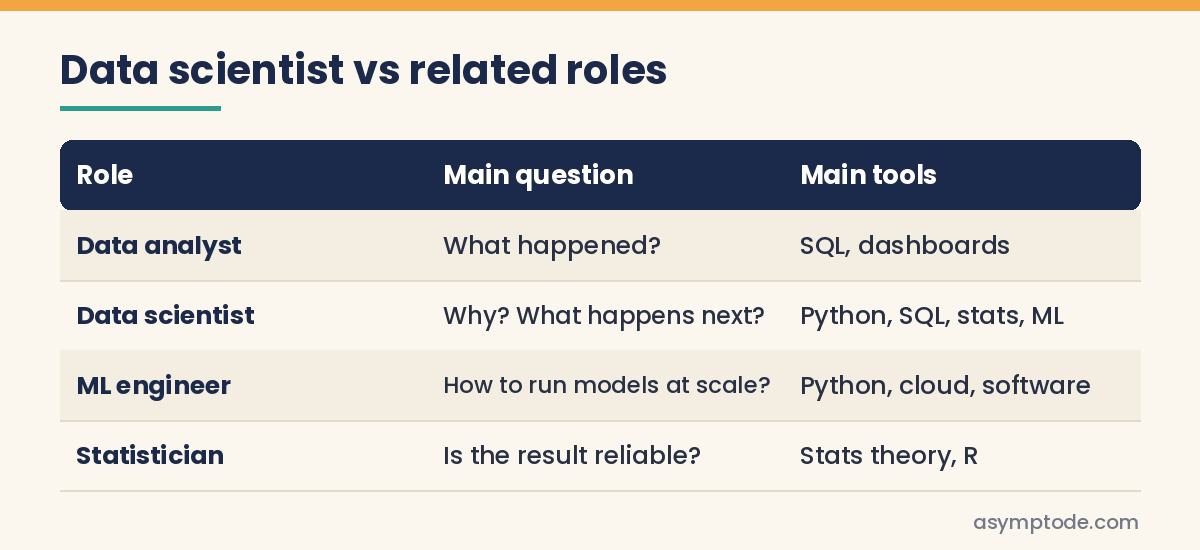
| Role | Main question | Main tools | Typical output |
|---|---|---|---|
| Data analyst | What happened? | SQL, spreadsheets, dashboards | Reports and dashboards |
| Data scientist | Why did it happen? What will happen next? | Python, SQL, statistics, machine learning | Models, experiments, recommendations |
| Machine learning (ML) engineer | How do we run a model at scale? | Python, software engineering, cloud | Models running inside apps |
| Statistician | Is this result real and reliable? | Statistical theory, R, study design | Survey and experiment designs, sound conclusions |
Many people start as data analysts and move into data science. Strong statistics helps in all four roles.
Which school subjects do you need to become a data scientist?
Maths is the one subject you cannot skip. Choose the strongest maths course your school offers. Then add statistics and computer science where you can. Physics or economics also help, because both teach you to model real problems with numbers.
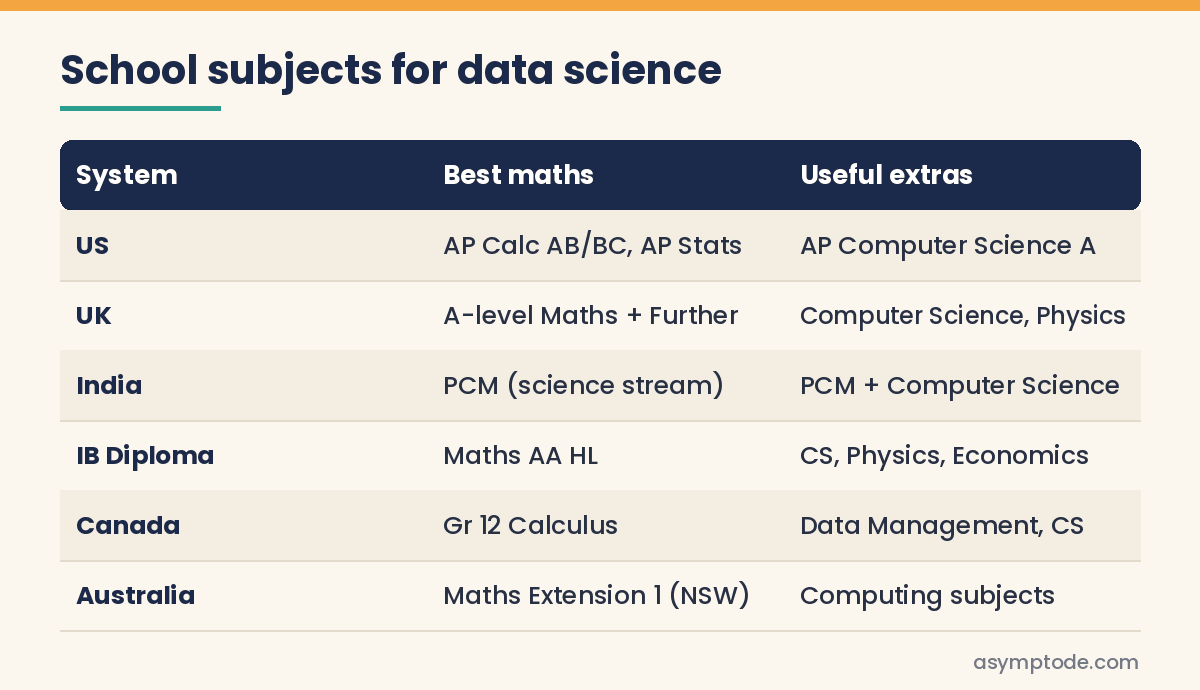
| Country or system | Best maths choice | Useful extras |
|---|---|---|
| US | AP Calculus AB or BC, AP Statistics | AP Computer Science A |
| UK | A-level Maths, plus Further Maths if possible | A-level Computer Science, Physics or Economics |
| India | Science stream with PCM (Physics, Chemistry, Maths) | PCM + Computer Science, or Informatics Practices |
| IB Diploma | Maths Analysis and Approaches (AA) HL | Computer Science, Physics or Economics |
| Canada | Grade 12 Calculus and advanced functions/pre-calculus | Computer Science, Data Management (Ontario) |
| Australia | Higher maths (e.g. NSW Maths Extension 1) | Software or computing subjects |
US: which AP courses help most?
AP Statistics teaches data, sampling and inference, which is the heart of data science. AP Calculus AB or BC builds the calculus used in machine learning. AP Computer Science A teaches programming in Java. The 2027 AP exams run 3-7 May and 10-14 May 2027: AP Calculus AB and BC are on Monday 10 May, AP Statistics on Tuesday 11 May and AP Computer Science A on Wednesday 12 May (College Board AP exam calendar). Read our guides to AP Statistics changes for 2026-27 and AP Calculus AB vs BC.
UK: is Further Maths needed?
A-level Maths is close to essential for a data science, maths or statistics degree. Top courses often want Further Maths too. For example, Warwick's MSci Data Science (2027 entry) typically asks for A*A*A with A* A* in Maths and Further Maths, or A*A*A* with an A* in Maths for students without Further Maths (University of Warwick). See our A-level Maths guide.
India: which stream should you choose?
Choose the science stream with PCM. If your school offers Computer Science as a fifth subject, take it. Maths in Class 11 and 12 is the key, because most data science and statistics degrees need it.
IB: AA or AI?
Maths Analysis and Approaches (AA) HL is the safest choice. Some universities accept other options. UBC's Data Science BSc (Okanagan campus) lists IB Maths AA SL or HL, or Applications and Interpretations (AI) HL, and does not accept AI SL (UBC). Compare both in our guide to IB Maths AA vs AI.
Want a mentor to strengthen your maths and statistics before Grade 11? Book a free demo class.
Which degrees lead to a data science career?
The BLS says data scientists typically need at least a bachelor's degree in mathematics, statistics, computer science or a related field, and some employers want a master's or doctorate. Good first degrees include:
- Statistics (strongest base for data analysis)
- Mathematics (deep theory, very flexible)
- Computer science (strong coding and software skills)
- Data science (a mix of all three)
- Economics, physics or engineering, with extra statistics and coding
What are the entrance routes in India?
| Route | How you get in | Notes |
|---|---|---|
| IIT B.Tech in Mathematics and Computing | JEE Main, then JEE Advanced | Offered at several IITs, e.g. IIT Hyderabad |
| ISI B.Stat (Hons) | ISI Admission Test | The 2026 test was on 10 May 2026 (ISI) |
| ISI Bachelor of Statistical Data Science (BSDS) | JEE Main or CUET (UG) scores, 2026 cycle | Kolkata, Delhi and Bengaluru; Class 12 Maths and English; 75% aggregate (ISI) |
| CMI B.S. (Hons) Maths and Computer Science | CMI entrance exam | 2027 exam: Saturday 15 May 2027; Data Science minor available (CMI) |
| IIT Madras BS in Data Science and Applications | Online qualifier process, or JEE Advanced eligibility | Open to anyone who has passed Class 12 (IIT Madras) |
ISI has not yet announced its 2027 dates; the test is usually in May. For JEE timelines, read our JEE Main 2027 guide.
What about the UK, US, Canada and Australia?
- UK: Apply through UCAS. For 2027 entry, the deadline for most courses is 13 January 2027 at 18:00 UK time (UCAS). Some courses accept TMUA or STEP as part of an offer.
- US: There is no single entrance exam. Many colleges offer statistics, data science or computer science majors. Strong AP maths scores and projects help.
- Canada: Apply to each university or through provincial systems. Most data science programmes need Grade 12 maths, and many need calculus.
- Australia: UNSW's Bachelor of Data Science and Decisions is a three-year degree with Mathematics Extension 1 as assumed knowledge. Domestic students apply through UAC (UNSW).
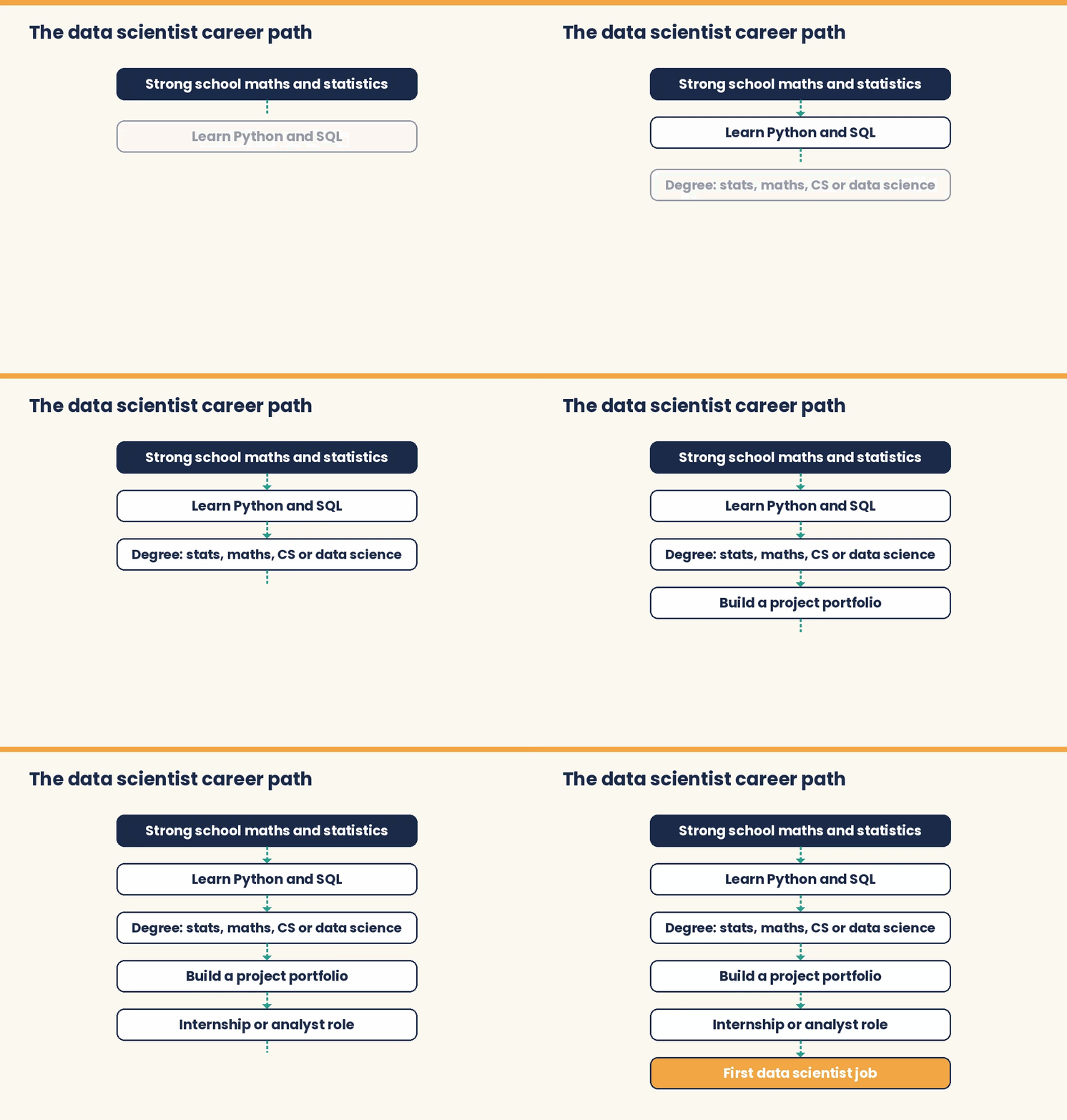
The usual path has six stages: strong school maths and statistics; learning Python and SQL; a degree in statistics, maths, CS or data science; a portfolio of projects; an internship or analyst role; and then a data scientist job.
What skills does a data scientist need?
| Skill | Why it matters | Where to start |
|---|---|---|
| Python | The main language for analysis and models | CS50 Python, Kaggle Learn |
| SQL | Pulls data out of databases | Kaggle Learn, school CS classes |
| Statistics | Tells real patterns from random noise | AP Statistics, A-level stats |
| Probability | Measures how likely events are | School maths, past paper practice |
| Linear algebra | Powers most machine learning models | Vectors and matrices in Further Maths or IB HL |
| Calculus | Explains how models learn | AP Calculus, A-level Maths |
| Communication | Turns results into decisions | School projects, presentations |
Worked example: mean and standard deviation
Standard deviation tells you how spread out data is. It is one of the first tools every data scientist uses.
Problem: Six students recorded hours of sleep: 4, 8, 6, 5, 3, 10. Find the mean and the standard deviation.
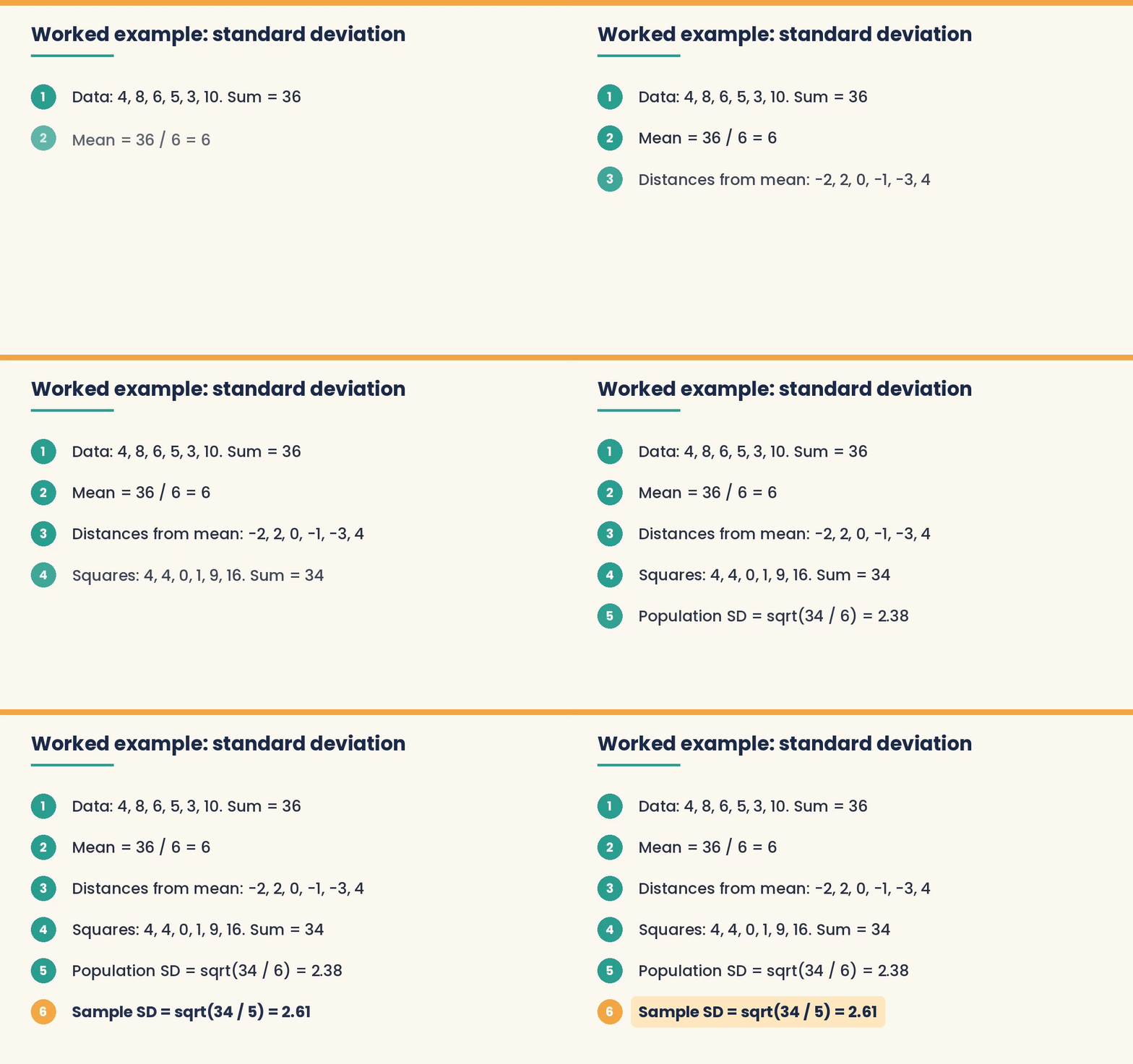
- Add the values: 4 + 8 + 6 + 5 + 3 + 10 = 36.
- Find the mean: 36 / 6 = 6 hours.
- Find each distance from the mean: -2, 2, 0, -1, -3, 4.
- Square each one: 4, 4, 0, 1, 9, 16. Their sum is 34.
- Population variance: 34 / 6 = 5.67. Population standard deviation: square root of 5.67 = 2.38 hours.
- Sample version: If these six students are a sample of a bigger class, divide by 5 instead: 34 / 5 = 6.8, so the sample standard deviation is 2.61 hours.
What it means: Most students slept within about 2.4 hours of the 6-hour average. Choosing between dividing by n or n - 1 is exactly the kind of detail data scientists must get right.
Quick probability check
Problem: You roll two fair dice. What is the chance the total is 7?
There are 6 x 6 = 36 equally likely outcomes. Six of them make 7: (1,6), (2,5), (3,4), (4,3), (5,2), (6,1). So the probability is 6/36 = 1/6, about 0.167. We checked both answers in Python.
Which free projects and competitions can school students try?
You do not need to wait for university. These are real, free options:
- Kaggle Learn: No-cost short courses in Python, Pandas, data visualisation and more, with real datasets. Under-16s need a parent or guardian to set up access, as MEI's school guidance explains (MEI Kaggle guidance).
- CS50's Introduction to Programming with Python: Harvard's free course for beginners. No prior coding needed.
- MEI Introduction to Data Science (UK): A free 12.5-hour online course for A-level Maths and Core Maths students, using Python on Kaggle.
- ASA Data Visualization Poster Competition (US and Canada): Open to K-12 students. The poster deadline is 1 April each year.
Starter project ideas:
- Track your own screen time for a month and find your average and spread.
- Survey classmates about sleep and test scores. Is there a link?
- Download a public weather dataset and chart rainfall trends.
- Analyse your favourite sport's player statistics.
Write up each project: question, data, method, result and what you would do next.
What is the job outlook for data scientists?
We only quote official numbers here. From the BLS Occupational Outlook Handbook: Data Scientists (last modified 27 August 2026):
| Measure | Official figure |
|---|---|
| Median pay (2025) | $120,230 per year ($57.80 per hour) |
| Typical entry-level education | Bachelor's degree |
| Number of jobs (2025) | 275,600 |
| Projected growth (2025-35) | 35%, much faster than average |
| Openings per year (average) | About 24,800 |
These figures are for the US only. Pay and demand in the UK, India, Canada and Australia differ, so check official national sources. Median pay means half earned more and half earned less. Starting pay is usually lower.
Step-by-step plan: Grade 9 to your first job
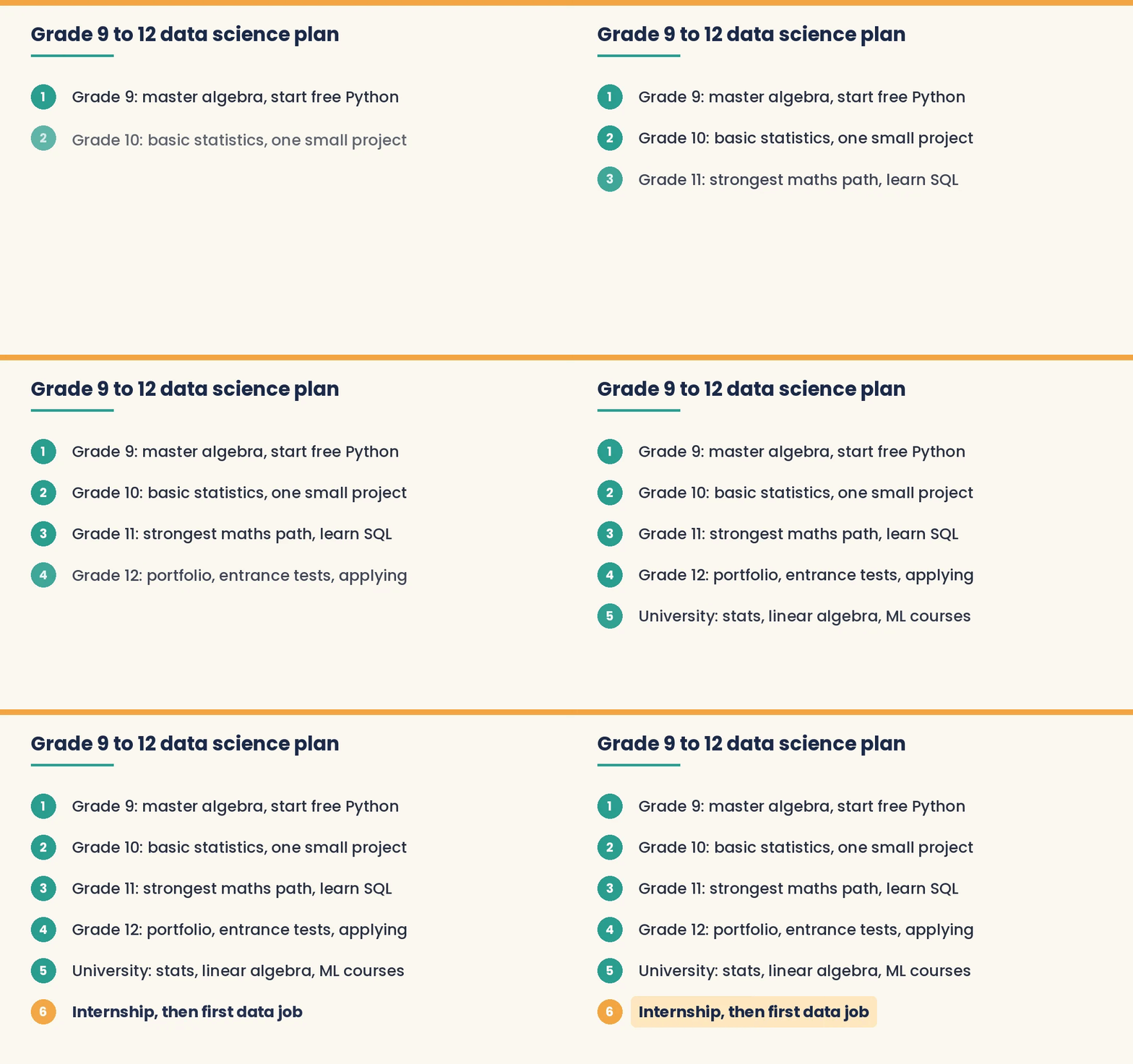
- Grade 9: Master algebra and graphs. Start a free Python course.
- Grade 10: Learn basic statistics: mean, median, standard deviation, charts. Finish one small data project.
- Grade 11: Choose the strongest maths path (AP Calculus or Statistics, A-level Maths and Further Maths, IB AA HL, or PCM). Learn SQL basics.
- Grade 12: Build two or three projects into a portfolio. Prepare for entrance exams (JEE, ISI, CMI) or apply through UCAS, UAC or US colleges.
- University: Take statistics, probability, linear algebra and machine learning courses. Join a data club.
- Internship: Aim for a summer internship or research project in Year 2 or 3.
- First job: Many people start as data analysts or junior data scientists, then grow.
What are the most common mistakes?
- Learning tools before maths. Libraries make it easy to run a model you do not understand.
- Weak statistics. Confusing correlation with cause leads to wrong decisions.
- Dropping maths too early. In India, leaving PCM, or in the UK, skipping A-level Maths, closes many doors.
- Collecting certificates, not projects. One well-explained project beats ten course badges.
- Ignoring communication. A great analysis is useless if nobody understands it.
- Copying code without checking it. Always check results by hand on a small example, as we did above.
How 1-on-1 tutoring helps with a data science path
Data science rests on maths. A student who is shaky in algebra, statistics or calculus will struggle later, however good their coding is. At Asymptode, each student works 1-on-1 with one dedicated mentor in live online classes, with no batches.
- Maths and statistics foundation: The mentor watches each step of the working and fixes the method, from standard deviation to probability trees.
- AP Statistics and AP Calculus: Lessons follow the student's own syllabus and exam dates.
- A-level Maths, Further Maths and IB AA HL: Focused practice on the statistics and calculus topics that matter most.
- JEE maths: Calm, method-first problem solving for JEE Main and Advanced.
- Flexible and transparent: Scheduling works across time zones, every class is recorded, homework is personalised with feedback, and parents get short updates.
Ready to build a strong maths base? Book a free demo class or see fees. Interested in research too? Read how to become a scientist.
Facts checked against official sources on 27 October 2026.
FAQ
How many years does it take to become a data scientist?
It usually takes three to four years for a bachelor's degree, plus time to build projects and experience. Some employers want a master's degree, which adds one to two years. Starting Python and statistics in school can speed things up.
Can I become a data scientist without a computer science degree?
Yes. The BLS lists mathematics, statistics, computer science or a related field. Many data scientists studied statistics, maths, economics or physics and learned to code alongside their degree.
Is data science hard to learn in school?
The basics are not too hard. Mean, standard deviation, simple charts and beginner Python are well within reach of a Grade 9 or 10 student. The harder parts, like machine learning theory, come later with university maths.
Which is better for data science: AP Statistics or AP Calculus?
Both help, so take both if you can. AP Statistics teaches data and inference directly. AP Calculus builds the maths behind machine learning and is often expected by strong university programmes.
Do I need JEE to study data science in India?
Not always. JEE Advanced leads to IIT Mathematics and Computing programmes, and ISI's BSDS used JEE Main or CUET scores in 2026. ISI B.Stat and CMI use their own entrance exams, and IIT Madras's online BS has its own qualifier.
How much does a data scientist earn?
In the US, the BLS reports a median pay of $120,230 per year for 2025. We do not quote figures for other countries without an official source. Pay depends on country, city, experience and employer.
Sources
- U.S. Bureau of Labor Statistics: Occupational Outlook Handbook, Data Scientists
- College Board: AP Exam Calendar (2027)
- University of Warwick: MSci Data Science (2027 entry)
- UCAS: 2027 entry deadline for most undergraduate courses
- UBC: Data Science (Okanagan) admission requirements
- UNSW: Bachelor of Data Science and Decisions
- Indian Statistical Institute: Admissions
- Indian Statistical Institute: Bachelor of Statistical Data Science (BSDS)
- Chennai Mathematical Institute: Admissions
- IIT Madras: BS in Data Science and Applications admissions
- IIT Hyderabad: B.Tech in Mathematics and Computing
- Kaggle Learn
- Harvard CS50: Introduction to Programming with Python
- MEI: Introduction to Data Science
- MEI: Kaggle guidance for students
- American Statistical Association: Data Visualization Poster Competition for Grades K-12