
If you want to know how to get into Oxford, the short version is this: pick one course, meet its subject needs, apply through UCAS by 15 October, do well in any admissions test, and show real thinking at interview. The 15 October 2026 deadline for 2027 entry has now passed, so this guide is built for students aiming at 2028 entry and beyond. Every fact below comes from the University of Oxford's own admissions pages.
Key takeaways
- You apply through UCAS to one Oxford course. You cannot apply to Oxford and Cambridge in the same year.
- The UCAS deadline is 6pm UK time on 15 October in the year before you start. For 2027 entry it was 15 October 2026 and has passed. For 2028 entry it is usually 15 October 2027 (official dates not yet announced).
- For 2027 entry, Oxford replaced its own MAT, PAT and TSA with the UAT-UK tests: TMUA, ESAT and TARA. Medicine uses UCAT and Law uses LNAT.
- Typical offers are A*A*A to AAA at A-level, or 38 to 40 IB points including core, with 6s and 7s at Higher Level.
- Interviews are online in December. Decisions come out in January.
- Maths is at the heart of most science tests. Strong method, built early, matters more than last-minute cramming.
How do you get into Oxford? The short answer
Quick answer: To get into Oxford, choose a course that fits your strongest subjects, take the A-levels, IB subjects or other qualifications it needs, and aim for top grades. Apply on UCAS by 15 October. Prepare early for any admissions test (such as TMUA or ESAT). If shortlisted, you will have online interviews in December, and you will hear in January.
Oxford is looking for academic potential and real interest in your subject. It does not judge you on manners, looks or background. Clubs and sports only count if they show something about your subject. So the whole process is about one thing: can you think hard and well about the subject you chose?
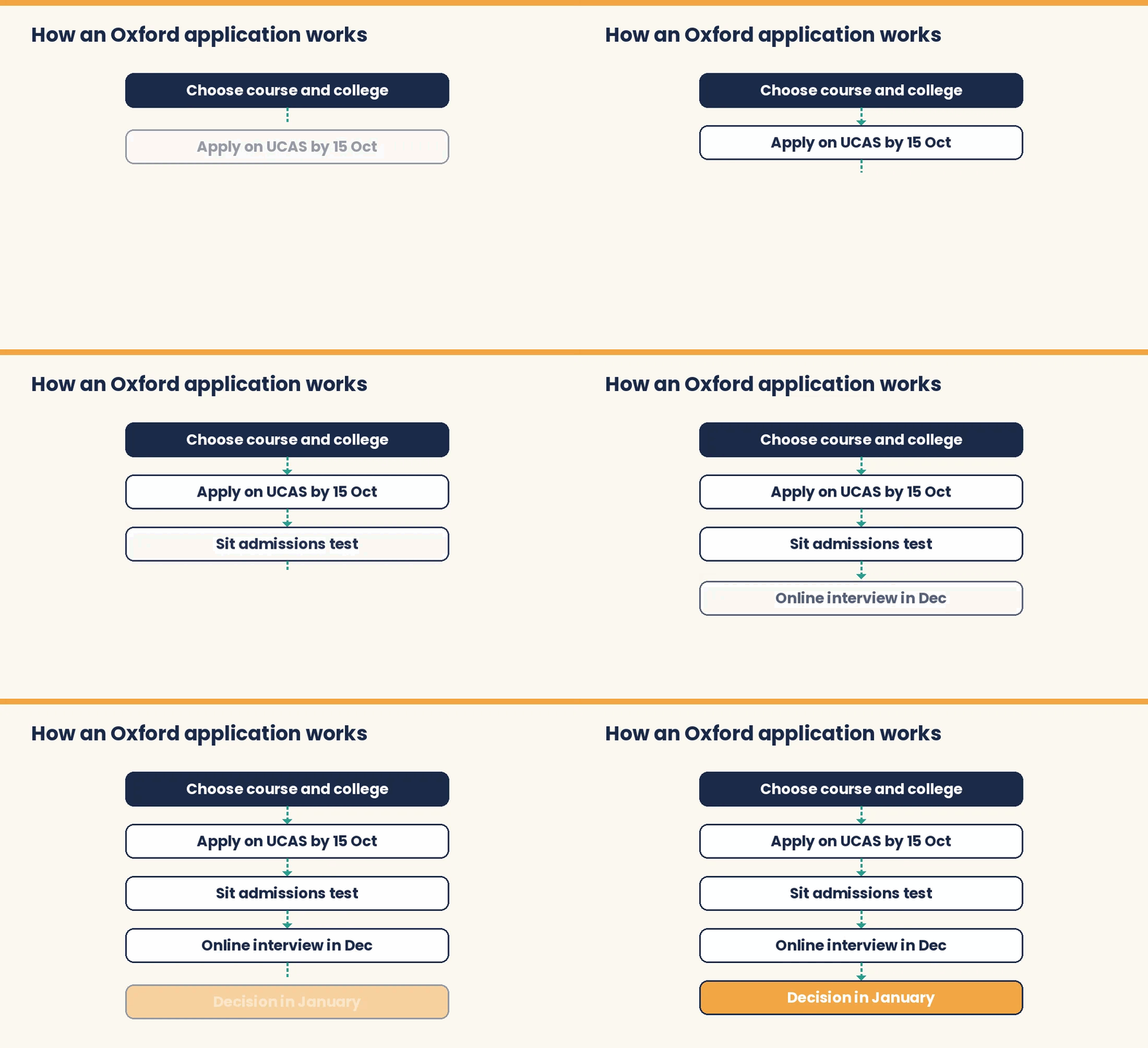
- Choose your course and a college (or an open application).
- Apply on UCAS by 6pm UK time on 15 October.
- Sit your admissions test, if your course needs one (usually October).
- Online interview in December, if you are shortlisted.
- Get your decision in January, then meet your offer conditions.
What is the Oxford application timeline?
Oxford runs earlier than most UK universities. Here are the official dates for 2027 entry, from Oxford's admissions timeline, next to the usual pattern for 2028 entry.
| Stage | 2027 entry (official) | 2028 entry (usual pattern) |
|---|---|---|
| Start UCAS form | From May 2026 | Usually May 2027 |
| UAT-UK test booking closes | 28 September 2026 | Usually late September 2027 |
| UCAS deadline | 6pm UK, 15 October 2026 (passed) | Usually 15 October 2027 |
| UAT-UK tests (TMUA, ESAT, TARA) | 12 to 16 October 2026 | Usually October 2027 |
| Written work (some courses) | 10 November 2026 | Usually early November 2027 |
| Shortlisting news | Late November to early December 2026 | Usually late November 2027 |
| Online interviews | Early to mid-December 2026 | Usually December 2027 |
| Decisions | 12 January 2027 | Usually January 2028 |
For 2028 entry, official dates are not yet announced. Check the timeline page again in spring 2027.
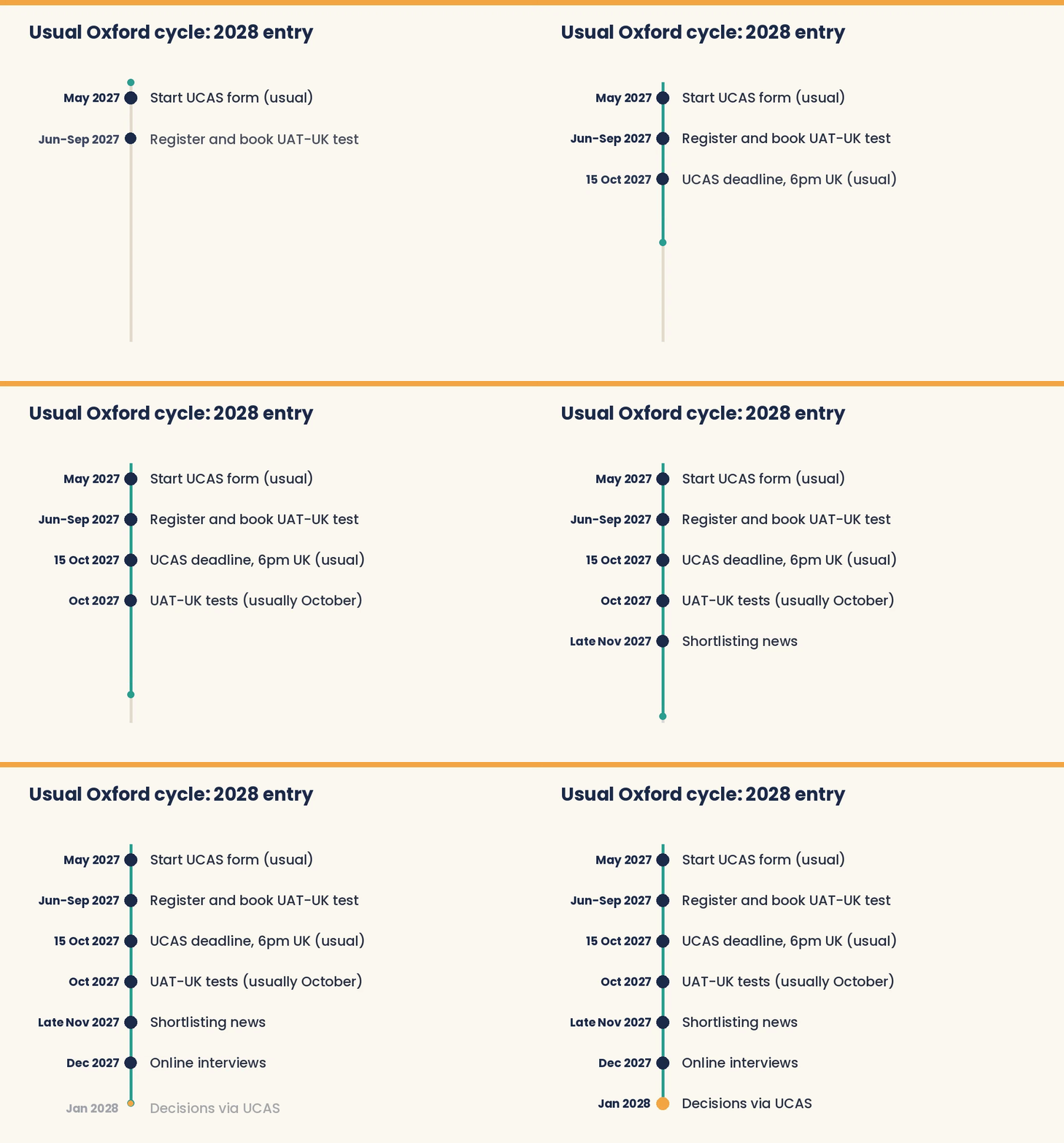
- May 2027: start your UCAS form (usually opens in May).
- June to September 2027: register and book your UAT-UK test, if your course needs one.
- 15 October 2027: usual UCAS deadline, 6pm UK time.
- October 2027: UAT-UK tests usually take place.
- Late November 2027: shortlisting news usually arrives.
- December 2027: online interviews.
- January 2028: decisions via UCAS.
Which admissions test do I need for Oxford?
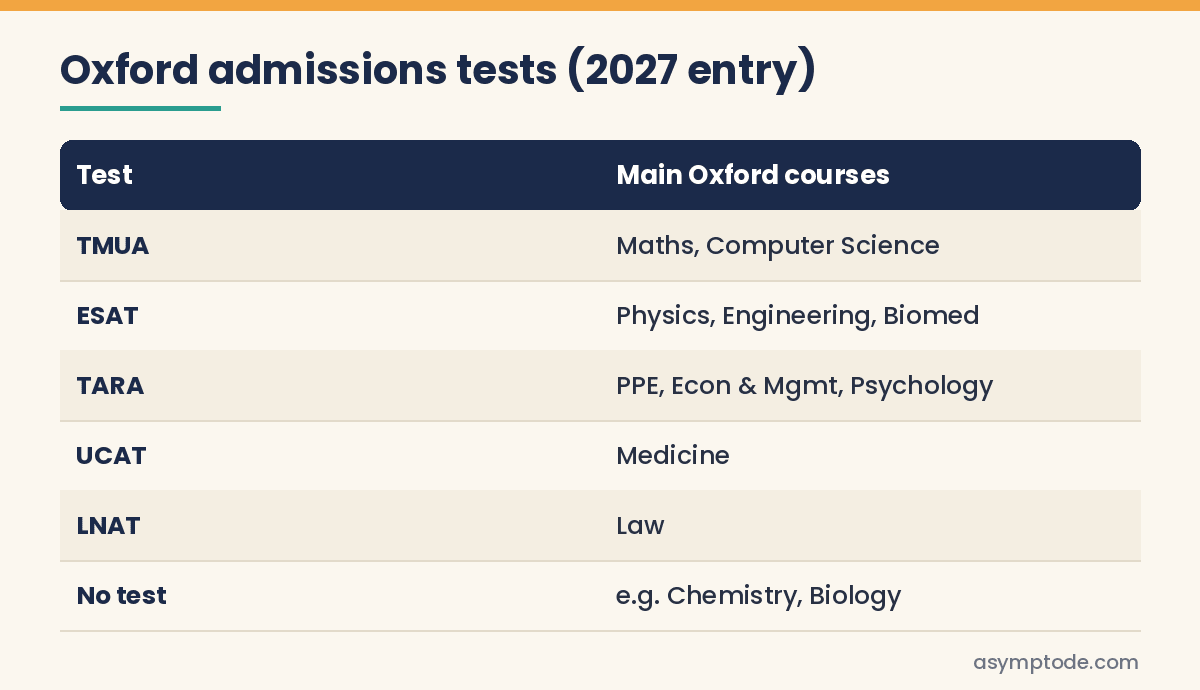
Most Oxford courses now use national tests run by UAT-UK and Pearson. Here is the list for 2027 entry, from Oxford's admissions tests page. Check it again for 2028 entry, as lists can change.
| Test | Oxford courses (2027 entry) |
|---|---|
| TMUA | Mathematics; Mathematics and Statistics; Computer Science; Maths and Computer Science; Maths and Philosophy; Computer Science and Philosophy |
| ESAT | Physics; Physics and Philosophy; Engineering Science; Biomedical Sciences |
| TARA | PPE; Economics and Management; History and Economics; History and Politics; Human Sciences; Experimental Psychology; Psychology, Philosophy and Linguistics |
| UCAT | Medicine; Graduate-entry Medicine |
| LNAT | Law (Jurisprudence); Law with Foundation Year |
| No test | Other courses, such as Chemistry and Biology (some ask for written work instead) |
What happened to the MAT, PAT and TSA?
For 2027 entry, Oxford stopped using them. The MAT and PAT were replaced by TMUA and ESAT, and the TSA by TARA. Old MAT and PAT papers are still good practice for maths and physics thinking. But your real target is now the new test format.
What are TMUA and ESAT like?
According to the official UAT-UK site:
- TMUA: two papers of 75 minutes, each with 20 multiple-choice questions. Paper 1 is about using maths in new situations. Paper 2 is about mathematical reasoning and logic. No calculator.
- ESAT: everyone takes Mathematics 1. Most people also take two of Biology, Chemistry, Physics and Mathematics 2. Each module is 40 minutes with 27 multiple-choice questions. No calculator. Your course page says which modules you need.
- Both are scored from 1 to 9. Wrong answers are not penalised, so answer every question.
For 2027 entry, the October sitting ran from 12 to 16 October 2026, and booking closed on 28 September 2026. For 2028 entry, expect a similar October window. UCAT and LNAT have their own dates, set by Pearson.
What grades do you need to get into Oxford?
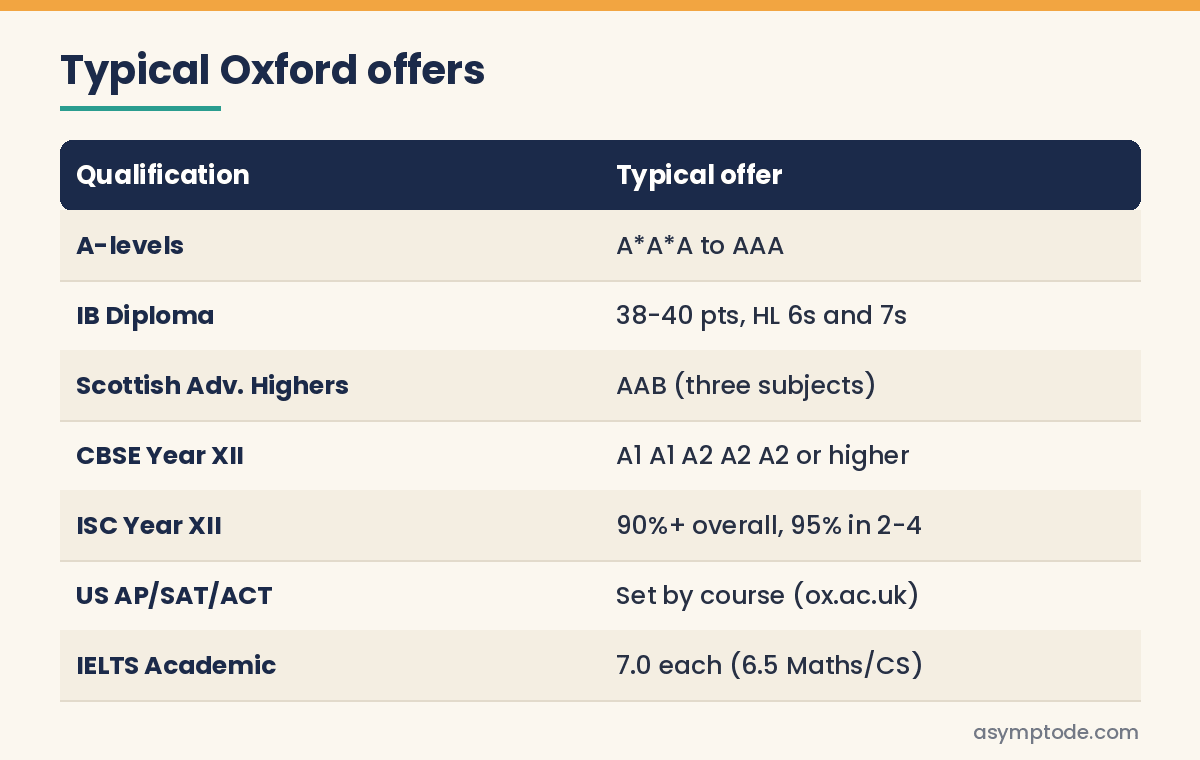
Oxford's UK qualifications page and international qualifications page set out the typical offers. Your exact offer depends on the course.
| Qualification | Typical offer |
|---|---|
| A-levels | A*A*A to AAA |
| IB Diploma | 38, 39 or 40 points including core, with 6s and 7s at Higher Level |
| Scottish Advanced Highers | Usually AAB in three Advanced Highers, plus strong Highers |
| India: CBSE Year XII | From A1 A1 A2 A2 A2 (AAA courses) to A1 A1 A1 A1 A2 (A*A*A courses) |
| India: ISC (CISCE) Year XII | At least 90% overall, with 95%+ in two to four subjects and 85%+ in the rest |
| USA: AP / SAT / ACT | Set by course; see the official list |
| English (IELTS Academic) | 7.0 in each part (6.5 for Maths and Computer Science courses) |
What about GCSEs?
No course has a fixed GCSE requirement. But Oxford says successful applicants usually have a high share of grades 7, 8 and 9. Tutors read GCSEs in the context of your school.
Can I apply from India?
Yes, with CBSE or ISC Year XII. Oxford does not accept state board exams, NIOS, or the JEE and NEET entrance exams as a basis for an offer. You need an A1 (CBSE) or a high mark in subjects linked to your course.
Can I apply with US qualifications?
Yes. Oxford asks US applicants for a mix of AP results and/or SAT or ACT scores. The rules vary by course. As one example, Oxford's Computer Science department lists four APs at grade 5 including Calculus BC, or SAT or ACT routes with set minimum scores. A high school diploma alone is not enough. Our AP guide for parents explains how AP exams work.
Which subjects should I take?
Many science courses need maths. For example, Physics and Engineering need A-level Maths and Physics (or equivalents). Computer Science needs Maths, and the department strongly recommends Further Maths. If you study IB, choose Maths at Higher Level. Our guides on A-level Maths, A-level Physics and IB Maths AA vs AI help you plan.
What English level do international students need?
Oxford's English language requirements have two levels:
- Standard level (Computer Science, Maths, Maths and Computer Science, Maths and Statistics): IELTS 6.5 in each part.
- Higher level (all other courses): IELTS 7.0 in each part.
Other tests, such as TOEFL iBT, Cambridge C1/C2 and PTE Academic, are also accepted with set scores. You may be exempt if you studied the IB in English, or if your last two years of full-time school were taught in English. You do not need proof when you apply. You must meet the level by 31 July of the year you get your offer.
Need help with the maths or science side of your Oxford plan? Book a free demo class with an Asymptode mentor, or see our fees.
How does the UCAS application work for Oxford?
Oxford's UCAS page sets the rules:
- Choose one course. You can only apply to one Oxford course, and not to Cambridge in the same year.
- Choose a college, or make an open application. Open applicants are placed at a college with fewer applicants for that course that year.
- Write your personal statement. The new UCAS format has three questions, at least 350 characters each, and 4,000 characters in total. The same statement goes to all your universities, so focus on your subject.
- Get your reference. Your school uploads it. Oxford will not look at an application without one.
- Submit by 6pm UK time on 15 October.
- Register for any test and send any written work by the deadline (10 November for 2027 entry).
Does my college choice matter?
Less than many people think. Oxford says you may be interviewed at more than one college, so your first choice is not your only chance. Choose a college you like, or apply open. Spend your energy on the test and interview instead.
What are Oxford interviews like?
Oxford's interviews page says interviews are held online on Microsoft Teams in early to mid-December. Some subjects use a virtual whiteboard or a stylus for working. Each interview is usually with two tutors, and you will likely have more than one. Oxford runs around 20,000 interviews for about 10,000 shortlisted applicants.
An interview is like a short tutorial. A tutor gives you a new problem and watches how you think. For maths and science, this often means a question you have never seen. The tutor wants to hear your steps, not just your answer.
How to prepare:
- Practise solving problems out loud.
- Re-read your personal statement and any written work.
- Look at the sample questions and demo interview on Oxford's site.
- Test your camera, microphone and internet early.
- Keep paper, a pen and water nearby.
Does Oxford use contextual data?
Yes, for UK applicants. Oxford's contextual data page explains that tutors look at your school's results, your postcode (using ACORN and the Index of Multiple Deprivation), free school meals since age 11 and care experience. Applicants with care experience or free school meals, and others in the most disadvantaged group, are strongly recommended for interview, as long as they look likely to meet the offer and reach a suitable test standard.
How much does Oxford cost, and are there scholarships?
Oxford's course fees page lists these fees for 2027 entry (2027/28):
| Student status | Tuition fee per year (2027/28) |
|---|---|
| Home | £10,050 |
| Overseas | £39,620 to £66,580, depending on course |
Clinical Medicine costs more for overseas students. Living costs are extra. Fees usually rise each year, and 2028 entry fees are not yet published. Always check the official page.
Scholarships: The Reach Oxford Scholarship is for students from low-income countries on the OECD list who cannot study for a degree at home. It covers fees, a living grant and one return flight a year. Oxford says there are around two or three awards each year. You can only apply after you get an offer, usually in January and February of your start year. UK students should look at Oxford's bursaries on the fees and funding pages.
Step-by-step plan: from Year 10 (Grade 9) to an Oxford offer
- Year 10 / Grade 9: build strong foundations. Aim for top GCSE or IGCSE grades, especially in maths and science. Fix weak topics now, not later.
- Year 11 / Grade 10: choose the right subjects. Pick A-levels or IB subjects that match your course. For maths, physics, engineering or computer science, take Maths (and Further Maths if you can).
- Year 12 / Grade 11, autumn to spring: read beyond the syllabus. Try problem sets, books and online lectures in your subject. Start a notebook of ideas you find interesting.
- Year 12 / Grade 11, spring to summer: start test prep. Learn the TMUA or ESAT format. Do timed practice without a calculator. Go to open days, in person or online.
- Summer before Year 13 / Grade 12: draft your personal statement and book your test. For 2028 entry, UCAS usually opens in May 2027.
- September to October: finish your UCAS form, get your reference, and submit by 15 October. Sit your test in October.
- November to December: practise interview problems out loud. Interviews are in December.
- January: get your decision. Then work hard to meet your offer.
Common mistakes to avoid
- Leaving test prep too late. TMUA and ESAT reward fast, accurate, calculator-free maths. That takes months, not weeks.
- Missing the test booking deadline. For 2027 entry it was 28 September 2026, before the UCAS deadline.
- Choosing the wrong subjects. Not taking Maths (or Maths HL in IB) can close the door to many science courses.
- A list-style personal statement. Tutors want depth in your subject, not a list of clubs.
- Memorising answers for interview. Tutors give new problems. They want to see you think.
- Ignoring the English rule. International offers can depend on meeting the English level by 31 July.
- Relying on unofficial dates. Always check ox.ac.uk and UAT-UK, as rules changed for 2027 entry.
How 1-on-1 tutoring helps with getting into Oxford
At Asymptode, we teach maths and science one-to-one, live online. Each student works with one dedicated mentor. Here is how that supports an Oxford plan:
- School grades first. Your mentor follows your own syllabus (A-level, IB, CBSE, ISC or AP) and your exam dates, so your grades stay on track.
- Method-first problem solving. Your mentor watches each step of your working and fixes the method, not just the final answer. This is exactly the skill TMUA, ESAT and interviews test.
- Test prep for the maths and science parts. We help with TMUA, the ESAT maths, physics, chemistry and biology modules, and MAT and PAT-style problems for extra practice. For TARA, UCAT or LNAT, we help with the maths and logic parts and with study planning.
- Thinking out loud. Live sessions are great practice for explaining your steps, just like an interview.
- Personalised homework with feedback, plus short updates for parents.
- Every class is recorded, so you can revise hard topics again.
- Flexible times across time zones, which helps students in India, the US and elsewhere.
You can book a free demo class to meet a mentor, or see our fees. To pick the right person, read how to choose an online maths tutor.
Facts checked against official sources on 25 October 2026.
FAQ
When is the Oxford application deadline?
It is 6pm UK time on 15 October, a year before you start. For 2027 entry it was 15 October 2026 and has passed. For 2028 entry it is usually 15 October 2027.
Does Oxford still use the MAT and PAT?
No. For 2027 entry, Oxford replaced the MAT with TMUA, the PAT with ESAT and the TSA with TARA. Old MAT and PAT papers are still useful practice.
What IB score do I need for Oxford?
Usually 38, 39 or 40 points including core, depending on the course, with 6s and 7s in Higher Level subjects.
Can Indian students apply to Oxford with CBSE?
Yes. Oxford accepts CBSE and ISC Year XII with high grades. It does not accept state boards, NIOS, JEE or NEET for entry.
Are Oxford interviews online?
Yes. Interviews are online on Microsoft Teams, usually in early to mid-December. You will likely have more than one.
Can I apply to Oxford and Cambridge in the same year?
No. You can apply to only one of them in a single UCAS cycle, and to only one Oxford course.
Ready to build the maths and science skills Oxford looks for? Book a free demo class or see our fees.
Sources
- University of Oxford: Admissions timeline
- University of Oxford: Admissions tests
- UAT-UK: ESAT
- UAT-UK: TMUA
- University of Oxford: UK qualifications
- University of Oxford: International qualifications
- University of Oxford: English language requirements
- University of Oxford: UCAS application
- University of Oxford: Interviews
- University of Oxford: Contextual data
- University of Oxford: Course fees for 2027 entry
- University of Oxford: Reach Oxford Scholarship
- Oxford Department of Computer Science: Entrance requirements