
Here is how to get into Cambridge in one line: pick one course, meet its grade and subject rules (usually A*A*A or A*AA at A level, or 41-42 IB points with 776 at Higher Level), apply through UCAS by 15 October, complete My Cambridge Application, sit any admissions test and do well at interview. The 15 October 2026 deadline for 2027 entry has now passed. The next one is for 2028 entry, usually mid-October 2027. This guide covers each step for students in the UK, India, the US and elsewhere.
Key takeaways
- Cambridge has one main application route: UCAS plus an extra form called My Cambridge Application.
- For 2027 entry, the UCAS deadline was 15 October 2026 (6pm UK time). Official 2028 entry dates are not yet announced; expect mid-October 2027.
- Typical minimum offers are A*A*A for sciences and A*AA for many arts courses. The IB offer is 41-42 points with 776 at Higher Level.
- Many courses need a test. ESAT is for Engineering and Natural Sciences. TMUA is for Maths, Computer Science and Economics. UCAT is for Medicine.
- You cannot apply to Cambridge and Oxford in the same year.
- CBSE Class XII alone suits only some courses and Colleges. US students usually need five AP 5s plus a high SAT or ACT.
How do you get into Cambridge?
Quick answer: Choose one course and either one College or an open application. Apply through UCAS by the October deadline, then submit My Cambridge Application about a week later. Sit any required admissions test, attend an interview in December if shortlisted, and meet your conditional offer grades in the summer.
Cambridge receives about six applications per place on average, says its official statistics page. This varies by course, so check the official dashboard for yours.
Colleges weigh your grades, predicted grades, personal statement, school reference, test score, interview and context together. Successful students usually know their subject deeply and can explain their thinking out loud.
What is the Cambridge application timeline for 2027 and 2028 entry?
The official Cambridge dates and deadlines page currently lists the 2027 entry cycle. Key dates:
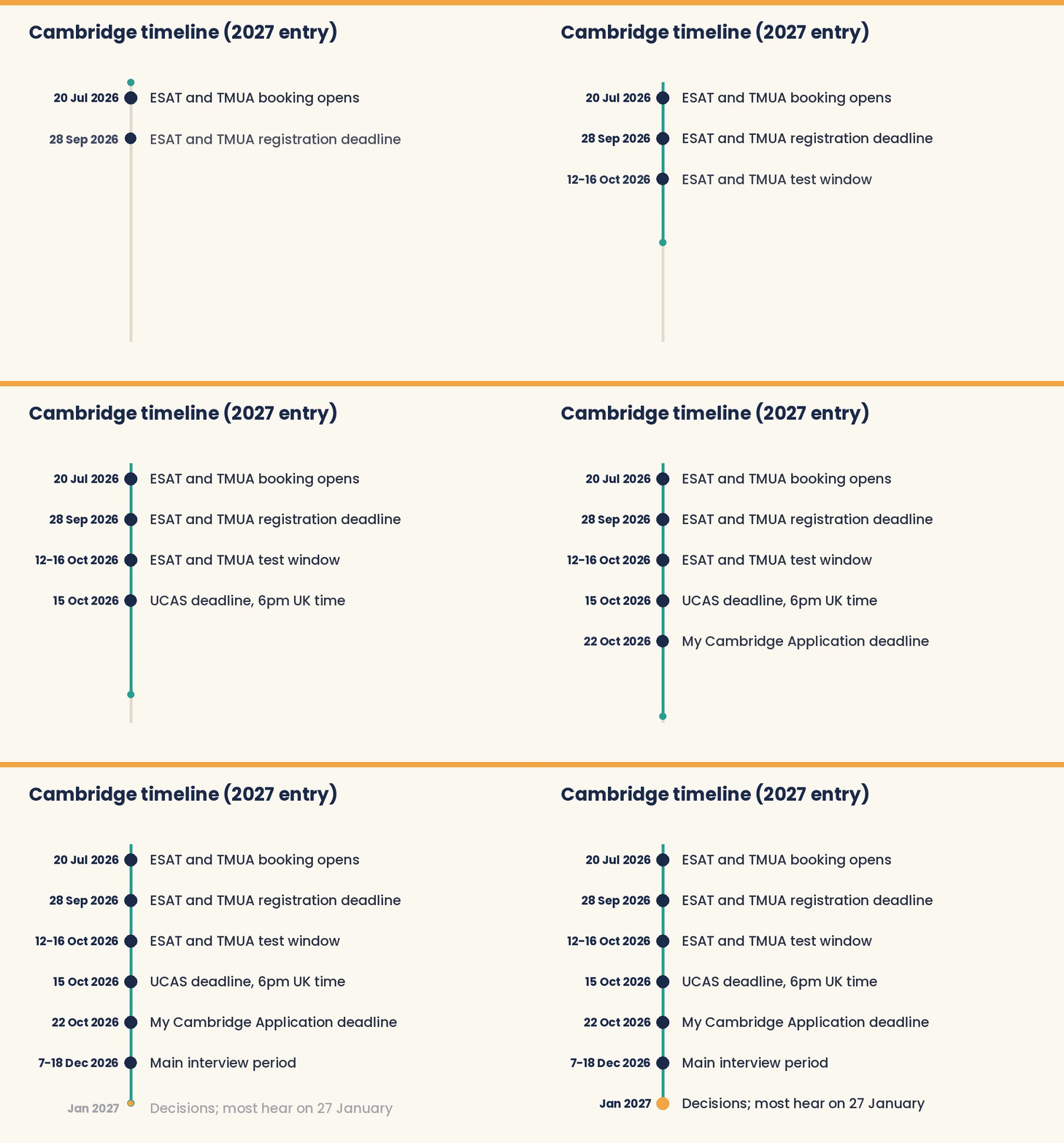
| Date (2027 entry cycle) | What happens |
|---|---|
| 12 May 2026 | You can start your UCAS application |
| 20 July 2026 | ESAT and TMUA booking opens |
| 28 September 2026 | ESAT and TMUA registration deadline |
| 12-16 October 2026 | ESAT and TMUA test window |
| 15 October 2026 | UCAS deadline, 6pm UK time (passed) |
| 22 October 2026 | My Cambridge Application and transcript deadline, 6pm UK time (passed) |
| 7-18 December 2026 | Main interview period |
| January 2027 | Decisions; most interviewed applicants hear on 27 January 2027 |
| August 2027 | Exam results and final decisions |
For 2028 entry: official dates are not yet announced. Expect the UCAS deadline around mid-October 2027. UCAS also confirms the 15 October date as the equal consideration date for Oxford and Cambridge in the 2027 entry cycle.
How do I choose a course and a College?
You apply for one course, so pick the subject you truly enjoy. Each course page lists required subjects, offer levels and the test. Then choose a College (where you live and get small-group teaching) or make an open application. The official College guide suggests you shortlist 3 to 5 Colleges and check:
- Which Colleges offer your course.
- Higher offers or A* in a set subject.
- Online or in-person interviews.
- Accommodation, costs and support.
Should I make an open application?
With an open application, Cambridge places you at a College with fewer applications per place for your course. The UCAS application page says Colleges treat open and direct applicants the same. But you cannot transfer later, and you might get a higher offer or a different interview format. Cambridge does not recommend it if you will be under 18 when you start. If one College clearly fits, apply to it.
What grades do you need for Cambridge?
Each course page gives a minimum offer level. Colleges can ask for more.
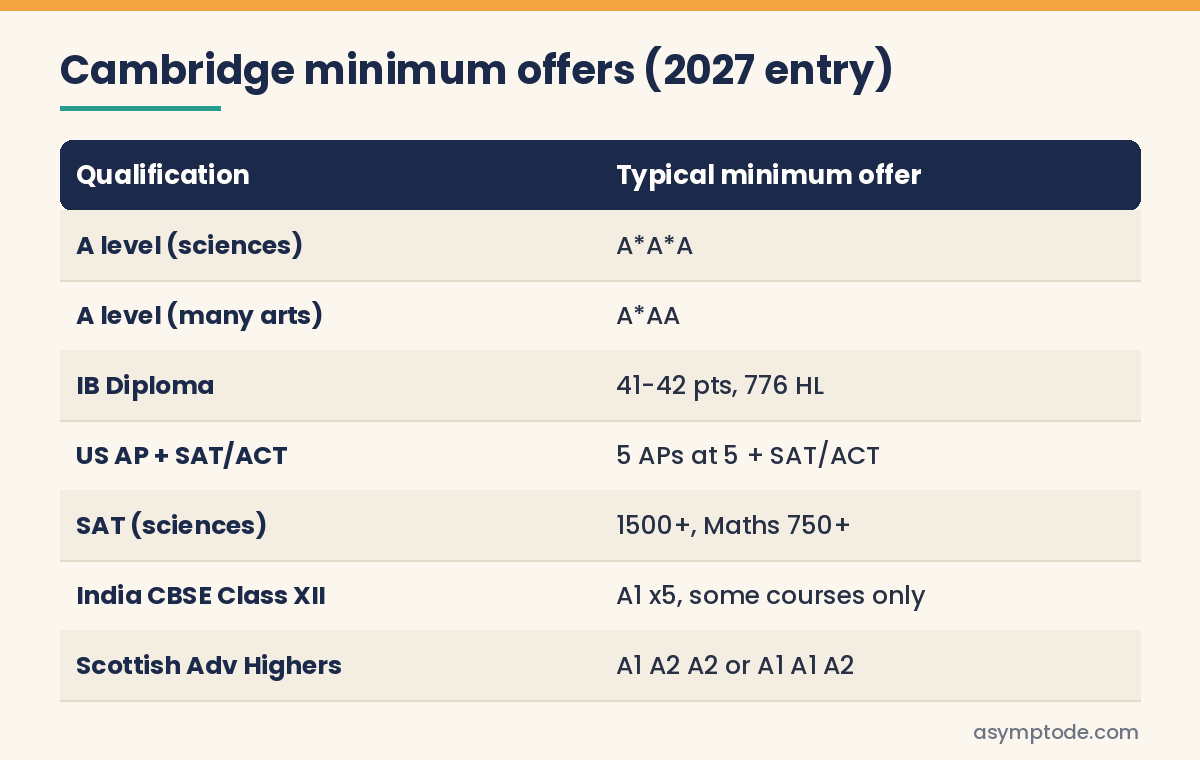
| Qualification | Typical minimum offer (2027 entry) |
|---|---|
| A level (sciences, maths, economics, medicine) | A*A*A |
| A level (many arts courses, e.g. History) | A*AA |
| IB Diploma | 41-42 points, 776 at Higher Level |
| US: AP + SAT/ACT | Five AP scores of 5, plus SAT 1500+ (Maths 750+) or ACT 33+ for sciences |
| India: CBSE Class XII | A1 A1 A1 A1 A1, only some courses and Colleges |
| Scottish Advanced Highers | A1 A2 A2 (A*AA courses) or A1 A1 A2 (A*A*A courses) |
A few rules from the official qualifications page are worth knowing:
- Offers are usually based on 3 A levels. A fourth does not normally help, but strong STEM applicants usually take Further Mathematics.
- Churchill, Corpus Christi and Selwyn usually make IB offers above the minimum. Some Colleges ask for 777.
- For most maths-based courses, IB students should take Maths Analysis and Approaches HL. Our IB Maths AA vs AI guide explains the difference.
- STEP maths papers are part of almost all Mathematics offers, taken in June after you apply.
For example, the Engineering page says Colleges usually require an A* in Mathematics and/or Further Mathematics, and often A* or 7 in Physics or another science. To build these foundations, see our A level Maths guide and A level Physics guide.
What English test do international students need?
If you are not from a majority English-speaking country, the entry requirements page says you normally need IELTS Academic 7.5 overall (usually 7.0 in each part) by the start of your course. At application, IELTS 6.5 (no part below 6.0) is recommended for interview.
Which admissions test does my Cambridge course need?
Some tests you book yourself before applying. Others are set by your College after an interview invitation. The official admissions tests page lists all of them.
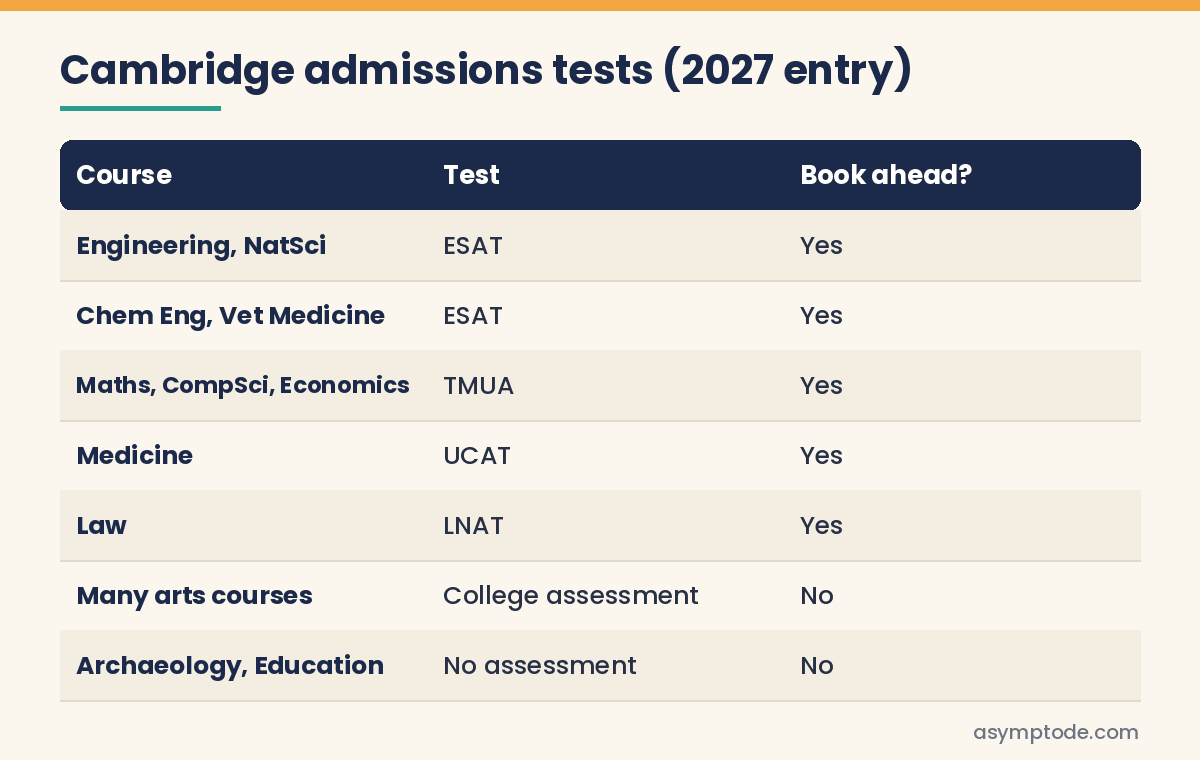
| Course | Test (2027 entry) | Book in advance? |
|---|---|---|
| Engineering, Natural Sciences, Chemical Engineering and Biotechnology, Veterinary Medicine | ESAT | Yes |
| Mathematics, Computer Science, Economics | TMUA | Yes |
| Medicine | UCAT | Yes |
| Law | LNAT | Yes |
| Computer Science at Peterhouse or Trinity | TMUA plus CSAT | TMUA yes |
| Many arts and social science courses | College assessment | No |
| Archaeology, Education, History of Art and some others | No assessment | n/a |
What is the ESAT? The ESAT page says it is computer-based and made of 40-minute multiple-choice modules. Mathematics 1 is compulsory. Engineering applicants also take Physics and Mathematics 2.
What is the TMUA? The TMUA page says it lasts 2 hours 30 minutes, in two parts: Applications of Mathematical Knowledge and Mathematical Reasoning. No calculator is allowed. Cambridge says it uses school maths you already know. Almost no one gets full marks, and there is no pass mark, but a strong score usually helps you reach interview.
Worked example: a TMUA-style algebra question
Our own practice question, no calculator. Question: How many real solutions does x^4 - 5x^2 + 4 = 0 have?
- Spot the pattern. The powers are 4 and 2, so let y = x^2.
- Rewrite: y^2 - 5y + 4 = 0.
- Factorise: (y - 1)(y - 4) = 0, so y = 1 or y = 4.
- Go back to x. If x^2 = 1, then x = 1 or -1. If x^2 = 4, then x = 2 or -2.
- Answer: 4 real solutions.
The skill is spotting structure fast. If factorising feels slow, see our guide to solving quadratic equations three ways.
Worked example: an ESAT-style physics question
Question: A ball is dropped from rest from 20 m. Ignore air resistance and take g = 10 m/s^2. How long does it take to hit the ground?
- Use s = ut + (1/2)at^2 with u = 0.
- 20 = (1/2)(10)t^2, so 20 = 5t^2.
- t^2 = 4, so t = 2 s.
Want a plan for your own course and test? Book a free demo class or advisor call. An Asymptode mentor can check your maths and science foundations and map out test practice. See fees for class options.
How do I apply to Cambridge, step by step?
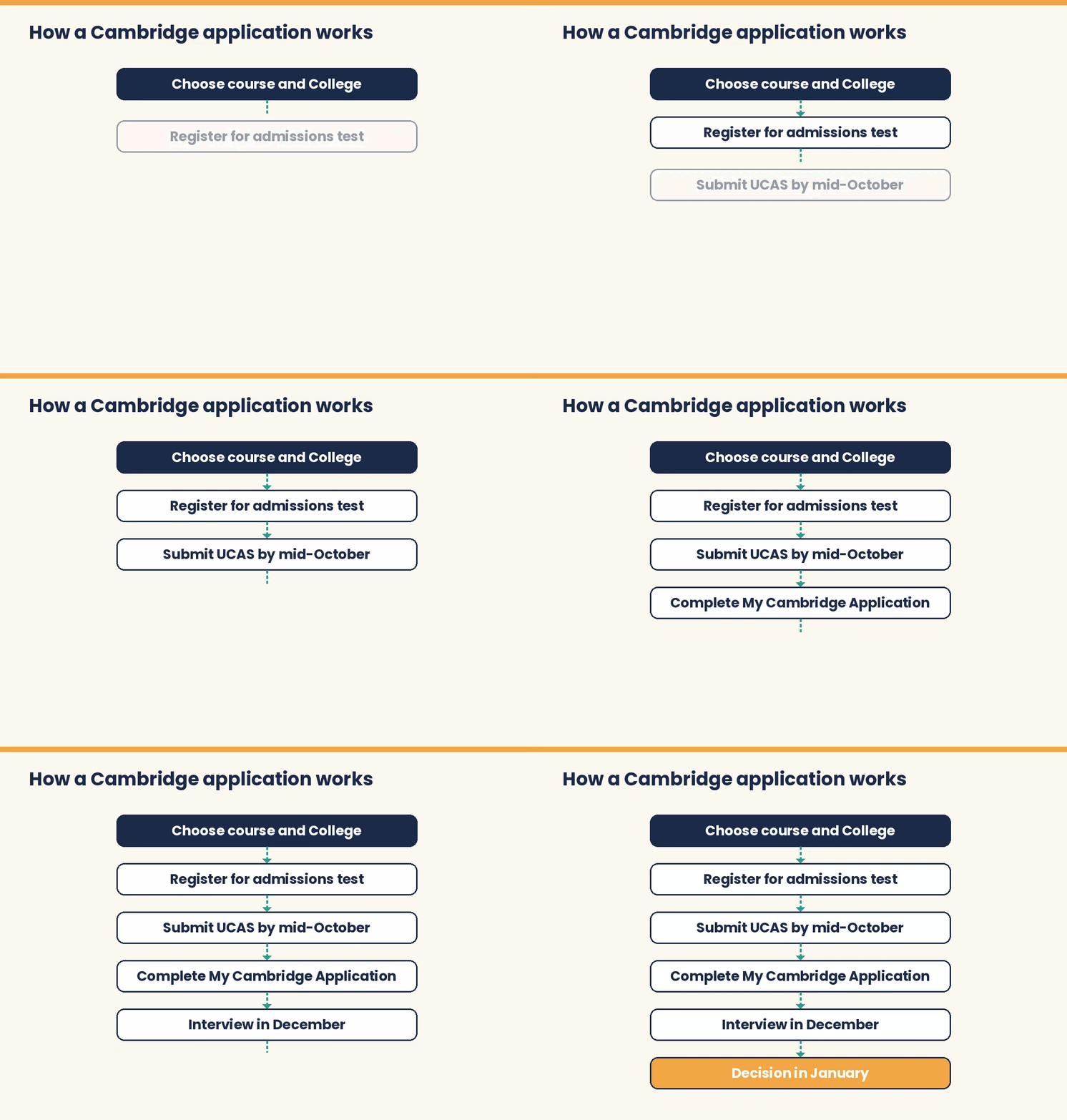
- Choose one course and a College (or make an open application).
- Register for your admissions test if your course needs one booked in advance.
- Submit your UCAS application by the October deadline, with personal statement and school reference (required).
- Complete My Cambridge Application. The link arrives within 48 hours of your UCAS submission. It takes about an hour and allows an optional 1,200-character statement. Applicants from outside the UK, Ireland, Channel Islands and Isle of Man may pay a £60 fee, says the My Cambridge Application page. Send a transcript by the same deadline if your qualifications need one.
- Attend interview in December if shortlisted.
- Get a decision in January, then meet your offer conditions in August.
For 2027 entry, Cambridge did not review extra documents uploaded to UCAS, so send them through My Cambridge Application or your College.
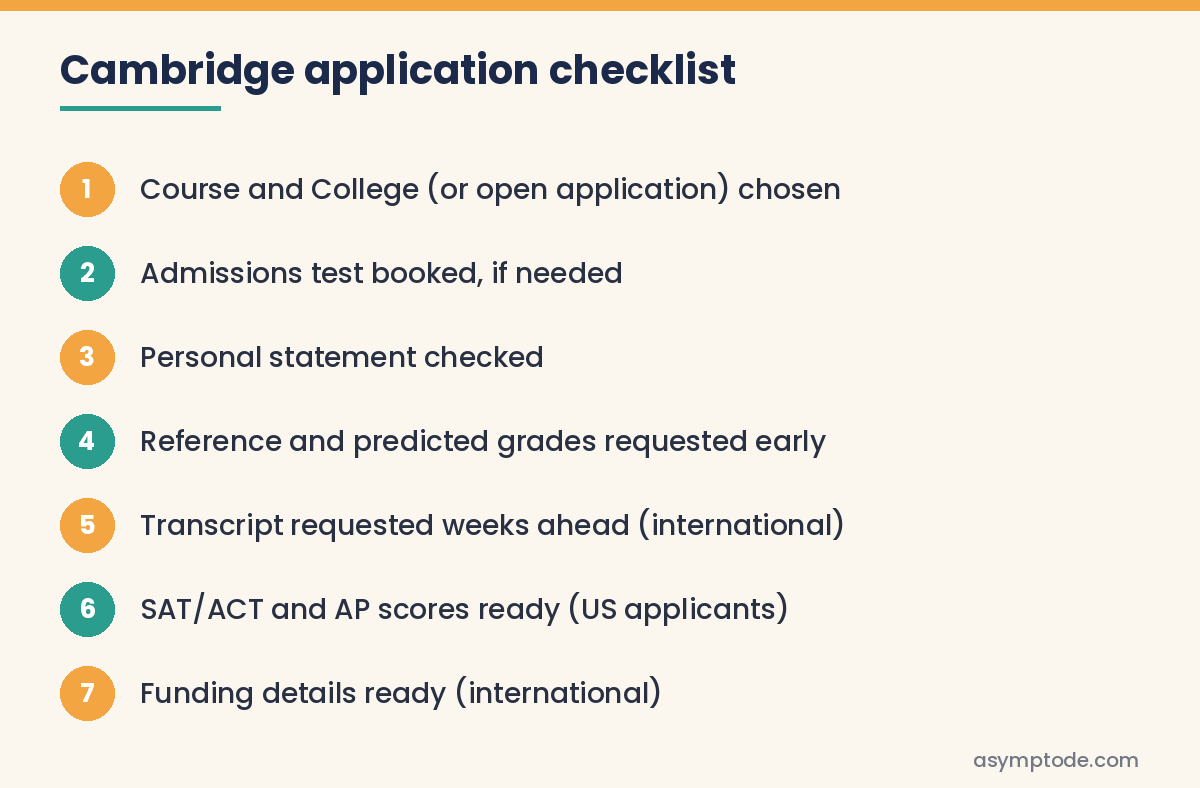
Application checklist:
- Course and College (or open application) chosen.
- Admissions test booked, if needed.
- Personal statement checked.
- Reference and predicted grades requested early.
- Transcript requested weeks ahead (international).
- SAT/ACT and AP scores ready (US applicants).
- Funding details ready (international).
How do I get into Cambridge from the UK, India, the US or elsewhere?
UK students
Most UK students apply with A levels, Advanced Highers or the IB. Choose matching subjects in Year 11, and take Further Maths for STEM if offered. There are no GCSE requirements, but Colleges read GCSEs in context, so use your GCSE years well.
Students in India
The international entry requirements page (updated March 2026 for 2027 entry) says CBSE Class XII is accepted by some Colleges only, for a list of mainly arts, humanities and social science courses, plus Veterinary Medicine. The minimum is A1 A1 A1 A1 A1 in relevant subjects.
Engineering, Mathematics, Natural Sciences, Computer Science, Medicine and Economics are not on the CBSE list. Students on ISC or other boards, or aiming at courses or Colleges outside the list, are strongly advised to take further study: A levels, the IB, or five or more AP tests at score 5 plus Class XII A1 grades. Contact your Colleges early if you plan the AP route.
Students in the US
Cambridge says a US High School Diploma alone is not enough. You usually need:
- At least five AP scores of 5 in subjects related to your course.
- A high SAT or ACT score. For most sciences and Economics: SAT 1500+ with Maths 750+, or ACT 33+ (plus ACT Science 33+).
- A high GPA.
Cambridge strongly prefers AP Calculus BC for maths-heavy courses and both AP Physics C tests where A level Physics is needed. You can sit AP tests without the AP course. Our Digital SAT Math guide can help with the Maths section.
Students in other countries
Check your country on the international entry requirements page. Some diplomas are accepted; others need A levels, the IB or APs alongside them. If your country is not listed, your local qualifications are likely not accepted.
What should my plan look like from Grade 9 or 10?
Grade 9 is about Year 10 in England. Adjust to your school system.
- Grade 9 / Year 10: Build strong maths and science basics. Read beyond the syllabus in the subject you love.
- Grade 10 / Year 11: Choose A level, IB or AP subjects that match your likely course. Check each course page for required subjects.
- Grade 11 / Year 12 (autumn to spring): Read widely, practise problem solving, attend webinars, shortlist Colleges.
- Grade 11 / Year 12 (summer): Draft your personal statement. Book your test when booking opens in July. Plan English tests and transcripts if needed.
- Grade 12 / Year 13 (September to October): Do timed test practice. Submit UCAS by mid-October, then My Cambridge Application about a week later.
- November to December: Prepare for interview if invited. Keep up with school work.
- January to August: Get your decision, then focus on final exams and STEP if needed.
How do I prepare for a Cambridge interview?
Interviews are "academic conversations". The interviews page says everyone who gets an offer will have been interviewed. For 2027 entry, the main interview period is 7 to 18 December 2026. Some Colleges interview online and some in person.
The official interview preparation page suggests:
- Re-read your personal statement and any written work.
- Explore your subject beyond school.
- Have a practice interview with someone who does not know you well.
- For maths and science, practise problem solving and explaining how you got the answer.
Interviewers care about how you think, and it is fine to ask them to explain a question.
What are the common mistakes Cambridge applicants make?
- Missing the second deadline. My Cambridge Application is due a week after UCAS.
- Not booking the test in time. ESAT and TMUA registration closed on 28 September 2026 for 2027 entry.
- Wrong subjects. Missing Further Maths, or taking IB Maths AI when AA is expected.
- Assuming CBSE or a diploma is enough. Check your course and College on the official international page.
- Learning answers, not methods. Tests and interviews reward reasoning.
- Open applications without checking offers and interview formats.
- Ignoring costs. International students pay tuition plus a College fee.
How does applying to Cambridge compare with Oxford?
Cambridge states that you cannot apply to Cambridge and Oxford in the same year, so you must choose.
| Point | Cambridge | Oxford |
|---|---|---|
| Apply to both same year? | No | No |
| UCAS deadline (2027 entry) | 15 October 2026 | 15 October 2026 |
| Extra Cambridge form | My Cambridge Application | Not applicable |
Compare the courses first, then read our guide on how to get into Oxford.
How much does Cambridge cost for 2027 entry?
From the official tuition fees page and international fees page:
| Fee type (2027 entry, per year) | Amount |
|---|---|
| Home students | £10,050 |
| Overseas: arts and social sciences, incl. Economics, Law | £30,798 |
| Overseas: Mathematics | £34,356 |
| Overseas: Architecture, Design, Geography, Music | £40,296 |
| Overseas: Engineering, Natural Sciences, Computer Science | £46,872 |
| Overseas: Medicine and Veterinary Medicine | £70,554 |
| Overseas College fee (extra) | £12,885 to £15,950 at undergraduate Colleges |
College fees are from the official 2027-28 fees document. Fees for 2028 entry will be published by 1 October 2027. Living costs are extra.
What financial help is there?
- Cambridge Bursary: up to £3,500 a year for eligible UK students, based on household income. It does not need to be repaid, according to the scholarships and bursaries page.
- Cambridge Trust: means-tested awards for international students. You can only apply after you get an offer, as the international financial support page explains. Most support is partial.
How 1-on-1 tutoring helps with getting into Cambridge
At Asymptode, we teach maths and science in private, live 1-on-1 online classes. We cannot promise anyone a place. We help you build the foundations the application rewards:
- One dedicated mentor. Your mentor assesses where you are, makes a plan, teaches, marks homework and reports to parents.
- Your own syllabus. We follow A level, IB, AP or your school board, with your own exam and test dates.
- Method first. The mentor watches each step of your working, which builds the habit of explaining your reasoning.
- Admissions test maths. For TMUA and ESAT maths and physics, we practise methods, no-calculator speed and logic. Since the TMUA uses school maths, strong foundations matter most.
- Personalised homework with feedback, weekly parent updates, and every class recorded.
- Flexible scheduling across time zones.
For personal statements and non-maths parts, our mentor helps with maths, science method and planning only. Use your school and official Cambridge resources for the rest.
Ready to start? Book a free demo class or advisor call to talk through your course, test and timeline. You can also check our fees.
Facts checked against official sources on 26 October 2026.
FAQ
Has the Cambridge deadline for 2027 entry passed?
Yes. The UCAS deadline for 2027 entry was 15 October 2026 (6pm UK time), and My Cambridge Application closed on 22 October 2026. Foundation Year applicants, and mature students applying for some courses, have a later deadline of 13 January 2027.
When is the Cambridge deadline for 2028 entry?
Official 2028 entry dates are not yet announced. In the current cycle the deadline was 15 October, so expect it to be around mid-October 2027. Check the official Cambridge dates page before you plan.
Can I apply to Oxford and Cambridge in the same year?
No. Cambridge states that you cannot apply to Cambridge and Oxford in the same year. You also submit only one application to Cambridge per year, for one course.
Is CBSE Class XII enough for Cambridge Engineering or Maths?
Not on its own. For 2027 entry, CBSE Class XII is accepted only for mainly arts and social science courses, plus Veterinary Medicine, at some Colleges. For Engineering and Maths, Cambridge recommends A levels, the IB or five AP scores of 5.
What IB score do you need for Cambridge?
The usual minimum offer is 41-42 points out of 45, with 776 at Higher Level. Some Colleges ask for 777 or a higher total, and some set a 7 in specific subjects. For most maths-based courses, take Maths Analysis and Approaches HL.
Do I need tutoring for the TMUA or ESAT?
Not necessarily. Cambridge says the TMUA uses maths you already know and points to free practice materials. Tutoring helps if your school maths has gaps or you want timed method practice with feedback.
Sources
- University of Cambridge: Application dates and deadlines (2027 entry)
- University of Cambridge: Completing your UCAS application
- University of Cambridge: Completing My Cambridge Application
- University of Cambridge: Admission tests and assessments
- University of Cambridge: Engineering and Science Admissions Test (ESAT)
- University of Cambridge: Test of Mathematics for University Admissions (TMUA)
- University of Cambridge: Entry requirements and English language
- University of Cambridge: Qualifications we accept
- University of Cambridge: International entry requirements
- University of Cambridge: Engineering course page
- University of Cambridge: Cambridge interviews
- University of Cambridge: Interview preparation
- University of Cambridge: Choosing a College
- University of Cambridge: Application statistics
- University of Cambridge: Tuition fees
- University of Cambridge: International fees and costs
- University of Cambridge: Undergraduate tuition fees 2027-28 (PDF)
- University of Cambridge: Scholarships and bursaries
- University of Cambridge: Financial support for international students
- UCAS: Dates and deadlines for uni applications