

AIME 2027 is the invite-only second round of the US maths competition path, and it takes place on February 5 or 6, 2027. You get there by scoring well on the AMC 10 or AMC 12 in November 2026. This guide explains the dates, the qualifying scores, the format and a simple plan to prepare.
Key takeaways
- AIME 2027 is on February 5 or 6, 2027. You can take it on either date, but only if you are invited.
- To qualify, you need 100 or above on the AMC 10, or 85 or above on the AMC 12 (plus other eligibility rules).
- The exam has 15 questions in two 90-minute parts. Every answer is a whole number from 0 to 999.
- It is computer-based, in English, at Pearson testing centers in the US and Canada. You must be 13 or older.
- For 2027, USAMO and USAJMO selection is based mainly on AIME scores. AMC scores are no longer a factor.
What is the AIME 2027 exam?
Quick answer: The AIME (American Invitational Mathematics Examination) is a hard, invite-only maths exam run by the Mathematical Association of America (MAA). It is the second round after the AMC 10 and AMC 12. In 2027 it runs on February 5 or 6. It has 15 questions, and each answer is an integer from 0 to 999.
The AIME sits between the AMC and the olympiad rounds. Top AIME scorers can be invited to the USAMO or USAJMO. You can read the MAA overview on the MAA invitational competitions page.
How do you qualify for AIME 2027?
You qualify through the AMC 10 or AMC 12. Here is the full path, step by step.
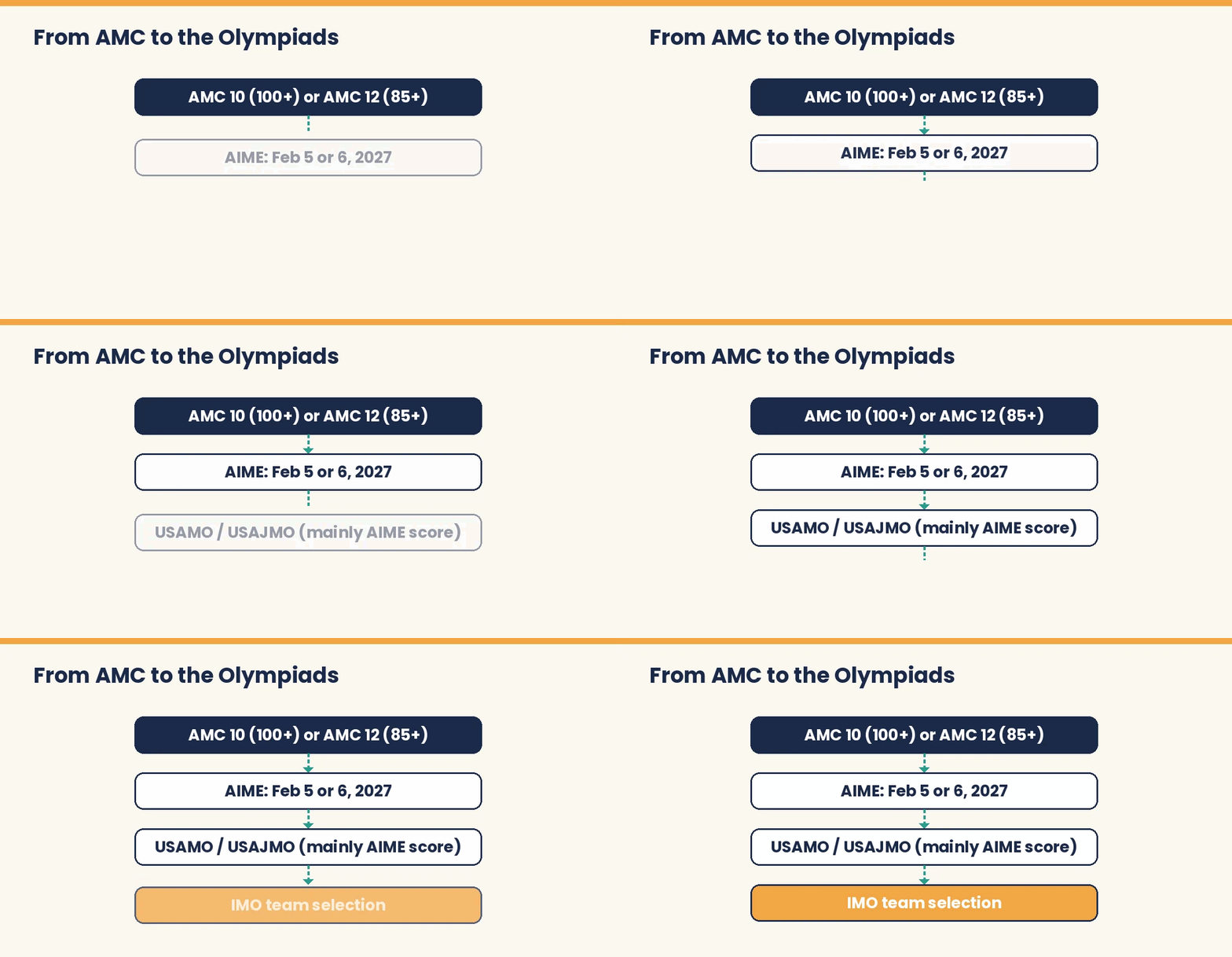
The path from the AMC to AIME, then to USAMO or USAJMO and team selection.
- Take the AMC 10 or AMC 12. The A test is on Thursday, November 5, 2026. The B test is on Friday, November 13, 2026.
- Reach the qualifying score. You need 100 or above on the AMC 10, or 85 or above on the AMC 12.
- Get your AIME invite. Qualifiers then choose a test time at a Pearson center they prefer.
- Sit the AIME on February 5 or 6, 2027.
- Get invited to USAMO or USAJMO. For 2027, selection is based mainly on AIME scores.
- Team selection. Students in the current IMO selection group are also invited to USAMO.
What are the AIME 2027 qualifying scores?
| Exam | Score needed for AIME 2027 |
|---|---|
| AMC 10 | 100 or above |
| AMC 12 | 85 or above |
Other eligibility rules also apply. The most important one: only students aged 13 and older may take the AIME in 2027.
How do you register for the AMC 10/12?
Schools and other groups register through a competition manager at maa.org/amcreg. The late registration deadline for returning managers is October 28, 2026, and it costs $115. That deadline is very close, so ask your school's maths teacher now. We will cover the AMC 10/12 in more depth in a separate guide.
When and where is AIME 2027?
AIME 2027 is on February 5 or 6, 2027. You may pick either date. It is taken at Pearson testing centers across the US and Canada. The MAA lists these on its official testing centers announcement.
| Detail | AIME 2027 |
|---|---|
| Dates | February 5 or 6, 2027 |
| Entry | Invite only |
| Where | Pearson testing centers, US and Canada |
| Mode | Computer-based, in English |
| Age | 13 and older |
| Fee | $85 (financial assistance available) |
The MAA says financial assistance is available to any student who needs it. Details are sent to qualifiers.
Want help getting ready? Book a free demo class and meet a mentor who can plan your AIME prep with you.
What is the AIME 2027 format?
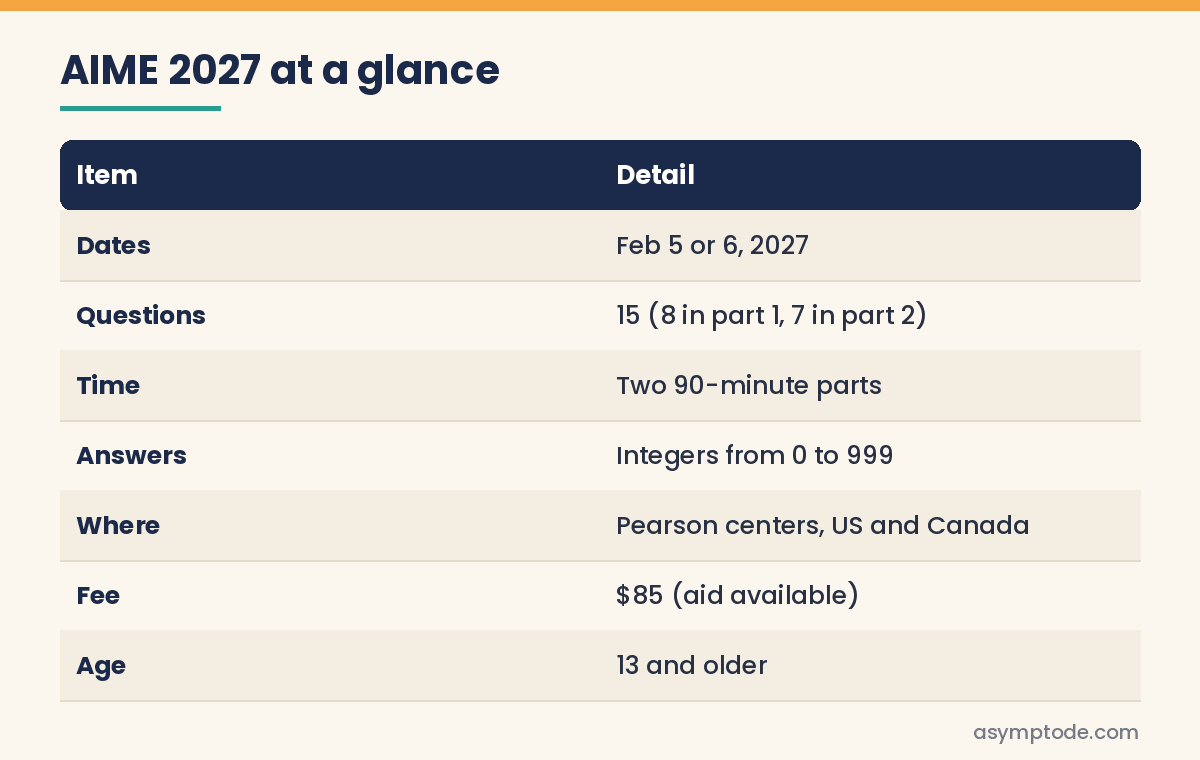
The AIME 2027 format at a glance.
Here is the same format as text:
- Total questions: 15
- Part 1: 8 questions, 90 minutes
- Part 2: 7 questions, 90 minutes
- Answers: each one is an integer from 0 to 999
- Materials: you cannot bring any materials into the exam room. No compass and no ruler.
Since every answer is a whole number, there are no choices to guess from. You must work the problem out fully.
Can international students take AIME 2027?
International students follow the policies of their country's AMC International Group Leader. The MAA describes AIME centers only in the US and Canada. If you live in Canada, you may also like our CEMC Pascal, Cayley and Fermat guide.
What comes after AIME?
The MAA invites 400+ students to the USAMO and USAJMO each year. For 2027, selection is based mainly on AIME scores, and AMC scores are no longer a factor. The 2026 USAMO and USAJMO were on March 20-21, 2026, at 31 host institutions. The 2027 dates are not yet announced.
What does an AIME problem look like?
AIME problems often test number sense. Counting, factors and multiples come up a lot. Let's solve one together.
Problem: How many positive integers n ≤ 1000 are divisible by 6 or by 15, but not by both?
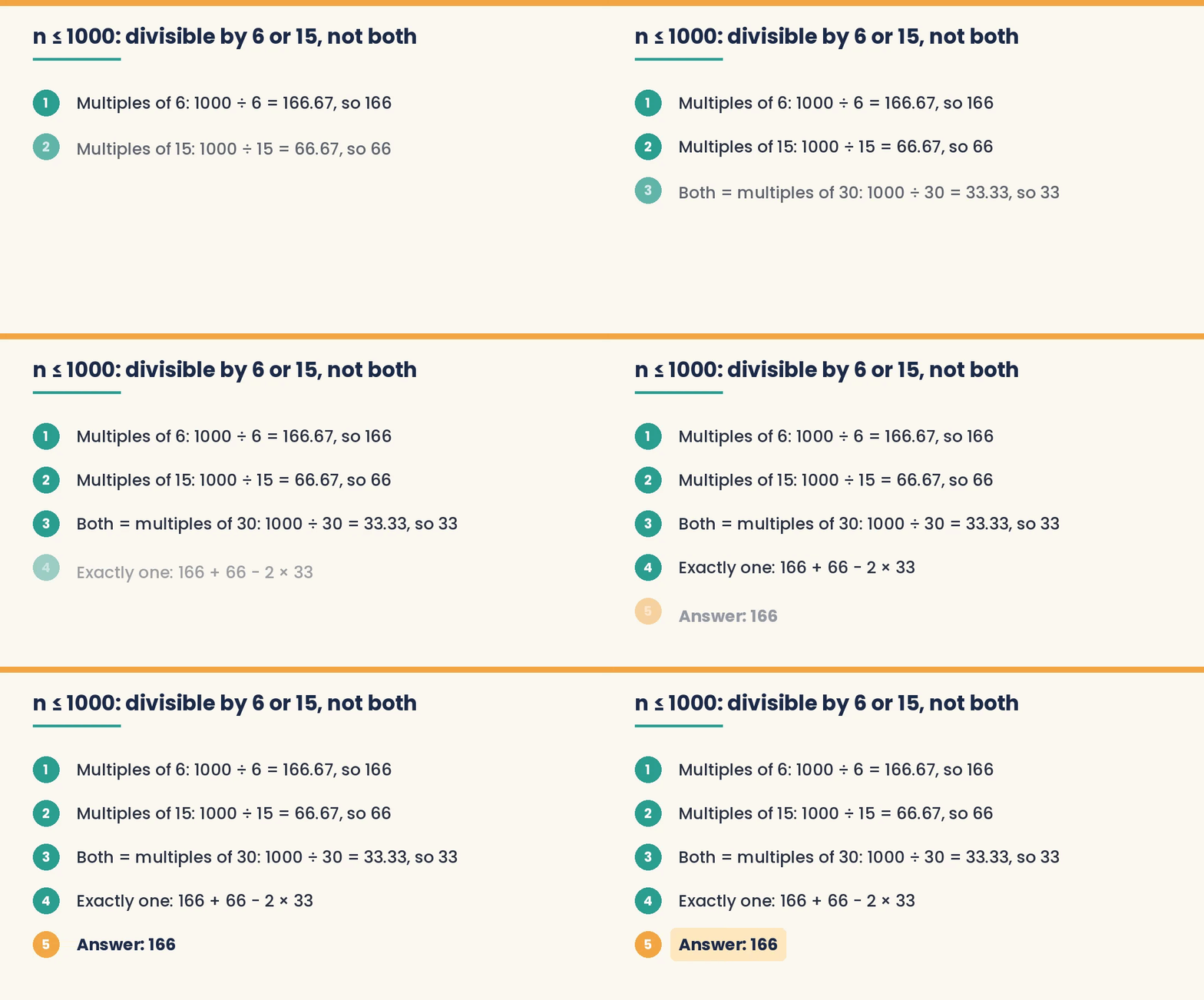
Step-by-step count of numbers up to 1000 divisible by 6 or 15, but not both.
Here are the steps as text:
- Count multiples of 6: floor(1000 ÷ 6) = 166.
- Count multiples of 15: floor(1000 ÷ 15) = 66.
- Both means multiples of 30: the LCM of 6 and 15 is 30, and floor(1000 ÷ 30) = 33.
- Exactly one: 166 + 66 − 2 × 33 = 166. We subtract the "both" group twice, because it was counted once in each list.
- Answer: 166.
The key idea is the LCM. If it feels rusty, read GCF and LCM explained.
A second quick example
Problem: How many ordered pairs of positive integers (a, b) have ab = 360?
- Factor 360: 360 = 2³ × 3² × 5.
- Count divisors: (3 + 1)(2 + 1)(1 + 1) = 24.
- Each divisor a gives exactly one b.
- Answer: 24.
This uses prime factorization. Review prime, composite and coprime numbers and factors and multiples explained if you need a refresher.
What are common AIME mistakes?
- Double-counting. In "or" problems, you must remove the overlap. In "not both" problems, you remove it twice.
- Rushing the reading. Words like "positive", "ordered" and "at most" change the answer.
- Skipping checks. With no answer choices, a small slip goes unnoticed. Check each step.
- Weak basics. Many hard problems rest on factors, primes and LCM.
- Poor timing. You have 90 minutes per part. Don't spend 40 minutes on one question.
- Missing deadlines. You can't take the AIME without an AMC 10/12 score first.
How should you prepare for AIME 2027?
Start now. Here is a simple plan.
- Now to early November: Make sure you are registered for the AMC 10 or AMC 12 through your school.
- November: Take the AMC. Practice past AMC problems, timed.
- After your AMC result: If you qualify, choose your AIME test time and center.
- December to January: Do one full AIME-style set each week. Review every wrong answer.
- Last two weeks: Practice in two 90-minute blocks, with no materials, just like the real test.
Quick AIME checklist
- Registered for AMC 10/12 through a competition manager
- Know the qualifying score for your exam (100 or 85)
- Aged 13 or older (required for AIME 2027)
- Chosen a Pearson center and test time after the invite
- Solid on factors, primes, GCF and LCM
- Practiced full timed sets with no materials
Younger students can build these skills early with the AMC 8 guide.
How 1-on-1 tutoring helps with AIME 2027
At Asymptode, you get live 1-on-1 online classes with one dedicated mentor. Your mentor follows your own syllabus and your exam dates, so your plan fits the AMC in November and the AIME in February.
We teach method first. Your mentor watches each step of your working and fixes the method, not just the final answer. That matters on the AIME, where one wrong step ruins an integer answer.
You also get:
- Personalised homework with feedback
- Short updates for parents
- A recording of every class, so you can rewatch hard problems
To be honest, a tutor cannot change the qualifying scores, the age rule or the test dates. The work of solving still has to be yours. A good mentor helps you get there with a clear plan. Not sure how to pick one? Read how to choose an online math tutor.
Ready to start? Book a free demo class, have an advisor call to plan your prep, or see our fees.
Facts checked against official sources on 25 October 2026.
FAQ
When is AIME 2027?
AIME 2027 is on February 5 or 6, 2027. Students may take it on either date. It is invite only, so you must qualify through the AMC 10 or AMC 12 first.
What score do you need on the AMC to qualify for AIME 2027?
You need 100 or above on the AMC 10, or 85 or above on the AMC 12. Other eligibility requirements also apply, such as being 13 or older.
How many questions are on the AIME?
The AIME has 15 questions in two 90-minute parts. In 2027, part 1 has 8 questions and part 2 has 7. Each answer is an integer from 0 to 999.
How much does the AIME 2027 cost?
The registration fee is $85. The MAA says financial assistance is available to any student who needs it. Details are sent to students who qualify.
Can I bring anything into the AIME exam room?
No. Students cannot bring any materials into the exam room. That includes no compass and no ruler.
Do AMC scores count for USAMO and USAJMO in 2027?
No. For 2027, selection is based primarily on AIME scores, and AMC scores are no longer a factor. The 2027 USAMO and USAJMO dates are not yet announced.