
NSE 2026 is the first step for any Indian school student who dreams of the International Physics, Chemistry, Biology, Astronomy or Junior Science Olympiad. The National Standard Examinations are run by the Indian Association of Physics Teachers (IAPT) on 21 and 22 November 2026. Enrolment is closed, so this guide is for enrolled students with three weeks left, and for families planning next year.
Key takeaways
- NSEA is on Saturday 21 November 2026. NSEP, NSEC, NSEB and NSEJS are on Sunday 22 November 2026.
- Every paper is 2 hours: 48 single-correct questions (+3/-1) and 12 multi-correct questions (6 marks, all or nothing). Total 216 marks.
- The level is CBSE class 12 for the four senior papers and CBSE class 10 for NSEJS.
- About 400 to 500 students per subject go on to the national olympiads (INOs) on 30-31 January 2027. The list is due by 15 January 2027.
- NSE is the only route in India to IPhO, IChO, IBO and IOAA. Next year, enrolment usually opens in late August on iapt.org.in.
What is NSE 2026 and who conducts it?
Quick answer: NSE 2026 is a set of five national science exams: NSEP (physics), NSEC (chemistry), NSEB (biology), NSEA (astronomy) and NSEJS (junior science). IAPT runs them with the chemistry and biology teachers' associations. They are stage 1 of India's olympiad programme. Good scorers move to the Indian National Olympiads, then camps, then the international olympiads.
The official IAPT student brochure says the NSEs are "the first stage and the only screening tests in India" for these olympiads. There is no other way in.
HBCSE (Homi Bhabha Centre for Science Education, TIFR) runs the later stages in physics, chemistry, biology and astronomy. IAPT runs every stage of the junior path (NSEJS, INJSO, IJSO). In 2025, 66,515 students enrolled in NSEP at about 1,700 centres, says the IAPT NSE 2026 booklet.
When is the NSE exam date 2026?
All five papers fall on one weekend. NSEB and NSEJS share a slot, but no one can take both.
| Exam | Day and date | Time |
|---|---|---|
| NSEA (Astronomy) | Saturday 21 November 2026 | 2:30 pm to 4:30 pm |
| NSEP (Physics) | Sunday 22 November 2026 | 8:30 am to 10:30 am |
| NSEC (Chemistry) | Sunday 22 November 2026 | 11:30 am to 1:30 pm |
| NSEB (Biology) | Sunday 22 November 2026 | 2:30 pm to 4:30 pm |
| NSEJS (Junior Science) | Sunday 22 November 2026 | 2:30 pm to 4:30 pm |
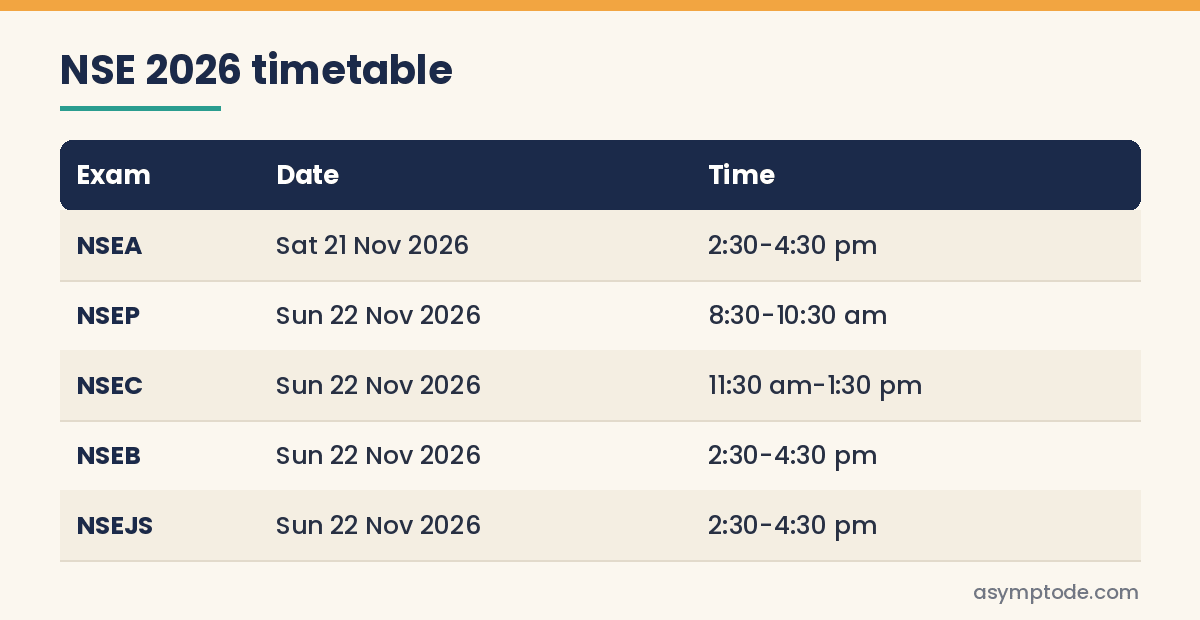
The picture shows the same timetable. NSEA is on Saturday afternoon. On Sunday, NSEP is in the morning, NSEC at midday, and NSEB and NSEJS in the afternoon. One student can take NSEP, NSEC and NSEB on the same day.
Other key dates for the 2026-27 cycle
| Event | Date |
|---|---|
| Student enrolment | 21 August to 16 September 2026, after extension (closed) |
| Hall tickets | Sent to your centre about two weeks before the exam |
| NSE results | Expected 25 December 2026 |
| INO selection list | By 15 January 2027, on iapt.org.in |
| INAO and INChO | Saturday 30 January 2027 |
| INPhO and INBO | Sunday 31 January 2027 |
| OCSC camps | April to June 2027 (dates by 15 January 2027) |
INO dates are from the HBCSE Science Olympiad 2026-27 page. INJSO 2027 dates are not yet announced. IAPT runs INJSO, so watch jso.indapt.org.in.
How do I get my NSE 2026 admit card?
The IAPT booklet says hall tickets are emailed to your centre about two weeks before the exam. The principal signs and stamps them. Collect yours and carry it with a photo ID. If you enrolled online, contact your allotted centre or the helpline on iapt.org.in.
What is the NSE eligibility for 2026?
Eligibility is the student's job to check. If you are found ineligible later, you are disqualified with no refund.
| Rule | NSEP, NSEC, NSEB, NSEA | NSEJS |
|---|---|---|
| Date of birth | 1 Jul 2007 to 30 Jun 2012 | 1 Jan 2012 to 31 Dec 2013 |
| Board exam | Class 12 board not before 30 Nov 2026 | Class 10 board not before 30 Nov 2026 |
| University | Not started by 1 Jun 2027 | Not applicable |
| Other papers | Cannot take NSEJS 2026 | Cannot take any senior NSE |
Every candidate must also:
- Be eligible to hold an Indian passport.
- Have lived and studied in India since 30 November 2024 or earlier, or have studied in an Indian school system since that date.
Can NRI or OCI students take NSE?
An NRI student eligible for an Indian passport can take NSE if they have studied in an Indian school system (such as a CBSE school abroad) since 30 November 2024. The IAPT brochure does not mention OCI. The HBCSE brochure 2026-27 says that, as per Madras High Court orders, OCI students can go up to the OCSC camp, but cannot be selected for the Indian team. This can change. For NSEJS and the junior path, check directly with IAPT.
What is the NSE exam pattern and marking scheme?
All five papers use the same pattern.
| Part | Questions | Marks each | Total |
|---|---|---|---|
| A: one correct option | 48 | +3, wrong -1 | 144 |
| B: one or more correct | 12 | 6, no negative | 72 |
| Whole paper | 60 | 2 hours | 216 |
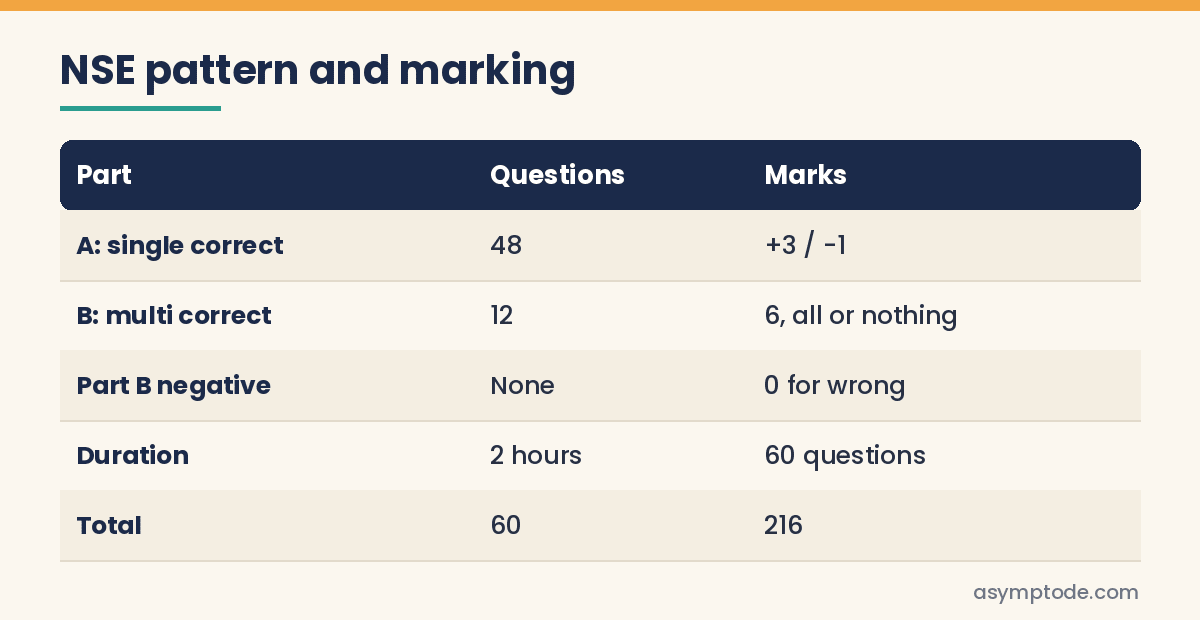
The picture shows the two parts. Part A has 48 single-correct questions: +3 for right, -1 for wrong. Part B has 12 questions with one or more correct options. You get 6 marks only if you mark all the correct options and no wrong ones.
NSE syllabus level
- NSEP, NSEC, NSEB: broadly CBSE up to and including class 12.
- NSEA: CBSE class 12 level, with more weight on physics, maths and basic astronomy.
- NSEJS: broadly CBSE up to class 10, with equal weight on physics, chemistry and biology.
Questions test reasoning, not memory. HBCSE says the first two stages need no special coaching beyond school.
Which languages are the papers in?
NSEP, NSEC and NSEJS come in English, Hindi, Gujarati, Bangla, Kannada, Tamil and Telugu. NSEB and NSEA come in English and Hindi. You picked the language when you enrolled.
How is an NSE score worked out?
Let us take an example student. In Part A they get 36 right, 8 wrong and leave 4 blank. In Part B they get 7 questions fully right.
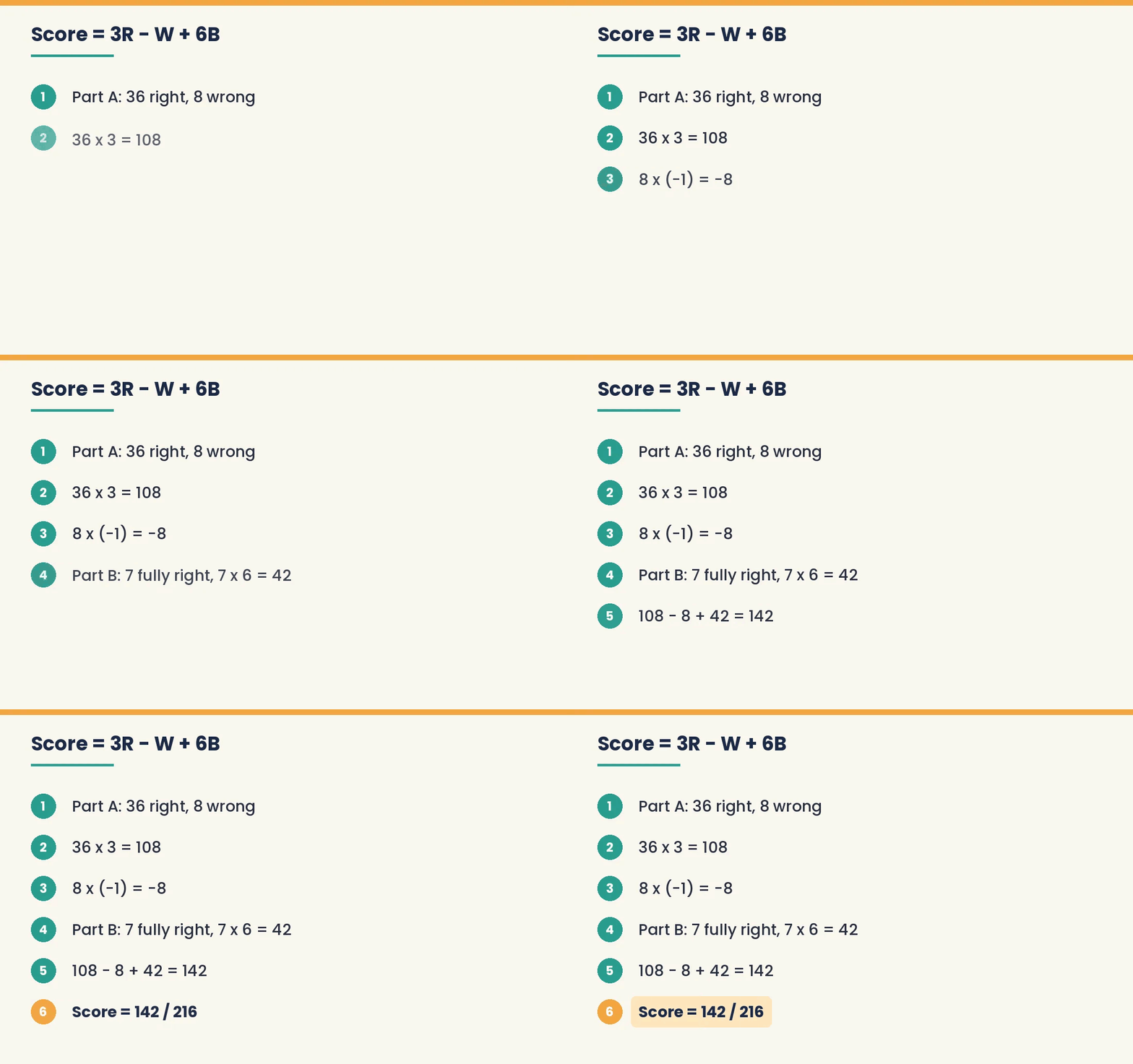
The animation adds up the marks in steps. Part A gives 36 x 3 = 108, minus 8 x 1 = 8 for the wrong answers. Part B gives 7 x 6 = 42. So the score is 108 - 8 + 42 = 142 out of 216.
How does selection from NSE to INO work?
The rules come from the HBCSE brochure. Senior students are split into two groups:
- Group A: in class 12 on 30 November 2026.
- Group B: in class 11 or 10 on 30 November 2026.
| Subject | Target for INO |
|---|---|
| INPhO, INChO, INBO | 200 per group (at least 400) |
| INAO | 250 per group (at least 500) |
| INJSO (from NSEJS) | 300, no groups |
Then:
- Minimum Admissible Score (MAS): 50% of the average of the top ten scores, rounded down. Below this, you cannot qualify at all.
- Merit Index (MI): 80% of the top-ten average, rounded down. Anyone at or above MI qualifies automatically.
- State quota: each state and UT gets seats based on the old NTSE quota, with a small minimum per state.
- Top-up: if the target is not met, more students are added purely on merit.
- Girls: at least 20% of INO students in each subject are girls, if enough girls are above MAS.
Illustrative example only (not a real cut-off): say the top ten scores average 120.5. MAS = 50% of 120.5 = 60.25, so 60. MI = 80% of 120.5 = 96.4, so 96. A score of 96+ qualifies at once. A 70 may qualify through the state quota. A 55 cannot, as it is below MAS. Real cut-offs change every year.
What comes after NSE: the path to IPhO, IChO, IBO and IOAA
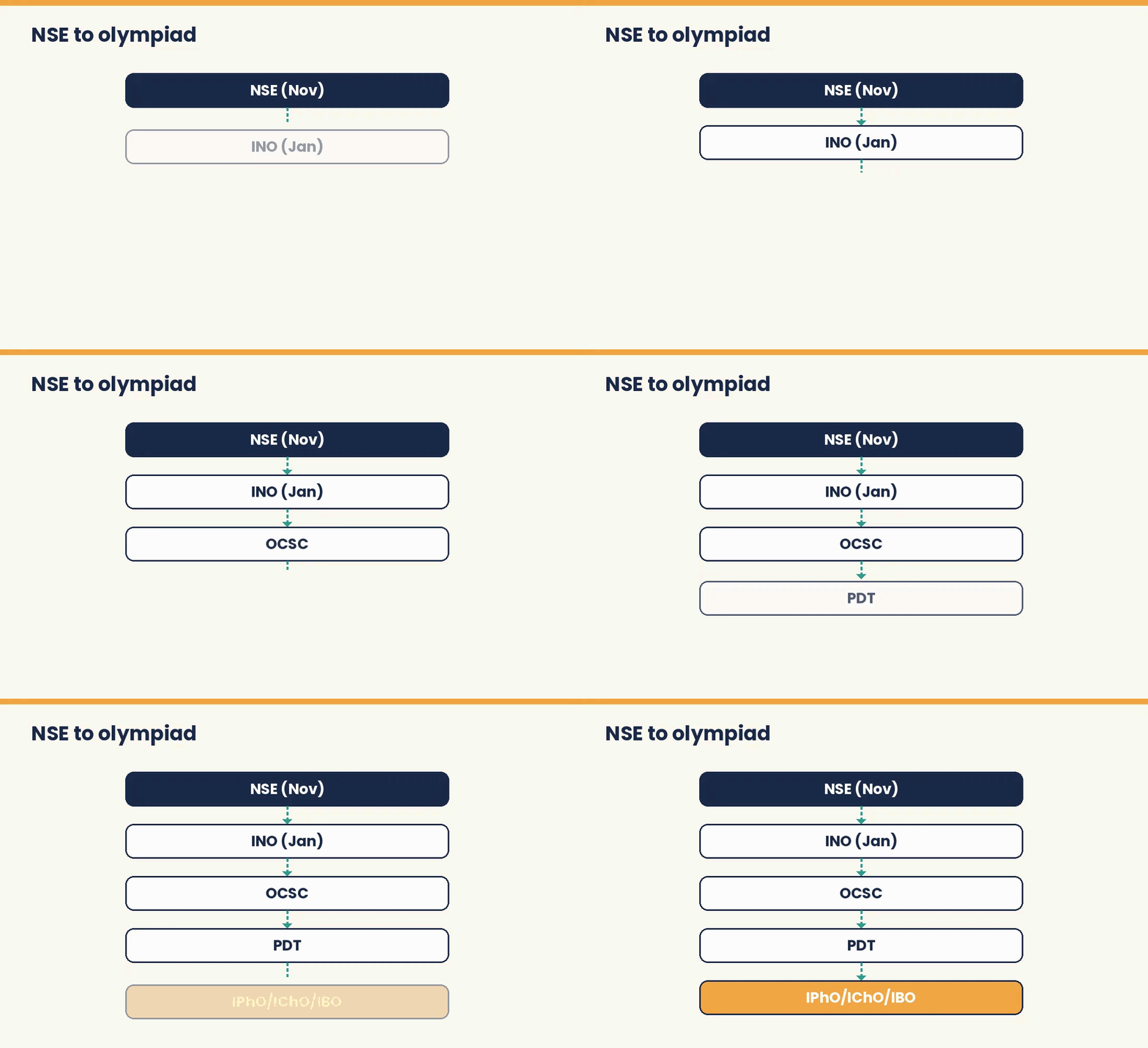
The animation shows the five stages: NSE in November, INO in late January, the OCSC camp at HBCSE, pre-departure training (PDT), and then the international olympiad.
IPhO, IChO and IBO 2027 are all in July 2027. IOAA 2027 is in August or September 2027. Teams have 5 students for IPhO and IOAA and 4 for IChO and IBO. If you qualify, you must register on the HBCSE website after the January list, or you lose your INO seat. INO and the camps are free.
Is NSE worth it? Honest benefits
- Certificates: top 10% at each centre, top 1% per state, and national top 1% (book prize in physics, astronomy and junior science). Everyone gets a report card.
- Gold medal and camp: every OCSC student gets a gold medal and two weeks of training with scientists.
- Admissions: for 2026-27, IIT Madras, IIT Kharagpur and IIT Mandi offered extra seats under the SCOPE scheme to students who attended an HBCSE OCSC in physics, chemistry or biology. Rules for later years may change.
- Research careers: many past olympiad students now work as scientists. See our guide on how to become a scientist.
HBCSE itself says olympiads "may not lead directly to any career benefits". The real gain is deep problem solving, which also helps in JEE Main and JEE Advanced.
Worked examples in NSE style
Physics: projectile motion
Question: A ball is thrown at 20 m/s at 30 degrees above the ground. Take g = 10 m/s^2. Find the maximum height and the range.
- Vertical speed = 20 sin 30 = 10 m/s.
- Maximum height H = (10)^2 / (2 x 10) = 100 / 20 = 5 m.
- Time of flight T = 2 x 10 / 10 = 2 s.
- Horizontal speed = 20 cos 30 = 17.32 m/s.
- Range R = 17.32 x 2 = 34.6 m. (Check: u^2 sin 60 / g = 400 x 0.866 / 10 = 34.6 m.)
A trap option would be 10 m (forgetting the 2). Revise with our projectile motion guide.
Chemistry: limiting reagent
Question: 4 g of hydrogen reacts with 16 g of oxygen: 2H2 + O2 gives 2H2O. How much water forms?
- Moles of H2 = 4 / 2 = 2 mol.
- Moles of O2 = 16 / 32 = 0.5 mol.
- 2 mol H2 needs 1 mol O2. We only have 0.5 mol, so O2 is the limiting reagent.
- 0.5 mol O2 gives 2 x 0.5 = 1 mol H2O.
- Mass of water = 1 x 18 = 18 g. Hydrogen is left over (1 mol = 2 g).
The trap is 36 g, from using hydrogen. See our mole concept guide.
A 3-week final study plan for NSE 2026
About three weeks are left. Sharpen what you know; skip new chapters.
- Week 1 (1-7 November): Solve two past NSE papers under a timer. Tag each mistake: concept gap, silly error or guess. Fix your three weakest topics with 20 short problems each.
- Week 2 (8-14 November): One full paper every other day. On the other days, revise formula sheets and redo every wrong question from week 1. Practise Part B separately: 12 questions in 30 minutes.
- Week 3 (15-21 November): Two last mock papers at the real exam time (8:30 am for NSEP). Revise lightly in the last two days. Collect your hall ticket.
- Exam day: Do Part A in two passes, sure answers first. Leave 25-30 minutes for Part B.
IAPT sells ten years of past NSE papers for Rs 150 per subject. INO past papers are free on the HBCSE site.
If you want a mentor to check your working before the exam, Book a free demo class with Asymptode. You can also see our plans and fees.
Common NSE mistakes to avoid
- Blind guessing in Part A. A pure guess among four options is worth 0 on average (1/4 x 3 - 3/4 x 1 = 0). If you can rule out one option, a guess has a small positive value. Rule out two, and it is clearly worth it.
- Greedy marking in Part B. One extra wrong option makes the whole 6 marks zero. Mark only options you have checked.
- Leaving Part B blank. Part B has no negative marking, so a careful attempt can only help.
- Running out of time. 60 questions in 120 minutes is 2 minutes each. Skip long ones on the first pass.
- Forgetting INO registration. If you qualify, register on HBCSE in January. No registration means no INO.
How to apply for NSE next year
Enrolment for 2026 is closed. For the next cycle, plan like this (dates are based on the 2026 pattern; the new dates are not yet announced):
- August: Ask your school to register as an NSE centre. Centre registration usually runs 1-20 August.
- Late August to mid-September: Enrol through your school centre, or directly online on iapt.org.in if your school is not a centre. The fee in 2026 was Rs 300 per subject.
- Then: Start past papers early. Younger students take NSEJS; class 10-12 students can take any senior NSEs.
How 1-on-1 tutoring helps with NSE preparation
- One dedicated mentor, live online 1-on-1: the same Asymptode mentor every class, following your NSE subject and exam date.
- Method-first: your mentor watches each step of your working, so slips in vectors, mole ratios or units are caught before 22 November.
- Personalised homework with feedback: NSE-style problems picked for your weak spots. For planning, like INO registration, your mentor helps you track dates.
- For families: short parent updates, every class recorded, and a free demo class to start.
Related guides
- JEE Advanced 2027 guide
- How to get into IIT
- How to become a scientist
- Circular motion explained
- Research for high school students
Facts checked against official sources on 29 October 2026.
FAQ
What is the NSEP 2026 exam date?
NSEP 2026 is on Sunday 22 November 2026, from 8:30 am to 10:30 am. NSEC is the same day at 11:30 am and NSEB at 2:30 pm. NSEA is a day earlier, on Saturday 21 November.
What is the NSEJS 2026 eligibility?
You must be born between 1 January 2012 and 31 December 2013 and be eligible for an Indian passport. You must not take your class 10 board exam before 30 November 2026. NSEJS students cannot sit any senior NSE in the same year.
What is the NSE cut-off for INO?
There is no fixed cut-off. Each subject and group has a Minimum Admissible Score (50% of the top-ten average) and a Merit Index (80%). State and girls' quotas decide the rest.
Is there negative marking in NSE?
Yes, in Part A only. A wrong answer costs 1 mark and a right one gives 3. Part B has no negative marking, but you get the 6 marks only if all your marked options are right and none are missing.
When will the NSE 2026 result come out?
IAPT expects results on 25 December 2026. The INO selection list will be on iapt.org.in by 15 January 2027. Selected students must then register on the HBCSE website.
Can a class 10 student take NSEP 2026?
Yes, if they meet the date-of-birth rule (1 July 2007 to 30 June 2012) and skip NSEJS. Class 10 and 11 students compete in Group B, with its own cut-off.
Ready to start? Book a free demo class and advisor call, or see our plans and fees.