

Circular motion is what happens when an object moves along a circle. In uniform circular motion the speed stays the same, but the direction keeps changing. So the object accelerates toward the center at v^2/r, which needs a net inward force of mv^2/r. Below: formulas, three worked examples and common mistakes.
Key takeaways
- Speed is constant, but velocity is not. The object accelerates toward the center.
- Angular speed: ω = 2π/T. Linear speed: v = ωr.
- Centripetal acceleration: a = v^2/r = ω^2 r. Centripetal force: F = mv^2/r = mω^2 r.
- Centripetal force is not a new force. Tension, friction, gravity or the normal force provides it.
- Frictionless banked curve: tan θ = v^2/(rg). Top of a vertical circle: v_min = √(gr).
- There is no "centrifugal force" in an inertial frame. Never draw it.
What is circular motion in physics?
Quick answer: Circular motion is movement along a circular path. If the speed is constant, it is uniform circular motion. The velocity still changes because its direction changes, so there is an acceleration of v^2/r toward the center. A net inward force of mv^2/r must act, supplied by real forces like tension, friction or gravity.
Whirl a ball on a string and let go. It flies off along a tangent, not outward. The string was pulling it inward all along. Without that pull, it would move in a straight line, as Newton's first law says.
What are angular displacement and angular speed?
Angular displacement (θ) is the angle turned, in radians. One turn is 2π rad, and arc length s = rθ.
Angular speed (ω) is angle per second, in rad/s: ω = 2π/T = 2πf, where T is the period and f = 1/T.
Linear speed links them: v = ωr. Every point on a spinning disc has the same ω, but outer points move faster.
Circular motion formulas: the table
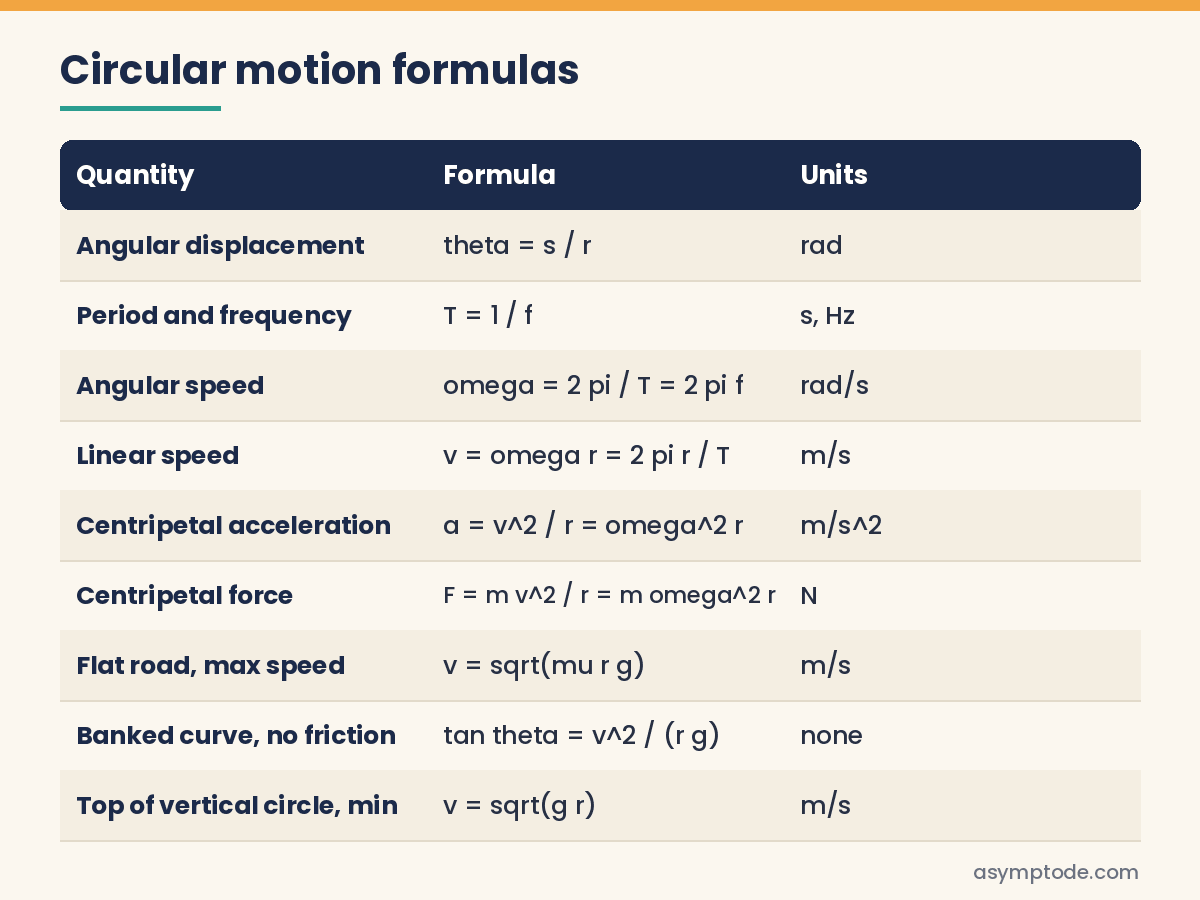
The core circular motion formulas on one card.
| Quantity | Formula | Units |
|---|---|---|
| Angular displacement | θ = s/r | rad |
| Period and frequency | T = 1/f | s, Hz |
| Angular speed | ω = 2π/T = 2πf | rad/s |
| Linear speed | v = ωr = 2πr/T | m/s |
| Centripetal acceleration | a = v^2/r = ω^2 r | m/s^2 |
| Centripetal force | F = mv^2/r = mω^2 r | N |
| Flat road, max speed | v = √(μrg) | m/s |
| Banked curve, no friction | tan θ = v^2/(rg) | none |
| Top of vertical circle, min speed | v = √(gr) | m/s |
Always use radians in ω formulas.
Why is there acceleration if the speed is constant?
Velocity is a vector, so a change of direction is a change of velocity. In a circle that change always points to the center, so the acceleration is called centripetal ("center-seeking"). Its size is a = v^2/r = ω^2 r. Double the speed and it goes up four times.
What provides the centripetal force?
Newton's second law says the net inward force must be F = mv^2/r. This is a job, not a new force. A real force does it:
| Situation | Force that provides it |
|---|---|
| Ball whirled on a string (horizontal) | Tension |
| Car turning on a flat road | Static friction from the road |
| Moon or satellite in orbit | Gravity |
| Car on a banked curve | Horizontal part of the normal force (plus friction, if any) |
| Rider at the bottom of a loop | Normal force minus weight |
| Conical pendulum | Horizontal part of tension |
Flat road: friction must supply mv^2/r, so v_max = √(μrg). With μ = 0.60, r = 40 m and g = 9.8 m/s^2, v_max = √235.2 ≈ 15.3 m/s.
Worked examples with full working
Use g = 9.8 m/s^2.
Example 1: puck on a string
A 0.20 kg puck moves on a frictionless air table, tied to a 0.50 m string. It makes 2.0 revolutions per second. Find ω, v, a and the tension.
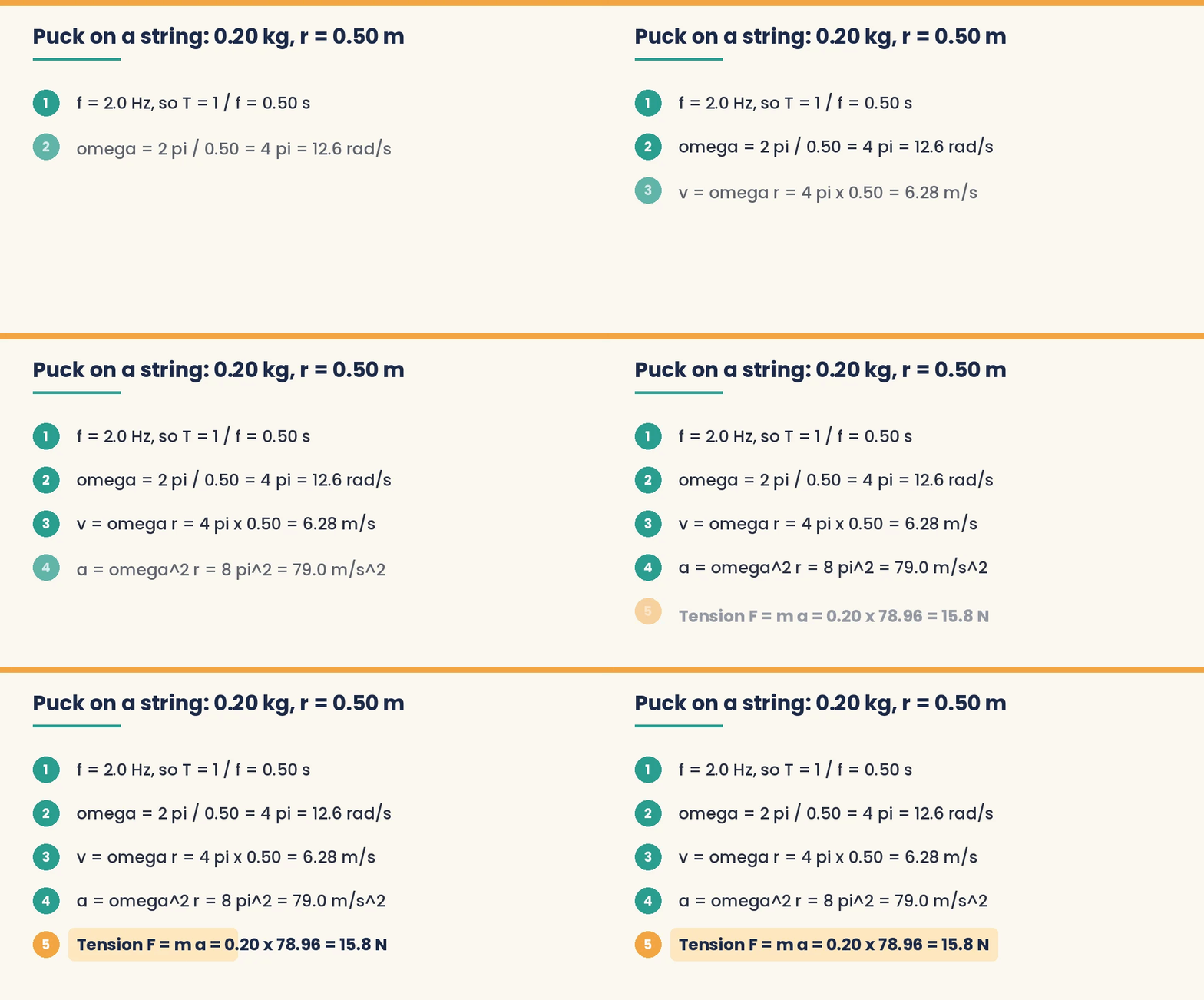
Example 1 solved one step at a time.
- Period: f = 2.0 Hz, so T = 1/f = 0.50 s.
- Angular speed: ω = 2π/T = 2π/0.50 = 4π ≈ 12.6 rad/s.
- Linear speed: v = ωr = 4π x 0.50 = 2π ≈ 6.28 m/s.
- Centripetal acceleration: a = ω^2 r = (4π)^2 x 0.50 = 8π^2 ≈ 79.0 m/s^2.
- Tension: F = ma = 0.20 x 78.96 ≈ 15.8 N, pointing toward the center.
Check: v^2/r = 6.283^2/0.50 ≈ 79.0 m/s^2.
Example 2: banked curve with no friction
A road curve has radius 50 m. It is designed so cars at 15 m/s need no friction. Find the bank angle.
- Draw two forces: weight mg down and normal force N at right angles to the road.
- Vertical: N cos θ = mg (no vertical acceleration).
- Horizontal: N sin θ = mv^2/r (this provides the centripetal force).
- Divide: tan θ = v^2/(rg) = 15^2/(50 x 9.8) = 225/490 ≈ 0.459.
- θ = tan⁻¹(0.459) ≈ 24.7°.
Mass cancels. NCERT Class 11 Physics, Chapter 4 derives this result and the friction case.
Example 3: bucket in a vertical circle
A 1.5 kg bucket of water swings in a vertical circle of radius 0.80 m. (a) What is the minimum speed at the top? (b) At the bottom it moves at 6.0 m/s. What is the tension there?
(a) Top: at minimum speed, gravity alone provides the centripetal force (tension is zero).
- mg = mv^2/r, so v^2 = gr.
- v_min = √(gr) = √(9.8 x 0.80) = √7.84 = 2.8 m/s.
(b) Bottom: tension points up (to the center) and weight points down.
- T − mg = mv^2/r.
- v^2/r = 6.0^2/0.80 = 45 m/s^2.
- T = m(g + v^2/r) = 1.5 x (9.8 + 45) = 82.2 N.
That is far more than the weight (14.7 N), so strings tend to snap at the bottom.
Want a mentor to check your free-body diagrams? Book a free demo class.
How do you solve any circular motion problem?
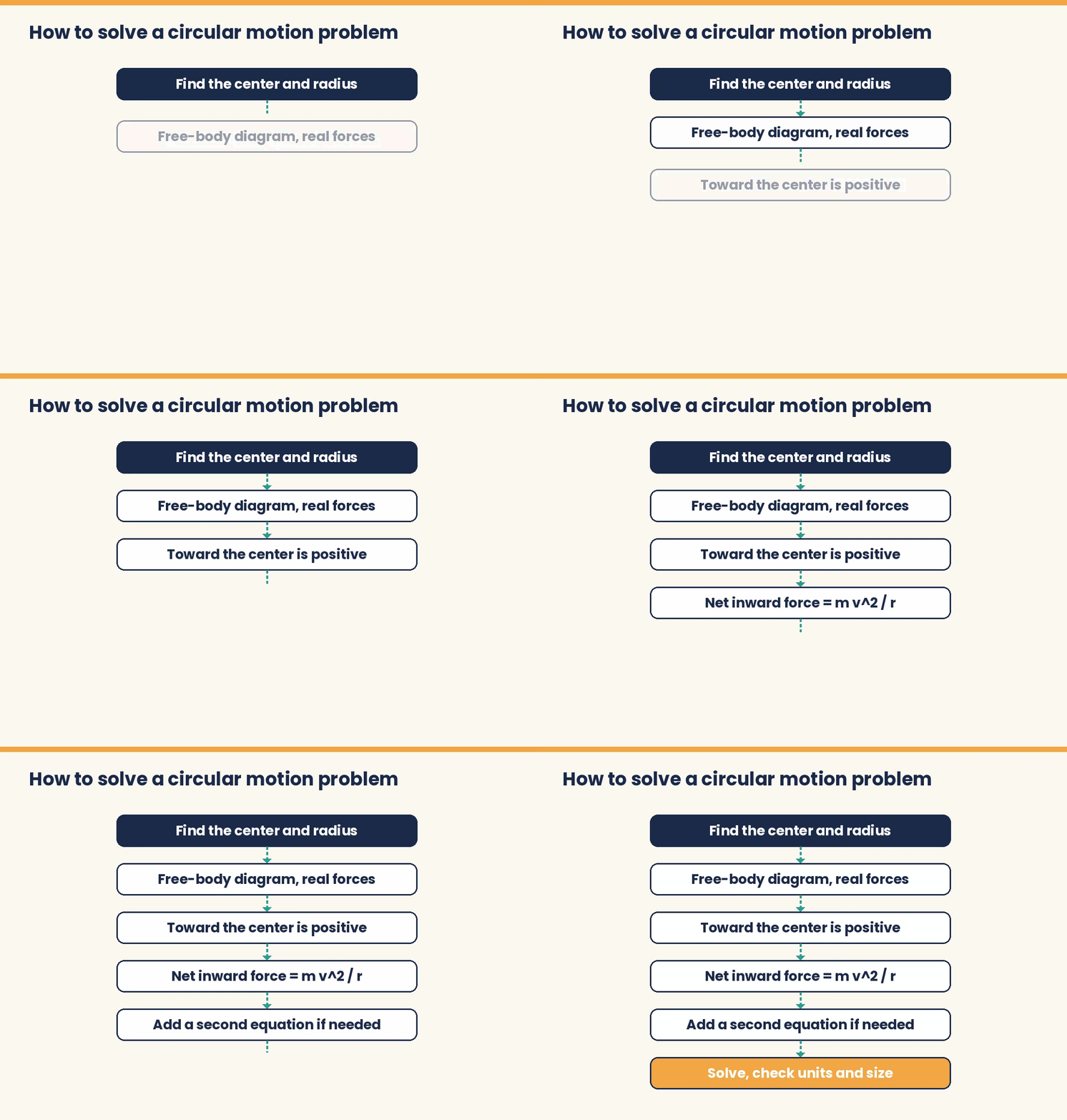
A six-step method that works for strings, cars, loops and orbits.
- Find the center and radius of the actual circle.
- Draw a free-body diagram with real forces only.
- Take "toward the center" as positive and resolve forces.
- Write F_net inward = mv^2/r (or mω^2 r).
- Add a second equation if needed, such as vertical balance.
- Solve and check units and size.
It is the same idea as in projectile motion: split forces by direction.
Common mistakes in circular motion
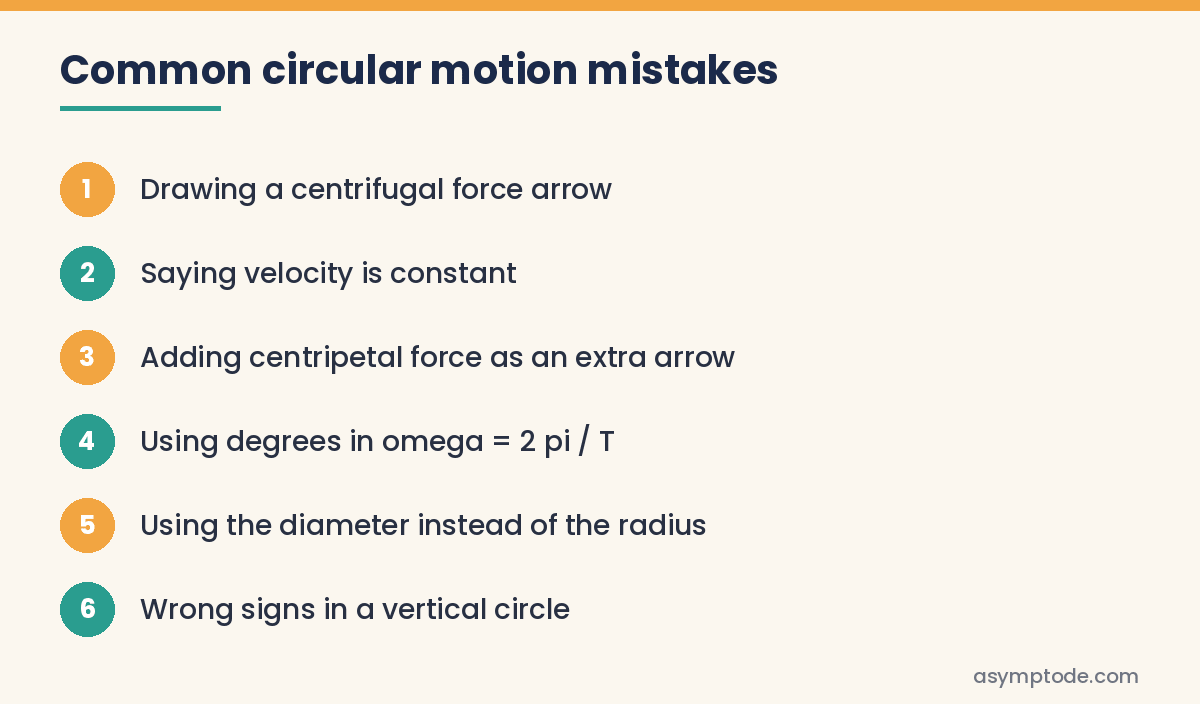
Six mistakes that cost marks in circular motion questions.
- Drawing "centrifugal force." It does not exist in an inertial frame. The outward "push" in a turning car is your body trying to go straight.
- Saying velocity is constant. Only the speed is constant. Velocity changes direction, so there is acceleration.
- Adding "centripetal force" as an extra arrow. It is the net inward force, made of real forces you already drew.
- Using degrees in ω = 2π/T. Use radians.
- Using the diameter instead of the radius.
- Wrong signs in a vertical circle. At the top, weight points to the center. At the bottom, it points away.
Where does circular motion sit in your syllabus?
- AP Physics 1: Topic 2.9 Circular Motion in Unit 2 (18-23% of the multiple-choice score); ω and v = ωr come in Unit 5. The Course and Exam Description (effective Fall 2024) lists a = v^2/r and v = √(gr) at the top of a loop. Banked curves are quantitative only when no friction is needed. See our AP Physics 1 exam guide.
- AQA A-level: Section 3.6.1.1 (A-level only) of the 7408 specification lists ω = v/r = 2πf, a = v^2/r = ω^2 r and F = mv^2/r = mω^2 r. The derivation of the acceleration formula "will not be examined." See our A-level Physics guide.
- JEE Main and NEET: The JEE Main 2026 syllabus (latest published; 2027 not yet announced) lists "vehicle on a level circular road, vehicle on a banked road" and "motion in a vertical circle." NCERT Class 11 covers it in Sections 3.10 and 4.10. See our JEE Main 2027 guide.
- IB and GCSE: Check your own course guide. GCSE students can use this page as extension reading.
A 2-week practice plan for circular motion
- Days 1-3: ω = 2π/T and v = ωr. Convert rpm to rad/s.
- Days 4-5: a = v^2/r and F = mv^2/r on strings and turntables.
- Days 6-7: Free-body diagrams only. Name the inward force each time.
- Days 8-9: Flat roads and banked curves. Redo Example 2 from memory.
- Days 10-11: Vertical circles, top and bottom.
- Days 12-14: Timed past questions from your board. Sort every mistake: diagram, formula, algebra or units.
How 1-on-1 tutoring helps with circular motion
Most lost marks come from the free-body diagram, not the formula. At Asymptode, one student works live online with one dedicated mentor. No batches. The mentor watches each step and catches a "centrifugal" arrow or a wrong sign at the bottom of a loop, then fixes the method. Classes follow your own syllabus and exam dates: AP Physics 1, AQA A-level, IB or JEE. You get personalized homework on banked curves and vertical circles, with feedback. Times are flexible across time zones, every class is recorded, and parents get short updates.
Ready to master circular motion? Book a free demo class or see fees.
Facts checked against official sources on 27 October 2026.
Related guides on Asymptode
- Newton's three laws explained
- Projectile motion explained
- AP Physics 1 exam guide
- A-level Physics guide
- JEE Main 2027 guide
FAQ
What is the formula for circular motion?
ω = 2π/T, v = ωr, a = v^2/r = ω^2 r and F = mv^2/r, all pointing to the center.
Is centripetal force a real force?
It is the name for the net inward force, not a separate force. Tension, friction, gravity or a normal force provides it.
Does centrifugal force exist?
Not in an inertial (non-rotating) frame, used in school physics. The outward feeling in a turning car is inertia.
What is the minimum speed at the top of a vertical circle?
For an object on a string, v = √(gr). At that speed, gravity alone provides the centripetal force and the tension is zero. For r = 0.80 m, the minimum speed is 2.8 m/s.
Does mass affect the angle of a banked curve?
No. For a frictionless banked curve, tan θ = v^2/(rg). Mass cancels, so every vehicle at the design speed needs the same angle.
Sources
- College Board: AP Physics 1 Course and Exam Description (Topic 2.9 Circular Motion)
- AQA: A-level Physics 7408 specification, 3.6 Further mechanics and thermal physics
- NTA: JEE (Main) syllabus page
- NTA: Syllabus for JEE (Main) 2026 (PDF)
- NCERT: Class 11 Physics Part 1 textbook
- NCERT: Class 11 Physics Chapter 3, Motion in a Plane (PDF)
- NCERT: Class 11 Physics Chapter 4, Laws of Motion (PDF)