

The mole concept is a way to count tiny particles by weighing them. One mole of any substance holds exactly 6.02214076 x 10^23 particles. Once you know the mass of one mole (the molar mass), you can turn grams into moles, moles into particles, and moles into gas volumes or concentrations. This guide shows every formula, five worked examples and practice questions with answers.
Key takeaways
- One mole = exactly 6.02214076 x 10^23 entities (the 2019 SI definition).
- Molar mass (g/mol) has the same number as the relative formula mass. Water is 18.0 g/mol.
- The core formulas are n = m / M, N = n x NA, V = n x Vm and n = c x V.
- In reactions, compare moles, not grams. The balanced equation gives the mole ratio.
- Gas volume per mole depends on conditions. Use the value your syllabus gives.
What is the mole concept in chemistry?
Quick answer: A mole is the SI unit for amount of substance. One mole contains exactly 6.02214076 x 10^23 particles, such as atoms, molecules or ions. The mass of one mole in grams is the molar mass. So you can count particles by weighing: moles = mass / molar mass.
Atoms are far too small to count one by one. Chemists solve this the way a shop sells rice: by the bag, not by the grain. The "bag" in chemistry is the mole.
Since 20 May 2019, the mole has a fixed definition. The BIPM page on the mole says one mole contains exactly 6.022 140 76 x 10^23 elementary entities. NIST lists the Avogadro constant as 6.022 140 76 x 10^23 mol^-1, marked "exact". Most exam questions round this to 6.02 x 10^23.
If atoms and relative atomic mass feel shaky, read atoms and elements explained first.
What is the Avogadro constant?
The Avogadro constant, NA, is the number of particles per mole: 6.02 x 10^23 mol^-1. It links the world you can weigh to the world of atoms.
Always say which particle you mean. One mole of water molecules contains 6.02 x 10^23 molecules. But each molecule has 3 atoms, so it holds 3 x 6.02 x 10^23 atoms.
What is molar mass and how do you find it?
Molar mass, M, is the mass of one mole, in g/mol. Add up the relative atomic masses from the periodic table.
- H2O: 2(1.0) + 16.0 = 18.0 g/mol
- CO2: 12.0 + 2(16.0) = 44.0 g/mol
- CaCO3: 40.0 + 12.0 + 3(16.0) = 100.0 g/mol
The number is the same as the relative formula mass (Mr). Only the unit changes. OpenStax Chemistry 2e, section 3.1 explains this link in more depth.
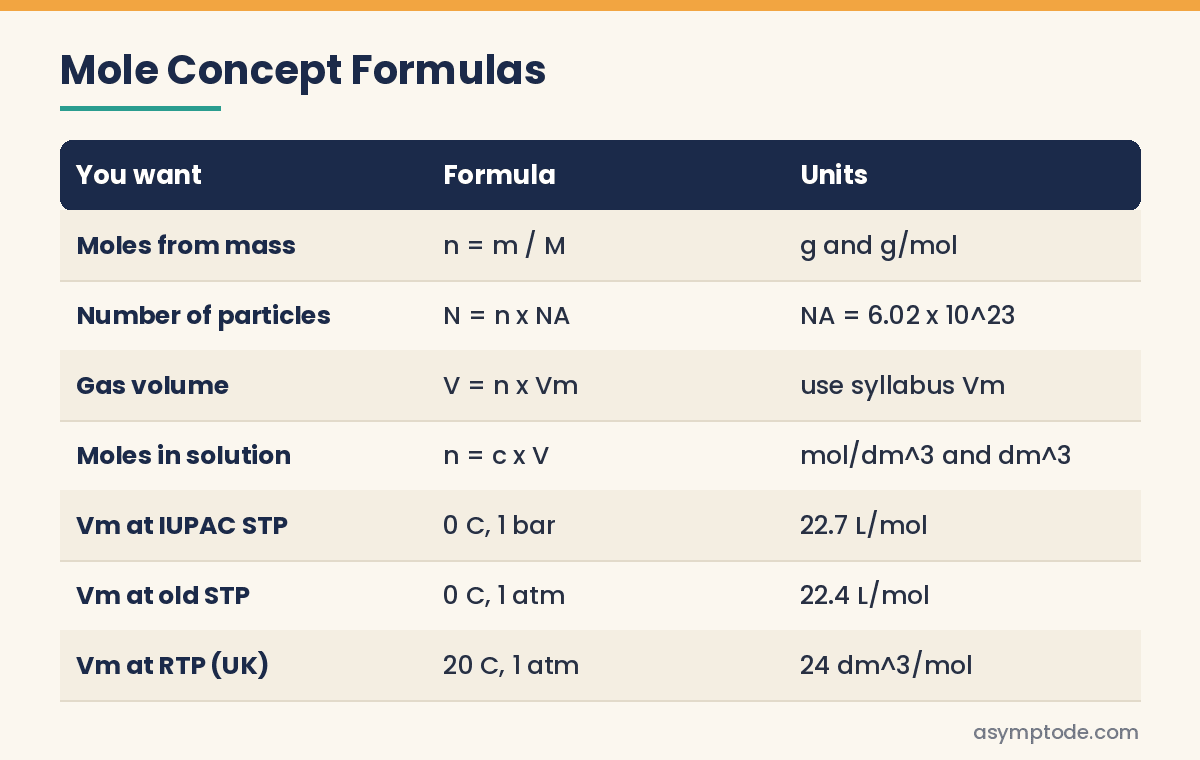
What are the mole concept formulas?
| Quantity you want | Formula | Units |
|---|---|---|
| Moles from mass | n = m / M | mol = g / (g/mol) |
| Number of particles | N = n x NA | NA = 6.02 x 10^23 mol^-1 |
| Gas volume | V = n x Vm | Vm in L/mol or dm^3/mol |
| Moles in a solution | n = c x V | c in mol/dm^3, V in dm^3 |
Which molar gas volume should you use?
The molar volume of a gas, Vm, depends on temperature and pressure. Different books use different conditions:
| Convention | Conditions | Vm |
|---|---|---|
| IUPAC STP (current) | 0 C, 1 bar (100 kPa) | 22.7 L/mol |
| Older STP | 0 C, 1 atm (101.325 kPa) | 22.4 L/mol |
| RTP (UK boards) | 20 C, 1 atm | 24 dm^3/mol |
The 22.7 and 22.4 values come from NIST at 100 kPa and NIST at 101.325 kPa. The AQA GCSE Chemistry specification uses 24 dm^3 at 20 C and 1 atm. Many US and Indian textbooks still use 22.4 L. Use the value your syllabus or exam paper gives. Note: 1 L = 1 dm^3 = 1000 cm^3.
How do you solve mole concept problems? Five worked examples
Example 1: grams to moles to particles
How many molecules are in 36 g of water?
- Find the molar mass: M(H2O) = 18.0 g/mol.
- Find moles: n = 36 / 18.0 = 2.00 mol.
- Find molecules: N = 2.00 x 6.02 x 10^23 = 1.20 x 10^24 molecules.
- Bonus: each molecule has 3 atoms, so atoms = 3.61 x 10^24.
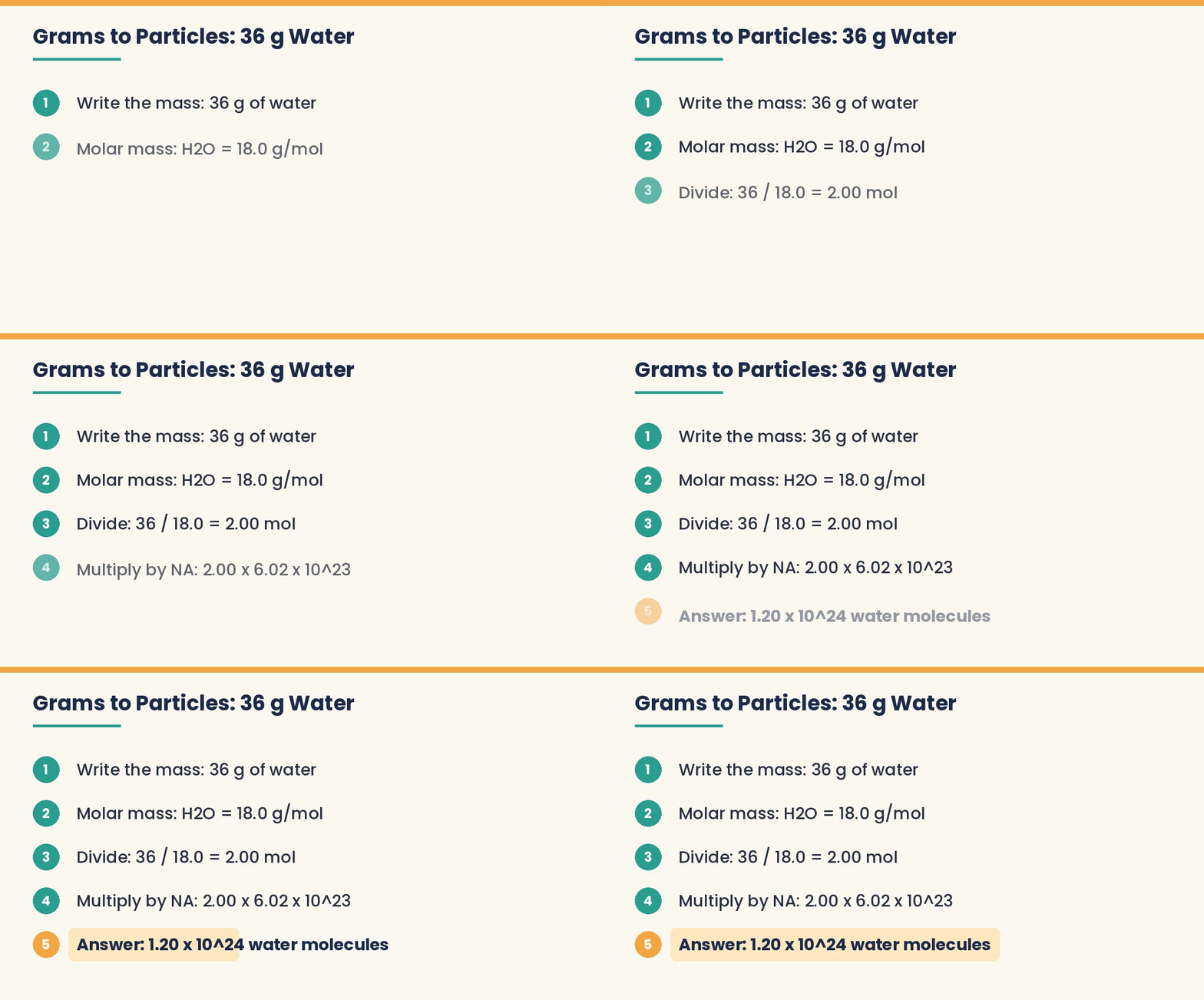
The steps in the animation:
- Write the mass: 36 g of water.
- Work out molar mass: H2O = 18.0 g/mol.
- Divide mass by molar mass: 36 / 18.0 = 2.00 mol.
- Multiply by NA: 2.00 x 6.02 x 10^23.
- Answer: 1.20 x 10^24 water molecules.
Example 2: moles to gas volume
What volume does 8.8 g of carbon dioxide fill?
- n = 8.8 / 44.0 = 0.200 mol.
- At RTP (24 dm^3/mol): V = 0.200 x 24 = 4.8 dm^3.
- At IUPAC STP (22.7 L/mol): V = 4.54 L. With 22.4 L/mol: V = 4.48 L.
Example 3: concentration and titration
25.0 cm^3 of 0.100 mol/dm^3 NaOH is neutralised by 20.0 cm^3 of HCl. Find the HCl concentration. The equation is NaOH + HCl -> NaCl + H2O (1 : 1).
- Convert volume: 25.0 cm^3 = 0.0250 dm^3.
- Moles of NaOH: n = c x V = 0.100 x 0.0250 = 0.00250 mol.
- Mole ratio 1 : 1, so HCl = 0.00250 mol.
- c(HCl) = n / V = 0.00250 / 0.0200 = 0.125 mol/dm^3.
You need a correct balanced equation for every ratio. See how to balance chemical equations if you need practice.
Example 4: limiting reagent
4.8 g of magnesium burns in 4.8 g of oxygen: 2Mg + O2 -> 2MgO. Which reactant runs out, and what mass of MgO forms?
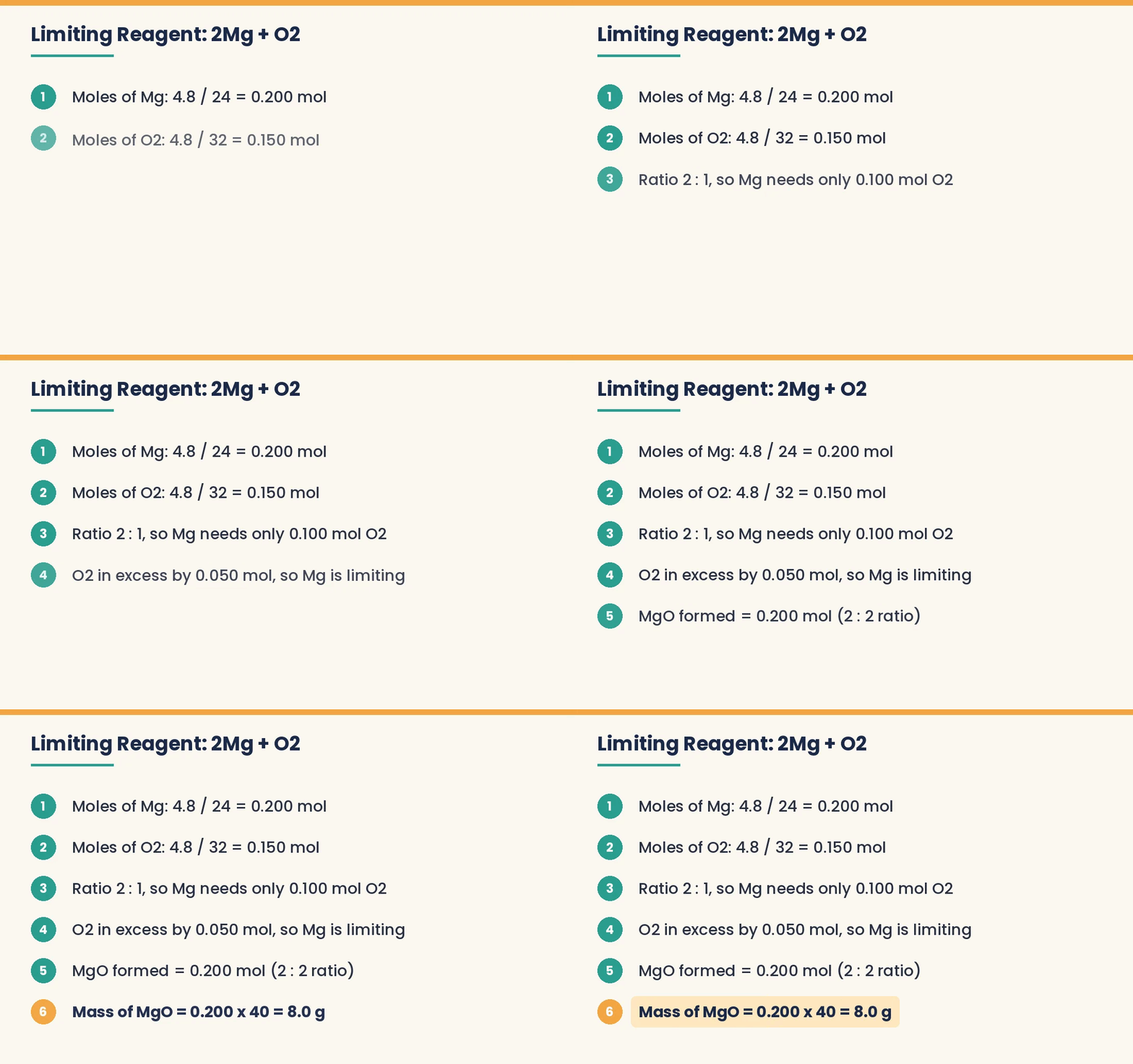
The steps in the animation:
- Moles of Mg: 4.8 / 24 = 0.200 mol.
- Moles of O2: 4.8 / 32 = 0.150 mol.
- Ratio 2 : 1, so 0.200 mol Mg needs only 0.100 mol O2.
- Oxygen is in excess by 0.050 mol (1.6 g). Magnesium is limiting.
- MgO formed = 0.200 mol (2 : 2 ratio).
- Mass of MgO = 0.200 x 40 = 8.0 g.
The limiting reagent decides how much product you get. Always base the product amount on it.
Example 5: empirical and molecular formula
A compound is 40.0% C, 6.7% H and 53.3% O by mass. Its molar mass is 180 g/mol. Find both formulas.
| Element | Mass in 100 g | Moles | Divide by smallest |
|---|---|---|---|
| C | 40.0 g | 40.0 / 12.0 = 3.33 | 1 |
| H | 6.7 g | 6.7 / 1.0 = 6.7 | 2 |
| O | 53.3 g | 53.3 / 16.0 = 3.33 | 1 |
The empirical formula is CH2O (mass 30). Then 180 / 30 = 6, so the molecular formula is C6H12O6 (glucose).
Want a mentor to watch you work through questions like these? Book a free demo class and see how a 1-on-1 session runs.
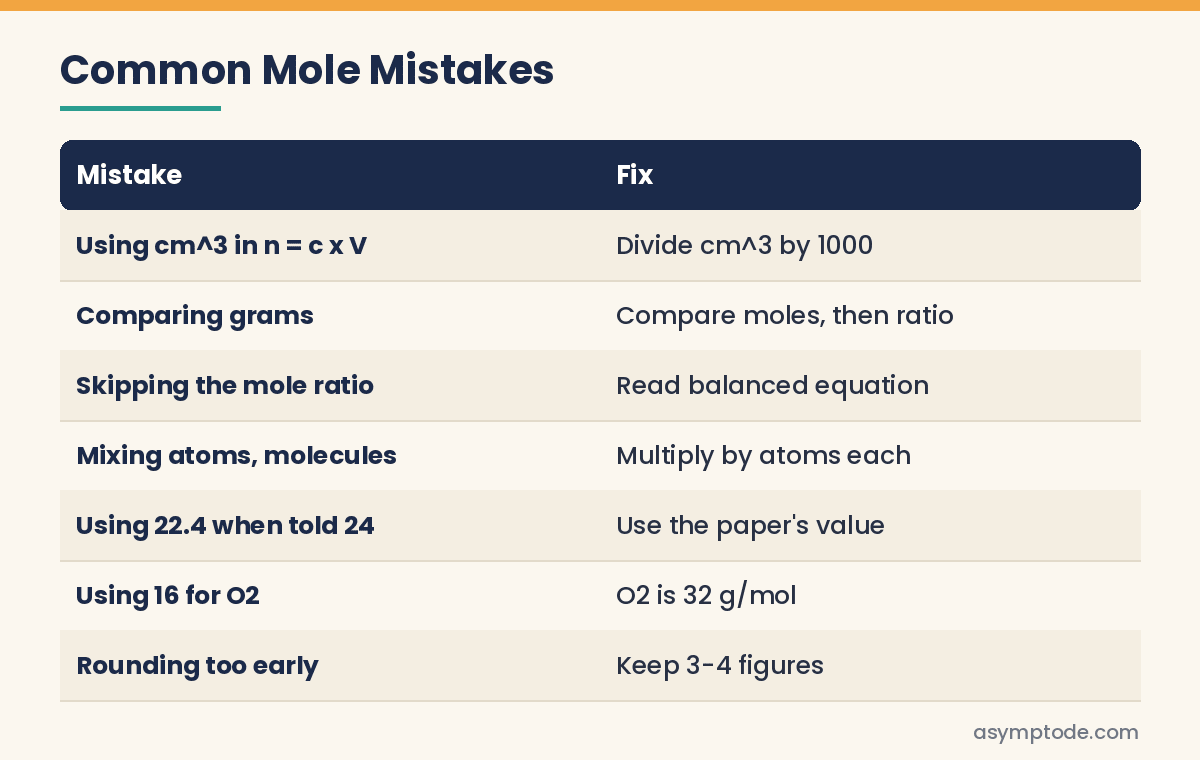
What are the most common mole concept mistakes?
| Mistake | Fix |
|---|---|
| Using cm^3 in n = c x V | Divide cm^3 by 1000 first |
| Comparing grams in reactions | Compare moles, then use ratio |
| Skipping the mole ratio | Read ratio from balanced equation |
| Mixing atoms and molecules | Multiply by atoms per formula |
| Using 22.4 when told 24 | Use the value the paper gives |
| Using Ar for O2 (16, not 32) | Diatomic gases: H2, N2, O2, Cl2 |
| Rounding too early | Keep 3-4 figures until the end |
How do you study the mole concept? A simple plan
- Week 1: Learn molar mass and n = m / M. Do 15 short questions.
- Week 2: Add N = n x NA and gas volumes. Learn your syllabus value for Vm.
- Week 3: Practise n = c x V and simple titrations.
- Week 4: Reacting masses, limiting reagents, empirical formulas and percentage yield.
- Every week: Mix in past-paper questions and redo any you got wrong.
Exam guides that show where moles appear: GCSE Chemistry, A-Level Chemistry, AP Chemistry and NEET UG 2027. In India, "Some Basic Concepts of Chemistry" in Class 11 covers this topic.
Practice questions (with answers)
Use Ar values: H = 1.0, C = 12.0, O = 16.0, Na = 23.0, Cl = 35.5, Ca = 40.0.
- How many moles are in 10.0 g of CaCO3?
- How many molecules and atoms are in 0.25 mol of CO2?
- What volume does 0.50 mol of O2 fill at RTP (24 dm^3/mol)?
- What mass of NaCl do you need for 250 cm^3 of 0.200 mol/dm^3 solution?
- A hydrocarbon has 2.4 g C and 0.6 g H. Find its empirical formula.
Answers:
- M = 100 g/mol, so n = 10.0 / 100 = 0.100 mol.
- Molecules = 0.25 x 6.02 x 10^23 = 1.51 x 10^23. Atoms = 3 x that = 4.52 x 10^23.
- V = 0.50 x 24 = 12 dm^3.
- n = 0.200 x 0.250 = 0.0500 mol. Mass = 0.0500 x 58.5 = 2.93 g.
- C: 2.4 / 12 = 0.20 mol. H: 0.6 / 1.0 = 0.60 mol. Ratio 1 : 3, so CH3.
How 1-on-1 tutoring helps with the mole concept
At Asymptode, every student gets one dedicated mentor in private, live 1-on-1 online classes. The mentor first checks where the mole concept breaks down for your child. Is it unit conversion, the mole ratio or reading the question?
The mentor then teaches method first and watches each line of working. That is where mole errors hide. Homework is personalised and marked with feedback. Classes follow your own syllabus, whether that is GCSE, IGCSE, AP, IB or Class 11 for JEE and NEET, and your exam dates. Scheduling is flexible across time zones. Every class is recorded for revision, and parents get a short weekly update.
Ready to start? Talk to an advisor or book a free demo class, or see our fees.
Facts checked against official sources on 26 October 2026.
FAQ
What is 1 mole equal to?
One mole equals exactly 6.02214076 x 10^23 particles. This value has been fixed since the 2019 SI redefinition. For exams, 6.02 x 10^23 is usually enough.
Is the molar volume 22.4 L or 22.7 L?
Both appear in textbooks. 22.4 L/mol is for 0 C and 1 atm. 22.7 L/mol is for the current IUPAC STP of 0 C and 1 bar. UK boards often use 24 dm^3 at room temperature, so always use the value your paper gives.
How do you convert grams to moles?
Divide the mass in grams by the molar mass in g/mol: n = m / M. For example, 36 g of water / 18.0 g/mol = 2.00 mol.
What is the difference between molar mass and relative formula mass?
They have the same number. Relative formula mass (Mr) has no units. Molar mass has units of g/mol.
How do I find the limiting reagent?
Convert each reactant to moles. Use the balanced equation's ratio to see how much of the other reactant each one needs. The one that runs out first is limiting, and it sets the amount of product.
Why is the mole concept hard for students?
It mixes maths and chemistry. Most errors come from units, skipped mole ratios or confusing atoms with molecules. Clear steps and regular practice fix most of these problems.