JEE Main vs JEE Advanced is the first question most Class 11 and 12 students ask when they plan for engineering. In short, JEE Main is the national exam for NITs, IIITs and other central colleges, and it is also the gate to JEE Advanced. JEE Advanced is the harder exam for the IITs. This guide compares the two using only official NTA and IIT documents. For full details, see our JEE Main 2027 guide and JEE Advanced 2027 guide.
Key takeaways
- JEE Main is run by the National Testing Agency (NTA). JEE Advanced is run by the IITs.
- JEE Main leads to NITs, IIITs and other CFTIs. JEE Advanced leads to the IITs.
- Indian nationals must be in the top 2,50,000 of JEE Main Paper 1 to sit JEE Advanced.
- JEE Main has one fixed pattern: 75 questions, 300 marks, +4 and -1. JEE Advanced has two compulsory papers, and its pattern can change each year.
- JEE Main 2027 Session 1 registration closes on 22 November 2026. JEE Advanced 2027 dates are not yet announced.
What is the difference between JEE Main vs JEE Advanced?
Quick answer: JEE Main is a national computer-based exam by NTA for admission to NITs, IIITs and other centrally funded colleges. It is also the qualifying test for JEE Advanced. JEE Advanced is run by the IITs, has two compulsory papers with more varied question types, and is the basis for IIT admission. Only the top 2,50,000 JEE Main candidates can take it.
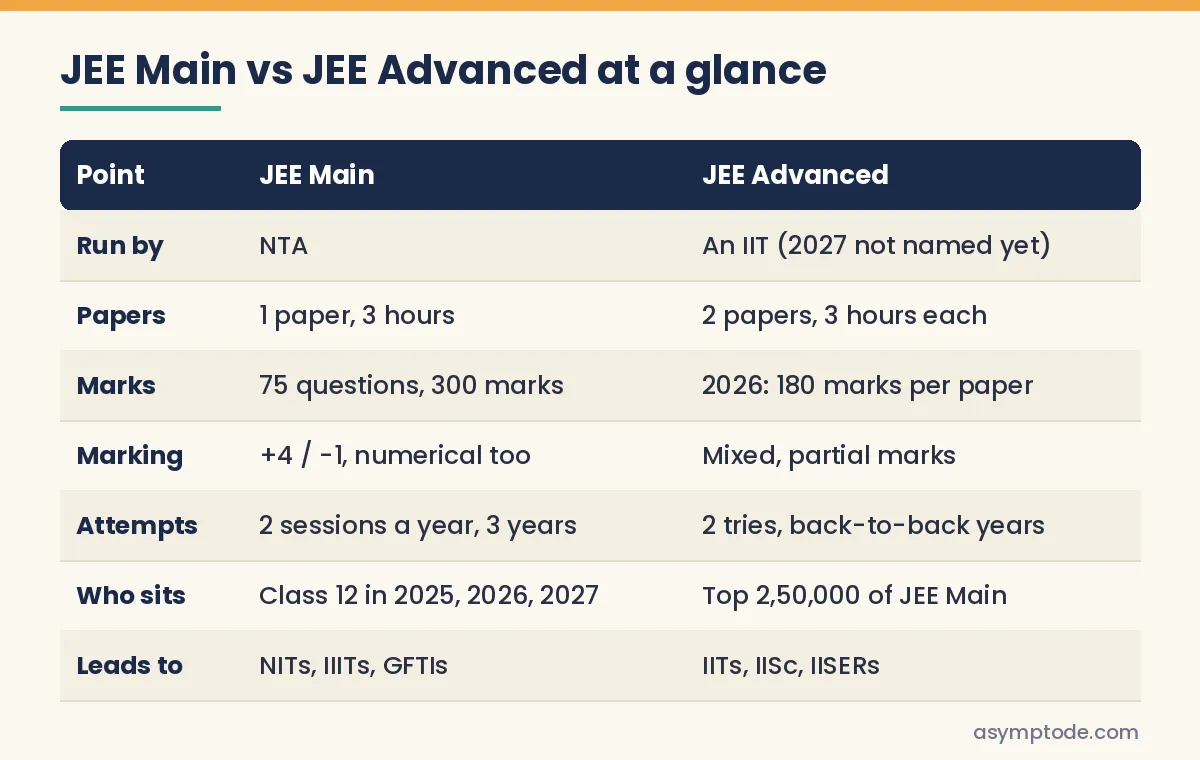 JEE Main and JEE Advanced compared at a glance.
The picture shows that NTA runs JEE Main and the IITs run JEE Advanced. JEE Main Paper 1 is one 3-hour paper of 300 marks. JEE Advanced has two compulsory 3-hour papers. JEE Main marking is +4 and -1. JEE Advanced marking changes by section. JEE Main leads to NITs and IIITs. JEE Advanced leads to the IITs.
| Point | JEE Main 2027 | JEE Advanced (2026 rules, latest) |
|---|---|---|
| Who runs it | NTA | Seven zonal IITs under the Joint Admission Board (2026: IIT Roorkee) |
| Leads to | NITs, IIITs, other CFTIs; also the JEE Advanced qualifier | IIT Bachelors, Integrated Masters and Dual Degree |
| Sessions | Two (January and April); best score counts | One exam day |
| Papers | One 3-hour paper (Paper 1) | Paper 1 and Paper 2, both compulsory |
| Marks | 75 questions, 300 marks | 180 per paper, 360 in total |
| Marking | +4 right, -1 wrong, 0 blank | Varies by section; partial marks in some |
| Numerical answers | Rounded to nearest integer | 2 decimal places |
| Languages | 13 | English and Hindi |
| Attempt rule | Class 12 passed in 2025 or 2026, or appearing in 2027 | Maximum two, in consecutive years |
Sources: JEE (Main) 2027 Information Bulletin and JEE (Advanced) 2026 Information Brochure.
Who conducts JEE Main and JEE Advanced?
JEE Main is run by the National Testing Agency, in charge since 2019. NTA only runs the exam. It does not give admission. Notices are on the JEE Main official site.
JEE Advanced 2026 was run by the seven Zonal Coordinating IITs, with IIT Roorkee as organiser. The 2027 organising IIT is not yet announced. Watch the JEE Advanced official site.
Which colleges accept JEE Main and JEE Advanced?
- JEE Main: its Common Rank List is used for JoSAA/CSAB admission to NITs, IIITs and other CFTIs. Some state or central bodies may also use the scores under their own rules, so check each college.
- JEE Advanced: its rank is used for IIT admission. In past years, IISc Bengaluru, the IISERs, IIST, RGIPT and IIPE have also used it. Contact them directly.
Want options outside JoSAA too? Read our BITSAT 2027 guide.
Who can appear for JEE Main and JEE Advanced?
JEE Main 2027 eligibility
- No age limit.
- You can sit if you passed Class 12 in 2025 or 2026, or are appearing in 2027. Those who passed in 2024 or earlier cannot.
- The passing year is the year your result first said "pass". Improvement exams do not reset it.
- CBSE, CISCE, state boards, NIOS, GCE A-level, Cambridge HSC and the IB Diploma are accepted. Other foreign boards need an AIU equivalence certificate.
JEE Advanced eligibility (2026 rules)
The 2027 rules are not out yet. In 2026, Indian nationals had to:
- Be in the top 2,50,000 of JEE Main Paper 1.
- Be born on or after 1 October 2001 (SC/ST/PwD: 1 October 1996).
- Have first appeared in Class 12 in 2025 or 2026, with Physics, Chemistry and Maths.
- Stay within two attempts in two consecutive years.
For an IIT seat in 2026, you also needed 75% in Class 12 (65% for SC/ST/PwD), or a place in your board's top 20 percentile for your category. For NITs and IIITs, JoSAA sets the Class 12 rule, so check josaa.nic.in.
How does JEE Main lead to JEE Advanced?
 The path from JEE Main to an IIT seat.
The animation shows five steps. First you take JEE Main and reach the top 2,50,000. Then you take JEE Advanced and register for JoSAA counselling. The last step is an IIT seat.
Your JEE Main result shows if you qualify. In 2026, the top 2,50,000 were split as 40.5% OPEN, 10% GEN-EWS, 27% OBC-NCL, 15% SC and 7.5% ST, with 5% PwD within each. JoSAA registration is compulsory for an IIT seat. See how to get into IIT for every step.
How are the exam patterns different?
JEE Main 2027: Maths, Physics and Chemistry each have Section A (20 MCQs) and Section B (5 numerical questions). That is 75 questions and 300 marks in 3 hours. Treat all as compulsory.
JEE Advanced 2026: two compulsory papers on one day, each with Physics, Chemistry and Maths. Question types were:
- Single-correct MCQs (+3, -1 if wrong)
- One-or-more-correct MCQs with partial marks (+4 full, -1 if wrong)
- Numerical questions (+4, no negative marks)
- Matching lists (Paper 1) and paragraph-based numericals (Paper 2)
The brochure gives no fixed pattern. The marking scheme is shown at exam time, so 2027 may differ.
How does JEE Main marking work?
 A worked example of JEE Main marking in one subject.
The animation uses Physics: 18 right, 4 wrong, 3 blank. 18 x 4 = 72. 4 x (-1) = -4. Blanks give 0. 72 - 4 = 68 out of 100.
The rule is the same for MCQs and numericals, so a wild guess can cost you. Raw marks are then turned into a percentile (the "NTA score") within your shift. A percentile is not a percentage of marks, and each shift topper gets 100. Ties are broken by Maths, then Physics, then Chemistry.
Is JEE Advanced harder than JEE Main?
Most students find it harder. We will not invent numbers, but the official papers show why:
- More question types, including matching and paragraph questions.
- Multiple-correct answers, where you must find every right option for full marks.
- Exact answers to 2 decimal places.
- Two papers in one day, with the pattern revealed on the day.
JEE Main is wide and fast. JEE Advanced is deep and tests how you think.
Not sure where your child stands? Book a free demo class and a mentor will check their working, step by step.
Is the syllabus the same for JEE Main and JEE Advanced?
They overlap a lot, but they are two separate lists. The JEE Main 2027 syllabus has 14 Maths, 20 Physics and 20 Chemistry units. The JEE Advanced syllabus is Annexure-I of the 2026 brochure, listed by topic.
Neither document compares the two, so read both side by side. Core topics like the mole concept and projectile motion matter in both.
What are the JEE 2027 dates?
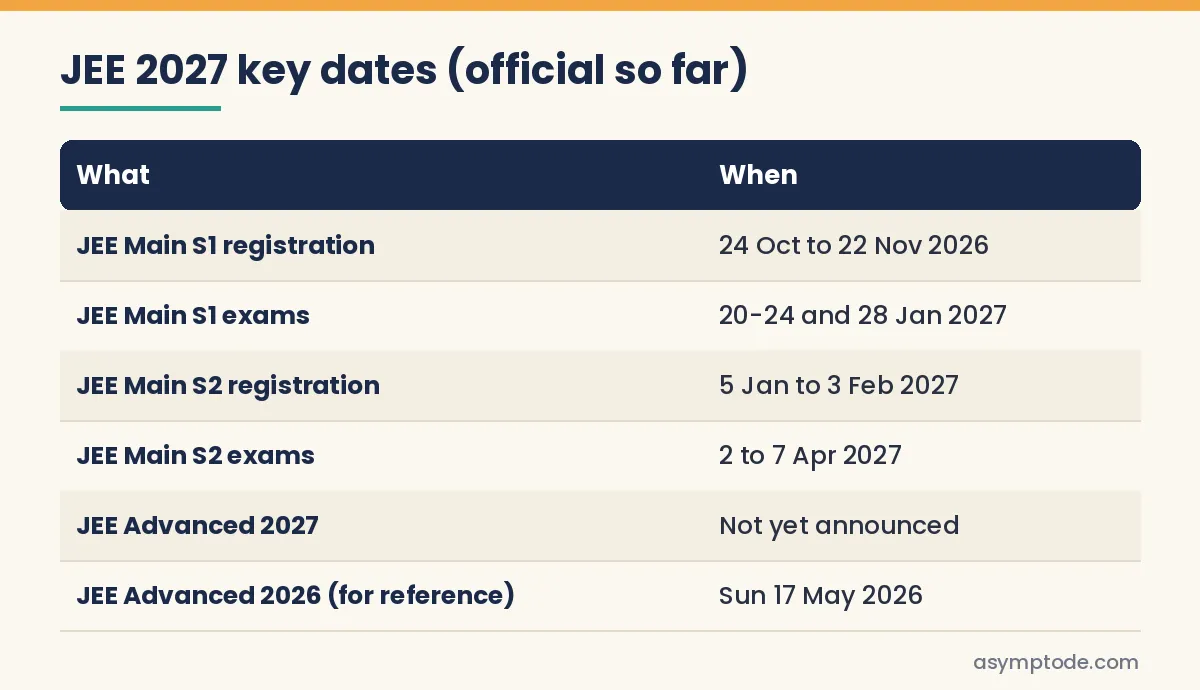 Key JEE 2027 dates from official notices.
Session 1 registration runs from 24 October to 22 November 2026, with exams in January 2027. Session 2 registration runs from 5 January to 3 February 2027, with exams from 2 to 7 April 2027. JEE Advanced 2027 dates are not yet announced.
| Event | Date |
|---|---|
| Session 1 registration | 24 Oct to 22 Nov 2026 (till 11:50 PM) |
| Session 1 late submission (Rs 500 extra) | 23 to 26 Nov 2026 |
| Session 1 exams | 20 to 24 and 28 Jan 2027 |
| Session 2 registration (tentative) | 5 Jan to 3 Feb 2027 |
| Session 2 exams (tentative) | 2 to 7 Apr 2027 |
| JEE Advanced 2027 | Not yet announced |
Before applying, do Re-KYC on DigiLocker. Your name and date of birth must match your Class 10 certificate, says the NTA advisory. Our JEE Main 2027 registration guide has the steps.
What about NRI, OCI and foreign students?
- Centres abroad: JEE Main 2027 has 9: Manama, Kuwait City, Kathmandu, Muscat, Doha, Riyadh, Dubai, Abu Dhabi and Sharjah. JEE Advanced 2026 had only Abu Dhabi and Kathmandu.
- Fees abroad: JEE Main Paper 1 abroad is 5 times the India fee. JEE Advanced 2026 abroad was USD 200 for Indian nationals.
- OCI, Class 12 abroad: eligible for All India quota seats at NITs, IIITs and CFTIs, not Home State quota.
- Foreign nationals and OCI/PIO (F): no JEE Main needed. They register directly for JEE Advanced.
How should you prepare for both?
- Build one strong base. Most topics are shared.
- Train speed for JEE Main. 75 questions in 3 hours, with negative marks.
- Train depth for JEE Advanced. Practise multiple-correct and multi-step problems.
- Use both JEE Main sessions. The better score counts.
- Keep up with boards. IITs have a Class 12 rule. See our CBSE board exams 2027 guide.
How 1-on-1 tutoring helps with JEE Main and JEE Advanced
At Asymptode, each student gets one dedicated mentor for live online 1-on-1 classes.
- Method first. The mentor watches each step of your working, so slips in a numerical or a multiple-correct question are caught early.
- Your syllabus, your dates. Classes follow your own board syllabus and JEE Main session dates.
- Personalised homework with feedback. Practice is built for both speed (Main) and depth (Advanced).
- Parents stay informed. Parents get short updates, every class is recorded, and you can start with a free demo class. For forms and counselling, the mentor helps with planning; the rules come from NTA, the IITs and JoSAA.
Facts checked against official sources on 30 October 2026.
FAQ
Can I take JEE Advanced without JEE Main?
Indian nationals cannot. You must first be in the top 2,50,000 of JEE Main Paper 1. Foreign nationals and OCI/PIO (F) candidates register directly.
How many attempts are allowed in JEE Main and JEE Advanced?
JEE Main has no age limit, and you can sit if you passed Class 12 in 2025 or 2026 or are appearing in 2027. Under 2026 rules, JEE Advanced allows two attempts in two consecutive years.
Is there negative marking in JEE Main numerical questions?
Yes. In JEE Main 2027, a wrong answer loses 1 mark in both MCQs and numericals. A right answer gets 4 and a blank gets 0.
Can I get into an NIT with JEE Advanced?
No. NITs, IIITs and other GFTIs admit through the JEE Main Common Rank List. JEE Advanced ranks are for the IITs and a few other institutes.
When will JEE Advanced 2027 dates be announced?
They are not yet announced as of 30 October 2026. The official site still shows 2026 details. Check jeeadv.ac.in for the 2027 brochure.
Is the JEE Main 2027 syllabus the same as 2026?
NTA has published the 2027 syllabus but does not say whether it changed. Some news sites report no changes. Read the official PDF to be sure.
Ready to start? Book a free demo class and advisor call, or see our plans and fees.
Sources
- JEE (Main) official site, NTA
- JEE (Main) 2027 Information Bulletin (24 Oct 2026)
- NTA Public Notice, JEE (Main) 2027 Session 1 (24 Oct 2026)
- NTA Advisory on registration and DigiLocker Re-KYC (28 Oct 2026)
- JEE (Main) 2027 Syllabus
- JEE (Advanced) official site
- JEE (Advanced) 2026 Information Brochure
- JEE (Advanced) 2026 Paper 1
- JEE (Advanced) 2026 Paper 2
- JoSAA portal
- National Testing Agency