
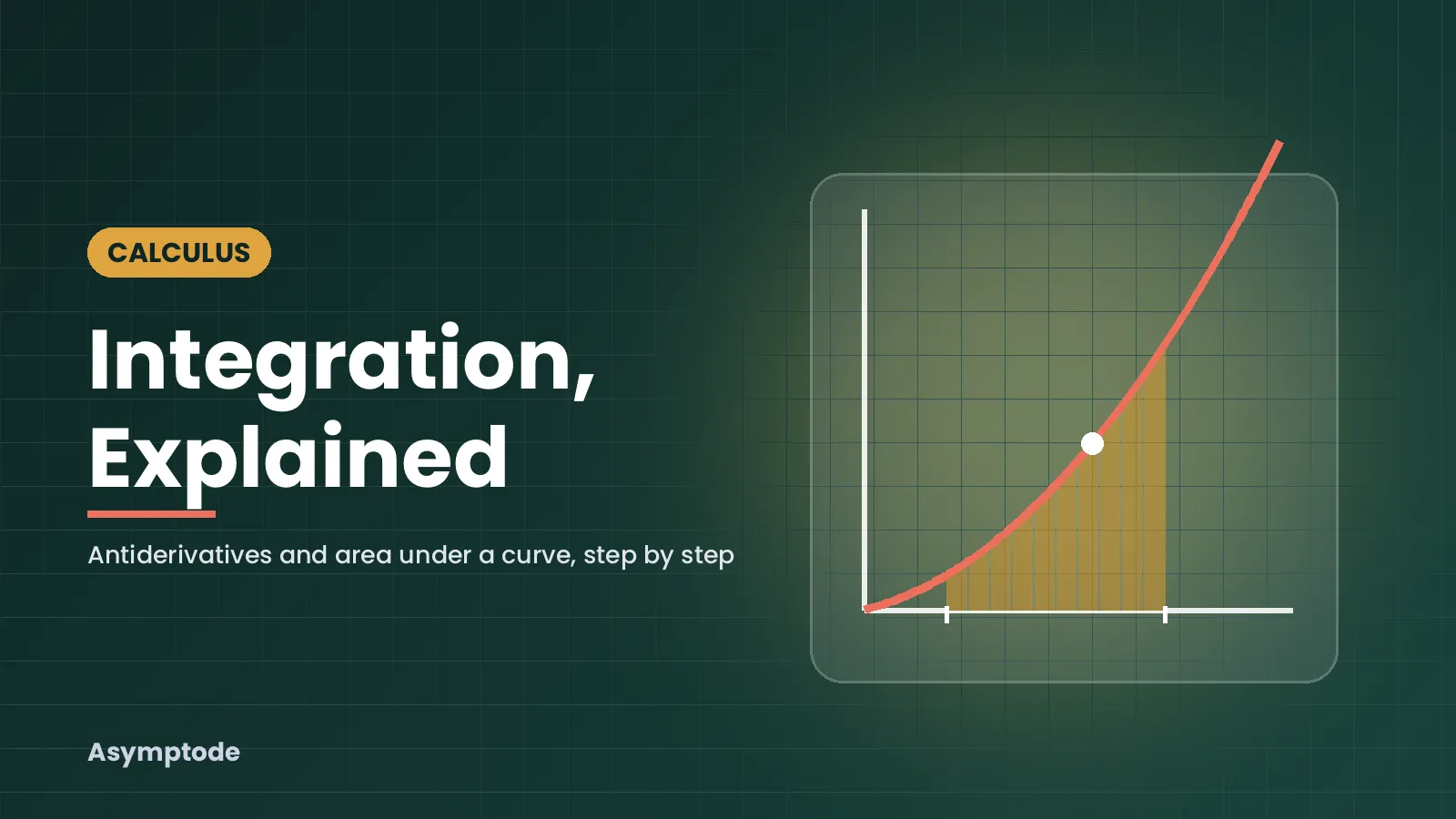
Integration explained simply: it is the reverse of differentiation, and it is also the tool for finding the area under a curve. It appears on AP Calculus, IB Maths AA and A-level Maths. This guide shows what an integral is, how to work one out step by step, and gives practice questions you can check yourself.
Key takeaways
- Integration reverses differentiation: if the derivative of F is f, then the integral of f is F + C.
- The power rule for integrals: ∫ x^n dx = x^(n+1) / (n+1) + C, for any n except -1.
- A definite integral gives a number: the area under a curve between two x-values.
- The Fundamental Theorem of Calculus links the two ideas: area = F(b) - F(a).
- The most common mistakes are forgetting "+ C" and mixing up the top and bottom limits.
What is integration explained simply?
Quick answer: Integration is the process of finding a function whose derivative is the one you are given (an antiderivative), and of adding up tiny pieces to find a total, such as the area under a curve. An indefinite integral gives a function plus a constant C. A definite integral, with limits, gives a single number.
Differentiation asks, "how fast is this changing?" Integration asks the opposite: "if I know how fast something changes, how much has it built up?" Distance from speed, and area from height, are both integrals.
What is the difference between a definite and an indefinite integral?
An indefinite integral, such as ∫ 3x^2 dx, has no limits. Its answer is a function with a constant: x^3 + C. The constant C is there because many functions share the same derivative. x^3, x^3 + 5 and x^3 - 2 all differentiate to 3x^2.
A definite integral, such as the integral of 2x from x = 1 to x = 3, has a bottom and a top limit. Its answer is one number, because the constant C cancels out.
How do you integrate step by step?
For a power of x, use the power rule:
- Spot the power. In x^n, n is the power.
- Add 1 to the power. The new power is n + 1.
- Divide by the new power. Divide the whole term by n + 1.
- Add the constant C. Always, for an indefinite integral.
- Check by differentiating. You should get back the original function.
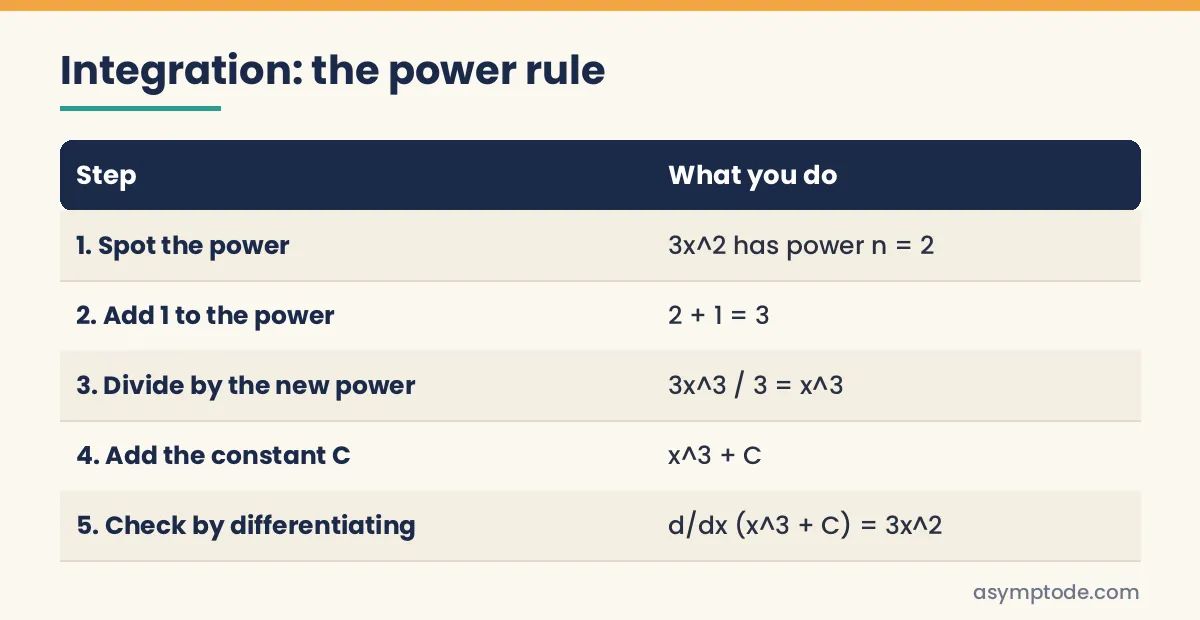 The power rule for integration applied to 3x^2, one step at a time.
For ∫ 3x^2 dx: the power is 2, so add 1 to get 3 and divide by 3. That gives 3x^3 / 3 = x^3. Add C, and the answer is x^3 + C. Differentiate it to check: the derivative of x^3 + C is 3x^2.
Worked example 1: a polynomial
Integrate 6x^2 - 2x + 5. Integrate each term separately: 6x^2 becomes 2x^3, 2x becomes x^2, and 5 becomes 5x. The answer is 2x^3 - x^2 + 5x + C.
Worked example 2: a definite integral
Find the integral of 2x from x = 1 to x = 3. An antiderivative of 2x is x^2. Put in the top limit: 3^2 = 9. Put in the bottom limit: 1^2 = 1. Subtract: 9 - 1 = 8. There is no "+ C" here, because it would cancel.
How does integration find the area under a curve?
Picture the area under a curve cut into many thin rectangles. Each rectangle has a height f(x) and a tiny width. Adding all the rectangles gives an estimate of the area, and making them thinner makes the estimate better. The integral is what that sum becomes as the rectangles get infinitely thin.
You do not have to add rectangles by hand. The Fundamental Theorem of Calculus says the area from a to b equals F(b) - F(a), where F is any antiderivative of the function.
 Antiderivative, top limit, bottom limit, subtract — the area under y = x^2 from 0 to 3 is 9.
For y = x^2 from 0 to 3, the antiderivative is x^3 / 3. At x = 3 it is 27 / 3 = 9, and at x = 0 it is 0. So the area is 9 - 0 = 9 square units.
Which integrals should you memorise?
| Function | Its integral |
|---|---|
| x^n (n not -1) | x^(n+1) / (n+1) + C |
| 1/x | ln|x| + C |
| e^x | e^x + C |
| sin x | -cos x + C |
| cos x | sin x + C |
If the inside of the function is more than plain x, such as e^(2x), a small adjustment is needed: the integral of e^(2x) is (1/2) e^(2x) + C. It undoes the chain rule, which is why knowing differentiation well makes integration much easier.
Talk to a learning expert about where your child is with calculus, or see our plans and fees.
Where is integration examined?
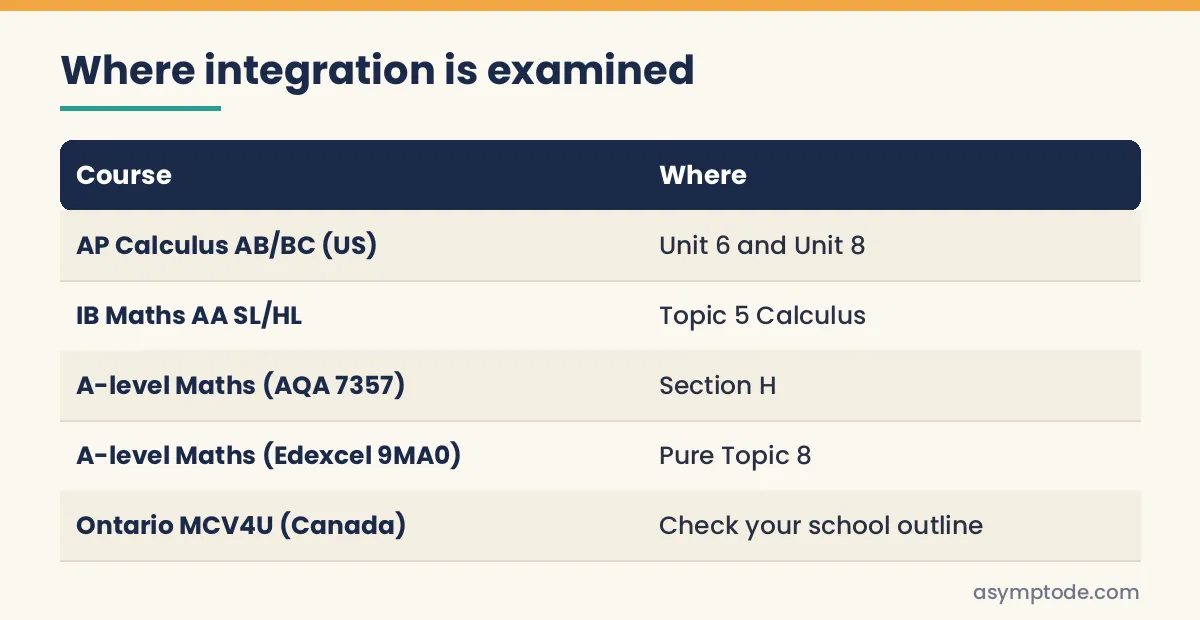 Integration sits inside the calculus unit of every major senior maths course.
- AP Calculus AB/BC (US): the College Board's AP Calculus AB course page lists Unit 6, "Integration and Accumulation of Change," and Unit 8, "Applications of Integration." The 2026-27 course description has only minor clarifications, and the College Board says course content has not changed. See our AP Calculus AB exam guide, the AB vs BC guide and AP exam dates 2027.
- IB Maths AA: Topic 5, Calculus, per the IB mathematics curriculum. See our IB Maths AA vs AI guide.
- A-level Maths: AQA 7357 (Section H) and Edexcel 9MA0 (Pure Topic 8).
- Ontario (Canada): the published MCV4U strands are "Rate of Change" and "Derivatives and Their Applications." Integration is not a named strand, so check your school's course outline for what your child will meet.
Before integration, make sure logarithms, trigonometric identities and radians feel comfortable. The AP Precalculus guide covers the groundwork.
What are the most common integration mistakes?
- Forgetting "+ C" on an indefinite integral.
- Swapping the limits. Always do F(top) - F(bottom), not the other way round.
- Using the power rule when n = -1. The integral of 1/x is ln|x| + C.
- Not checking. Differentiating your answer takes ten seconds and catches most errors.
Practice questions with answers
- Find ∫ 4x^3 dx.
- Find ∫ (6x^2 - 2x + 5) dx.
- Find ∫ cos x dx.
- Find the integral of 3x^2 from x = 0 to x = 2.
- Find ∫ e^(2x) dx.
Answers
- x^4 + C.
- 2x^3 - x^2 + 5x + C.
- sin x + C.
- An antiderivative is x^3. At x = 2 it is 8, and at x = 0 it is 0, so the answer is 8 - 0 = 8.
- (1/2) e^(2x) + C.
How to get better at integration
- Learn the short table of standard integrals until you do not need to look.
- Always differentiate your answer to check it.
- Draw a quick sketch of the area before calculating, so you know whether the answer should be positive.
- Move to exam questions from your own course once short examples feel automatic.
How Asymptode Can Help You Prepare for Integration
Integration questions are long, and one slipped sign or a missing "+ C" can cost marks all the way down the page. At Asymptode, your child has live, one-to-one online classes with a mentor who teaches calculus at your child's level, following their actual course, such as AP Calculus AB or BC, IB Maths AA or A-level Maths, and its real exam dates. The mentor watches your child work line by line, so a swapped limit is caught in the moment, not weeks later on a graded test.
Between classes, your child gets AI-assisted practice built from what their own last attempt showed they had not yet understood, written to the mentor's brief and sent only after the mentor approves it. The AI supports the mentor; it never teaches or replaces the mentor. The mentor marks the work, and in the parent dashboard you can see what was understood and what to practise next.
Every class is recorded, so a tricky explanation can be rewatched. Book a free demo class or see our plans and fees.
Facts checked against official sources on 18 November 2026.
FAQ
What is integration in simple terms?
Integration reverses differentiation. It finds a function whose derivative is the one you are given, and it also adds up tiny pieces to find totals such as the area under a curve.
What is the difference between integration and differentiation?
Differentiation finds how fast a quantity changes. Integration finds the total built up from that rate of change. They are inverse processes, linked by the Fundamental Theorem of Calculus.
Why do we add "+ C" when we integrate?
Many functions have the same derivative, because a constant disappears when you differentiate. The "+ C" stands for that unknown constant. A definite integral has no "+ C", because it cancels.
What is the power rule for integration?
∫ x^n dx = x^(n+1) / (n+1) + C, for any n except -1. Add 1 to the power, then divide by the new power.
How do you find the area under a curve?
Find an antiderivative F of the function, then work out F(top) - F(bottom). For y = x^2 from 0 to 3, the area is 27/3 - 0 = 9.
Is integration on the AP Calculus exam?
Yes. The College Board lists "Integration and Accumulation of Change" as Unit 6 and "Applications of Integration" as Unit 8 of AP Calculus AB.
Ready to start? Book a free demo class and advisor call, or see our plans and fees.
Sources
- AP Calculus AB, AP Students (College Board)
- AP Calculus AB Exam, AP Central
- Ontario curriculum: Calculus and Vectors (MCV4U)
- IB Diploma Programme mathematics curriculum
- AQA 7357 specification, as reported by AQA
- Pearson Edexcel 9MA0 specification, as reported by Pearson Edexcel