
Radians and the unit circle are the two ideas that turn school trigonometry into the trigonometry used in calculus, physics and every A-level, AP and IB course. A radian measures an angle by arc length, not by splitting a turn into 360 pieces. The unit circle then shows you sine and cosine as plain coordinates.
Key takeaways
- One radian is the angle at the centre of a circle when the arc length equals the radius. It is about 57.3°.
- To change degrees to radians, multiply by π/180. To change radians to degrees, multiply by 180/π.
- On the unit circle (radius 1), any point is (cos θ, sin θ). So x = cos θ and y = sin θ.
- Arc length is s = rθ and sector area is A = ½r²θ, but only when θ is in radians.
- The most common lost marks come from a calculator left in degree mode.
What are radians and the unit circle?
Quick answer: A radian is the angle you get when you wrap one radius around the edge of a circle. A full turn is 2π radians, so 180° = π. The unit circle has radius 1 and centre the origin. Any angle θ meets it at the point (cos θ, sin θ).
If you need a refresher on SOH CAH TOA first, read our guide to trigonometry ratios. The unit circle builds straight on top of it.
Why is one radian about 57.3°?
The circumference of a circle is 2πr. So you can fit 2π radius-lengths around the edge. That means a full turn of 360° equals 2π radians, and half a turn gives 180° = π radians.
One radian is therefore 180/π degrees. That is about 57.3°, a little less than 60°.
The College Board defines it the same way in the AP Precalculus Course and Exam Description: the radian measure of an angle is the arc length divided by the radius. On a unit circle, one radian is the angle made by an arc of length 1.
How do you convert degrees to radians?
Multiply by π/180. Then simplify the fraction. Leave π in the answer unless the question asks for a decimal.
- Write the angle in degrees, for example 150°.
- Multiply by π/180: 150 × π/180 = 150π/180.
- Simplify by dividing top and bottom by 30.
- Answer: 5π/6 radians.
To go back, multiply by 180/π. For example, 7π/4 × 180/π = 7 × 45 = 315°.
 Converting 150° to radians, one step at a time.
The animation starts with 150°. It multiplies by π/180 to get 150π/180. It then divides top and bottom by 30 to reach 5π/6 radians. To convert back, you multiply by 180/π.
Which angles should you know in radians?
Learn these six as fractions of a turn, and the rest follow.
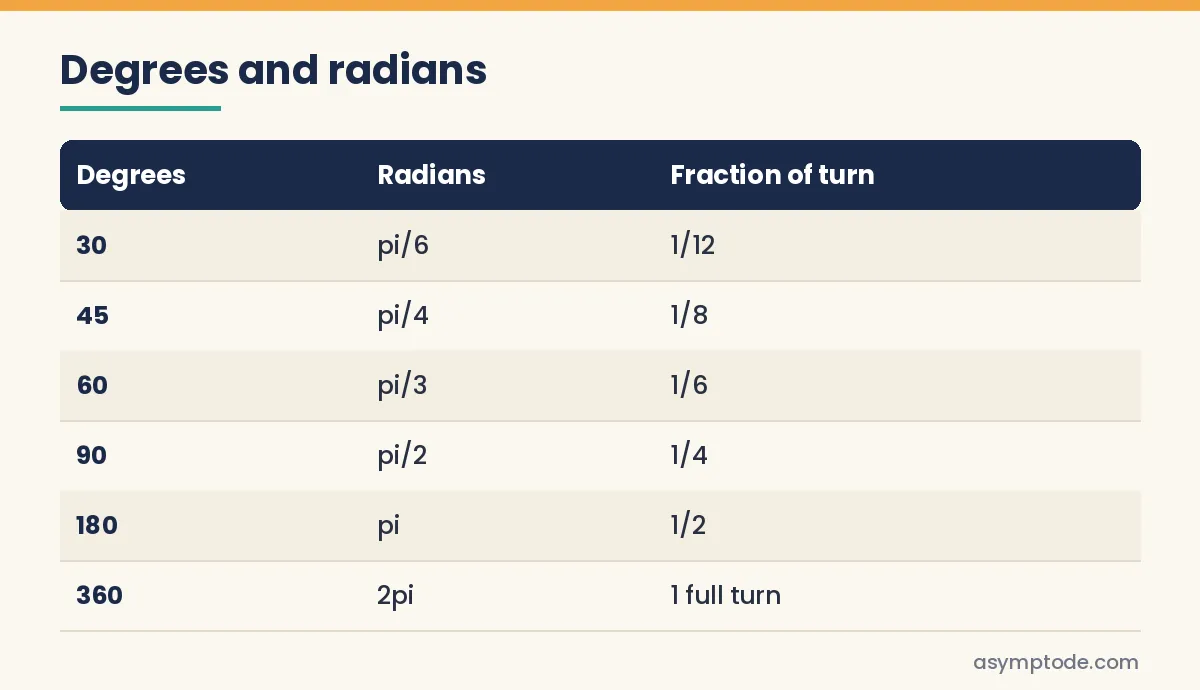 Common angles in degrees and radians.
| Degrees | Radians | Fraction of a full turn |
|---|---|---|
| 30° | π/6 | 1/12 |
| 45° | π/4 | 1/8 |
| 60° | π/3 | 1/6 |
| 90° | π/2 | 1/4 |
| 180° | π | 1/2 |
| 360° | 2π | 1 full turn |
The table pairs each angle with its radian form. 30° is π/6, 45° is π/4, 60° is π/3 and 90° is π/2. Half a turn, 180°, is π, and a full turn, 360°, is 2π.
How does the unit circle work?
Draw a circle of radius 1 with its centre at the origin. Start at the point (1, 0) on the positive x-axis. Turn anticlockwise through an angle θ. The point where you land has coordinates (cos θ, sin θ).
- x = cos θ (how far across)
- y = sin θ (how far up)
- tan θ = sin θ ÷ cos θ (the gradient of the radius)
Why? The radius is a hypotenuse of length 1, so cos θ = x and sin θ = y. Since x² + y² = 1, you also get cos²θ + sin²θ = 1.
Negative angles turn clockwise. Adding 2π brings you back to the same point, so θ and θ + 2π have the same sine and cosine.
What are the exact values on the unit circle?
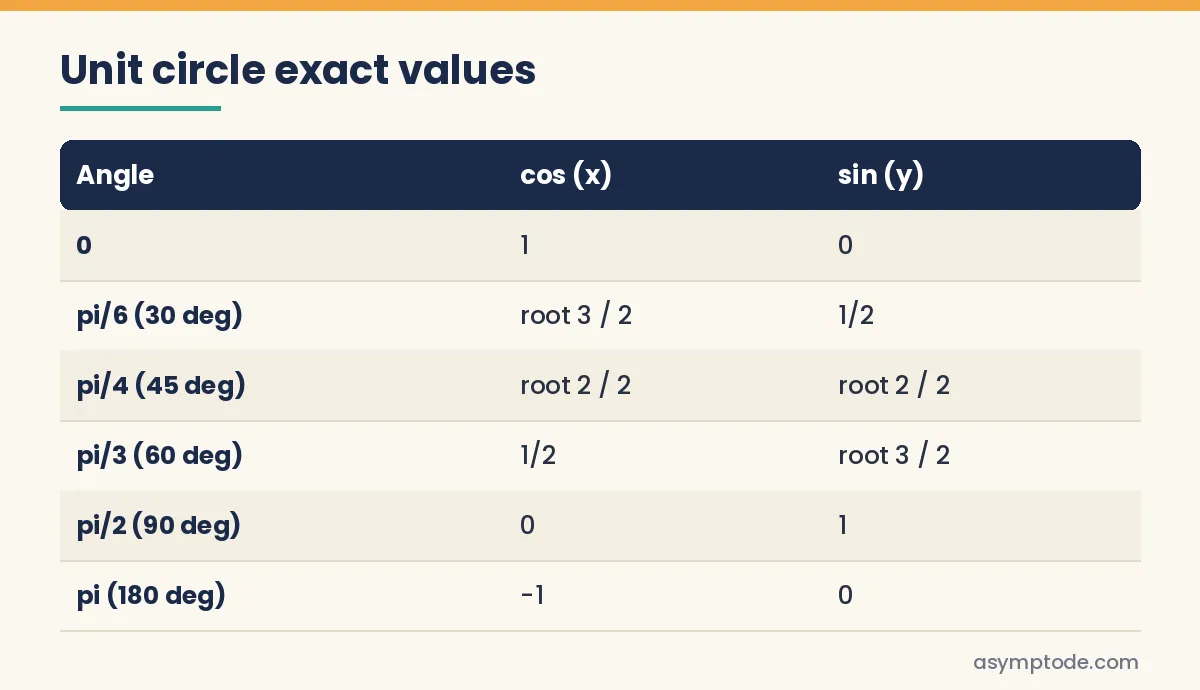 Exact cos (x) and sin (y) values for the key angles.
| Angle | cos θ (x) | sin θ (y) | tan θ |
|---|---|---|---|
| 0 | 1 | 0 | 0 |
| π/6 (30°) | √3/2 | 1/2 | 1/√3 |
| π/4 (45°) | √2/2 | √2/2 | 1 |
| π/3 (60°) | 1/2 | √3/2 | √3 |
| π/2 (90°) | 0 | 1 | undefined |
| π (180°) | −1 | 0 | 0 |
The picture lists the same values. At π/6, cos is √3/2 and sin is 1/2. At π/4 both are √2/2. At π/3, cos is 1/2 and sin is √3/2. At π/2 the point is (0, 1), and at π it is (−1, 0).
A quick pattern for sine at 0, π/6, π/4, π/3, π/2: √0/2, √1/2, √2/2, √3/2, √4/2. Cosine runs the same list backwards.
How do you find values for multiples like 2π/3 or 7π/4?
Every other key angle is a reflection of one in the first quadrant. Use three steps:
- Find the quadrant.
- Find the reference angle: the acute angle back to the x-axis.
- Take the first-quadrant value and fix the sign using the quadrant.
For 2π/3: it is in quadrant 2. The reference angle is π − 2π/3 = π/3. So sin(2π/3) = √3/2 and cos(2π/3) = −1/2.
For 7π/4: it is in quadrant 4. The reference angle is 2π − 7π/4 = π/4. So cos(7π/4) = √2/2 and sin(7π/4) = −√2/2.
What signs do sin, cos and tan have in each quadrant (ASTC)?
Remember "All Students Take Calculus", going anticlockwise from quadrant 1:
| Quadrant | Angles (radians) | Positive ratios |
|---|---|---|
| 1 | 0 to π/2 | All: sin, cos, tan |
| 2 | π/2 to π | Sin only |
| 3 | π to 3π/2 | Tan only |
| 4 | 3π/2 to 2π | Cos only |
This follows from the coordinates. In quadrant 2, x is negative and y is positive, so cos is negative and sin is positive.
How do you find arc length and sector area in radians?
Radians make these formulas short:
- Arc length: s = rθ
- Sector area: A = ½r²θ
Here θ must be in radians. If you are given degrees, convert first.
These formulas also matter in physics. Angular speed is in radians per second, and v = rω comes from s = rθ. See our guide to circular motion.
Worked examples
Example 1: Find sin(5π/6) and cos(4π/3) exactly
5π/6 is in quadrant 2. Reference angle π − 5π/6 = π/6. Sine is positive there, so sin(5π/6) = 1/2.
4π/3 is in quadrant 3. Reference angle 4π/3 − π = π/3. Cosine is negative there, so cos(4π/3) = −1/2.
Example 2: Arc length and sector area from degrees
A sector has radius 6 cm and angle 120°. Find the arc length and the area.
 Arc length and sector area for r = 6 cm, θ = 120°.
- Convert: θ = 120 × π/180 = 2π/3.
- Arc length: s = rθ = 6 × 2π/3 = 4π ≈ 12.6 cm.
- Sector area: A = ½ × 6² × 2π/3 = 12π ≈ 37.7 cm².
The animation shows the same three moves. It turns 120° into 2π/3 radians. It then gives s = 4π, about 12.6 cm, and A = 12π, about 37.7 cm².
Example 3: Work backwards to the angle
A sector of radius 5 cm has arc length 7.5 cm. Find the angle and the area.
θ = s ÷ r = 7.5 ÷ 5 = 1.5 radians. A = ½ × 5² × 1.5 = 18.75 cm².
Not every angle needs π in it.
What are the most common mistakes with radians?
- Calculator in the wrong mode. sin(30) in radian mode gives about −0.988, not 0.5. Check the D or R on the screen before every trig question. The AP Precalculus CED says calculators should be in radian mode for the AP exam.
- Using s = rθ with degrees. The formula only works in radians.
- Converting the wrong way. Degrees to radians uses π/180. A quick check: the radian number should be smaller than the degree number.
- Forgetting the sign. cos(2π/3) is −1/2, not 1/2. Always ask which quadrant you are in.
- Dropping π too early. Keep exact answers like 4π unless the question asks for decimals.
Where are radians in your syllabus?
Here is what the official documents say.
- AQA A-level Maths (7357): the AQA specification asks students to work with radian measure, including arc length and sector area (E1). E2 adds the small angle approximations sin θ ≈ θ, cos θ ≈ 1 − θ²/2 and tan θ ≈ θ, with θ in radians. Students must recall s = rθ and A = ½r²θ without being given them. See our A-level Maths guide.
- AP Precalculus: Unit 3, Trigonometric and Polar Functions, carries 30–35% of the multiple-choice section weighting in the Course and Exam Description (effective fall 2026). Topic 3.2 uses the unit circle, and exact values for multiples of π/4 and π/6 are listed in Topic 3.3. See our AP Precalculus exam guide.
- Cambridge IGCSE Additional Mathematics (0606): topic 9, Circular measure, asks for arc length and sector area problems using radian measure. The 2025–2027 syllabus notes that formulas are not given. The 2028–2030 syllabus keeps the same wording. If you also take the core course, see our IGCSE Maths 0580 guide.
- IB Maths: the IB subject briefs for Analysis and Approaches and Applications and Interpretation list trigonometric functions and measurement in circles. These briefs describe courses first assessed in 2029; for your exam year, check the official IB guide with your school. Our IB Maths AA vs AI guide compares the two routes.
- JEE Main: the NTA syllabus for JEE (Main) 2027 lists trigonometrical identities and functions (Unit 14), plus differentiation and integration of trigonometric functions. Radian measure is not named separately, but you need it for these functions.
Practice questions
Try these, then check your answers below.
- Convert 225° to radians.
- Convert 5π/3 to degrees.
- Find cos(3π/4) exactly.
- Find sin(11π/6) exactly.
- Find tan(7π/6) exactly.
- A sector has radius 10 cm and angle 0.8 radians. Find its arc length and area.
- A sector of radius 4 cm has area 24 cm². Find the angle in radians.
Answers
- 225 × π/180 = 5π/4.
- 5π/3 × 180/π = 300°.
- Quadrant 2, reference π/4, cos negative: −√2/2.
- Quadrant 4, reference π/6, sin negative: −1/2.
- Quadrant 3, reference π/6, tan positive: 1/√3 = √3/3.
- s = 10 × 0.8 = 8 cm. A = ½ × 100 × 0.8 = 40 cm².
- θ = 2A ÷ r² = 48 ÷ 16 = 3 radians.
Stuck on any of these? A short live session often clears it fast. Book a free demo class with a maths mentor, or see our fees.
How Asymptode helps you with radians and the unit circle
A qualified mentor teaches your child one-to-one, live online, working through radians and the unit circle as their own course sets them out: AQA 7357, AP Precalculus Unit 3, IGCSE 0606 circular measure, IB Maths or JEE Main, timed to their school's real test and exam dates. The mentor checks they can convert both ways, read exact values off the unit circle, use ASTC for signs and apply s = rθ and A = ½r²θ.
Between classes, your child gets practice built for them. It is a worksheet made from what their last attempt showed they had not yet understood, such as a quadrant sign error or a degree-mode slip, set at their level and never generic. This is Asymptode's AI-assisted practice. It is written to the mentor's brief and sent only after the mentor approves it.
The mentor marks each worksheet. You then see what was understood and what to practise next, so the work keeps correcting itself towards confident use of radians and the unit circle. Book a free demo class or view fees.
Facts checked against official sources on 11 November 2026.
FAQ
Why do we use radians instead of degrees?
Radians link angle directly to arc length, so s = rθ needs no extra factor. Calculus results for sine and cosine, and the small angle approximations, only work in radians.
How many degrees is 1 radian?
One radian is 180/π degrees, which is about 57.3°. A full turn is 2π radians, or roughly 6.28 radians.
Is π radians the same as 180°?
Yes. π radians is half a turn, which is 180°. Both π/180 and 180/π come from this one fact.
How do I remember the unit circle?
Learn the first quadrant only: π/6, π/4 and π/3. Then use reference angles and ASTC for every other key angle.
Should my calculator be in degrees or radians?
Match the units in the question. If angles are written with π or labelled "rad", use radian mode. The AP Precalculus exam description says calculators should be in radian mode for that exam.
Do I need radians for IGCSE?
Radian measure is part of Cambridge IGCSE Additional Mathematics (0606), in the circular measure topic. For other IGCSE courses, check the official syllabus for your exam series.
Ready to start? Book a free demo class and advisor call, or see our plans and fees.
Sources
- AQA A-level Mathematics 7357 specification
- AP Precalculus Course and Exam Description (College Board)
- Cambridge IGCSE Additional Mathematics 0606 syllabus 2025-2027
- Cambridge IGCSE Additional Mathematics 0606 syllabus 2028-2030
- IB Mathematics: analysis and approaches subject brief
- IB Mathematics: applications and interpretation subject brief
- NTA Syllabus for JEE (Main) 2027