
The AP Calculus AB exam takes place on Monday, May 10, 2027, and it has a new, slightly shorter format. This guide for US and Canadian families covers the format, calculators, units, scoring, fees, a study plan, and how to write strong justifications.
Key takeaways
- The AP Calculus AB exam is on Monday, May 10, 2027, in the morning session.
- From May 2027 there are 42 multiple-choice questions (down from 45). The total time is 3 hours 10 minutes.
- The course content has not changed. Only the number of questions and the timing changed.
- Multiple-choice answers go into the Bluebook app. Free-response answers are handwritten in a paper booklet.
- Justification counts for 35-60% of the free-response score, so learn to explain your reasoning in calculus language.
When is the AP Calculus AB exam in 2027, and what is on it?
Quick answer: The AP Calculus AB exam is on Monday, May 10, 2027, in the morning. It lasts 3 hours 10 minutes. You answer 42 multiple-choice questions and 6 free-response questions. Each section is worth 50% of your score. The exam covers 8 units, from limits to applications of integration.
Most US schools start the morning session at 8 a.m. local time (7 a.m. in Alaska). AP exam weeks are May 3-7 and May 10-14, 2027, with late testing May 17-21. For the full list of subjects, see our AP exam dates 2027 guide.
AP Calculus BC is also on May 10, and a student cannot take both AB and BC in the same year. See the official AP Calculus AB assessment page.
What changed in the AP Calculus AB exam format for 2027?
From May 2027, College Board changed the number of multiple-choice questions and the timing. The course content and the free-response section did not change.
Many websites still show the old 45-question format. Here is old vs new.
| Part | Old format (to 2026) | New format (from May 2027) | Calculator |
|---|---|---|---|
| Section I, Part A (MCQ) | 30 questions, 60 min | 29 questions, 62 min | No |
| Section I, Part B (MCQ) | 15 questions, 45 min | 13 questions, 38 min | Graphing calculator required |
| Section II, Part A (FRQ) | 2 questions, 30 min | 2 questions, 30 min | Graphing calculator required |
| Section II, Part B (FRQ) | 4 questions, 60 min | 4 questions, 60 min | No |
| Total | 45 MCQ + 6 FRQ, 3 h 15 min | 42 MCQ + 6 FRQ, 3 h 10 min |
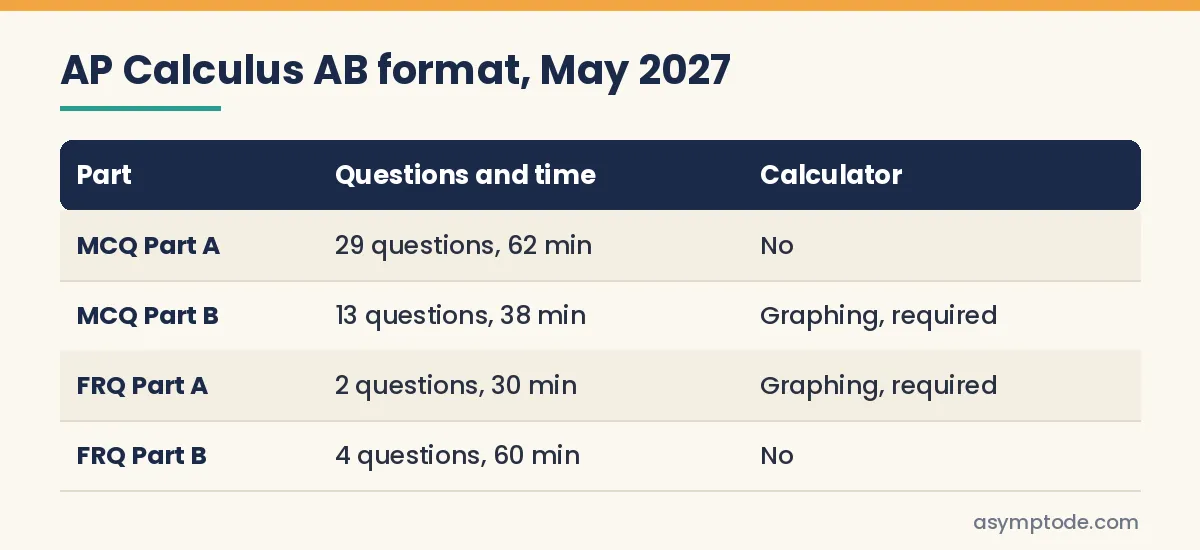 The four parts of the AP Calculus AB exam from May 2027.
Multiple-choice Part A has 29 questions in 62 minutes, with no calculator. Multiple-choice Part B has 13 questions in 38 minutes, and a graphing calculator is required. Free-response Part A has 2 questions in 30 minutes, with a graphing calculator. Free-response Part B has 4 questions in 60 minutes, with no calculator.
How much is each part worth?
Multiple choice is 50% of your score (Part A 35%, Part B 15%). Free response is the other 50% (Part A 16.7%, Part B 33.3%). So about two-thirds of the exam (by weight) is done without a calculator. At least two free-response questions use a real-world context.
Sources: the AP Calculus AB exam page and the course clarifications PDF for fall 2026.
Is the AP Calculus AB exam digital?
It is a hybrid digital exam. You answer multiple-choice questions in the Bluebook app. You read the free-response questions in Bluebook but write your answers by hand in a paper booklet.
So keep practicing full written solutions on paper. Try the free Bluebook test preview before exam day.
Which calculator can I use?
You may use an approved handheld graphing calculator or the Desmos graphing calculator built into Bluebook. You can only use a calculator in the calculator-required parts (MCQ Part B and FRQ Part A). The web or app version of Desmos is not allowed. See the official AP calculator policy.
What units are on the AP Calculus AB exam?
The course has 8 units. Each unit has a weight range for the multiple-choice section. These weights come from the official course and exam description.
| Unit | Topic | MCQ weight |
|---|---|---|
| 1 | Limits and Continuity | 10-15% |
| 2 | Differentiation: Definition and Fundamental Properties | 10-15% |
| 3 | Differentiation: Composite, Implicit, and Inverse Functions | 5-10% |
| 4 | Contextual Applications of Differentiation | 10-15% |
| 5 | Analytical Applications of Differentiation | 15-20% |
| 6 | Integration and Accumulation of Change | 15-20% |
| 7 | Differential Equations | 5-10% |
| 8 | Applications of Integration | 10-15% |
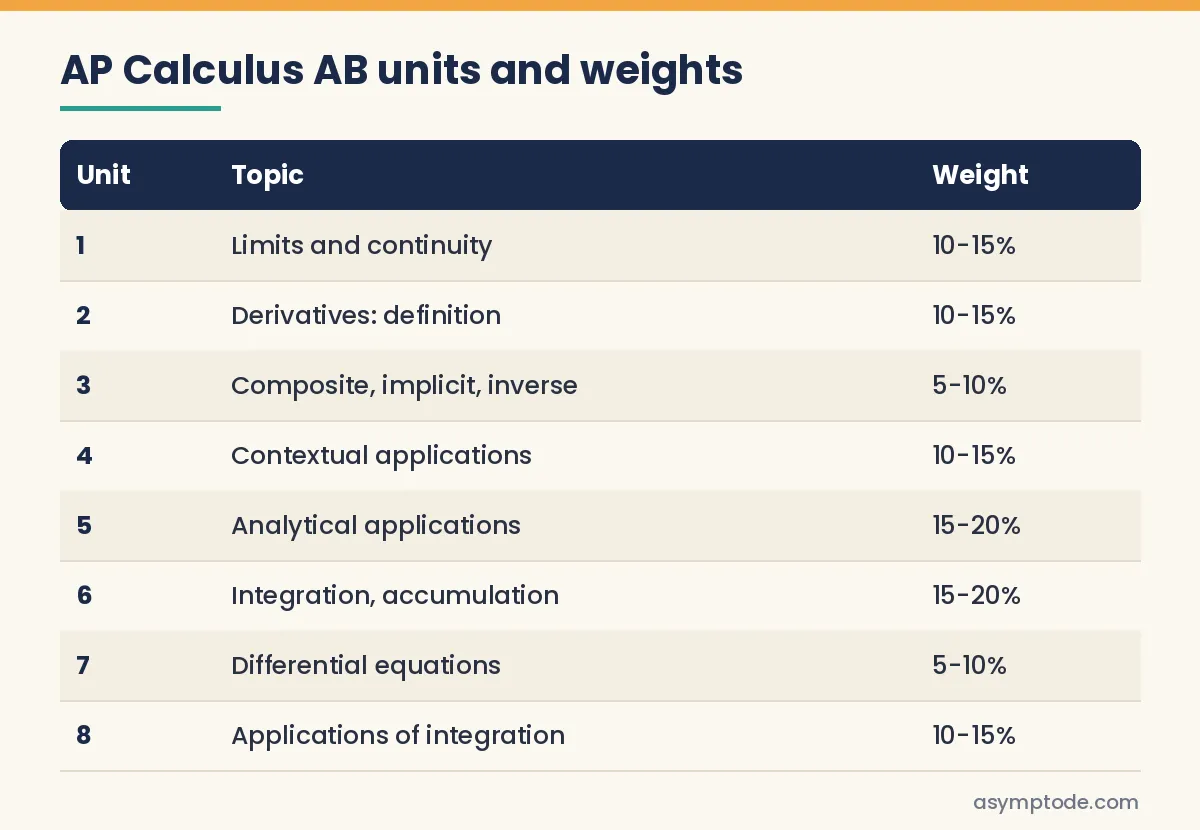 The 8 units of AP Calculus AB and their multiple-choice weights.
Units 5 and 6 carry the most weight, at 15-20% each. Units 3 and 7 carry the least, at 5-10% each. Units 1, 2, 4 and 8 are 10-15% each.
The course is built on three Big Ideas: Change, Limits, and Analysis of Functions.
What are the math practices, and why does justification matter so much?
The exam also tests four mathematical practices. These are skills, not topics.
| Practice | MCQ weight | FRQ weight |
|---|---|---|
| 1. Implementing Mathematical Processes | 50-70% | 35-60% |
| 2. Connecting Representations | 15-30% | 10-20% |
| 3. Justification | 10-20% | 35-60% |
| 4. Communication and Notation | Not assessed | 10-25% |
Justification is only 10-20% of the multiple-choice section, but 35-60% of the free-response section. A right answer with no reason can still lose points.
How do you write a good FRQ justification?
A justification links a calculus fact to your conclusion. Use these rules:
- Name the function you are using. Write "f'(x)" or "g(x)", not "it" or "the graph".
- State the calculus reason. For example: "because f'(x) changes from positive to negative at x = 1".
- State the conclusion. For example: "so f has a relative maximum at x = 1".
- Show your setup. Write the integral or derivative before you put in numbers.
- Give units in context questions.
Example: let f'(x) = x^2 - 4x + 3 = (x - 1)(x - 3). Then f'(0) = 3 > 0 and f'(2) = -1 < 0. A full-credit answer says: "f has a relative maximum at x = 1 because f'(x) changes from positive to negative at x = 1." "The graph goes up then down" is not enough.
AP Calculus AB worked examples
Try each one first.
Example 1: A limit (no calculator)
Find the limit of (x^2 - 4)/(x - 2) as x approaches 2.
Putting in x = 2 gives 0/0, so simplify first. Factor: x^2 - 4 = (x - 2)(x + 2). Cancel (x - 2) to get x + 2, which approaches 4. The limit is 4.
Example 2: A derivative with the chain rule
Find the derivative of y = (3x^2 + 1)^4, then find its value at x = 1.
The outside is u^4 and the inside is u = 3x^2 + 1. The chain rule gives:
dy/dx = 4(3x^2 + 1)^3 times 6x = 24x(3x^2 + 1)^3.
At x = 1: 24 times 1 times (3 + 1)^3 = 24 times 64 = 1,536.
Example 3: An integral with the Fundamental Theorem of Calculus
Find the integral of (2x + 1) from x = 1 to x = 3.
 The Fundamental Theorem of Calculus, step by step.
First find an antiderivative: F(x) = x^2 + x. Then work out F(3) = 9 + 3 = 12 and F(1) = 1 + 1 = 2. Subtract: F(3) - F(1) = 12 - 2 = 10. Because 2x + 1 is positive on this interval, 10 is also the area under the graph from x = 1 to x = 3.
How is the AP Calculus AB exam scored?
AP scores run from 1 to 5. The official score scale says:
- 5: extremely well qualified (like a college A+ or A)
- 4: very well qualified (A-, B+ or B)
- 3: qualified (B-, C+ or C)
- 2: possibly qualified
- 1: no recommendation
Scores come out in July 2027. The exact day is not yet announced.
How did students score in 2025?
The official 2025 AP Calculus AB score distribution covers 285,891 students. The mean score was 3.21.
- 5: 20.3%
- 4: 28.9%
- 3: 15.0%
- 2: 22.8%
- 1: 13.0%
So 64.2% scored 3 or higher. Past results are not a promise for future years.
What do colleges do with an AP Calculus AB score?
Credit and placement policies vary from college to college. Always check each college's own AP policy.
For a broader overview of the whole AP program, read our complete AP guide for parents.
How do I prepare for the AP Calculus AB exam? (Nov to May study plan)
The exam is about six months away. Adjust this plan to your school's pace.
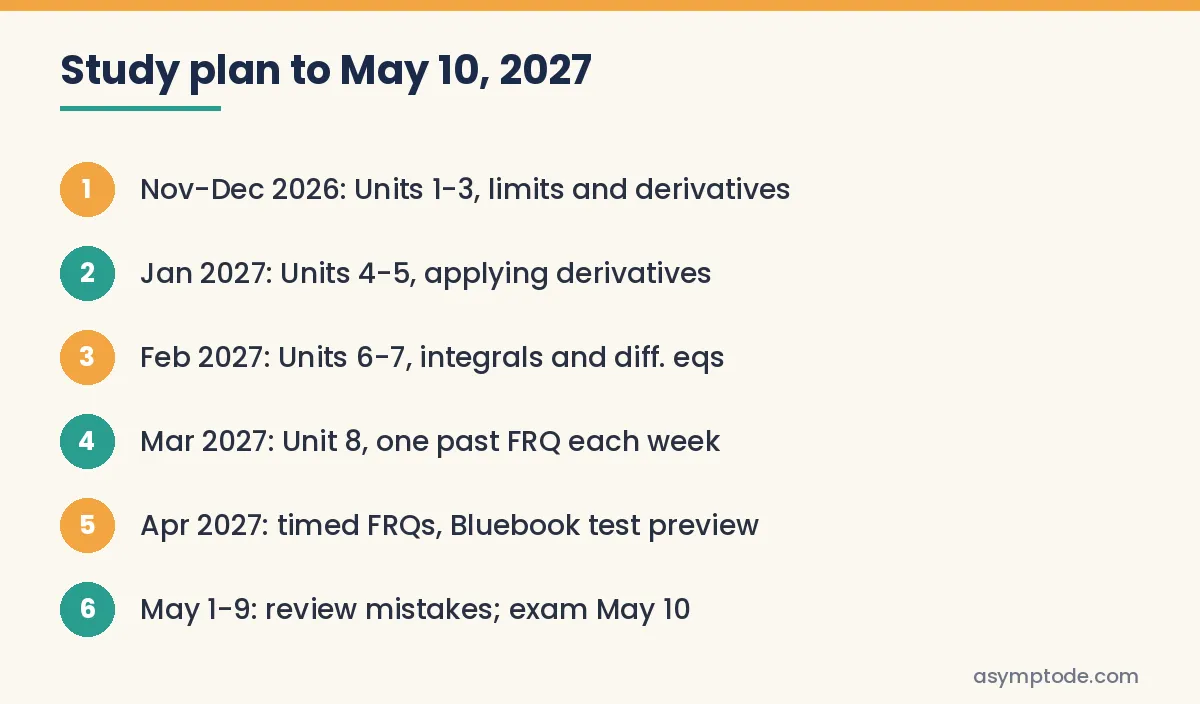 A six-step study plan for the May 10, 2027 exam.
- November-December 2026: Lock in Units 1-3. Practice limits, the derivative definition, and the chain rule until they feel easy.
- January 2027: Units 4-5. Work on related rates, motion, and using f'(x) and f''(x) to describe a graph.
- February 2027: Units 6-7. Learn integrals, accumulation, and differential equations.
- March 2027: Unit 8 and the end of the course. Start doing one past FRQ each week.
- April 2027: Do timed past FRQs. Take a full practice test in the Bluebook test preview.
- May 1-9, 2027: Review your own mistake list. Rest the night before the exam on May 10.
What free official resources should I use?
- AP Classroom: Your teacher gives you access through school.
- Past free-response questions: College Board posts past AP Calculus AB FRQs with scoring guidelines, including 2026. Study the scoring guidelines to see which steps earn points.
- Bluebook test preview: Use it to get used to the app and the built-in Desmos calculator.
Want one-to-one help with this plan? Book a free demo class and talk to an advisor, or see our plans and fees.
What is the best strategy for calculator and no-calculator parts?
MCQ Part A and FRQ Part B have no calculator, and together they are 68.3% of the score.
No-calculator parts:
- Know derivative and integral rules by heart.
- Know unit-circle values for sine and cosine. Our guides on radians and the unit circle and trigonometry ratios can help.
- Know the rules for logs and e^x. See our logarithms guide for a refresher.
Calculator parts:
- Practice these calculator skills: graph a function, find a zero, find a derivative at a point, and find a definite integral.
- Write the setup on paper first, so the reader can follow how you got your calculator answer.
What are the most common AP Calculus AB mistakes?
- Missing justification. The answer is right, but there is no calculus reason.
- Forgetting the chain rule on the inside function.
- Dropping "+ C" on an indefinite integral.
- No units in a real-world question.
- Mixing up f and f'. For example, reading a graph of f' as if it were a graph of f. Our motion graphs guide shows how position, velocity and acceleration graphs connect.
What do I need to know before AP Calculus AB?
The course description recommends four years of college-prep math: algebra, geometry, trigonometry, and analytic geometry. Know the elementary functions (linear, polynomial, rational, exponential, logarithmic, trig, inverse trig, piecewise) and unit-circle values.
AP Precalculus is a strong foundation. But it is not a prerequisite. If you took it, our AP Precalculus exam guide explains what carries over.
Should I take AP Calculus AB or BC?
AP Calculus BC includes everything in AB. It adds two more units:
- Unit 9: Parametric Equations, Polar Coordinates, and Vector-Valued Functions (10-15%)
- Unit 10: Infinite Sequences and Series (15-20%)
The BC exam uses the same format: 42 multiple-choice and 6 free-response questions. BC students also get an AB subscore, based on about 60% of the BC exam. See the official page on the BC score structure.
AB suits students who want a steady pace on the core of calculus. BC suits students who are already strong in precalculus and want to cover more. For more, read our AP Calculus AB vs BC prep guide.
How much does the AP Calculus AB exam cost, and how do I order it?
For 2026-27, the fee is $99 per exam in the US, US territories, Canada, and DoDEA schools. It is $129 elsewhere. Eligible students get a $37 College Board fee reduction. See the official AP exam fees page.
You order through your school's AP coordinator. The final ordering deadline was November 13, 2026, at 11:59 p.m. ET. Late orders from November 14, 2026 to March 12, 2027 add $40 per exam. An unused or cancelled exam also costs $40. If you missed the deadline, talk to your AP coordinator soon. AP is offered in many Canadian schools, at the same $99 fee.
How Asymptode Can Help You Prepare for the AP Calculus AB Exam
At Asymptode, your student works one-to-one, live online, with an experienced calculus mentor. It is never a batch class. The mentor follows your student's own school AP course and plans around the May 10, 2027 exam date.
In class, the mentor watches the working, not just the final answer. So when a step goes wrong, such as a missing justification on an FRQ, the mentor traces it back to the idea behind it.
Every class is recorded and searchable by topic. Your student can jump back to the exact minute a topic like the chain rule or the Fundamental Theorem was taught.
After class, your student gets practice worksheets on the topics taught. Each one is built from what their last attempt showed. The worksheets are prepared with AI assistance and sent only after your student's own mentor approves them. The AI supports the mentor. It does not teach or mark on its own.
After each class, parents can read what was taught, how the student got on, and what to practice next. Book a free demo class or see our fees.
Related guides
- AP exam dates 2027
- AP Calculus AB vs BC prep guide
- AP Precalculus exam guide
- AP complete guide for parents
- Radians and the unit circle explained
Facts checked against official College Board sources on 13 November 2026.
FAQ
How many questions are on the AP Calculus AB exam in 2027?
From May 2027 there are 42 multiple-choice questions and 6 free-response questions. The old format had 45 multiple-choice questions. The free-response section did not change.
How long is the AP Calculus AB exam?
The new exam lasts 3 hours 10 minutes. The multiple-choice section takes 1 hour 40 minutes, and the free-response section takes 1 hour 30 minutes.
Did the AP Calculus AB course content change for 2027?
No. College Board changed only the number of multiple-choice questions and the timing. The 8 units and their topics stay the same.
Can I use Desmos on the AP Calculus AB exam?
Yes, but only the Desmos calculator built into the Bluebook app, and only in the calculator-required parts. You may use an approved handheld graphing calculator instead. The web or app version of Desmos is not allowed.
Is the AP Calculus AB exam fully on paper or fully digital?
It is hybrid. You answer multiple-choice questions in Bluebook. You read free-response questions in Bluebook but write your answers by hand in a paper booklet.
Can I still order the AP Calculus AB exam after November 13, 2026?
The final ordering deadline was November 13, 2026. Late orders are possible from November 14, 2026 to March 12, 2027, with an extra $40 per exam. Ask your school's AP coordinator.
Ready to start? Book a free demo class and advisor call, or see our plans and fees.